
Discover how specialist recruiters fill sales roles in the artificial intelligence sector with precision, faster hiring, and access to rare, high-converting talent.
Specialist Recruiters for Sales Roles in Artificial Intelligence Sectors
The artificial intelligence industry is expanding faster than almost any other technology sector, and behind every breakthrough product sits a sales team that can translate complex algorithms into measurable business value. Hiring those salespeople is harder than it sounds. Selling AI is not the same as selling generic software, and the people who do it well are rare, expensive, and highly sought after. This is exactly why specialist recruiters for sales roles in artificial intelligence sectors have become indispensable partners for fast-growing companies.
In this guide, we explore why niche recruitment matters, what separates a specialist from a generalist, and how the right hiring partner can shorten your sales cycle by putting the right closers in front of the right buyers.

Why AI Sales Hiring Is Different
A traditional software sales rep can often learn a product in a few weeks. AI products demand more. Buyers in this space include data scientists, machine learning engineers, compliance officers, and C-suite executives, each with different priorities and a low tolerance for vague claims. A salesperson who cannot speak credibly about model accuracy, data pipelines, inference costs, or ethical considerations will lose trust within the first call.
That means the ideal AI sales candidate sits at an unusual intersection: commercial drive plus genuine technical literacy. People with both are scarce, and they rarely respond to generic job ads. Reaching them requires recruiters who understand the technology, speak the language, and already maintain relationships with this talent pool.
Brands like ZoneTechify and WebPeak have seen firsthand how a single mis-hire in an AI sales seat can stall an entire go-to-market plan, while one exceptional hire can unlock an entire vertical.
What a Specialist Recruiter Actually Does
A specialist recruiter is far more than a resume forwarder. They act as a strategic extension of your revenue team, mapping the market, qualifying motivation, and protecting your employer brand throughout the process.

Their core responsibilities typically include:
- Market mapping: Identifying where top AI sales talent currently works and what would motivate them to move.
- Technical screening: Validating that candidates can hold a credible conversation about AI products, not just sales jargon.
- Compensation benchmarking: Advising on realistic base, commission, and equity packages for a competitive market.
- Discreet outreach: Approaching passive candidates who are performing well and not actively job hunting.
- Process management: Keeping candidates warm, aligned, and engaged so offers are accepted rather than declined.
This depth is why companies increasingly rely on dedicated partners rather than internal teams stretched across every function.
Specialist vs. Generalist Recruiters
Many companies start by using a generalist agency or an internal recruiter who handles every role from accounting to engineering. That approach can work for common positions, but AI sales is rarely common.
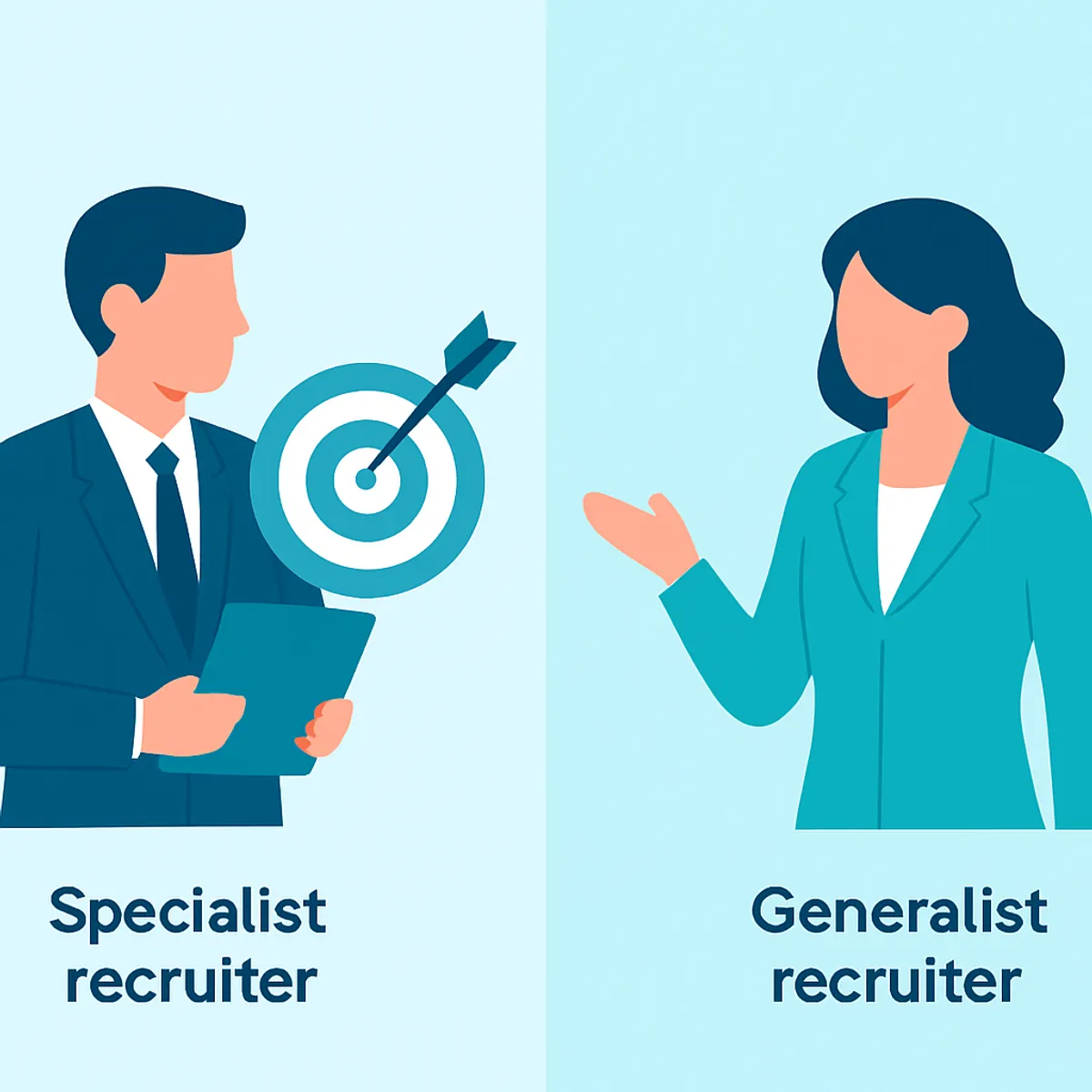
Here is how the two approaches compare in practice:
| Factor | Specialist Recruiter | Generalist Recruiter |
|---|---|---|
| Industry knowledge | Deep AI and sales expertise | Broad but shallow |
| Talent network | Established AI sales contacts | General candidate pools |
| Screening quality | Technical and commercial | Mostly commercial |
| Time to shortlist | Faster | Slower |
| Offer acceptance rate | Higher | Lower |
| Mis-hire risk | Lower | Higher |
The difference is not just speed. A specialist reduces the hidden costs of a bad hire, including lost pipeline, damaged customer relationships, and the months it takes to restart a search.
The Skills That Define Great AI Salespeople
Understanding what recruiters look for helps you evaluate whether a hiring partner truly knows the space. Elite AI sales professionals tend to share a recognizable profile.

The most valuable traits include:
Technical Fluency
They do not need to build models, but they must understand the concepts well enough to challenge objections and guide technical buyers confidently.
Consultative Selling
AI deals are often complex, multi-stakeholder, and long. Top performers diagnose problems before pitching solutions, positioning themselves as advisors rather than vendors.
Comfort With Ambiguity
AI roadmaps shift quickly. Great reps thrive when the product is evolving and can sell a vision while remaining honest about current limitations.
Outcome Orientation
Buyers want measurable results, not buzzwords. The best salespeople frame everything around return on investment, efficiency gains, and risk reduction.
A specialist recruiter screens for these qualities deliberately, rather than relying on a polished resume alone.
Hiring Trends Shaping the AI Sales Market
The demand for AI sales talent has reshaped compensation, expectations, and competition. Companies that ignore these trends struggle to attract anyone worth hiring.

Several patterns now dominate the landscape:
- Rising compensation: Strong AI sellers command premium packages, often with significant equity upside.
- Remote and hybrid flexibility: Top candidates expect location freedom and will decline rigid in-office mandates.
- Speed of process: The best candidates receive multiple offers, so slow interview loops lose talent.
- Mission alignment: Many AI professionals care about responsible deployment and want to work where ethics are taken seriously.
- Cross-functional collaboration: Sales is expected to work closely with product and engineering, blurring traditional lines.
A recruiter immersed in this market keeps you informed and competitive, so you do not lose candidates to faster, better-prepared rivals. For organizations also building out their underlying AI capabilities, pairing recruitment with expert artificial intelligence services ensures the sales team has a product worth selling.
Building a High-Performing AI Sales Team
Filling one role is rarely the end goal. Most companies need to assemble a coordinated team that scales with the product. This requires a deliberate structure rather than a series of reactive hires.

A proven approach to team building includes:
- Define the ideal customer profile first. Your sales hires should match the buyers they will face, whether technical founders or enterprise procurement teams.
- Hire a strong leader early. A capable sales director sets the playbook and attracts other talent through reputation.
- Balance hunters and farmers. New logo acquisition and account expansion demand different skill sets.
- Invest in onboarding. Even great reps need time to learn a technical product, so structured ramp plans protect early revenue.
- Measure the right metrics. Pipeline quality, win rates, and deal velocity matter more than raw activity numbers.
A specialist recruiter contributes to each step, advising on sequencing and ensuring every hire strengthens the broader team rather than creating gaps.
How to Choose the Right Recruitment Partner
Not every agency claiming AI expertise truly has it. When evaluating partners, ask pointed questions to separate genuine specialists from opportunists.
Consider asking:
- Can you describe recent AI sales placements and the results they delivered?
- How do you assess a candidate's technical understanding of AI products?
- What does your candidate guarantee or replacement policy look like?
- How do you approach passive candidates already employed at competitors?
- What is your typical time to shortlist for a senior AI sales role?
Clear, confident answers signal a partner who lives in this space daily. Vague responses suggest you may be paying specialist fees for generalist work.
The Future of AI Sales Recruitment
As AI tools mature, recruitment itself is becoming smarter. Data-driven sourcing, predictive matching, and richer candidate insights help recruiters move faster and with greater accuracy. Yet technology will never replace the human judgment required to evaluate motivation, cultural fit, and selling instinct.

The companies that win the talent war will combine the efficiency of modern tools with the relationships and discernment of experienced specialists. They will treat recruitment as an ongoing strategic function, not a last-minute scramble when a seat opens up.
For organizations serious about scaling revenue in the AI economy, the message is simple: the right salesperson is a force multiplier, and the right recruiter is how you find them. Partnering with experts who understand both the technology and the art of selling, such as the teams behind ZoneTechify and WebPeak, turns a difficult hiring challenge into a sustainable competitive advantage.
Conclusion
Specialist recruiters for sales roles in artificial intelligence sectors solve a problem that generic hiring simply cannot. They understand the technology, know where the talent lives, and can sell your opportunity as compellingly as your reps sell your product. In a market where one exceptional hire can open entire verticals and one mis-hire can stall growth for months, that expertise is not a luxury. It is the foundation of a durable, high-performing sales organization built for the AI era.