
A practical guide to how small London tech firms recruit software engineers, what they pay, how their interviews differ from big tech, and how to get hired faster.
Small London Tech Firms Recruiting Software Engineers
London has more than 3,000 venture-backed technology companies, and the overwhelming majority of them employ fewer than 50 people. That single fact reshapes how you should think about engineering hiring in the capital. The visible job market belongs to a handful of large employers with structured graduate schemes and famous interview loops. The actual volume of hiring sits with small firms of five to forty people who need one senior backend engineer, one front-end specialist, or one pragmatic full stack developer who can ship without supervision.
This guide explains how those firms recruit, what they pay, how their processes differ, and exactly what candidates and founders should do differently. It is written from the perspective of people who have sat on both sides of small-company hiring tables in Shoreditch, King's Cross and Southwark.
Quick Answer: Small London tech firms recruit software engineers mainly through founder-led outreach, referrals, community events and niche job boards rather than large graduate pipelines. They hire for shipping speed, product ownership and breadth over narrow specialism, run shorter three-stage interviews, and typically decide within one to two weeks.

Why Small London Firms Hire Differently
A company with nine engineers cannot absorb a bad hire. In a 200-person team, a weak performer costs velocity. In a nine-person team, they consume a tenth of the payroll and a disproportionate share of senior attention. This risk profile drives every decision small firms make about recruiting.
The practical consequences are consistent across the London market:
- They hire for breadth, not depth. A small firm needs someone who can write an API, wire a front end, read a Terraform file and talk to a customer. Pure specialists struggle to justify a headcount slot.
- They weight evidence over credentials. A public repository, a shipped side project, or a detailed write-up of a system you owned carries more weight than a degree classification.
- They move fast or lose candidates. Small firms know they cannot outbid large employers, so speed becomes their competitive advantage. Two-week decisions are common and one-week decisions are not unusual.
- The founder is usually in the loop. Expect to meet a founder or the technical lead in nearly every process. There is no recruiting layer to hide behind.
Key Term Definitions
Small tech firm: In the London context, a technology company with fewer than 50 employees, usually pre-Series B, where engineering headcount is under 20.
Founder-led hiring: A recruitment process where a company founder personally sources, screens and closes candidates rather than delegating to an internal talent team.
Product ownership: Responsibility for a feature or system from problem definition through to production monitoring, rather than implementing tickets written by someone else.

Where Small London Firms Actually Find Engineers
Large employers advertise. Small employers hunt. If you are searching only on the big aggregator boards, you are seeing a fraction of the real opportunity set. Small London firms consistently source from five channels, roughly in this order of effectiveness.
- Referrals from current staff and investors. The single largest source. A warm introduction from an existing engineer bypasses the screen entirely at most small firms.
- Founder direct outreach. Founders message engineers whose work they have seen in open source, at meetups, or in technical writing.
- Niche and community boards. Investor talent pages, local London tech newsletters and community Slack or Discord groups produce better signal-to-noise than general boards.
- In-person meetups and conferences. London hosts a dense weekly calendar of language and framework meetups. Small firms attend specifically to recruit.
- Specialist agencies and partner studios. Small firms often work with a lean development partner first, then hire engineers who have proven themselves on that project.
That last channel matters more than most candidates realise. A large share of early engineering hires at small London firms are people who first appeared as contractors or agency engineers. Teams that already deliver production systems, such as the senior-only build teams behind scalable web solutions, regularly become the recruiting ground for a startup's first in-house engineers because the working relationship has already de-risked the hire.
What the Interview Process Looks Like
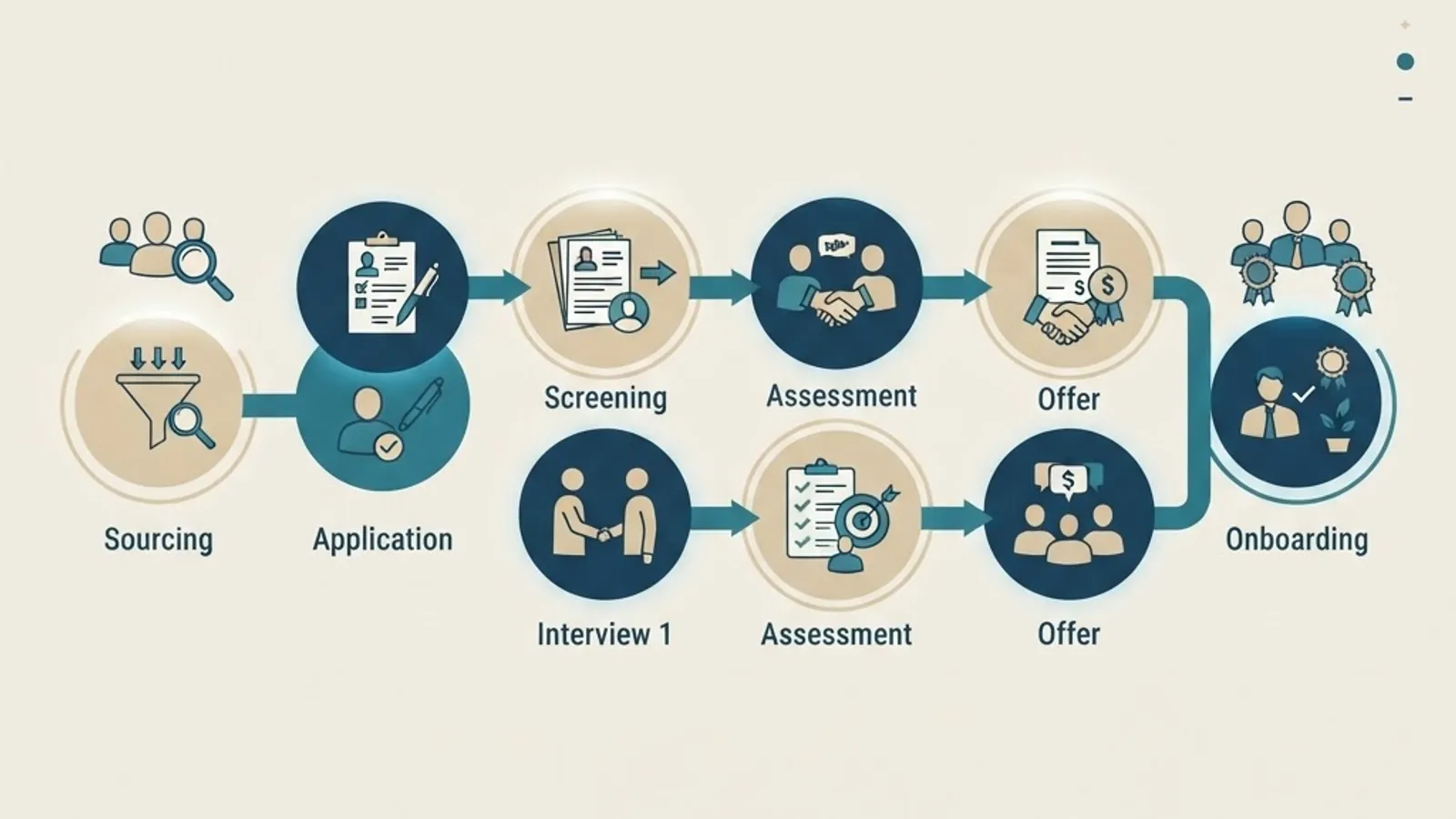
Small firms compress the process. Where a large employer might run six stages across six weeks, a ten-person London startup typically runs three stages across seven to ten days.

Stage One: Founder or Lead Screen
Thirty minutes, usually a video call. The goal is not to test your knowledge. It is to answer three questions: can you explain your own work clearly, do you understand what the company does, and do you want this specific job rather than any job. Candidates fail this stage almost entirely on the third question.
Stage Two: Practical Technical Assessment
Small firms rarely use algorithm puzzles. They prefer one of three formats: a short take-home task of two to four hours, a paired coding session on a realistic problem, or a structured walkthrough of a system you previously built. The paired session is increasingly the default because it costs the candidate less unpaid time and gives the interviewer better signal on collaboration.
Stage Three: Team Fit and Offer Conversation
A short conversation with one or two future colleagues, followed immediately by compensation discussion. At small firms these are often the same meeting. Equity, scope and progression are negotiated directly with the founder rather than routed through a compensation band committee.
Compensation: Small Firms Versus Large Employers
Small London firms usually cannot match large-employer base salaries. They compete on equity, scope and autonomy instead. The table below reflects typical 2025 to 2026 London market ranges for permanent engineering roles.
| Factor | Small London Firm (Under 50 Staff) | Large Tech Employer |
|---|---|---|
| Mid-level base salary | Around 65k to 85k GBP | Around 85k to 120k GBP |
| Senior base salary | Around 85k to 110k GBP | Around 120k to 160k GBP |
| Equity | Meaningful percentage, high risk | Small percentage, liquid |
| Time to offer | 1 to 2 weeks | 4 to 8 weeks |
| Interview stages | 2 to 3 | 4 to 6 |
| Scope of ownership | Whole features and systems | Component of a system |
| Formal progression framework | Rare | Standard |
| Learning breadth | Very high | Narrow but deep |

Two data points give this context. First, the UK Office for National Statistics classifies information and communication as one of the highest-paying UK sectors, and London commands a premium of roughly 20 to 30 percent over the rest of the country for equivalent engineering roles. Second, industry hiring surveys consistently show that firms with fewer than 50 staff fill technical roles faster than enterprises, largely because approval chains are shorter. Speed is the small firm's real currency.
How Candidates Should Approach These Firms

The tactics that win at a large employer actively hurt you at a small one. Volume applications with a generic CV get filtered instantly by a founder reading twenty applications personally.
Do this instead:
- Target 15 companies, not 150. Research each one's product, funding stage and public engineering output. Depth beats volume when a human reads every application.
- Lead with shipped outcomes. Replace "worked on payments platform" with "cut checkout failure rate from 4 percent to 0.9 percent by rewriting the retry layer." Specific numbers are the strongest E-E-A-T signal a CV can carry.
- Show your reasoning publicly. One well-written technical post explaining a decision you made, including the trade-offs you rejected, outperforms a portfolio of unexplained repositories.
- Ask about runway and roadmap. Asking how many months of funding remain and what the next two quarters look like signals commercial maturity. Founders respect it.
- Be explicit about scope you want. Small firms can shape a role around a strong candidate. Large firms cannot. Use that flexibility.
- Prepare for the reverse pitch. Founders will sell you the company. Come with questions about decision-making, code review culture and on-call expectations.

How Small Firms Should Improve Their Own Hiring
Founders lose good engineers to avoidable process failures. Four fixes deliver most of the improvement.
Write the role around a problem, not a title. "Own our data ingestion pipeline and cut processing cost" attracts better candidates than "Senior Backend Engineer."
Cap the take-home at two hours and pay for anything longer. Strong senior engineers with existing jobs simply decline eight-hour unpaid exercises.
Publish your salary band. Roles with visible ranges attract measurably more applications, and hiding the band wastes both sides' time.
Fix your careers page before you advertise. Candidates evaluate your engineering quality from your own website. Firms that treat their site as a recruiting asset, an approach the team at WebPeak Digital applies to conversion-focused builds, convert far more inbound interest than those with a stale hiring page.
Key Takeaways
- The majority of London's 3,000-plus venture-backed tech companies employ fewer than 50 people, so most engineering vacancies sit outside large employers.
- Small firms typically run 2 to 3 interview stages and decide within 1 to 2 weeks, compared with 4 to 6 stages over 4 to 8 weeks at large employers.
- Referrals and founder direct outreach are the two highest-yield recruiting channels for firms under 50 staff.
- London engineering salaries carry a premium of roughly 20 to 30 percent over the wider UK market, but small firms trade base salary for equity and ownership.
- Candidates win by targeting around 15 researched companies with quantified outcomes rather than mass-applying.
- Firms win by capping take-home tasks, publishing salary bands and describing problems rather than titles.
Frequently Asked Questions (FAQ)
Do small London tech firms pay less than big tech companies?
Usually yes on base salary. Mid-level roles at small London firms commonly sit around 65k to 85k GBP against 85k to 120k GBP at large employers. Small firms compensate with equity, wider technical ownership and faster progression, which can outweigh the base gap over several years.
How do I find small London tech firms that are hiring engineers?
Start with investor portfolio talent pages, London-focused tech newsletters, community Slack and Discord groups, and language-specific meetups. These channels surface roles before they reach large job boards. Following founders and engineering leads directly also reveals openings weeks earlier than public postings.
Do small firms still use algorithm interviews?
Rarely. Most small London firms prefer a short take-home task, a paired programming session on a realistic problem, or a deep walkthrough of a system you have already built. They are testing whether you can ship maintainable software, not whether you memorised data structure puzzles.
Is a small London startup a good first engineering job?
It can be excellent if the team has at least two senior engineers who will review your code. Without that mentorship layer you risk learning bad habits unchallenged. Ask directly about code review practices and who will support your first three months before accepting.
How long does hiring take at a small London tech company?
Most small firms complete the process in one to two weeks from first call to offer. Some decide in as little as four days. If a small firm takes more than three weeks without clear explanation, treat it as a signal about internal decision-making rather than a delay in your favour.
Should I negotiate equity at a small London firm?
Yes. Ask for the total share count, your percentage, the strike price, the vesting schedule and the latest valuation. Equity at a small firm is negotiable in a way base salary often is not, and founders expect informed candidates to ask these questions.