
A practical guide to senior software engineer jobs: what the title actually requires, how compensation is structured, how hiring loops work, and how to move up.
Senior Software Engineer Jobs
Senior software engineer jobs are the most contested tier in tech hiring. Companies post thousands of them, yet most hiring managers report the same problem: plenty of applicants can code, far fewer can own ambiguous problems end to end. That gap is where the title is actually decided, and it is where candidates either get an offer or get a polite rejection after the system design round.
This guide is written from the hiring side of the table. It explains what the senior label means in practice, how compensation is built, what interview loops test, and what separates a mid-level engineer from someone a company trusts with a critical service at 2 a.m.

Quick Answer: Senior software engineer jobs require roughly five or more years of production experience plus proven ownership: designing systems, making tradeoffs, reviewing code, mentoring teammates, and shipping without supervision. Hiring loops test system design, coding, and behavioral judgment. Pay typically lands between 130,000 and 220,000 USD in the United States, with equity added at product companies.
What Does a Senior Software Engineer Actually Do?
A senior software engineer converts unclear business problems into working, maintainable systems without needing a specification handed to them. That single sentence explains most of the level difference. A mid-level engineer is given a well-defined ticket. A senior engineer is given a goal, and is expected to find the ticket.
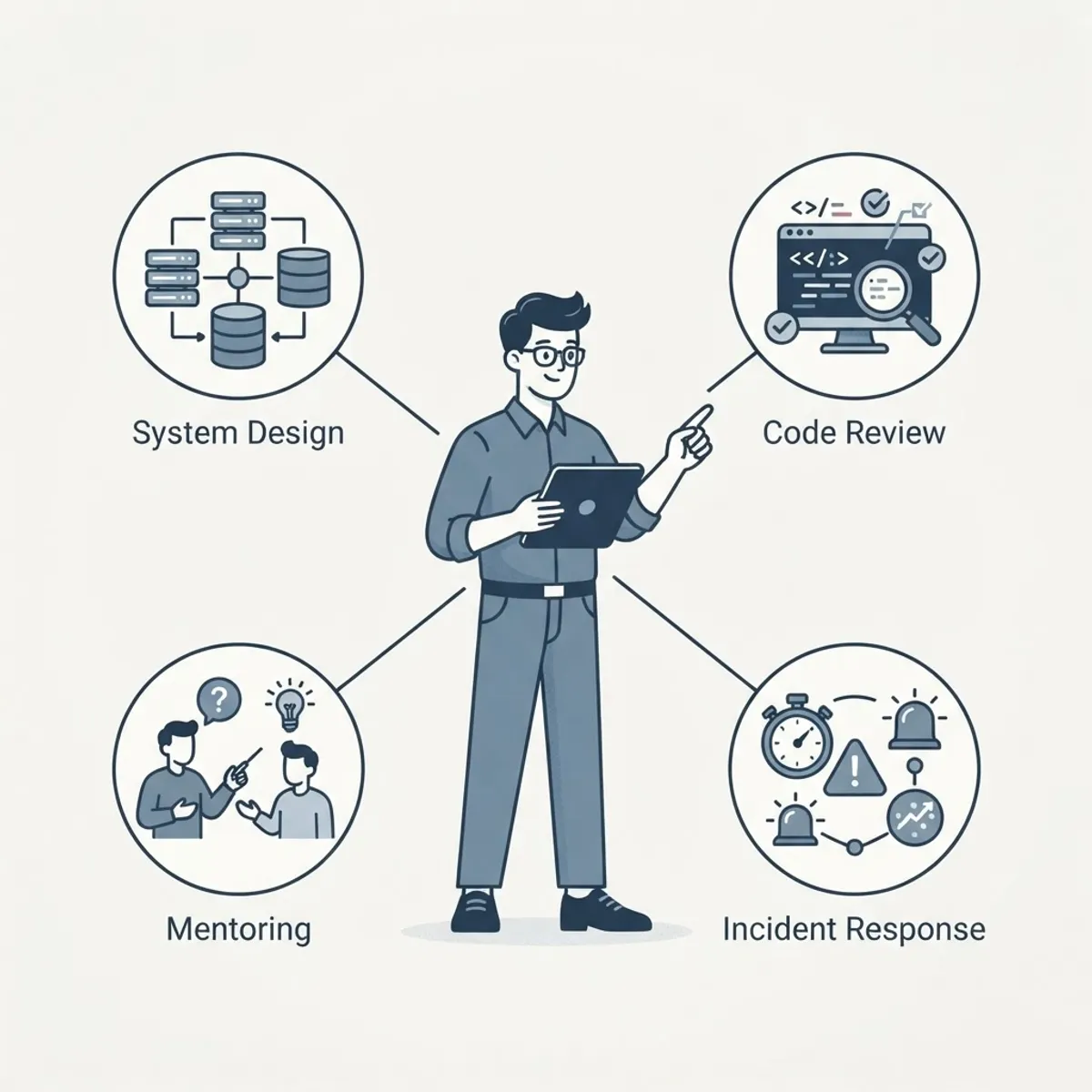
Day to day, the role usually splits across four responsibilities:
- System design and tradeoffs. Choosing between a queue and a cron job, a relational schema and a document store, and being able to explain the cost of being wrong.
- Code review and quality standards. Catching design flaws before they ship, not just style issues.
- Mentoring and unblocking. Raising the output of two or three other engineers, which is often worth more than personal throughput.
- Operational ownership. On-call, incident response, and root cause analysis on services they built.
Key definition: Ownership means being accountable for an outcome, not a task. If a feature ships and quietly breaks a downstream report three weeks later, the owner is the one who investigates it without being asked.
The Signal Hiring Managers Actually Look For
In interview debriefs, the phrase that decides senior offers is usually some version of "they told me what they would not build." Candidates who scope down, name constraints, and identify risk read as senior. Candidates who list every technology they know read as enthusiastic but junior. Original insight from reviewing hiring loops: the strongest senior candidates spend the first three to five minutes of a design round asking questions before drawing anything.
How Many Years of Experience Do Senior Roles Require?
Most job descriptions ask for five to eight years, but experience is a proxy, not the requirement. Companies use years because it is easy to filter on. What they are really screening for is exposure to consequences: production outages, migrations, legacy code, and shipping under a deadline that mattered.
Engineers hit senior faster in three situations:
- Early-stage startups, where scope expands quickly and there is nobody else to escalate to
- Infrastructure or platform teams, where failure is visible and measurable
- Roles with direct customer or revenue exposure, which forces prioritization skill
Engineers stall in the opposite conditions: narrow tickets, no design input, no on-call, no exposure to why the work matters.
Senior Software Engineer Salary Benchmarks
Compensation for senior software engineer jobs is a package, not a number. Two offers with identical base salaries can differ by 60 percent in total value once equity and bonus are counted.

The U.S. Bureau of Labor Statistics reported a median annual wage of 133,080 USD for software developers in 2024 and projected roughly 15 percent employment growth for the occupation through 2034, far above the average across all jobs. Senior titles sit above that median because the median includes all experience levels.
| Segment | Typical Base (USD) | Equity or Bonus | What Drives the Premium |
|---|---|---|---|
| Early-stage startup | 130,000 - 165,000 | Meaningful equity, low cash | Breadth, speed, product judgment |
| Funded scale-up | 150,000 - 190,000 | Moderate equity plus bonus | Scaling systems, hiring, mentoring |
| Large product company | 175,000 - 220,000+ | Large RSU grants | Depth, scale, interview rigor |
| Agency or consultancy | 110,000 - 160,000 | Performance bonus | Client delivery, communication |
| Non-tech enterprise | 120,000 - 160,000 | Small annual bonus | Stability, domain knowledge |
Treat these as bands to negotiate inside, not guarantees. Location policy matters more than most candidates expect: many companies now index pay to a national band rather than a city, which compresses the old San Francisco premium.
Three Negotiation Moves That Work
- Negotiate scope alongside money. Ask which systems you would own. A senior title without ownership is a mid-level job with better branding.
- Ask for the level band, not the offer number. If you are at the bottom of the band, that is a fixable conversation.
- Value equity conservatively. Private company equity is a lottery ticket with a strike price. Discount it heavily unless there is a real secondary market.
How Senior Engineering Hiring Loops Are Structured
Most senior loops follow the same five stages, and each one screens for a different failure mode.
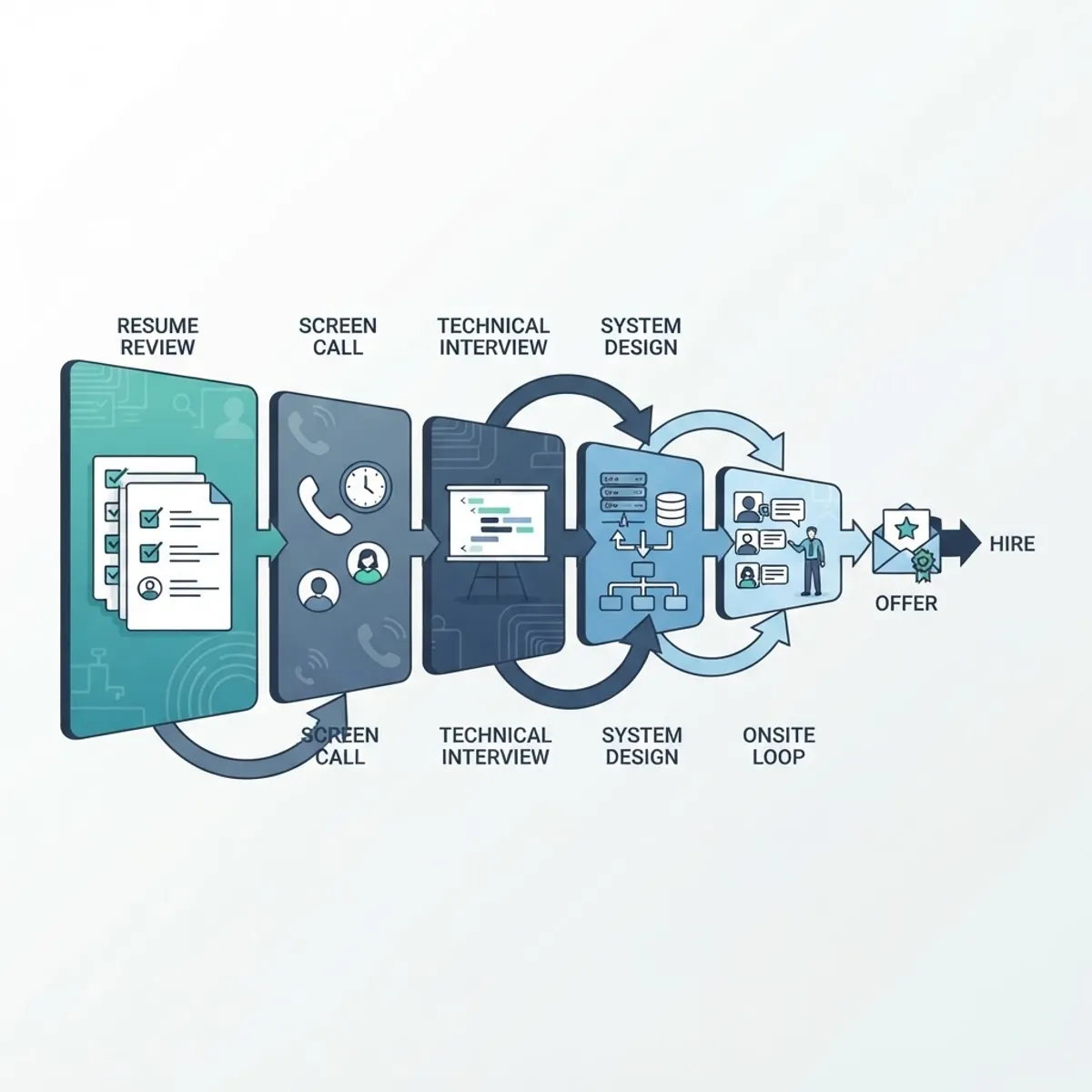
- Resume and referral screen. Filters for scope and impact, not tech stack lists.
- Recruiter call. Confirms level expectations, compensation range, and timeline.
- Technical screen. A focused coding or debugging exercise, usually 45 to 60 minutes.
- System design round. The single highest-weight round for senior candidates.
- Behavioral and manager round. Tests conflict handling, prioritization, and mentoring evidence.
A useful reference point: LinkedIn and industry hiring reports have repeatedly found that referred candidates convert to hires at multiples of the rate of cold applications. The practical takeaway is that application volume is the least efficient channel available to a senior candidate. One warm conversation with an engineering manager outperforms fifty cold submissions.
Where Senior Candidates Fail Most Often
The most common rejection reason is not a wrong answer. It is an unstructured one. Candidates jump into implementation detail, never state assumptions, and never quantify anything. Interviewers cannot distinguish confidence from guessing, so they default to no.
How to Prepare for the System Design Round
Prepare a repeatable structure instead of memorizing architectures. Structure is what transfers across unfamiliar prompts.

Use this sequence:
- Clarify requirements. Functional first, then non-functional: users, read and write ratio, latency target, consistency needs.
- Estimate load. Rough numbers beat precise silence. Say the number out loud.
- Draw the happy path. Client, API, service, data store, cache.
- Name the bottleneck. Every design has one. Find it before the interviewer does.
- Discuss failure. What breaks, how you detect it, how you recover.
- State the tradeoff you accepted. This is the senior signal.
Also prepare four stories in advance: a project you led, a production incident you resolved, a disagreement you handled, and a decision you got wrong. Each should include the constraint, your action, and a measurable result. Vague stories read as borrowed credit.
Which Skills Matter Most in Senior Job Descriptions?
Senior postings reward depth in one area plus working literacy across the rest. Nobody is hired for knowing a little about everything.
The consistent core across postings:
- One language at real depth, including its concurrency model, memory behavior, and testing ecosystem
- Data modeling and query performance, including indexes, transactions, and N+1 problems
- API and service design, including versioning, idempotency, and backward compatibility
- Cloud and CI/CD fluency, enough to deploy, observe, and roll back safely
- Observability practice, logging, metrics, tracing, and alert design
- Written communication, design documents, decision records, and clear pull request descriptions
Writing is the most undervalued item on that list. Teams that work asynchronously across time zones promote the engineer whose design document ended a two-week debate. Teams building with modern frameworks often lean on partners such as ZoneTechify Team for exactly that combination of depth and documentation discipline.
Remote and Distributed Senior Roles
Remote senior software engineer jobs are more competitive than local ones because the applicant pool is global while the headcount is not. Companies compensate by raising the bar on autonomy and written communication.

What distributed teams screen for specifically:
- Evidence you can make decisions without a same-day reply
- Documentation habits that survive time zone gaps
- Overlap hours that realistically match the core team
- Contracting and payroll logistics, which quietly eliminate many candidates
Candidates who include a short written work sample, such as a design document or a public architecture decision record, convert better in remote loops than candidates with longer resumes. Distributed studios like WebPeak Digital hire on that written signal because it predicts day-one effectiveness better than an interview does.
What Comes After Senior?
Senior is not the ceiling. It is the branch point, and choosing deliberately matters more than climbing quickly.

| Track | Core Currency | Best Fit If You Enjoy |
|---|---|---|
| Staff or principal engineer | Technical leverage across teams | Deep problems, architecture, standards |
| Engineering manager | Team outcomes and growth | Coaching, planning, unblocking people |
| Tech lead or hybrid | Delivery of one team's roadmap | Mixing hands-on work with coordination |
| Independent or consulting | Client outcomes and pricing power | Autonomy, variety, business ownership |
The practical advice: pick the track that matches what you want to be doing on a Wednesday afternoon, not the one with the better title. Moving from manager back to individual contributor is common and is not a demotion, but it does cost time.
Key Takeaways
- Senior software engineer jobs are defined by ownership and tradeoff judgment, not years served.
- The U.S. Bureau of Labor Statistics reported a 133,080 USD median wage for software developers in 2024, with roughly 15 percent projected growth through 2034.
- Typical senior base pay in the United States ranges from about 130,000 to 220,000 USD, with equity adding significant variance.
- The system design round carries the most weight in senior loops, and structure matters more than memorized architectures.
- Referrals convert far better than cold applications, making network outreach the highest-leverage job search activity.
- Written communication is the most underrated senior skill, especially in remote and distributed teams.
Frequently Asked Questions (FAQ)
How many years of experience do I need for a senior software engineer job?
Most postings ask for five to eight years, but companies really want evidence of ownership. If you have designed systems, handled production incidents, and mentored teammates, you can qualify earlier. Startups and platform teams tend to promote to senior faster than large enterprises with fixed calibration cycles.
What is the difference between mid-level and senior software engineer?
A mid-level engineer executes well-defined tasks reliably. A senior engineer defines the task, chooses the approach, names the tradeoffs, and owns the outcome including failures. The practical test is supervision: seniors ship correct work without someone reviewing every decision, and they improve the engineers around them.
How much do senior software engineers get paid?
In the United States, senior base salaries commonly fall between 130,000 and 220,000 USD, with large product companies at the top and agencies or non-tech enterprises lower. Equity, bonus, and location policy create most of the variance, so always compare total compensation rather than base salary alone.
How do I prepare for a senior software engineer interview?
Practice a repeatable system design framework: clarify requirements, estimate load, draw the happy path, identify the bottleneck, discuss failure modes, and state your tradeoff. Prepare four specific stories covering leadership, an incident, a conflict, and a mistake, each with measurable results and clear constraints.
Are remote senior software engineer jobs harder to get?
Yes, because the applicant pool is global while headcount is not. Remote teams weight autonomy and written communication heavily. Sharing a design document or architecture decision record improves your odds more than adding resume length, since it proves you can operate effectively without real-time supervision.
Should I become a manager or a staff engineer after senior?
Choose based on the work you want daily, not the title. Staff engineers trade in technical leverage across teams: architecture, standards, and hard problems. Managers trade in team outcomes: coaching, planning, and prioritization. Switching between tracks later is normal and common, though it costs some ramp-up time.