
A practical, experience-based guide to landing remote search engine optimization jobs in 2026, covering real roles, salary ranges, required skills, and where to apply.
Search Engine Optimization Jobs Remote
Remote SEO work is one of the few digital careers where output is almost perfectly measurable. Rankings, impressions, clicks, and revenue all sit in a dashboard that any manager can open from anywhere. That measurability is exactly why search engine optimization roles moved to remote-first faster than most marketing functions, and why they have stayed there while other departments were pulled back to offices.
This guide is written from the perspective of teams that actually hire and manage distributed SEO talent. It covers which remote SEO roles exist, what they pay, what hiring managers screen for, and the specific steps that move a candidate from "applied" to "offer."

Quick Answer: Remote SEO jobs are search optimization roles performed fully off-site, including technical SEO, content strategy, link acquisition, and analytics. Most require 1-3 years of hands-on experience, proven traffic case studies, and fluency in tools like Google Search Console, GA4, Ahrefs, or Semrush. Typical remote salaries range from 35,000 to 130,000 USD annually.
What Exactly Is a Remote SEO Job?
A remote SEO job is any role where the primary responsibility is improving a website's organic visibility in search engines and AI answer engines, performed entirely outside a physical office. The deliverables are the same as in-house work: audits, keyword strategy, on-page optimization, technical fixes, internal linking, content briefs, digital PR, and reporting.
The practical difference is workflow. Remote SEO teams document everything. Instead of walking to a developer's desk, you file a ticket with a clear reproduction path and business impact. Instead of a whiteboard session, you produce a written strategy doc that a stakeholder in another timezone can act on without a meeting. Written clarity is not a soft skill in remote SEO; it is the job.
Why SEO Became a Remote-First Career
Three structural factors explain the shift.
- The work is fully digital. Every tool an SEO uses is browser-based. There is no equipment that must live in an office.
- Results are independently verifiable. According to Google's own documentation, Search Console reports impressions, clicks, and average position for up to 16 months of history, which gives managers a neutral record of performance that does not depend on visible desk time.
- Search demand is global. A brand optimizing for multiple countries benefits from hiring people who actually live in those markets and understand local query phrasing.
There is also a demand-side reason. Google has stated that roughly 15 percent of daily searches are queries it has never seen before, which means keyword strategy is never finished. That continuous workload creates steady, ongoing roles rather than one-off projects.
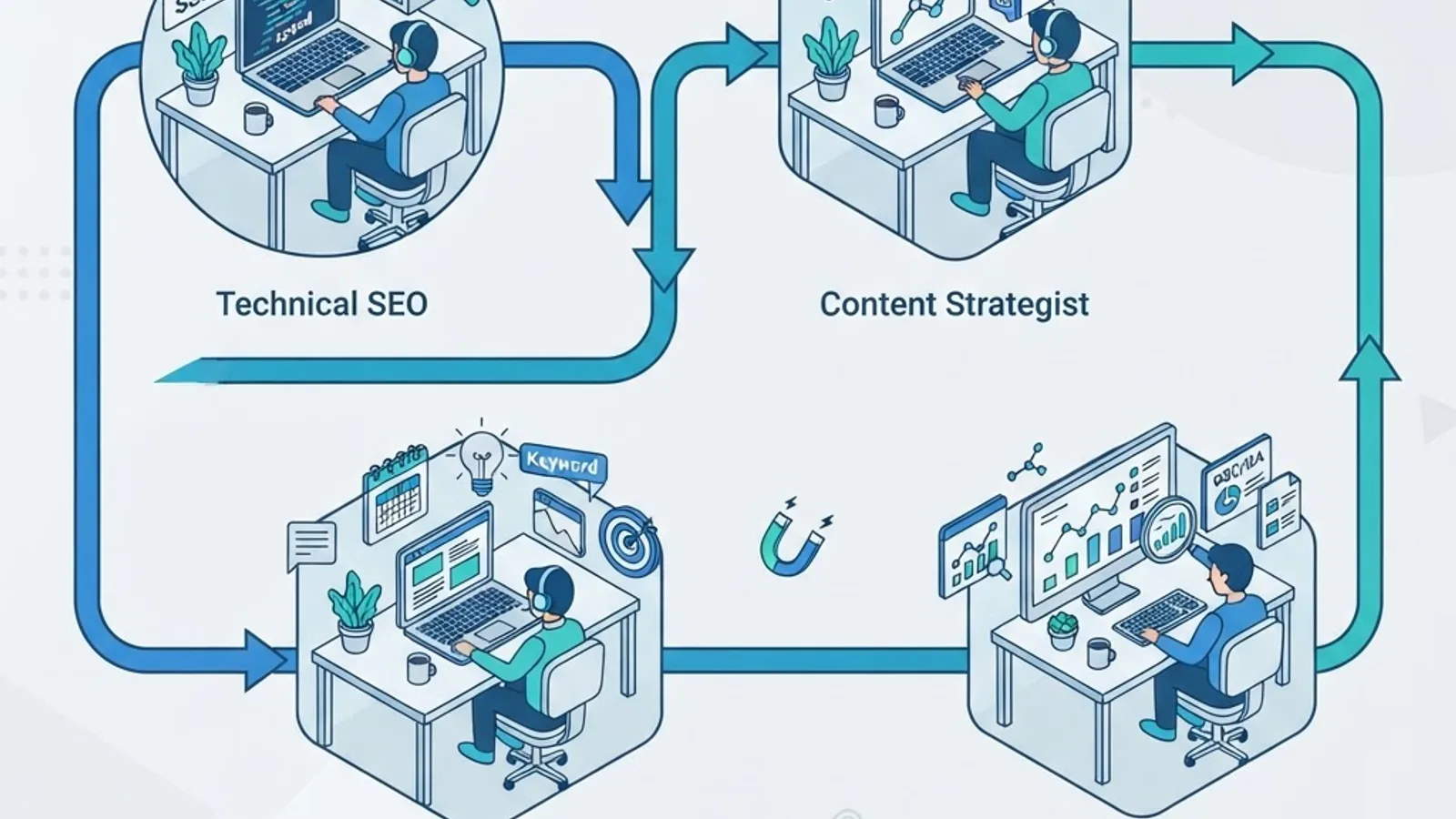
The Main Types of Remote SEO Roles
1. Technical SEO Specialist
You own crawlability, indexation, site architecture, structured data, Core Web Vitals, JavaScript rendering, and log file analysis. This is the highest-paid entry point because it overlaps with engineering. Expect to write tickets that developers respect, which means naming the exact template, the exact tag, and the expected before-and-after behavior.
2. SEO Content Strategist
You map search intent to page types, build topical clusters, write briefs, and decide what to consolidate or prune. Strong candidates can explain why they killed 200 thin pages and what happened to traffic afterward.
3. Link Acquisition and Digital PR Specialist
You earn links through data studies, expert commentary, and relationship outreach. Remote suits this role perfectly because the work is email, research, and calls.
4. SEO Analyst
You build dashboards, run forecasting models, attribute revenue to organic, and validate whether a change actually caused a lift. Comfort with GA4, BigQuery, and Looker Studio separates analysts from reporters.
5. SEO Manager or Head of Organic
You set strategy, manage budget and contractors, and defend organic in leadership meetings. Remote leadership adds an extra requirement: you must make progress visible without physical presence.
6. Freelance or Agency-Side SEO
You serve multiple clients across industries. Volume teaches pattern recognition fast, but you also carry sales, scoping, and invoicing. Agencies such as the team behind ZoneTechify and specialists at WebPeak run distributed delivery models where consultants handle strategy while implementation is coordinated through documented sprints.
Remote SEO Salary Ranges by Role and Level
The table below reflects commonly advertised full-time remote ranges in USD. Location-adjusted contracts, common for globally distributed teams, usually sit toward the lower half.
| Role | Experience | Typical Remote Range (USD/yr) | Contract Rate (USD/hr) |
|---|---|---|---|
| SEO Assistant / Junior | 0-1 years | 32,000 - 48,000 | 15 - 30 |
| SEO Specialist | 1-3 years | 48,000 - 70,000 | 30 - 55 |
| Technical SEO Specialist | 2-5 years | 65,000 - 95,000 | 50 - 90 |
| SEO Content Strategist | 2-5 years | 55,000 - 85,000 | 40 - 75 |
| SEO Analyst | 2-5 years | 60,000 - 90,000 | 45 - 85 |
| SEO Manager | 4-7 years | 80,000 - 115,000 | 65 - 110 |
| Head of Organic / Director | 7+ years | 110,000 - 160,000 | 100 - 175 |

Two pricing notes from experience. First, retainer freelancers who own a measurable revenue line almost always out-earn hourly freelancers doing task work. Second, technical SEO commands a premium because fewer candidates can read a rendered DOM and a server log with equal confidence.
Skills Hiring Managers Actually Screen For
Job descriptions list tools. Interviews test judgment. These are the capabilities that decide outcomes.
- Diagnostic reasoning. Given a 40 percent traffic drop, can you separate an algorithm update from a canonical error, a robots.txt change, a migration, and seasonality? Name your checking order.
- Search intent classification. Can you look at a keyword and correctly predict whether Google wants a product page, a comparison article, or a tool?
- Technical literacy. Redirect chains, hreflang, pagination, structured data validation, render-blocking resources, and how a CDN affects crawl behavior.
- Data honesty. Being able to say "this test was inconclusive" is a hiring signal, not a weakness.
- Async communication. A one-page written strategy beats a one-hour call in every distributed team.
- AI-era fluency. Understanding how content gets cited in AI answers, not just ranked in blue links.

Where to Find Legitimate Remote SEO Jobs
Applying broadly on general job boards produces the worst response rates. These channels work better.
- Company career pages of SaaS and ecommerce brands. Search for "organic growth" and "lifecycle" roles, not just "SEO."
- Remote-specific boards. We Work Remotely, Remote OK, Working Nomads, and Dynamite Jobs post vetted marketing roles.
- Agency careers pages. Distributed agencies hire continuously because client load fluctuates. Teams offering structured digital marketing services typically need specialists across technical, content, and analytics tracks.
- Niche communities. Slack groups, SEO Discords, and industry newsletters share roles before they hit boards.
- LinkedIn with saved alerts. Filter by "Remote" plus posted in the last 24 hours, then apply within a day. Early applications get read.
- Direct outreach. Audit a company's site, find three specific fixable issues, and email the growth lead with evidence. This converts far better than any application form.

Red Flags to Avoid
Skip listings that guarantee first-page rankings to clients, refuse to name the websites you would work on, pay per published link, or require you to purchase software or training upfront. Legitimate remote SEO employers give you tool access, a documented scope, and a named manager.
How to Build a Portfolio That Wins Remote SEO Offers
Remote hiring removes the benefit of the doubt that in-person interviews provide, so evidence carries more weight.
- Own one live site. Buy a domain in a topic you know, build 20 to 40 pages, and track it in Search Console for six months. Real data beats coursework.
- Write three short case studies. Use a fixed structure: situation, diagnosis, actions taken, measured result, and what you would do differently.
- Publish one public audit. Pick a mid-sized site, document five prioritized issues with screenshots and estimated impact, and share it openly.
- Show your reporting. A clean Looker Studio dashboard demonstrates that you can communicate outcomes to non-specialists.
- Keep numbers honest. Report percentages with baselines. "Traffic up 300 percent" from 40 sessions is not a win, and experienced interviewers will ask.

Passing the Remote SEO Interview Process
Most remote SEO hiring runs through four stages: a screening call, a technical or strategy interview, a paid or unpaid task, and a final conversation with leadership.
For the task stage, structure your submission as a prioritized list rather than an exhaustive audit. List each issue, its likely traffic or revenue impact, the effort required, and who needs to implement it. Hiring managers are evaluating whether you can sequence work under constraints, not whether you can run a crawl.
In the interview itself, expect scenario questions such as "our category pages are being outranked by our own blog posts, what do you do?" Answer with a diagnostic sequence, not a tactic list.

Career Growth and the AI Search Shift
Organic search is not shrinking, but the surface is changing. AI overviews, chat assistants, and answer engines increasingly summarize content instead of linking straight to it. The practical consequence for remote SEO careers is that the highest-value skills are moving toward entity clarity, original data, structured content, and brand authority, because those are the properties that make a page citable by both crawlers and language models.
The roles most protected from this shift are technical SEO, analytics, and strategy. The roles most exposed are volume content production and low-quality link placement. If you are early in your career, invest in the technical and measurement side first.

Key Takeaways
- Remote SEO jobs span six main tracks: technical, content strategy, link acquisition, analytics, management, and freelance or agency delivery.
- Salaries commonly range from about 32,000 USD for junior roles to 160,000 USD for directors, with technical SEO paying a premium.
- Google reports that around 15 percent of daily searches are entirely new queries, which keeps SEO work continuous rather than project-based.
- Search Console provides 16 months of performance history, making remote SEO output independently verifiable by managers.
- Evidence beats credentials: one live site with six months of real Search Console data outperforms most certifications.
- Direct outreach with a specific, documented site issue converts better than mass applications.
- AI answer engines reward entity clarity, original data, and brand authority, so technical and analytical skills are the safest long-term investment.
Frequently Asked Questions (FAQ)
Can I get a remote SEO job with no experience?
Yes, but you need proof instead of a resume line. Build and rank your own website, document six months of Search Console data, and publish two short case studies. Junior remote roles and agency assistant positions regularly hire candidates whose personal projects show real diagnostic thinking and measurable traffic growth.
How much do remote SEO jobs pay per hour?
Remote SEO contract rates typically run 15 to 30 USD per hour for junior work, 30 to 55 for mid-level specialists, and 50 to 110 for technical experts and managers. Rates depend more on demonstrated revenue impact than years worked, so strong case studies raise your ceiling quickly.
Do remote SEO jobs require coding skills?
Not full development skills, but technical literacy is expected. You should read HTML, understand JavaScript rendering effects, edit structured data, interpret server responses and redirects, and work comfortably in spreadsheets. Basic Python or SQL is a strong advantage for analyst roles and log file analysis, though it is rarely mandatory.
What tools should I learn first for remote SEO work?
Start with Google Search Console and GA4 because nearly every employer uses them. Add one crawler such as Screaming Frog, one keyword and backlink platform such as Ahrefs or Semrush, and Looker Studio for reporting. Learning two tools deeply is more valuable than surface familiarity with ten.
Are remote SEO jobs still in demand with AI search growing?
Demand remains strong, but the work is shifting. AI answer engines still need crawlable, authoritative, well-structured sources, so technical SEO, analytics, and strategy roles are growing. Low-value bulk content and paid link placement roles are declining, which makes technical and measurement skills the safer career investment.
How do I stand out when hundreds apply to one remote SEO role?
Apply within 24 hours of posting and attach a one-page mini audit of the company's own site listing three specific issues with estimated impact. Naming real URLs and real problems proves capability instantly and moves your application ahead of generic cover letters almost every time.