
A practical guide to what a search engine optimization consultant actually does, how they price their work, and how to hire one who delivers measurable organic growth.
Search Engine Optimization Consultant

Most businesses do not need more SEO advice. They need one accountable person who can look at their specific website, find the three things holding it back, and fix them in the right order. That is the job of a search engine optimization consultant, and it is very different from buying a package of ten blog posts a month.
After auditing hundreds of sites across SaaS, local services, and e-commerce, we have found the same pattern: companies rarely fail at SEO because they lack tactics. They fail because nobody owns prioritization. A consultant's real product is sequencing — knowing that fixing a broken faceted-navigation crawl trap this month is worth more than publishing twelve articles that will never be indexed.
Quick Answer: A search engine optimization consultant is an independent specialist who audits your website, diagnoses why it underperforms in search, and builds a prioritized roadmap covering technical fixes, content, and links. Unlike an agency, they focus on strategy and accountability rather than bulk execution, and typically charge hourly, monthly, or per project.
What Does a Search Engine Optimization Consultant Actually Do?
An SEO consultant diagnoses and prioritizes; they do not simply produce deliverables. The core work breaks into five repeatable functions.

- Technical diagnosis. Crawling the site to find indexation blockers: noindex tags on money pages, duplicate parameter URLs, broken canonicals, slow server response, orphaned pages, and JavaScript rendering failures.
- Keyword and intent mapping. Assigning one primary intent to each URL so pages stop competing with each other. Keyword cannibalization is one of the most common and most invisible causes of flat rankings.
- Content gap analysis. Comparing your topical coverage against the sites that consistently rank, then deciding what to create, what to merge, and what to delete. Pruning is often more profitable than publishing.
- Authority building. Designing a link acquisition approach based on digital PR, partnerships, or genuinely linkable assets rather than paid directories.
- Measurement and forecasting. Connecting rankings to sessions, sessions to conversions, and conversions to revenue so the work can be defended in a budget meeting.
Definition: Search Engine Optimization Consultant
A search engine optimization consultant is a specialist who is hired to improve a website's organic search visibility through independent analysis, strategy, and advisory work. They are typically engaged for expertise and direction, and may either implement changes themselves or guide an in-house team, developers, and writers who do.
Why Companies Hire a Consultant Instead of Guessing
The economics favour expertise because organic search is where most journeys begin. According to BrightEdge research, organic search drives roughly 53% of all website traffic — the single largest channel for most businesses. Google has also confirmed that its core ranking systems are updated thousands of times per year, with multiple broad core updates annually, which means an approach that worked eighteen months ago may now be actively harmful.
That volatility is the argument for a consultant. Someone whose full-time job is watching search behaviour will notice that your category has shifted toward AI-generated answer panels, or that a core update rewarded first-hand experience signals, long before your internal team spots the traffic decline in a quarterly review.
There is a second, less discussed reason: internal politics. A consultant can tell a marketing director that the site migration was executed badly, or that the CMS is the bottleneck, in a way an employee often cannot. External authority unblocks decisions.
SEO Consultant vs Agency vs In-House Hire

Choose based on where your constraint sits: strategy, execution capacity, or long-term ownership.
| Factor | SEO Consultant | SEO Agency | In-House SEO Hire |
|---|---|---|---|
| Best for | Diagnosis, strategy, unblocking teams | High-volume execution across content and links | Long-term ownership and internal knowledge |
| Typical cost | Hourly or mid-range monthly retainer | Higher monthly retainer plus production costs | Full salary plus tooling and benefits |
| Seniority you get | Almost always senior | Mixed — senior strategy, junior delivery | Depends entirely on hire |
| Execution capacity | Limited | High | Moderate |
| Speed to start | Days | Weeks | Months |
| Accountability | Direct and personal | Shared across account team | Direct but internal |
| Risk if it fails | Low — short contracts | Medium — longer contracts | High — hiring cost sunk |
The practical answer for most mid-sized companies is a hybrid: a consultant sets direction and audits quarterly, while an internal marketer or a production partner handles the volume. Teams that need broader campaign support alongside search often pair a consultant with a full digital marketing team so paid, social, and organic share one keyword and messaging framework instead of three conflicting ones.
What a Real Technical Audit Should Include

A credible technical audit is a prioritized action list, not a 90-page automated tool export. If a consultant hands you a raw crawler PDF, they have outsourced their thinking to software.
Ask that the audit cover, at minimum:
- Indexation reality check. How many pages Google actually has indexed versus how many you have published, and why the gap exists.
- Crawl budget waste. Parameter URLs, infinite calendars, filtered listings, and paginated duplicates consuming crawl capacity.
- Core Web Vitals by template. Google's own guidance states that Core Web Vitals are page experience signals, so measurement must be per template — product pages, blog posts, and category pages fail differently.
- Internal linking depth. Any revenue page more than three clicks from the homepage is structurally undervalued.
- Structured data validity. Errors in Product, Article, FAQ, or LocalBusiness schema that silently disqualify rich results.
- Log file evidence. How search engine bots actually behave on your site, not how a third-party crawler thinks they should.
When a rebuild is the honest recommendation, a good consultant will say so and scope it with a development partner rather than patching a broken foundation. That is where specialist web development capability matters more than another content calendar.
How SEO Consultants Charge
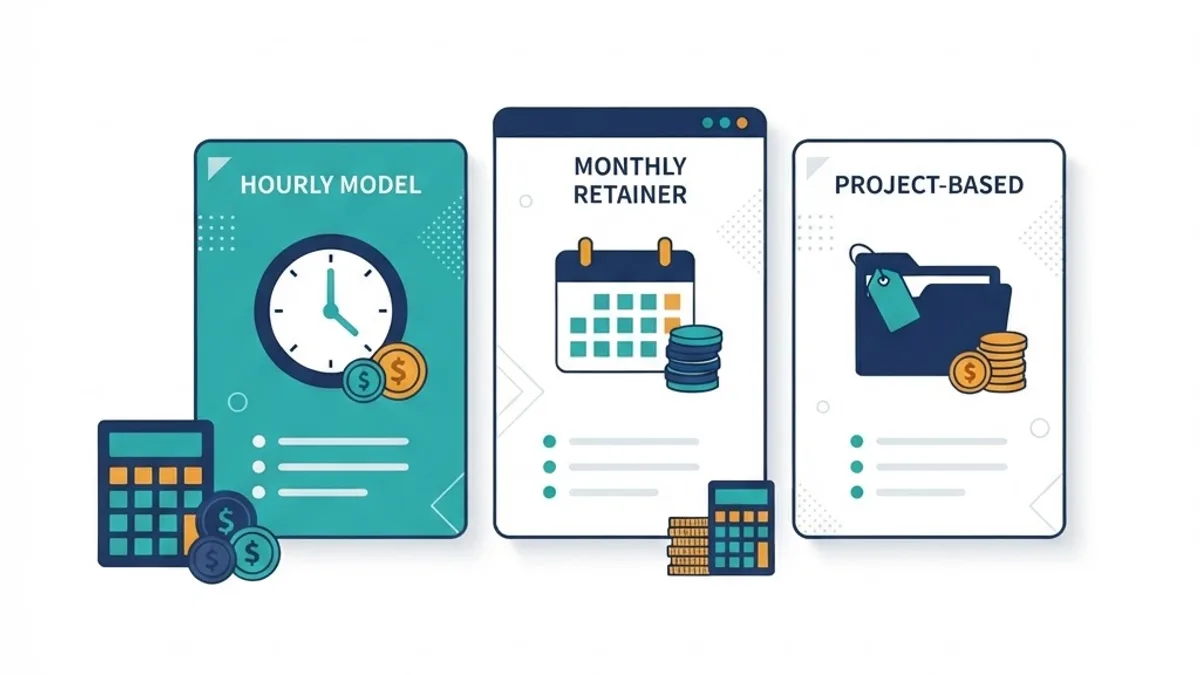
Pricing models signal what you are actually buying, so match the model to the outcome you need.
Hourly Consulting
Best for a specific unblock: reviewing a migration plan, training a team, or a second opinion on a traffic drop. You buy judgment in concentrated form. The risk is scope creep and no continuity.
Monthly Retainer
Best for ongoing programmes where priorities shift and someone must own the roadmap. Insist on a written scope of hours and deliverables. A retainer without defined outputs is where most disappointing SEO relationships begin.
Project or Deliverable Based
Best for defined outcomes: a technical audit, a keyword architecture, a content strategy, or a migration plan. Fixed scope, fixed price, clean handover.
Performance Based
Attractive but usually unwise. Ranking-based bonuses incentivize chasing easy keywords, and revenue-share deals require attribution clarity that most businesses do not have. If you try it, tie payment to qualified leads or revenue, never to ranking positions.
Ten Questions That Expose a Weak Consultant

Use these in a first call. The answers separate practitioners from presenters.
- Walk me through a client where you failed. What went wrong?
- What would you refuse to do even if I asked for it?
- Which of my competitors is doing SEO best, and why?
- What will you need from my developers, and how much of their time?
- How do you decide what not to work on this quarter?
- Show me a report you sent a client last month.
- How do you handle keyword cannibalization on a large site?
- What is your view on AI-generated content for my industry?
- What is the earliest honest date I should expect measurable movement?
- If we part ways in six months, what do I keep?
Answer ten is the most revealing. Strong consultants build documentation, dashboards, and internal capability that outlast the engagement. Weak ones build dependency.
Immediate red flags: guaranteed number-one rankings, refusal to name past clients, ownership of your Google Search Console or analytics accounts, private blog networks, and reports that show only rankings with no traffic or conversion data.
How to Measure Whether It Is Working

Judge an SEO consultant on leading indicators early and lagging indicators later. Expecting revenue movement in month one is how good engagements get cancelled prematurely.
- Weeks 1 to 4 — leading signals. Crawl errors resolved, indexation of priority pages, Core Web Vitals improvements, schema validation passing.
- Months 2 to 3 — visibility signals. Impressions in Search Console, keyword ranking distribution moving from positions 11 to 30 into the top ten, click-through rate on updated titles.
- Months 4 to 6 — traffic signals. Non-branded organic sessions, landing page depth, share of traffic to commercial pages rather than blog pages.
- Months 6 to 12 — business signals. Organic-assisted pipeline, qualified leads, revenue per organic session, and customer acquisition cost compared with paid channels.
One metric deserves special attention: non-branded organic clicks. Branded search grows with every other marketing activity you run, so it flatters SEO reports. Non-branded clicks are the honest measure of new demand your consultant created.
SEO Consultants in the Age of AI Answers

The consultant's remit has expanded from ranking pages to earning citations. AI Overviews, ChatGPT, Perplexity, and Gemini increasingly answer questions directly, and users click through only when they need depth or want to transact.
This changes three things in practice. First, thin informational content loses value fastest, because it is exactly what AI summarizes without attribution. Second, content that contains original data, first-hand testing, pricing specifics, or expert commentary becomes more valuable, because those are the elements AI systems quote and link. Third, clear structure — direct answers under descriptive headings, definitions, comparison tables — determines whether your page is extractable at all.
A consultant working today should be able to show you which queries in your category already trigger AI answers, whether your site is cited in them, and what content changes would make citation more likely. If they have no opinion on this, they are optimizing for the search engine of 2021. Businesses that want to go further and build their own AI-driven search and content workflows should look at dedicated artificial intelligence services rather than expecting a single consultant to build software.
When You Should Not Hire an SEO Consultant
Honest advice includes knowing when to decline. Do not hire one if:
- Your product has no existing search demand — you need demand creation, not capture.
- You cannot commit any developer or content resource for at least six months.
- You need revenue within 60 days. Buy ads, then layer SEO underneath.
- Your site is about to be rebuilt. Wait, and bring the consultant into the rebuild brief instead.
A consultant who tells you to wait is demonstrating exactly the judgment you would be paying for. For teams that want strategy, content, and implementation coordinated under one roof, working with a full-service partner like ZoneTechify can remove the handover gaps that stall most solo engagements.
Key Takeaways
- Organic search drives approximately 53% of website traffic, making it the largest single acquisition channel for most businesses.
- Google updates its ranking systems thousands of times per year, so SEO strategy requires ongoing recalibration rather than one-time fixes.
- A consultant's core value is prioritization and sequencing, not volume of deliverables.
- Pricing models — hourly, retainer, project, performance — should match the outcome you need; performance-based deals carry the most attribution risk.
- Non-branded organic clicks are the most honest measure of an SEO consultant's contribution, because branded search grows from all marketing activity.
- Expect technical wins in weeks, visibility shifts in two to three months, and business results in six to twelve months.
- AI answer engines reward original data, first-hand experience, and clear structure — thin informational content is the fastest-devaluing asset in search.
Frequently Asked Questions (FAQ)
What does an SEO consultant do exactly?
An SEO consultant audits your website, identifies why it underperforms in search, and builds a prioritized roadmap covering technical fixes, keyword architecture, content, and link acquisition. They either implement changes directly or guide your developers and writers, and they report on how organic search affects traffic and revenue.
How much does an SEO consultant cost?
Costs vary by market and seniority, and are typically structured as hourly consulting, a monthly retainer, or a fixed-price project such as an audit. Always tie pricing to a written scope of deliverables. Retainers without defined outputs are the most common source of disappointing SEO engagements.
How long before an SEO consultant shows results?
Expect technical improvements within four weeks, visibility and impression growth in two to three months, meaningful non-branded traffic gains in four to six months, and clear business results in six to twelve months. Competitive industries and newer domains sit at the longer end of that range.
Is an SEO consultant better than an agency?
A consultant is better when your constraint is strategy, diagnosis, or prioritization. An agency is better when you need high-volume execution across content and links. Many companies get the best result from a hybrid: a consultant setting direction and an agency or in-house team handling production.
Can I do SEO myself instead of hiring a consultant?
Yes, for small sites in low-competition niches. You can handle fundamentals like page titles, internal links, and useful content yourself. Hire a consultant once technical complexity, site migrations, cannibalization, or competitive markets mean guessing wrong costs more than expert advice would.
How do I know if my SEO consultant is doing good work?
Check non-branded organic clicks in Google Search Console, indexation of priority pages, and organic conversions — not ranking screenshots alone. A good consultant explains what they chose not to do and why, and leaves you with documentation and dashboards you keep after the engagement ends.