
A practical guide to product data management in e commerce, covering catalog structure, attribute taxonomy, data quality audits, feed syndication and governance ownership.
Product Data Management E Commerce
Product data management in e commerce is the discipline of collecting, structuring, enriching, validating and distributing every fact about the things you sell. It sounds like back office plumbing, and that is exactly why most stores neglect it until conversion rates stall, ad feeds get disapproved and returns spike. In practice, product data is the product online. A shopper cannot touch a jacket or weigh a blender, so the title, attribute set, images, dimensions and stock status are the entire buying experience.
This guide is written from hands on catalog work rather than theory. It explains how to structure product records, what to audit first, how to keep data consistent across channels, and how to measure whether the work paid for itself.
Quick Answer: Product data management in e commerce is the process of creating one accurate, complete and structured record for every product, then syndicating it to your store, marketplaces and ad feeds. Done well, it lifts conversion rates, cuts returns caused by wrong specifications, and reduces feed disapprovals across sales channels.

What Product Data Management Actually Covers
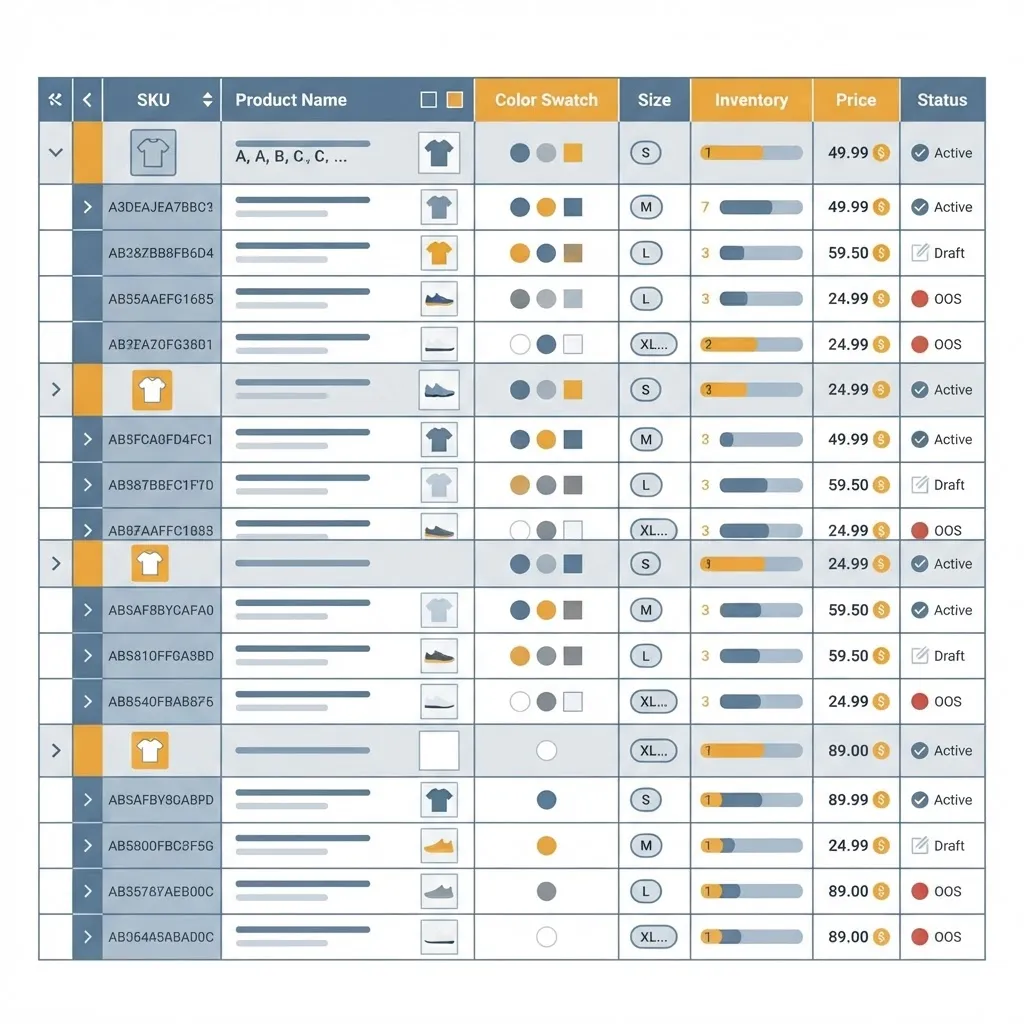
Product data management is broader than a spreadsheet of SKUs. A usable product record contains five distinct layers, and confusing them is the root cause of most catalog problems.
- Identity data: SKU, GTIN or barcode, brand, manufacturer part number. This layer must never change once published, because marketplaces and analytics use it as the join key.
- Descriptive data: title, short description, long description, bullet features, keywords. This is the layer marketing edits most often.
- Technical attributes: size, colour, material, wattage, compatibility, certifications. Structured values only, never free text buried in a paragraph.
- Media assets: images, alternate angles, video, size charts, spec sheets, with naming conventions and alt text.
- Commercial and logistics data: price, tax class, stock level, lead time, shipping weight, dimensional weight, country of origin.
When these layers live in one governed system, the same product looks identical on your site, in a marketplace listing and in a shopping ad. When they live in five separate exports, the versions drift within weeks.
Definition Of Key Terms
- PIM (Product Information Master): the system of record for descriptive and attribute data.
- Attribute taxonomy: the controlled list of attributes and allowed values per category.
- Data completeness: the percentage of required fields filled for a given channel.
- Feed syndication: the automated export of product data to external channels in their required schema.
Why Product Data Quality Moves Revenue
Two data points are worth anchoring on. Google states that a valid GTIN improves the performance of shopping listings and is required for most branded products, and listings missing required attributes can be disapproved entirely, meaning zero impressions rather than reduced impressions. Separately, Baymard Institute usability research has repeatedly found that insufficient product information is one of the most common reasons shoppers abandon a product page, with specification and sizing gaps ranking among the top causes of return behaviour in apparel and hardware categories.
The original insight most teams miss is this: bad product data does not fail loudly. It fails as a slow tax. A missing shipping weight quietly inflates carrier surcharges. A colour value typed three different ways silently breaks the filter that would have shown a shopper the item they wanted. An unstructured size chart turns into a returns queue two weeks later. None of these appear as an error message, which is why product data debt accumulates for years.
A useful mental model: every attribute you fail to structure becomes a decision the shopper has to make with incomplete information, and every incomplete decision has a measurable abandonment cost.
The Product Information Workflow That Scales
A workflow beats heroics. The pattern below works for catalogs from a few hundred to a few hundred thousand SKUs.
- Intake: receive supplier data in a fixed template. Reject anything that does not match the template rather than fixing it manually.
- Normalisation: map supplier field names and units to your own attribute taxonomy. Convert everything to a single unit system at this step.
- Enrichment: add differentiated content, the material detail, the use case, the compatibility notes that suppliers never provide.
- Validation: run automated rules for required fields, value ranges, image resolution and duplicate GTINs.
- Approval: a named owner signs off. Silence is not approval.
- Publication: push to store and channels through a single export layer, never through manual channel by channel uploads.
- Monitoring: track disapprovals, zero impression SKUs and search terms with no results.
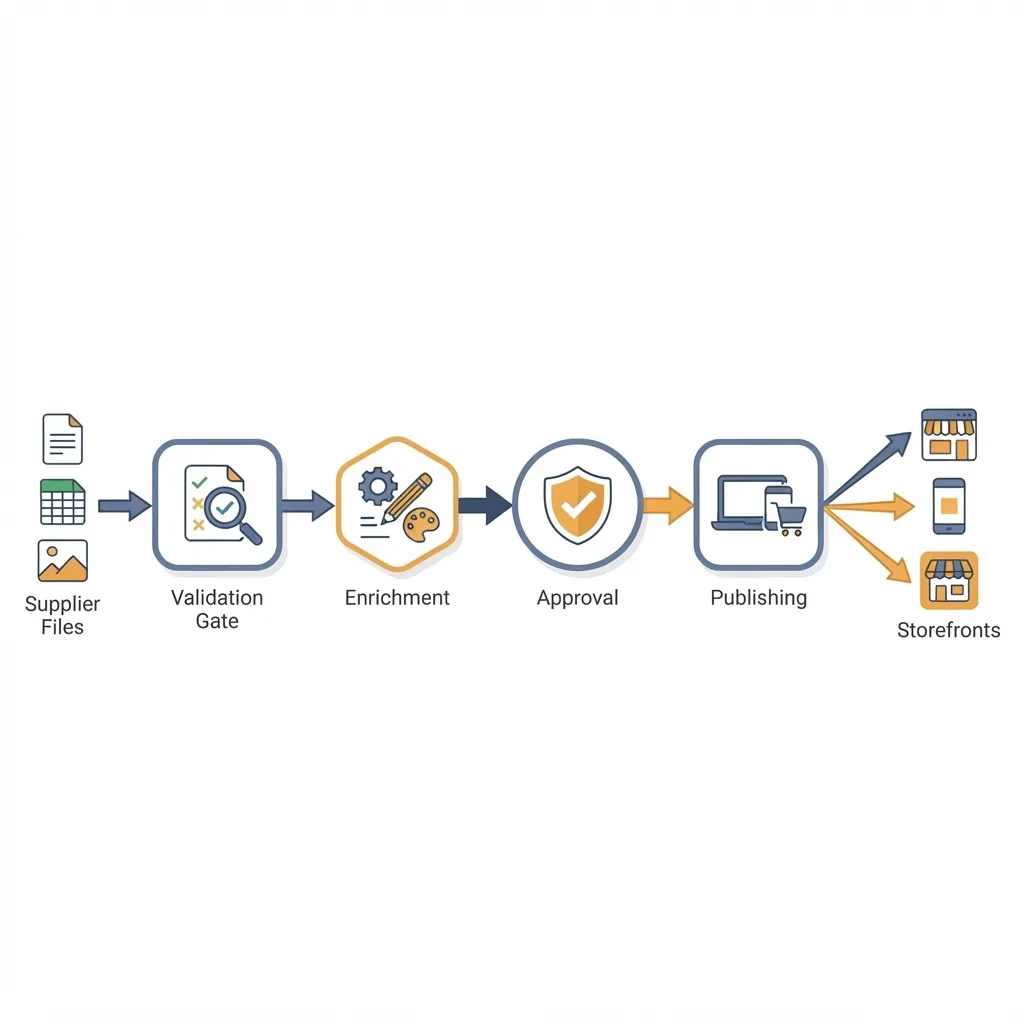
The non obvious step is number one. Teams usually try to fix supplier chaos downstream with clever automation. Enforcing a strict intake template at the boundary removes more work than any enrichment tool, because the cost of correcting a record rises every time it moves further into the pipeline.
How To Run A Product Data Audit In One Week
Start with measurement, not migration. A five step audit gives you a defensible priority list.
- Export everything into one flat file including channel status and 90 days of revenue per SKU.
- Score completeness per category, not per store. Weakness is almost always concentrated in one or two categories.
- Find contradiction, not just absence. Two different weights for the same SKU is more dangerous than a blank field, because automation will trust the wrong one.
- Cross reference with search logs. Internal site searches returning no results tell you which attributes shoppers expect and you do not have.
- Rank by revenue exposure. Fix the 20 percent of SKUs carrying most of the revenue before touching the long tail.

Teams that sequence the audit this way typically find that a small subset of categories is responsible for most disapprovals and most support tickets, which makes the first sprint easy to justify to finance.
Building An Attribute Taxonomy That Survives Growth
An attribute taxonomy is a contract. Three rules keep it stable.
- Controlled values over free text. Give colour a fixed list. Nobody should be able to type Navy, navy blue and NAVY into the same field.
- Category specific required fields. A laptop needs screen size and RAM. A candle does not. Global required fields produce empty columns and lazy defaults.
- Versioned changes. When you rename or merge an attribute, keep a mapping record so historical reports and channel feeds do not break.
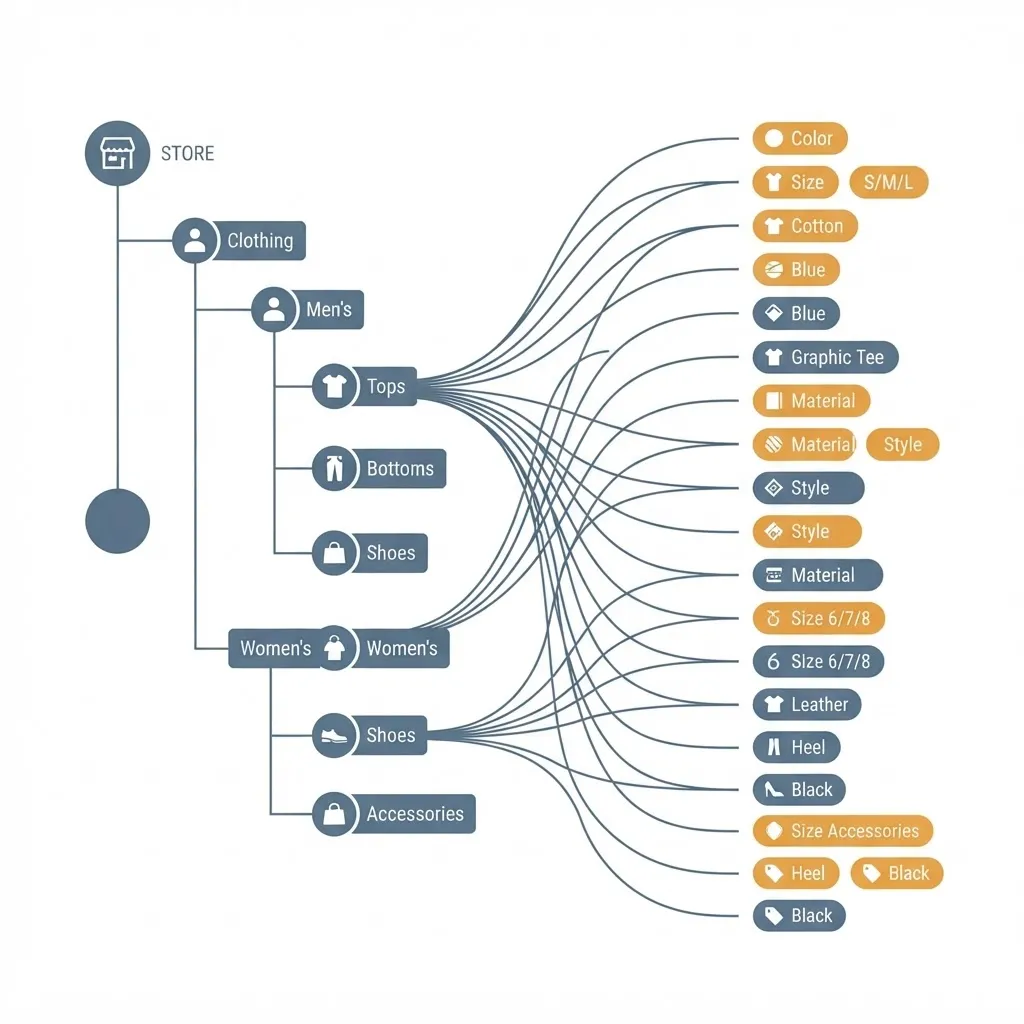
A practical starting point is to model your taxonomy on the schema your largest external channel demands, then extend it. If a marketplace already requires nine attributes for a category, that requirement is a distilled summary of what shoppers in that category actually filter on. Adopting it early avoids a rebuild later. Structured attributes also feed the merchandising and campaign work behind data-driven marketing, because segmentation is only as granular as the fields underneath it.
Multichannel Syndication Without Duplicate Truth
The single biggest architectural decision is whether channels read from one master record or hold their own copies. One master with channel specific transformation rules is the only version that stays consistent.
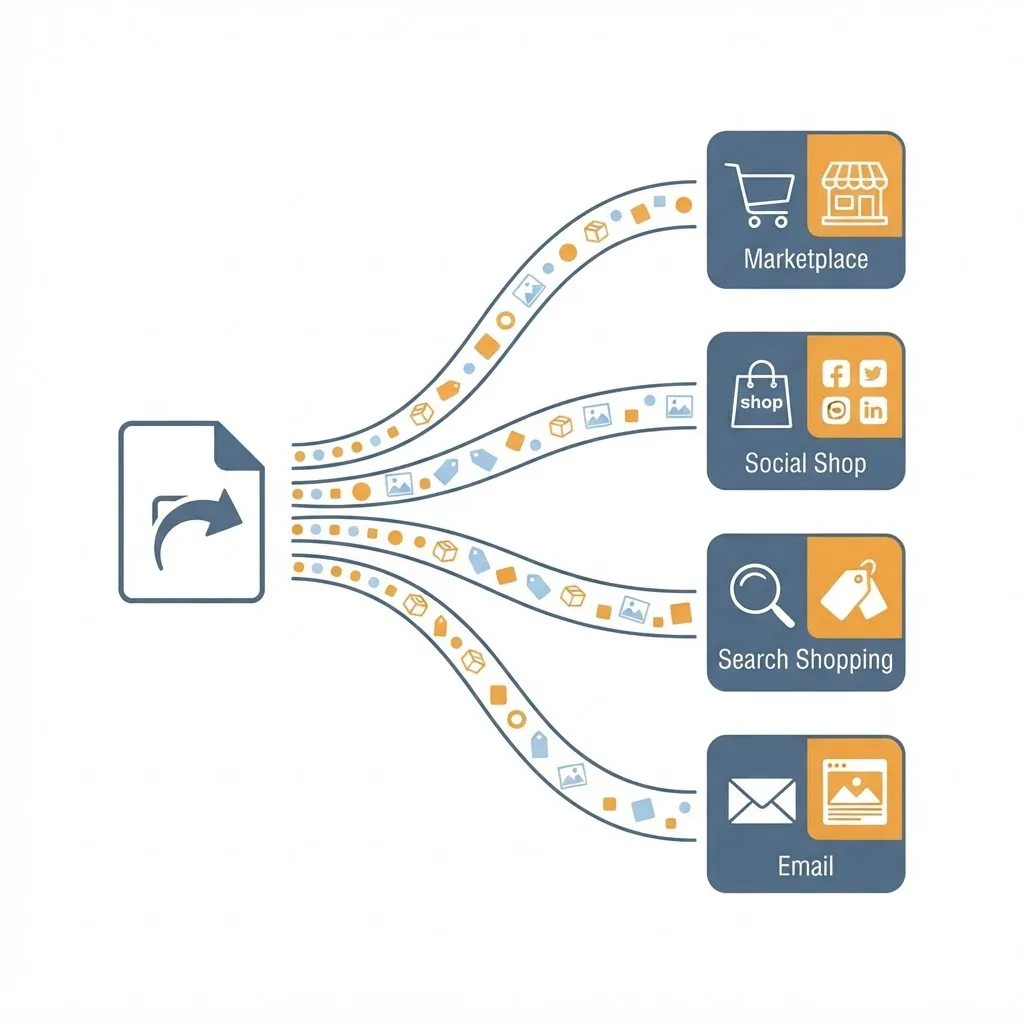
A transformation layer lets you keep one truthful title while satisfying a marketplace character limit, and one truthful colour value while mapping to a channel controlled vocabulary. If instead you edit titles inside each channel dashboard, every future bulk change requires the same work multiplied by the number of channels.
Comparison Of Product Data Management Approaches
| Approach | Best Catalog Size | Consistency | Effort To Maintain | Main Risk |
|---|---|---|---|---|
| Spreadsheets and manual uploads | Under 200 SKUs | Low | High as you grow | Version drift between files |
| Store platform as master | 200 to 5,000 SKUs | Medium | Medium | Weak attribute validation |
| Dedicated PIM with feed layer | 5,000 SKUs and above | High | Low per SKU | Setup and taxonomy design cost |
| Custom data service plus API | Complex or B2B catalogs | High | Medium | Requires engineering ownership |
The honest recommendation: do not buy a PIM to solve a governance problem. If nobody owns colour values today, a new tool will store the same inconsistency in a more expensive place. Decide ownership first, then choose tooling.
Governance, Ownership And Measurement
Product data fails on accountability far more often than on technology. Assign one owner per attribute group, not per product. Merchandising owns titles and descriptions. Operations owns weight, dimensions and lead time. Compliance owns certifications and country of origin.
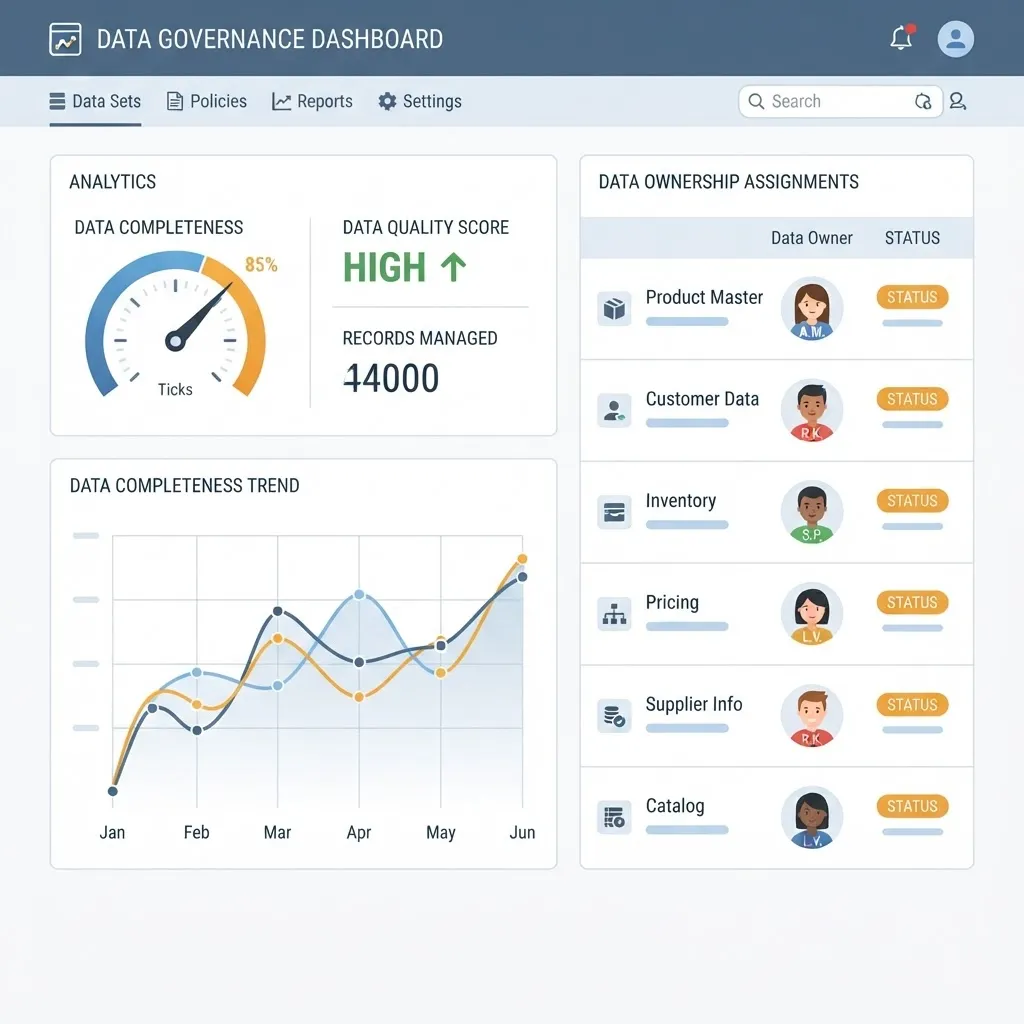
Track four metrics monthly and publish them internally:
- Completeness rate per channel and category.
- Feed disapproval count and time to resolution.
- Return rate attributed to product information, captured from return reason codes.
- Zero result internal searches, which reveal missing attributes and naming gaps.
When catalog work needs engineering support, a senior team that understands both commerce data models and front end performance shortens the project considerably, which is where partners such as WebPeak Digital fit into a build. For the campaign and channel side of the same catalog, structured feeds are the prerequisite for effective online marketing services, because bidding and audience logic depend on clean attribute data. If you are also mapping roles and responsibilities inside a commerce team, this breakdown of where a digital marketing consultant sits in ecommerce taxonomy is a useful companion read.
Key Takeaways
- Product data management in e commerce spans identity, descriptive, technical, media and commercial data layers, and each layer needs a named owner.
- Missing required attributes such as GTIN can cause full listing disapproval on shopping channels, not just reduced visibility.
- Insufficient product information is one of the most documented causes of product page abandonment and specification driven returns.
- Enforce a strict supplier intake template. Fixing data at the boundary costs less than fixing it downstream.
- One master record with channel transformation rules beats separate copies per channel in every catalog size above a few hundred SKUs.
- Measure completeness, disapprovals, information related returns and zero result searches monthly to prove the value of catalog work.
Frequently Asked Questions (FAQ)
What is product data management in e commerce?
It is the process of creating and maintaining one accurate, structured record for every product you sell, then distributing that record to your website, marketplaces and advertising feeds. It covers identifiers, descriptions, technical attributes, images and logistics data such as weight and stock availability.
Do I need a PIM system for a small online store?
Not immediately. Under roughly 200 SKUs, a disciplined spreadsheet with controlled value lists and a single owner works fine. Consider a dedicated PIM once you sell on multiple channels, manage thousands of variants, or spend more than a few hours weekly reconciling conflicting product information.
How does product data affect SEO and conversions?
Structured attributes power filters, internal search, rich results and shopping feeds. Complete specifications answer buying questions on the page, which reduces abandonment. Consistent titles and identifiers help search engines and marketplaces match your listing to the right query and to competitor comparisons.
What is the difference between product data management and inventory management?
Product data management describes what a product is, including attributes, media and descriptions. Inventory management tracks how many units exist and where they sit. They connect through the SKU, but they solve different problems and usually live in different systems with different owners.
How often should product data be audited?
Run a full catalog audit quarterly and automated validation continuously. Automated rules should check required fields, duplicate identifiers, image resolution and unit consistency on every import. Quarterly reviews should focus on category level completeness, channel disapprovals and attributes shoppers request but you do not store.
Who should own product data inside a company?
Ownership should be split by attribute group rather than by product. Merchandising owns titles and descriptions, operations owns weight, dimensions and lead times, and compliance owns certifications and origin data. One accountable coordinator should publish completeness and disapproval metrics each month.