A practical guide to choosing a PHP web application development company, covering frameworks, architecture, security, performance, pricing models, and vetting questions.
PHP Web Application Development Company
PHP still runs the majority of the server-rendered web, yet the gap between an average PHP shop and a genuinely strong one has never been wider. Modern PHP is a typed, JIT-capable, framework-driven language with mature tooling. Plenty of agencies never made that jump and are still shipping 2014-era code with 2025 invoices attached. This guide explains exactly what a competent PHP web application development company does differently, and how you can tell the difference before you sign anything.
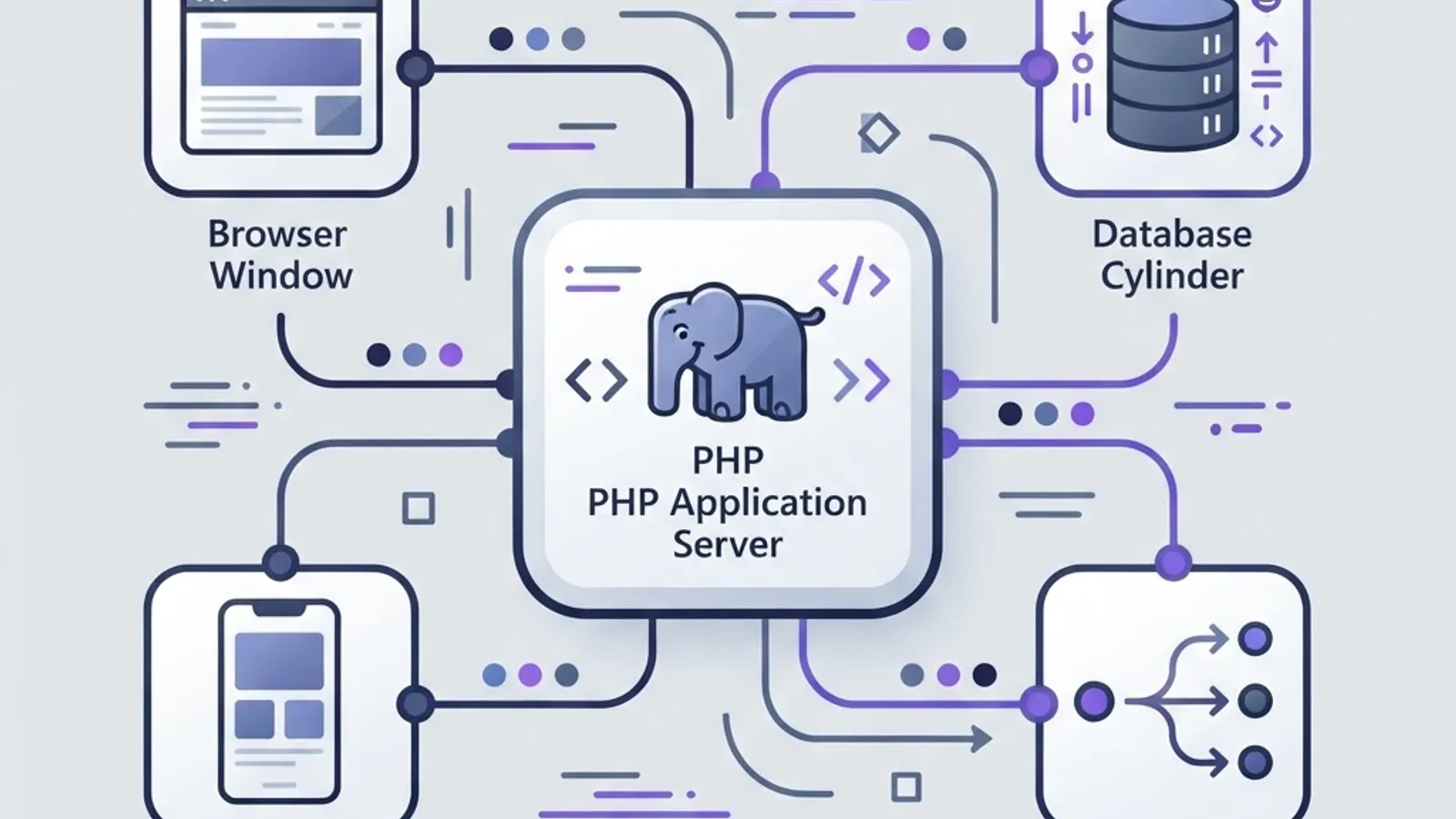
Quick Answer: A PHP web application development company designs, builds, secures, and maintains custom server-side applications using PHP and frameworks such as Laravel or Symfony. The strongest firms deliver typed, tested, containerized code with documented architecture, automated deployments, security hardening, and a measurable performance budget rather than a one-off codebase drop.
What a PHP Web Application Development Company Actually Does
A PHP web application development company builds custom software where the business logic lives on a server and PHP handles requests, data, authorization, and integrations. That is broader than website work. Website projects are largely presentation. Application projects involve state, roles, money, workflows, and rules that must never break silently.
A competent firm owns five distinct responsibilities:
- Domain modeling. Turning your business rules into entities, states, and permitted transitions before any code exists.
- Application architecture. Choosing framework, boundaries, data access strategy, and background job design.
- Implementation with tests. Writing code with automated coverage on the logic that would cost you money if it failed.
- Infrastructure and delivery. Containers, environments, CI pipelines, database migrations, rollbacks.
- Operations. Monitoring, error tracking, dependency patching, and performance regression checks after launch.
If a proposal only covers point three, you are buying code, not an application. That distinction is the single most common cause of failed PHP projects I have seen in post-mortems: the code worked on the developer machine and nobody owned the other four layers.
Definition: Web Application vs Website
A website delivers mostly static or lightly dynamic content to anonymous visitors. A web application authenticates users, holds persistent state, enforces business rules, and performs write operations that have consequences. Pricing, testing depth, and hosting requirements differ substantially between the two, so clarify which one you are buying in the first meeting.
Why PHP Is Still a Rational Choice in 2026
PHP powers roughly 74 percent of websites whose server-side language is known, according to W3Techs surveys, which makes it the most widely deployed server language on the public web. That scale matters commercially: hosting is cheap and universal, the hiring pool is deep, and the ecosystem of battle-tested packages is enormous.
The technical case improved sharply too. PHP 8 introduced the JIT compiler, constructor property promotion, enums, named arguments, and readonly properties. Independent benchmark suites consistently show PHP 8.x handling significantly more requests per second than PHP 5.6 on identical hardware, with framework-level gains frequently reported in the 2x to 3x range for CPU-bound workloads. Combined with OPcache and preloading, a well-tuned PHP application comfortably serves high traffic without exotic infrastructure.
The honest counterpoint: PHP's low barrier to entry means the average quality of publicly available PHP code is poor. Language capability is not the constraint. Engineering discipline is. That is precisely why the choice of company matters more in PHP than in ecosystems with narrower entry paths.
PHP Framework Comparison for Application Projects
Any agency that uses the same framework for every project regardless of context is optimizing for its own convenience. Here is how the realistic options compare.
| Framework | Best fit | Learning curve | Long-term maintainability | Typical use case |
|---|---|---|---|---|
| Laravel | Product MVPs, SaaS, admin-heavy apps | Low | High with discipline, degrades if logic lives in controllers | Subscription platforms, internal tools |
| Symfony | Complex enterprise domains, long lifecycles | High | Very high, explicit and decoupled | ERP, banking, government systems |
| CodeIgniter | Small, focused apps with tight hosting limits | Very low | Moderate, thin abstractions | Lightweight portals, legacy modernization |
| Slim | APIs and microservices | Low | High, minimal surface area | Headless backends, service layers |
| Plain modern PHP | Narrow single-purpose services | Medium | Depends entirely on the team | Webhooks, workers, cron services |
A useful vetting question: ask which framework the company would refuse to use for your project and why. A team with real judgment answers immediately with a reason tied to your domain. A team without it lists advantages of whatever they already know.
Architecture Standards That Separate Serious Firms
Architecture is where the money is either saved or quietly lost. The pattern that predicts long-term cost is where the business logic lives.
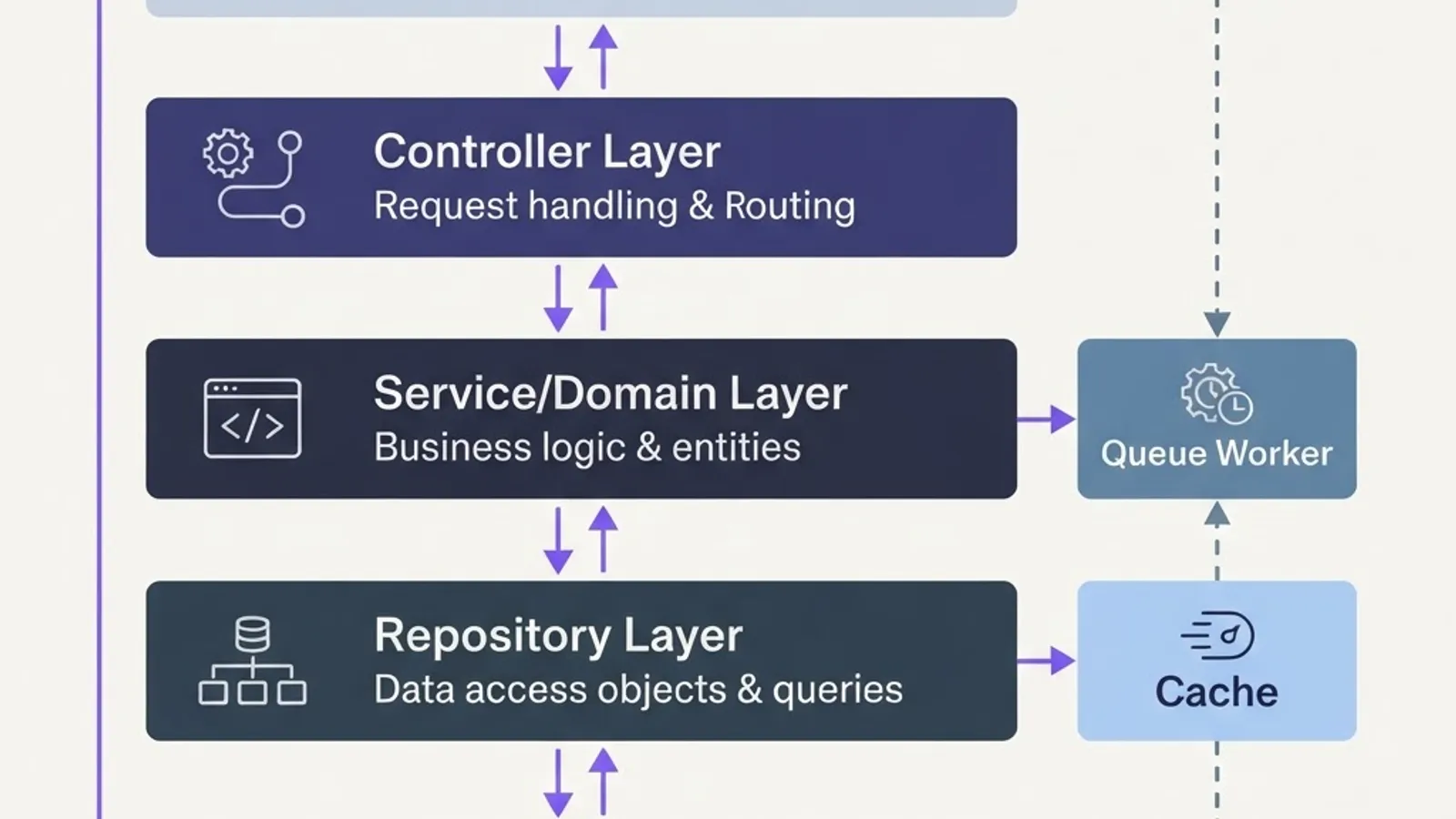
A well-structured PHP application keeps business rules out of controllers and out of templates. Controllers translate HTTP into a call. A service or action class holds the rule. A repository or query class touches the database. Templates render. When those four responsibilities blur, every future change requires reading the whole file to know what breaks.
Specific standards to require in writing:
- Strict types enabled on every file, with a static analysis tool such as PHPStan or Psalm running at a defined level in CI.
- Database migrations in version control. No manual schema edits on production, ever.
- Queued background jobs for email, exports, third-party API calls, and anything exceeding roughly 200 milliseconds of work.
- A documented caching strategy naming what is cached, for how long, and how it is invalidated.
- Environment parity through Docker or an equivalent, so local, staging, and production behave the same.
- Idempotent write endpoints for anything involving payments or inventory, so a retried request cannot double-charge.
These are not luxuries. Each one maps directly to a class of production incident that costs far more to fix later than to prevent now.
Security Practices You Should Insist On
Security in PHP applications rarely fails because of the language. It fails because of predictable implementation gaps. Injection flaws and broken access control both remain in the OWASP Top 10, and broken access control has been ranked the most prevalent web application risk in recent OWASP editions.
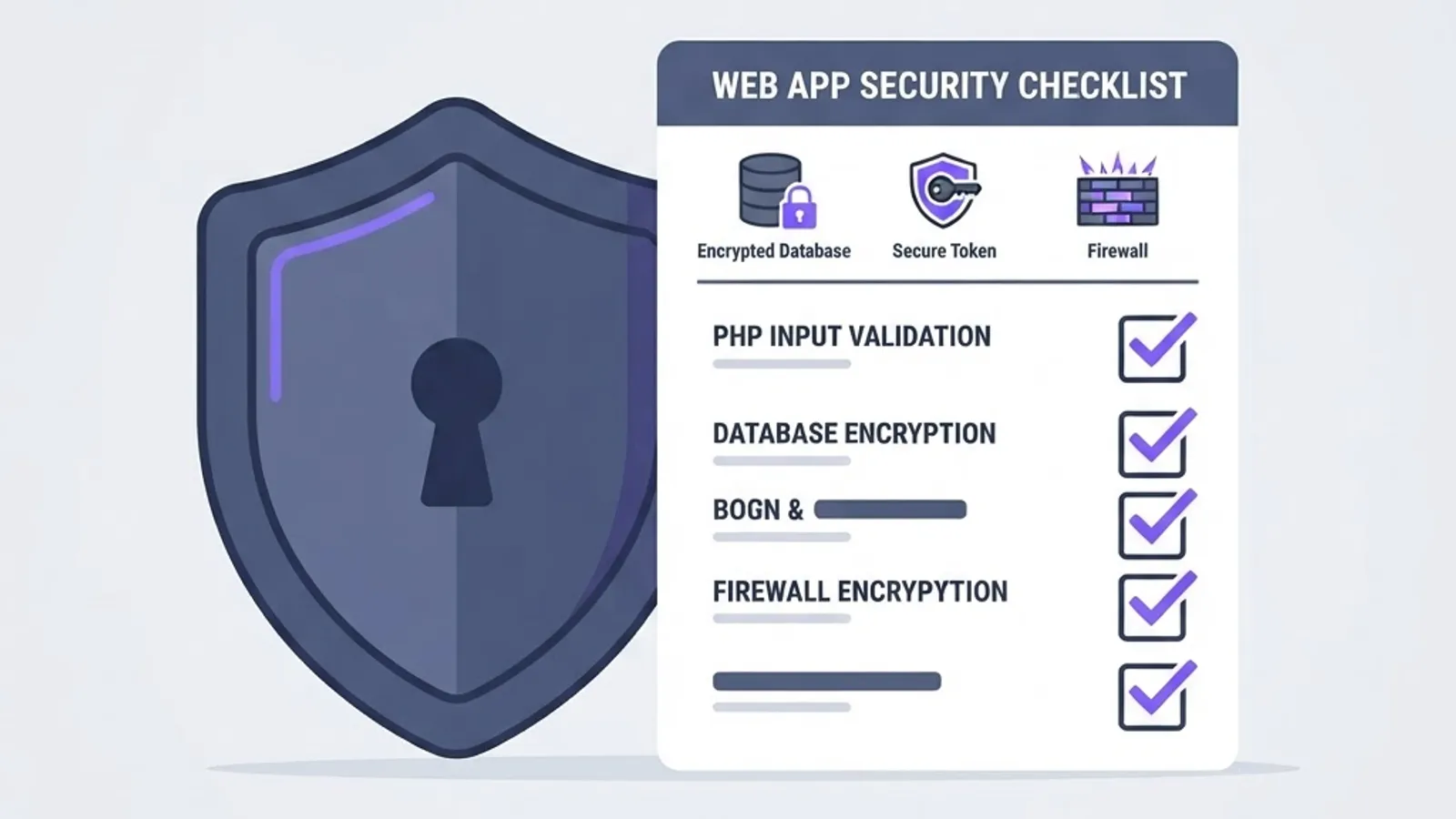
Ask your prospective PHP web application development company to confirm each of these in the proposal:
- Parameterized queries everywhere. No string-concatenated SQL, including in reporting and admin screens where it most often hides.
- Authorization checked server-side per action, not hidden in the UI. Hiding a button is not access control.
- Password hashing with PHP's native password_hash and Argon2 or bcrypt, never custom hashing.
- Output escaping by default in templates, with any raw output individually justified.
- CSRF protection on all state-changing requests, plus SameSite cookie attributes.
- File upload validation by MIME sniffing and extension allowlist, stored outside the web root.
- Dependency scanning in CI so a known vulnerable package fails the build instead of shipping.
- Rate limiting on authentication and password reset endpoints.
- Secrets in environment variables or a secret manager, never committed to the repository.
- Security headers set at the response level, including HSTS, nosniff, and a referrer policy.
A firm that cannot discuss these fluently in a 20 minute call will not implement them under deadline pressure.
Performance: Set a Budget, Not an Adjective
"Fast" is not a specification. A performance budget is. Insist on numeric targets in the contract: server response time at the 95th percentile of requests, maximum database queries per page, and a hard ceiling on payload size.
The highest-leverage optimizations in PHP applications are consistent and unglamorous:
- Eliminate N+1 queries. This single issue causes more slow PHP pages than every other cause combined. Eager loading fixes most of it.
- Enable OPcache with realistic memory settings and preloading where the framework supports it.
- Add database indexes based on actual slow query logs, not guesses.
- Cache expensive read models with explicit invalidation rules.
- Move slow work to queues so the user-facing request stays short.
- Use HTTP caching and a CDN for anything that does not vary per user.
Google's Core Web Vitals thresholds classify Largest Contentful Paint as good at 2.5 seconds or under, and server response time is a direct input to that figure. Server-side latency is therefore a ranking-adjacent concern, not just an engineering preference.
Engagement Models and What They Actually Cost You
Three models dominate, and each transfers risk differently.
| Model | Who absorbs scope risk | Best for | Main hazard |
|---|---|---|---|
| Fixed price | The agency | Well-defined, stable scope | Change requests become adversarial |
| Time and materials | The client | Evolving products, discovery work | Weak governance inflates hours |
| Dedicated team | Shared | Long roadmaps, ongoing product work | Paying for idle capacity |
My candid recommendation: run a small paid discovery phase first, priced fixed, producing an architecture document, a data model, and a prioritized backlog. You then choose the model with real information instead of an estimate built on assumptions. Teams like ZoneTechify structure engagements this way for custom web app development, and it consistently reduces the mid-project rescoping that wrecks budgets.
How to Vet a PHP Development Partner
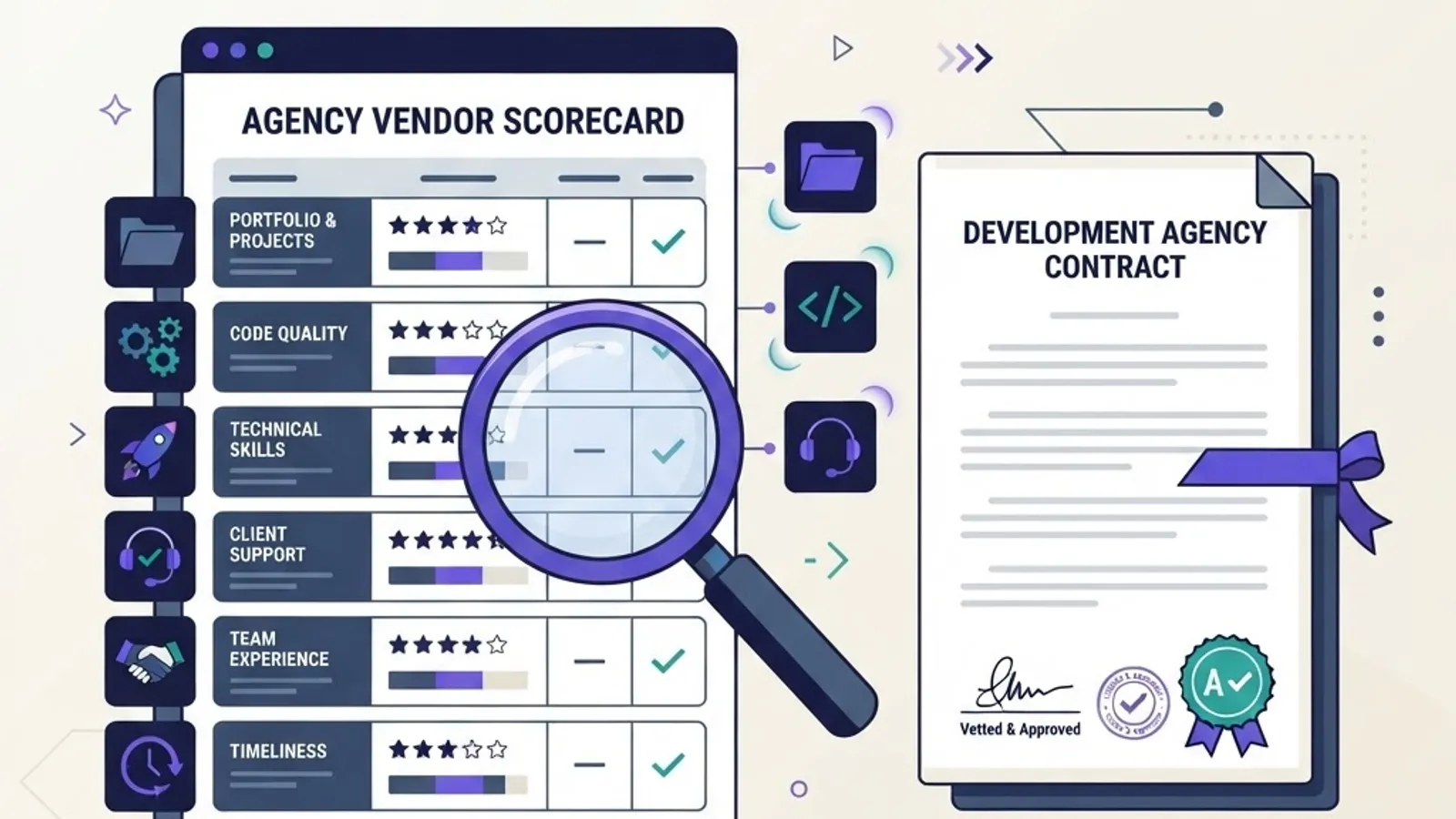
Ask for evidence, not claims:
- A real repository walkthrough on a project they own. Look at test coverage, commit hygiene, and whether controllers are thin.
- The PHP version and framework version of their last three launches. Anything on an unsupported PHP branch is a red flag about maintenance culture.
- Their incident story. How a production outage was detected, mitigated, and prevented. Detail here reveals operational maturity instantly.
- Who writes your code. Senior involvement quoted in the proposal must match who actually appears in standups.
- Handover terms. Repository ownership, credential transfer, and documentation obligations written into the contract, not promised verbally.
- Post-launch terms. Response times, patch cadence, and what counts as a bug versus a change.
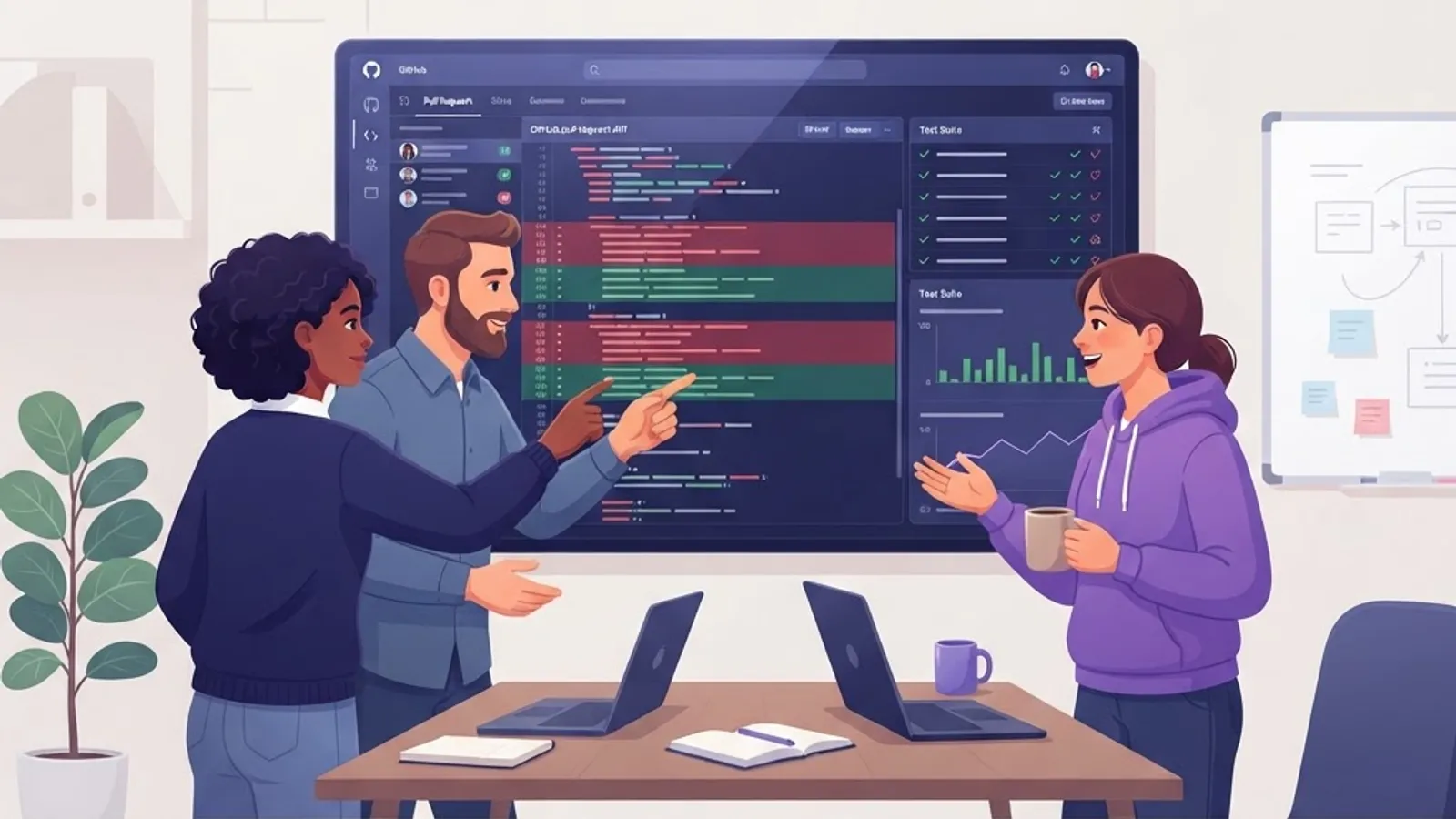
Team structure matters more than headcount. A four-person senior team with mandatory code review typically outperforms a twelve-person mixed team where juniors merge unreviewed work. When comparing vendors, ask what percentage of merged pull requests received a reviewing engineer's comments. Agencies with real review culture know the number. This is a common reason clients choose a smaller, senior-heavy web development company over a large generalist shop.
Common Failure Patterns to Avoid
- Building an admin panel from scratch when a framework's admin tooling covers 90 percent of the need.
- No staging environment, which turns every deploy into a live experiment.
- Logic duplicated between API and web controllers, guaranteeing divergent behavior within months.
- Unbounded exports and reports that work with 500 rows and time out at 50,000.
- Skipping seed data and factories, which makes testing edge cases so painful nobody does it.
Key Takeaways
- PHP powers approximately 74 percent of sites with a known server-side language, giving it the deepest hosting and hiring ecosystem of any backend option.
- PHP 8's JIT, OPcache, and preloading deliver large throughput gains over legacy versions, making performance a configuration and architecture question rather than a language limitation.
- Broken access control remains the most prevalent web application security risk in recent OWASP rankings, so server-side authorization checks per action are non-negotiable.
- Framework choice should follow domain complexity: Laravel for product speed, Symfony for long-lived enterprise domains, Slim for API-only services.
- N+1 queries are the most frequent cause of slow PHP pages, and eager loading resolves the majority of cases.
- Contract for a numeric performance budget, documented architecture, CI-enforced static analysis, and explicit handover terms.
Frequently Asked Questions (FAQ)
How much does it cost to hire a PHP web application development company?
Custom PHP applications typically range from a few thousand dollars for a narrow internal tool to six figures for multi-role platforms with integrations and compliance needs. Cost is driven by number of user roles, third-party integrations, and reporting complexity far more than by page count or visual design.
Is PHP still good for web application development?
Yes. PHP 8 offers strict typing, enums, JIT compilation, and mature frameworks, and it remains the most widely deployed server-side language on the web. The deciding factor is engineering discipline, not the language. Well-architected PHP applications scale to very high traffic on ordinary infrastructure.
Should I choose Laravel or Symfony for my project?
Choose Laravel when speed to market and developer availability matter most, such as SaaS products and admin-heavy tools. Choose Symfony when your domain is complex, the application will live for many years, and explicit, decoupled architecture reduces long-term maintenance risk. Both are production-grade choices.
How long does a PHP web application take to build?
A focused application with authentication, a few roles, and core workflows typically takes eight to sixteen weeks including discovery, build, testing, and deployment. Complex integrations, payment flows, or compliance requirements extend that. Any timeline quoted before a data model exists is a guess, not an estimate.
What should be included in a PHP development contract?
Insist on repository ownership, a documented architecture deliverable, automated test coverage expectations, a numeric performance budget, security requirements, credential handover, and a defined post-launch support window with response times. Also define clearly what counts as a bug fix versus a paid change request.
Can a PHP company modernize my existing legacy application?
Yes, and incremental modernization usually beats a rewrite. A strong team adds tests around current behavior, upgrades the PHP version, introduces static analysis, then extracts business logic module by module. This keeps the application shipping while risk is reduced, rather than freezing features for a year.