
A practical breakdown of what a Financial Recovery Technologies software engineer actually builds, the stack and data problems involved, and how to prepare for the role.
Financial Recovery Technologies Software Engineer
Financial Recovery Technologies (FRT) sits in an unusual corner of fintech: it helps institutional investors identify, file, and collect money from securities class action settlements, antitrust recoveries, and global opt-in litigation. That means the software engineers there are not building trading engines or consumer wallets. They are building data reconciliation systems that decide whether a pension fund recovers money it is legally owed. This article explains what that engineering work actually looks like, which skills matter most, and how to prepare for the role if you are targeting it.

Quick Answer: A Financial Recovery Technologies software engineer builds data-heavy systems that ingest institutional trade files, match them against securities class action and antitrust settlements, calculate eligible claims, and automate filing. The role blends backend engineering, SQL and data modeling, financial domain logic, and strict accuracy and audit requirements over flashy frontend work.
What Financial Recovery Technologies Actually Does
FRT operates in the shareholder claims recovery market. When a company settles a securities class action, eligible investors can file claims for their share of the settlement fund, but the money is only paid if a valid, documented claim is submitted before the deadline. FRT automates that process for asset managers, custodians, hedge funds, and pension plans.
Two facts define the market this software serves. First, US securities class action settlements have routinely totaled several billion dollars per year across dozens of resolved cases, according to annual settlement reviews published by NERA Economic Consulting and Cornerstone Research. Second, industry research on unclaimed settlement funds has repeatedly found that a large share of eligible institutional investors never file at all, largely because tracking eligibility across thousands of holdings and hundreds of active cases is operationally impossible by hand. That gap between eligible money and claimed money is the entire product thesis, and it is a software problem.
Why This Is an Engineering Problem, Not a Paperwork Problem
Eligibility depends on the exact securities held, purchase and sale dates, quantities, prices, and the class period defined by a court order. A single institutional client may send millions of transaction rows per month across multiple custodians, formats, and currencies. Determining a claim requires replaying trade history against a legal definition, applying a court-approved loss calculation formula, and producing an auditable output. Engineers own every layer of that.
The Core Systems a Financial Recovery Engineer Builds
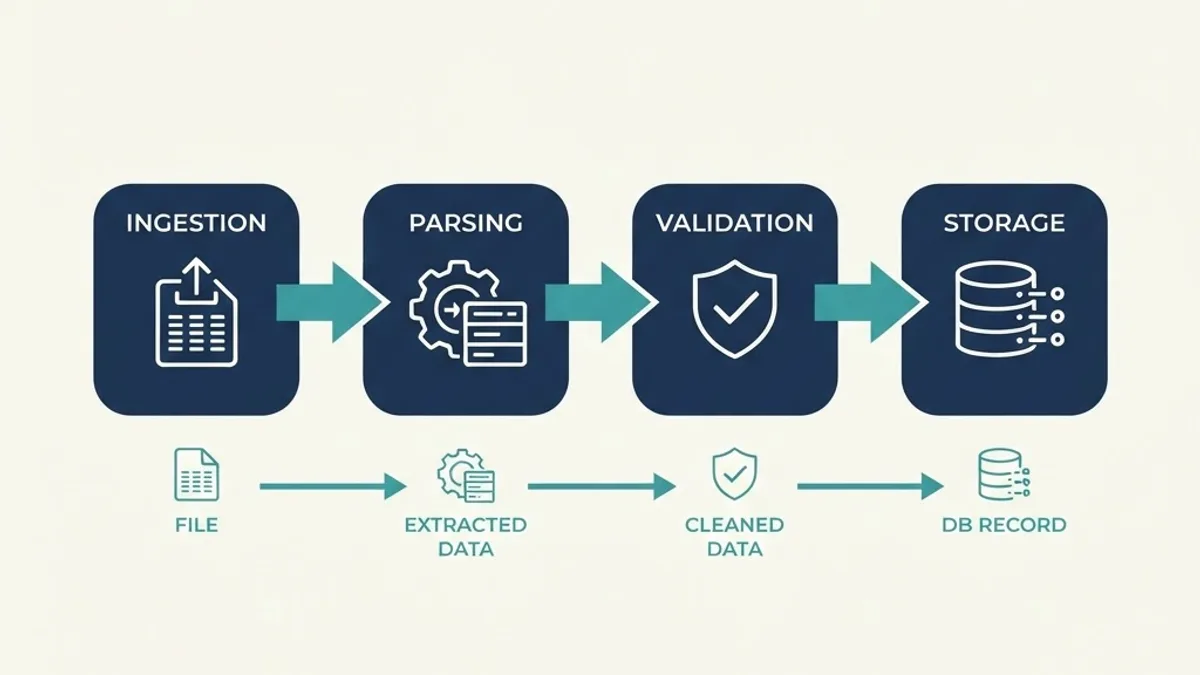
The day-to-day work clusters into five system areas. Understanding these gives you a realistic picture of the role.
- Ingestion and normalization. Parsers that accept custodian files, broker statements, and API feeds in inconsistent formats and map them into a canonical transaction schema.
- Security master and identifier resolution. Logic that reconciles CUSIP, ISIN, SEDOL, and ticker changes across corporate actions so a holding is still recognized after a merger, split, or symbol change.
- Case and eligibility engine. Rules-driven matching of client positions against class periods, damaged security lists, and settlement terms.
- Loss and allocation calculation. Implementation of court-approved plans of allocation, including FIFO or LIFO matching, holding-period rules, and statutory limits.
- Filing, tracking, and reporting. Automated claim package generation, deficiency response handling, and dashboards that show clients filed, pending, and distributed amounts.
The Hidden Difficulty: Correctness Has a Dollar Value
In most SaaS products, a bug degrades experience. Here, a rounding error or a missed corporate action silently reduces a client's recovery or triggers a claims administrator deficiency notice. That changes engineering culture in three concrete ways: test suites are built around known-answer fixtures from historical cases, calculation changes are versioned so past filings remain reproducible, and data lineage is treated as a first-class feature rather than an afterthought. If you interview for this role, saying you would add a reconciliation report and an immutable audit log before shipping a calculation change signals that you understand the domain.
The Technical Stack You Should Expect
Claims recovery platforms in this segment are typically built on mature, transaction-safe technology rather than experimental tooling. Expect a relational core, batch and streaming pipelines, and a services layer exposing data to internal analysts and client portals.
| Layer | Common Choices | Why It Matters Here |
|---|---|---|
| Data store | PostgreSQL, SQL Server, Snowflake | ACID guarantees and complex set-based eligibility queries |
| Backend services | Java, C#, Python, Node.js | Long-running batch jobs plus API endpoints for portals |
| Pipelines | Airflow, dbt, custom schedulers | Repeatable, retryable, observable nightly processing |
| Frontend | React or Angular with TypeScript | Analyst tooling and client-facing recovery dashboards |
| Infrastructure | AWS or Azure, containers, CI/CD | Auditable deployments and environment parity |
| Security | Encryption at rest, RBAC, SOC 2 controls | Clients transmit confidential position data |
The most valuable single skill on this list is advanced SQL. Engineers who can write and reason about window functions, recursive CTEs, and query plans over hundreds of millions of rows are disproportionately effective, because eligibility and loss calculations are naturally set-based operations.
Skills That Separate Strong Candidates

- Data modeling under changing rules. Court-approved allocation plans differ case by case. Model rules as configurable data, not hardcoded branches.
- Financial domain literacy. Know what a class period, plan of allocation, corporate action, and settlement administrator are. You do not need a CFA, but vocabulary fluency accelerates every requirements conversation.
- Precision arithmetic. Use fixed-point or decimal types for monetary math. Floating point in a loss calculation is a defect waiting to be discovered by an administrator.
- Idempotent batch design. Reruns must not duplicate claims. Design jobs so a partial failure is safe to replay.
- Testing with real-world fixtures. Golden datasets from resolved cases catch regressions that synthetic tests miss.
- Clear written communication. Legal, operations, and client service teams depend on engineers to explain why a position was or was not eligible.
Teams that build this kind of accuracy-critical infrastructure often pair in-house domain experts with specialist partners for platform work, which is why firms increasingly engage an AI-augmented development team when they need to modernize legacy claims tooling without pausing quarterly filing cycles.
Where Automation and AI Genuinely Help
The realistic wins are not in generating legal conclusions. They are in classification and extraction: identifying document types in incoming custodian mail, extracting fields from settlement notices and deficiency letters, flagging anomalous transaction batches, and prioritizing which unmatched positions an analyst should review first. Each of these keeps a human decision-maker in the loop while removing hours of manual triage. Teams exploring that path typically start with a narrow, measurable task and a confidence threshold, which is the same discipline recommended by practitioners offering AI automation services for regulated data workflows.

How the Interview Process Typically Works

Most fintech firms in this space run a four-stage loop. Prepare for each stage differently.
- Recruiter screen. Expect questions about your comfort with financial data and regulated environments. Have one specific story about handling data you could not afford to get wrong.
- Technical screen. Coding plus SQL. Practice joins with date-range conditions, deduplication, and aggregation with tie-breaking rules.
- System design. A likely prompt is designing a pipeline that ingests daily transaction files from many clients and produces eligible claims per case. Address schema, idempotency, reconciliation, and failure recovery explicitly.
- Domain and behavioral round. You will be asked how you handle ambiguous requirements from non-technical stakeholders. Describe how you convert legal language into testable rules.
A practical preparation tip: read one publicly available plan of allocation from a resolved securities settlement and try to express its loss calculation as pseudocode. Candidates who have done this exercise interview noticeably better because they have already met the real complexity.
Compensation and Career Path

Compensation follows regional fintech backend engineering benchmarks rather than a separate scale. In the greater Boston market where FRT is headquartered, US Bureau of Labor Statistics occupational data consistently places software developer wages well above the national all-occupations median, and specialized financial data engineering roles typically sit at the upper end of general software bands because domain knowledge is scarce.
The career path has an unusual advantage: domain expertise compounds. An engineer who deeply understands securities claims data becomes valuable across custody, fund administration, regulatory reporting, and litigation analytics. Common progressions include senior engineer to technical lead on the calculation engine, a move into data platform architecture, or a pivot into product ownership where legal and engineering knowledge intersect.
Key Takeaways
- A Financial Recovery Technologies software engineer builds data reconciliation and claims automation systems, not consumer fintech features.
- US securities class action settlements have totaled billions of dollars annually across dozens of cases, per NERA and Cornerstone Research reviews, and a significant share of eligible institutional money historically goes unclaimed.
- Advanced SQL, precise decimal arithmetic, idempotent batch pipelines, and auditable data lineage are the highest-leverage skills.
- Eligibility rules should be modeled as configurable data because every court-approved plan of allocation differs.
- AI adds the most value in document classification, field extraction, and anomaly triage, with human review retained.
- Domain expertise in claims data transfers well to custody, fund administration, and regulatory reporting roles.
Frequently Asked Questions (FAQ)
What does a software engineer at Financial Recovery Technologies do?
They build and maintain the systems that ingest institutional trade data, resolve security identifiers, match holdings against securities class action and antitrust settlements, calculate eligible losses under court-approved allocation plans, and automate claim filing and tracking with full audit trails for client reporting.
What programming languages should I learn for a financial recovery engineering role?
Focus on one strong backend language such as Java, C#, or Python, plus genuinely advanced SQL. Add TypeScript with React if you want to work on analyst tools or client dashboards. SQL depth matters more than language breadth because eligibility and loss logic is set-based.
Do I need finance experience to get hired in claims recovery software?
No, finance experience is not usually required, but vocabulary fluency helps enormously. Learn what class periods, plans of allocation, corporate actions, CUSIPs, and settlement administrators are. Candidates who can translate legal settlement language into testable engineering rules stand out immediately in interviews.
Is securities claims recovery software a good long-term career move?
Yes, because the domain knowledge compounds and transfers. Engineers who understand institutional position data and reconciliation move easily into custody platforms, fund administration, regulatory reporting, and litigation analytics. The work is also deadline-driven and measurable, which makes impact easy to demonstrate.
How is AI actually used in financial recovery technology?
AI is used for narrow, verifiable tasks: classifying incoming settlement and deficiency documents, extracting structured fields from notices, detecting anomalous transaction batches, and ranking unmatched positions for analyst review. Legal eligibility conclusions remain rules-based and human-reviewed because filings must be defensible and reproducible.
What is the hardest technical challenge in this domain?
Maintaining reproducibility. A claim filed two years ago must still be explainable under the calculation logic and reference data that existed at filing time. That requires versioned rules, immutable transaction snapshots, and lineage tracking, which is significantly harder than simply computing the correct number once.