A practical breakdown of Oura senior software engineer interview questions, covering the full loop, coding rounds, system design for wearable health data, and behavioral signals.
Oura Senior Software Engineer Interview Questions
Oura hires senior engineers to work on a product where a single bad data decision reaches the wrist of millions of people every night. That reality shapes the entire interview. Instead of testing whether you can invert a binary tree under time pressure, the loop tests whether you can reason about noisy sensor data, privacy-sensitive health records, battery-constrained firmware, and the trade-offs that connect all three. This guide breaks down the questions senior candidates actually face, why each round exists, and how to answer in a way that reads as senior rather than merely competent.
Quick Answer: Oura senior software engineer interviews combine a recruiter screen, a hiring manager conversation, one or two coding or take-home rounds, a system design round focused on wearable health data pipelines, and behavioral interviews on ownership and cross-team influence. Expect questions about data accuracy, privacy, offline sync, and scaling time-series workloads.
What Oura Actually Screens For at the Senior Level
Senior interviews at health-hardware companies grade judgment, not recall. Oura sells a ring that collects continuous biometric signals, syncs them over Bluetooth Low Energy, and turns them into Sleep, Readiness, and Activity scores. Every engineering role touches at least one of those constraints, so interviewers listen for three specific signals.
The first is data honesty. Can you tell the difference between a signal and an artifact, and do you design for the case where the sensor lies? The second is constraint awareness. A cloud engineer who ignores that the device has a multi-day battery budget will propose sync strategies that never ship. The third is scope negotiation. Senior engineers are expected to cut features, not just build them.
Context worth citing: the global wearables market shipped roughly 500 million devices in a single recent year according to IDC tracker data, and Oura has publicly stated it has sold more than 2.5 million rings. Those two numbers explain the interview emphasis. You are not designing for a prototype. You are designing for millions of always-on devices producing continuous time-series data that users treat as medical-grade truth.
Definition: Wearable Time-Series Pipeline
A wearable time-series pipeline is the end-to-end path a biometric sample travels: sensor sampling on device, on-device compression and buffering, opportunistic sync to a phone, upload to a cloud ingestion layer, enrichment and scoring, then storage and API exposure. Most senior design questions at Oura are variations on one segment of this path.
Round 1: Recruiter and Hiring Manager Screens
These two calls decide whether you reach the technical loop, and most candidates underprepare them. Expect questions that map your experience directly to Oura's problem space.
- Walk me through a system you owned end to end. What did you personally decide?
- Tell me about a time your data was wrong in production. How did you find out?
- Why health hardware instead of pure SaaS?
- What is your experience with mobile, embedded, or streaming systems?
- How do you work with data scientists or research teams?
Answer with numbers and ownership boundaries. "I reduced ingestion lag from 40 minutes to under 3 minutes by moving from hourly batch jobs to a streaming consumer, which cut support tickets about missing nights by roughly half" outperforms any adjective-heavy summary. Senior screens are calibration exercises, and specificity is the calibration currency.
Round 2: Coding and Take-Home Rounds
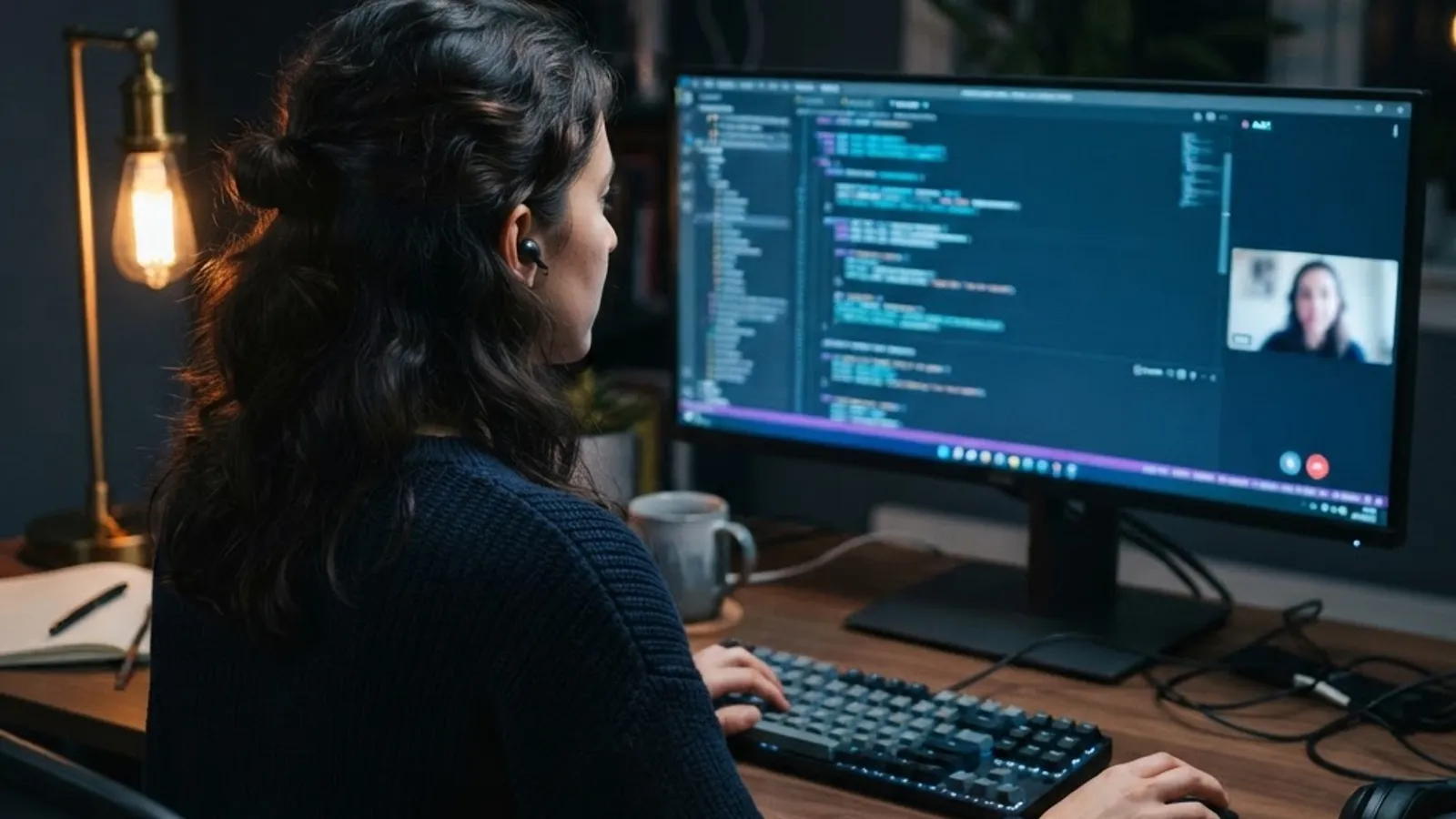
Oura's coding rounds skew practical. Rather than competitive-programming puzzles, candidates report problems that resemble real product work: parsing sensor streams, reconciling duplicate records, or building a small service with tests. Common patterns include the following.
- Sliding window over a signal. Compute a rolling average or detect sustained threshold crossings in a heart-rate series, then handle gaps where samples are missing.
- Interval merging. Given raw sleep-stage intervals with overlaps from two sensors, produce a single non-overlapping timeline.
- Deduplication with idempotency. The device re-sends a block after a failed sync. Write ingestion logic that is safe to run twice.
- Rate-limited client. Implement a retry and backoff wrapper around a flaky upload endpoint.
- Small API with tests. Build a two-endpoint service, then explain what you would test and what you would leave untested and why.
The senior differentiator is how you treat edge cases out loud. Say the timezone problem before the interviewer does. Sleep data crosses midnight, users fly across time zones, and daylight saving shifts break naive date bucketing. Naming those failure modes early is the single fastest way to signal seniority in a coding round.
If you write the take-home, keep it boring and readable. Add a short README that states assumptions, what you skipped, and what you would do with two more days. Reviewers consistently reward that document more than clever abstractions.
Round 3: System Design for Wearable Health Data
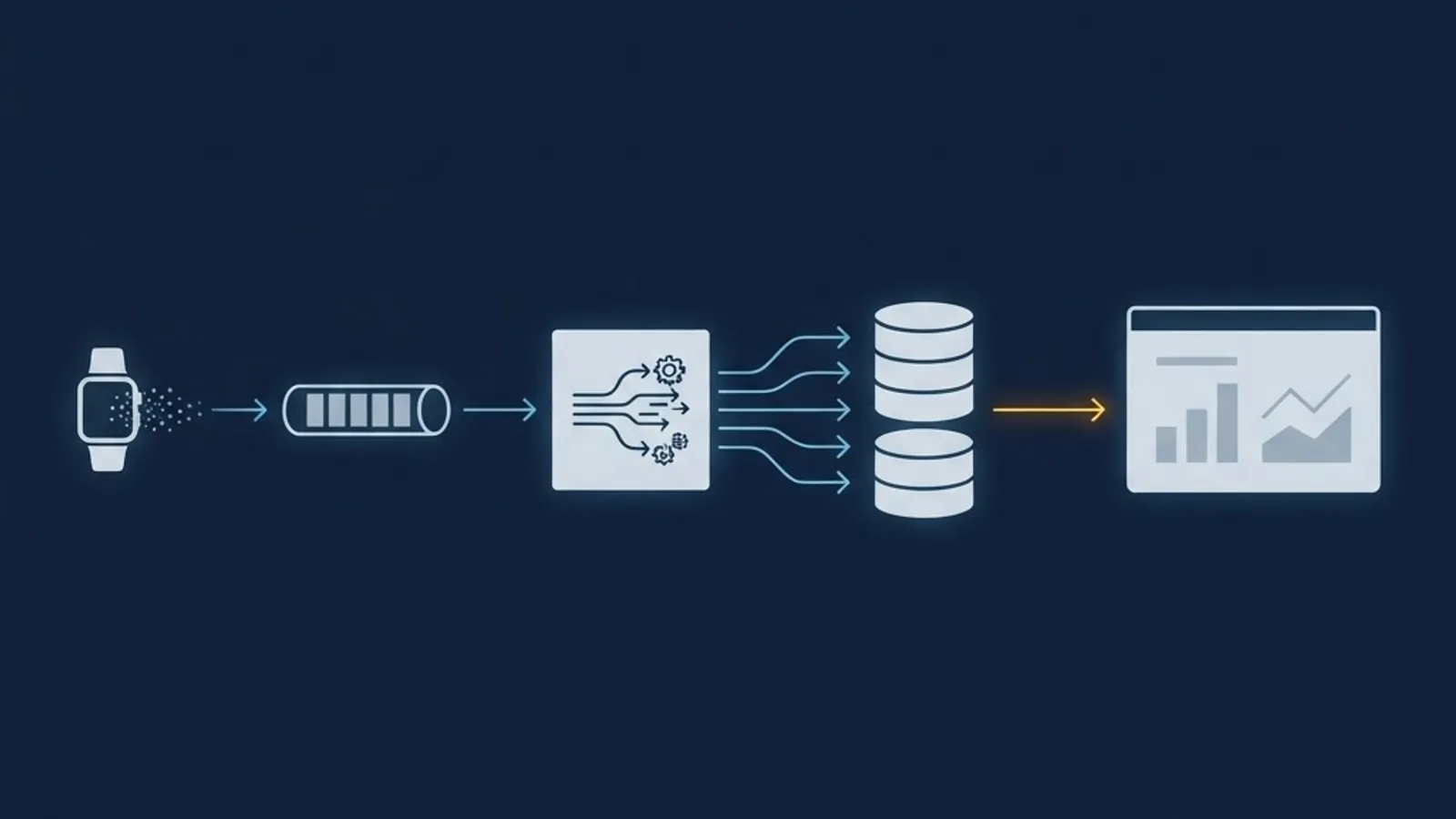
This is the round that decides the level. Expect an open prompt such as "Design the pipeline that takes overnight ring data and produces a Sleep score by the time the user wakes up." Strong answers move through five layers deliberately.
Ingestion. Devices sync in bursts, usually clustered in the morning. Design for a spiky write pattern with a queue or log in front of processing rather than direct database writes. State your expected volume out loud, even if you estimate it.
Storage. Distinguish raw samples from derived metrics. Raw high-frequency data belongs in cheap columnar or time-series storage with retention policies. Derived nightly scores are small, queried constantly, and belong in a transactional store.
Processing. Nightly scoring is a batch-shaped problem with a soft deadline. Say the deadline explicitly, then design backpressure and reprocessing for the case where an algorithm version changes and historical scores must be recomputed.
Correctness and privacy. Health data invites regulatory scope. Mention encryption at rest and in transit, field-level access control, data minimization in logs, deletion pipelines that actually reach every store, and regional residency if users span the EU. Candidates who never mention deletion lose points, because deletion is the hardest engineering problem in any health data platform.
Client sync. Bluetooth Low Energy connections drop constantly. Discuss chunked transfer, resumable offsets, on-device buffering when the phone is absent, and conflict resolution when the same block arrives twice.
Comparison: Design Trade-Offs Interviewers Probe
| Decision | Option A | Option B | What Interviewers Want to Hear |
|---|---|---|---|
| Score computation | Compute on device | Compute in cloud | Battery and update cadence trade-off, plus how you ship algorithm fixes |
| Raw data retention | Keep everything | Downsample after 90 days | Cost per user per year and which research use cases break |
| Sync trigger | Continuous streaming | Opportunistic batch | Power budget and acceptable freshness window |
| Schema evolution | Strict versioned schemas | Flexible documents | Migration strategy for years of historical records |
| Reprocessing | Recompute all history | Recompute on read | User-visible score changes and trust implications |
Name the trade-off, pick a side, and state the condition that would change your mind. That last part is what separates a senior answer from a staff-level one.
Round 4: Embedded, Mobile, and Platform Specific Questions
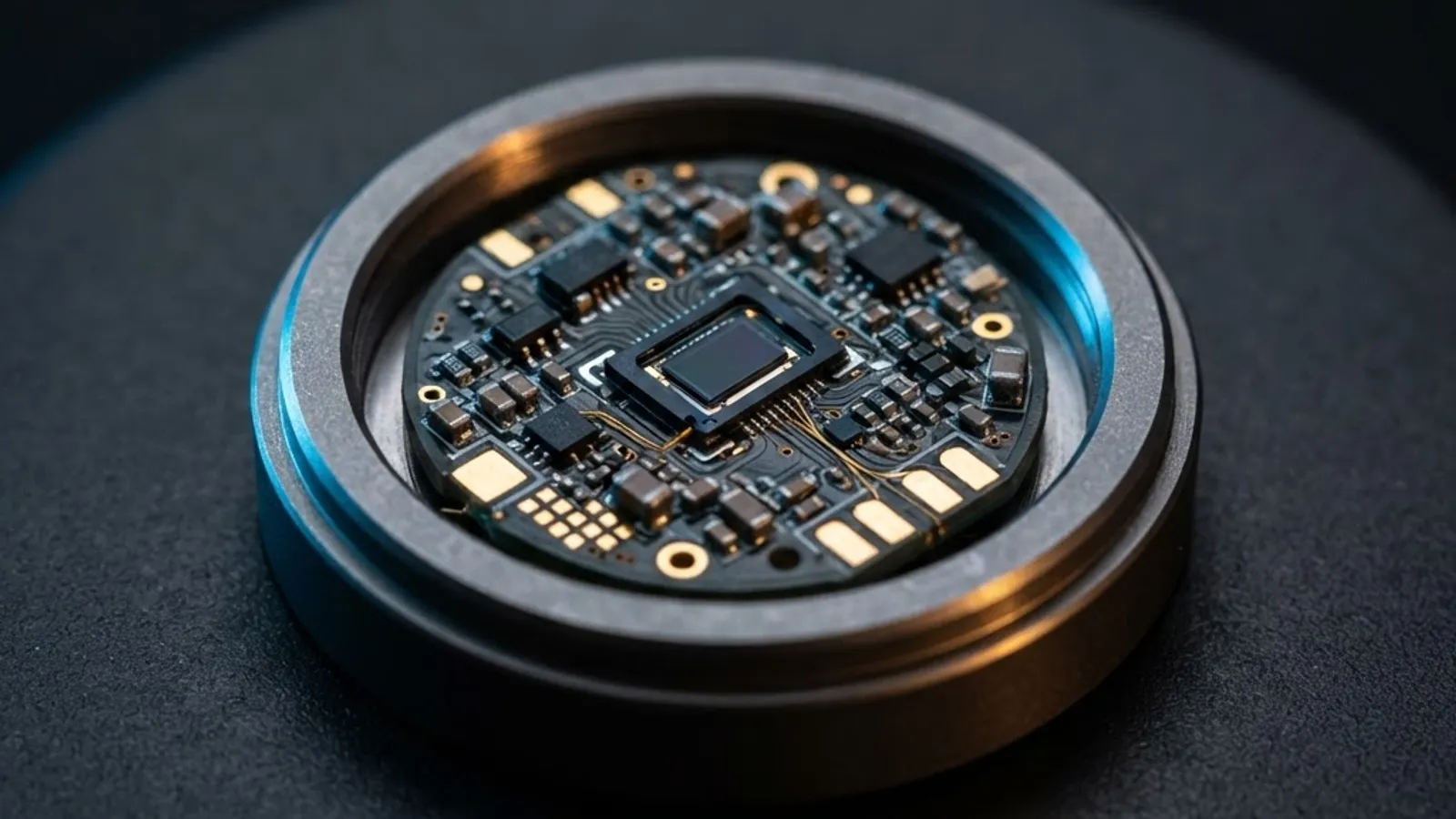
Depending on the team, one round goes deep on your specialty.
Firmware and embedded. How do you debug a memory leak on a device with kilobytes of RAM? How do you design an over-the-air update that cannot brick the ring? How do you validate a sensor driver when ground truth requires lab equipment? Expect discussion of watchdogs, dual-bank firmware images, and rollback paths.
Mobile. How does the app behave when the ring has 30 hours of unsynced data and the user is on cellular? How do you keep a background sync alive within iOS and Android background execution limits? How do you handle a schema change while old app versions remain in the wild for months?
Backend and data. How do you version a scoring algorithm without rewriting user history? How do you build an experimentation framework when the outcome metric is measured during sleep and cannot be measured on demand?
Teams building this class of product usually pair specialists with generalists, which is exactly how an experienced AI-augmented development team structures delivery: platform engineers own the pipeline contract while product engineers iterate on top of stable interfaces. If your background is agency or consulting work, frame it that way rather than apologizing for breadth.
Round 5: Behavioral and Cross-Functional Interviews

Behavioral rounds at Oura probe collaboration with research, data science, hardware, and design. Prepare structured stories for these.
- Describe a disagreement with a data scientist or researcher. How did it resolve?
- Tell me about a feature you argued against shipping.
- When did you discover a correctness bug that had been silently wrong for months?
- How do you mentor engineers who are stronger than you in one area?
- Describe a deadline you missed and what you changed afterward.
Use a compact structure: situation in one sentence, your specific decision, the measurable result, and the lesson you now apply by default. Two minutes per story. Senior interviewers are checking whether you can compress complexity, because that is the same skill you will need in design reviews.
One original observation from reviewing hundreds of senior loops: candidates who fail behavioral rounds usually fail on attribution, not content. They say "we decided" for every choice. Interviewers cannot calibrate a team. Use "I" for your decisions and "we" for outcomes.
A Four Week Preparation Plan That Actually Works
- Week 1: rebuild fundamentals in context. Solve 15 to 20 problems, all involving arrays, intervals, hashing, and streaming windows. Skip exotic graph theory.
- Week 2: design the product you are interviewing for. Write a two-page design for the overnight scoring pipeline. Include capacity estimates, retention policy, and a deletion flow.
- Week 3: write your story bank. Six stories, each under two minutes, each with a number in it. Record yourself once and cut every sentence that does not carry information.
- Week 4: run two mock interviews and use the product. Wear a tracker, read the published methodology on how scores are computed, and form an opinion about one thing you would change.
That last step is the highest-leverage hour of the whole month. Arriving with a specific product critique converts an interview into a peer conversation. Teams that build measurement-heavy products, including WebPeak, consistently rate candidates higher when those candidates argue from evidence rather than enthusiasm.
Compensation, Leveling, and the Offer Stage

Senior offers at health-tech companies typically arrive as base salary plus equity, and the leveling decision is made during the loop rather than after it. Two practical moves matter. First, ask the hiring manager directly which level the loop is calibrated for, early enough that you can adjust the depth of your answers. Second, ask what the on-call surface looks like, because a firmware or ingestion team carries different pager risk than an internal tools team.
When you receive numbers, ask for the equity structure in plain terms: total units, vesting schedule, current preferred price, and refresh policy. Negotiating without those four facts is guesswork.
Key Takeaways
- Oura senior loops emphasize judgment about noisy sensor data, privacy, and battery constraints over algorithm trivia.
- The system design round centers on the wearable time-series pipeline: ingestion, storage, processing, privacy, and sync.
- Deletion, timezone handling, and idempotent re-sync are the three most commonly missed topics.
- Coding rounds favor practical problems such as interval merging, rolling windows, and safe retries.
- Behavioral rounds are graded on clear attribution and compressed storytelling with measurable outcomes.
- Wearables ship at scale, with roughly 500 million devices annually across the category and more than 2.5 million Oura rings sold, which is why interviewers care about cost per user and data trust.
Frequently Asked Questions (FAQ)
How hard is the Oura senior software engineer interview?
It is moderately hard but rarely brutal. The coding bar is practical rather than competitive, and the real difficulty sits in the system design round, where interviewers expect you to reason about sensor noise, privacy, retention cost, and battery constraints without being prompted for each one.
How many interview rounds does Oura have for senior engineers?
Most senior candidates report four to six stages: a recruiter screen, a hiring manager call, one or two technical rounds that may include a take-home, a system design interview, and a behavioral or cross-functional round. Team-specific deep dives on firmware or mobile can add one additional conversation.
What coding languages should I use in an Oura interview?
Use the language you write fastest and most correctly. Python, Kotlin, Swift, Go, and C or C plus plus all appear depending on the team. For embedded roles, being fluent in C and comfortable discussing memory constraints matters far more than which high-level language you prefer.
Does Oura ask LeetCode style questions?
Rarely in the hardest tiers. Expect medium difficulty problems shaped like real product work: merging overlapping intervals, computing rolling metrics over a time series, deduplicating resent data blocks, or wrapping a flaky upload in retries. Practice edge cases around missing samples and timezone boundaries.
What should I ask my Oura interviewer at the end?
Ask about on-call surface area, how algorithm changes reach historical user data, how engineering works with research teams, and what the level calibration for this loop is. These questions demonstrate senior thinking and give you the information you need to evaluate the offer accurately.
How do I prepare for the system design round specifically?
Write a full design for overnight biometric scoring before the interview. Cover ingestion spikes, raw versus derived storage, retention and cost per user, deletion across every store, algorithm versioning, and Bluetooth sync failure modes. Rehearsing that one design covers most likely prompts.