How the Neuro-CareAxis partnership uses artificial intelligence to advance spine health research, from smarter imaging and predictive analytics to safer surgical planning.
Neuro-CareAxis Partnership Artificial Intelligence Spine Health Research
The Neuro-CareAxis partnership reflects a defining trend in modern medicine: pairing deep clinical neurological expertise with data-driven artificial intelligence to solve stubborn problems in spine health. Spinal disorders are among the most common and costly conditions in the world, yet progress has long been slowed by fragmented patient data, subjective imaging interpretation, and research cycles that can take years. A focused collaboration that fuses neuroscience with machine learning is designed to shorten that gap.
In this article, we break down what a partnership like Neuro-CareAxis means for patients, clinicians, and researchers. We look at how artificial intelligence is applied across the entire spine care journey, what the current evidence actually shows, and where the ethical guardrails must sit. Whether you are a healthcare leader, a technologist, or a patient trying to understand where spine medicine is heading, you should leave with a clear, practical picture.
Quick Answer: The Neuro-CareAxis partnership applies artificial intelligence to spine health research, using machine learning to analyze medical imaging, predict patient outcomes, and support surgical planning. The aim is faster diagnosis, more personalized treatment, and stronger clinical evidence for spinal conditions such as disc degeneration, stenosis, and scoliosis.
What the Neuro-CareAxis Partnership Actually Does
At its core, a partnership of this kind unites two halves of a difficult equation. One side brings clinical and neurological expertise: surgeons, radiologists, and researchers who understand spinal anatomy, pathology, and real patient outcomes. The other side brings the engineering muscle needed to build, validate, and deploy AI models on medical data at scale.
The collaboration typically focuses on three research pillars: building large, well-labeled datasets of spinal imaging and clinical records; training machine learning models that can detect and grade spinal conditions; and running clinical validation studies to prove those models are safe and reliable. Crucially, the work is people-first. AI is treated as a decision-support tool for clinicians, not a replacement for medical judgment. Organizations such as ZoneTechify and WebPeak champion the same principle in applied technology: intelligent systems should amplify human expertise, not obscure it.

Why Spine Health Needs Artificial Intelligence Now
Spine care is uniquely suited to AI because it is data-rich, image-heavy, and outcome-sensitive. Small differences in how an MRI or CT scan is read can change a treatment plan entirely, and demand for imaging far outpaces the supply of specialist readers.
The Scale of the Spine Health Problem
The need is enormous. According to the World Health Organization, low back pain is the single leading cause of disability worldwide, affecting an estimated 619 million people in 2020, with that figure projected to rise to roughly 843 million by 2050. On the technology side, Grand View Research valued the global AI-in-healthcare market at over 22 billion US dollars in 2023, with a projected compound annual growth rate above 36 percent through 2030. When a disease burden that large meets a technology adoption curve that steep, focused research partnerships become the fastest route from lab to bedside.
Definition: Spine health AI refers to machine learning systems trained on spinal imaging and clinical data to assist with detecting, grading, and managing conditions of the vertebrae, discs, and surrounding neural structures.
How AI Is Applied Across the Spine Care Journey
Artificial intelligence is not a single feature bolted onto spine care. It appears at every stage, from the first scan to long-term follow-up. The table below compares traditional workflows with AI-assisted ones.
| Stage | Traditional Approach | AI-Assisted Approach |
|---|---|---|
| Imaging review | Manual, reader-dependent | Automated detection and measurement |
| Diagnosis | Subjective grading | Consistent, quantified grading |
| Treatment planning | Experience-based | Data plus outcome models |
| Surgical prep | Static 2D images | 3D models with guidance overlays |
| Follow-up | Periodic check-ins | Continuous risk monitoring |
Each row represents a measurable efficiency gain, but the deeper value is consistency. AI reduces the variation between a busy Monday and a quiet Friday, or between a senior specialist and a first-year resident.
Machine Learning and Medical Imaging
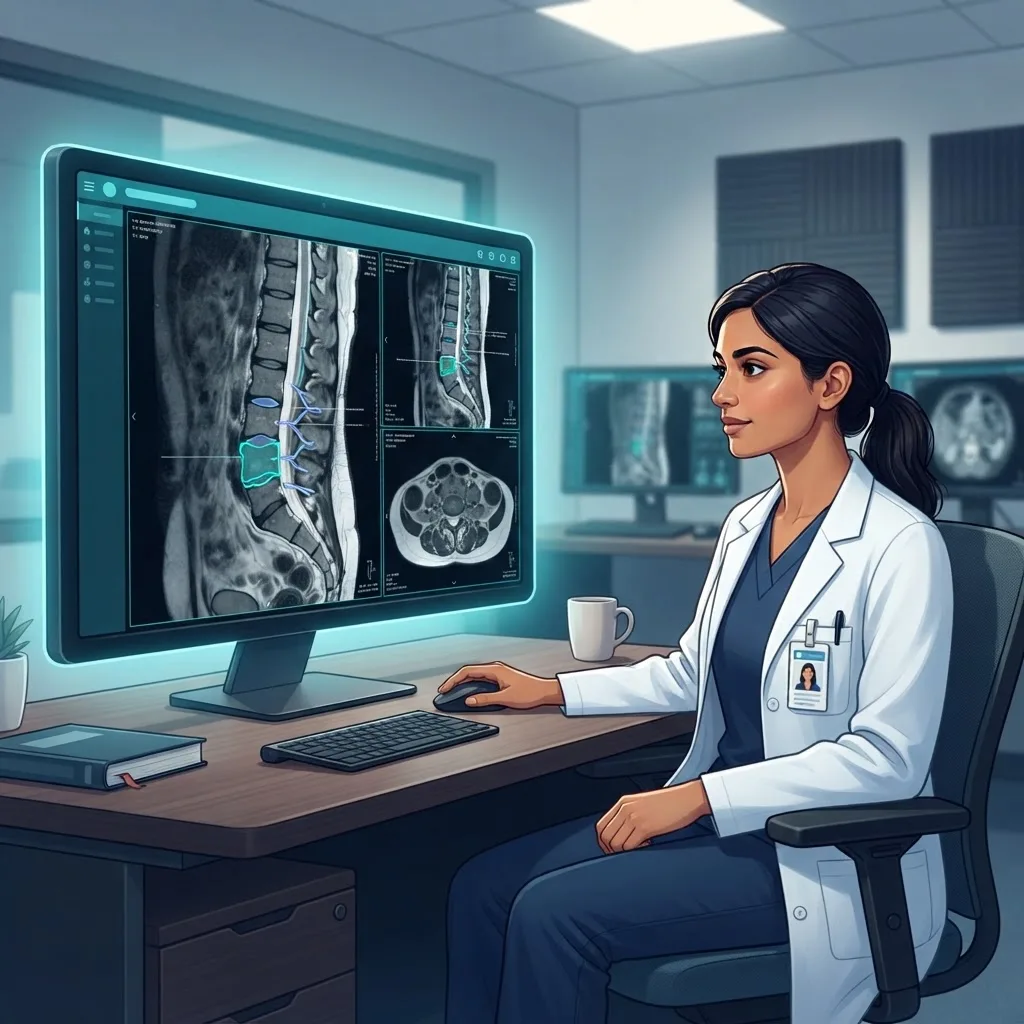
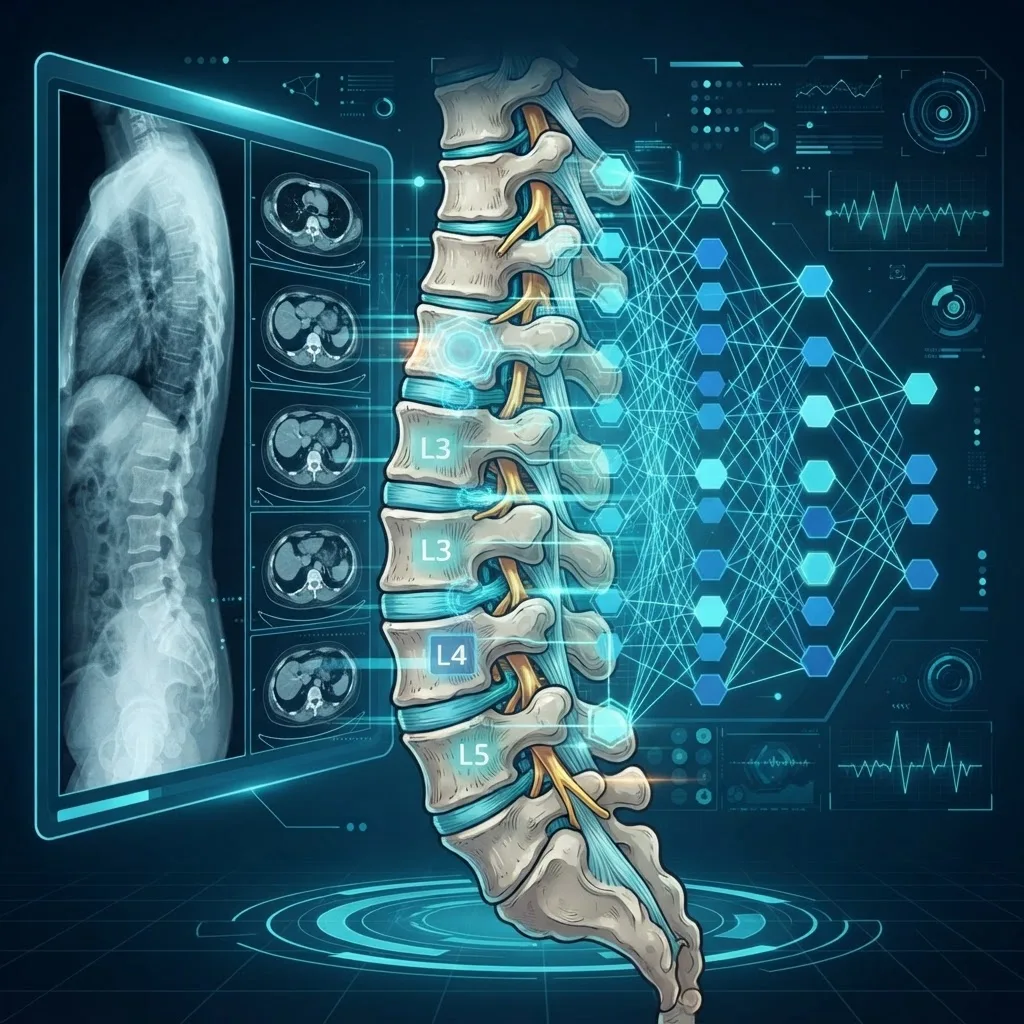
Medical imaging is where AI delivers its most immediate impact in spine research. Deep learning models can segment vertebrae, measure disc height, flag stenosis, and grade degeneration in seconds, tasks that are time-consuming and inconsistent when done by hand.
Peer-reviewed studies have repeatedly shown that convolutional neural networks can match or approach specialist-level accuracy for specific spinal findings on MRI and X-ray, often exceeding 90 percent agreement with expert consensus on well-curated datasets. The Neuro-CareAxis approach treats these numbers with healthy skepticism: a model that performs well on one hospital's scanner may falter on another's. That is why external validation across multiple sites is a research priority, not an afterthought.
Predictive Analytics for Better Outcomes
Beyond reading images, AI helps answer the harder question every patient asks: what happens next? Predictive analytics combines imaging findings with clinical history, age, comorbidities, and lifestyle factors to estimate outcomes.
These models can flag which patients are likely to benefit from conservative treatment versus surgery, who is at higher risk of complications, and how recovery is likely to progress. The practical benefit is shared decision-making. Instead of a one-size-fits-all recommendation, clinicians can show a patient a personalized risk profile grounded in data from thousands of comparable cases. This transparency is central to trust, and it is where AI moves from novelty to genuine clinical value.

AI-Assisted Surgical Planning
Spine surgery demands millimeter precision, and this is where research partnerships pay off most visibly. AI can convert flat imaging into detailed 3D models, recommend optimal screw trajectories, and simulate how a correction will affect spinal alignment before a single incision is made.
When paired with intraoperative navigation, these tools help reduce the guesswork that historically contributed to revision surgeries. The model does not operate; the surgeon does. But a well-validated planning system acts like an experienced second opinion available at every step. For teams building this kind of intelligent software, specialized artificial intelligence services provide the machine learning engineering and deployment expertise that clinical research groups often lack in-house.

Data Privacy, Ethics, and Trust
No discussion of medical AI is complete without addressing trust. Spine health data is deeply personal, and any research partnership must handle it responsibly.
Responsible programs follow a clear set of principles:
- Consent and transparency so patients know how their data is used.
- De-identification to protect privacy in research datasets.
- Bias auditing to ensure models perform fairly across age, sex, and ethnicity.
- Human oversight so clinicians always make the final call.
- Regulatory alignment with standards such as HIPAA and GDPR.
These are not optional extras. A model that is accurate but unfair, or effective but opaque, will never earn clinical adoption. The credibility of the entire field depends on getting the ethics right the first time.

The Future of AI in Spine Health
Looking ahead, the most exciting frontier is integration. Instead of isolated tools, expect unified platforms where imaging analysis, outcome prediction, and surgical planning share a single, continuously learning model.
Wearable sensors could feed real-world movement data back into these systems, closing the loop between the operating room and everyday life. Federated learning will allow hospitals to train shared models without ever exchanging raw patient data, unlocking scale while preserving privacy. The Neuro-CareAxis model of pairing clinical depth with engineering rigor is likely to become the template for how serious medical AI research is done.

Key Takeaways
- The Neuro-CareAxis partnership combines neurological expertise with machine learning to advance spine health research.
- Low back pain affects an estimated 619 million people worldwide, per the World Health Organization, making scalable AI tools urgently valuable.
- The AI-in-healthcare market exceeded 22 billion US dollars in 2023 and is growing at more than 36 percent annually.
- AI supports every stage of spine care: imaging, diagnosis, prediction, surgery, and follow-up.
- Ethics, privacy, bias auditing, and human oversight are non-negotiable for clinical adoption.
Frequently Asked Questions (FAQ)
What is the Neuro-CareAxis partnership in AI spine health research?
It is a research collaboration that combines clinical neurological expertise with artificial intelligence to study spinal conditions. The partnership builds labeled imaging datasets, trains machine learning models, and validates them clinically to improve diagnosis, treatment planning, and patient outcomes in spine care.
Can artificial intelligence accurately diagnose spine problems?
AI can assist diagnosis with high accuracy on well-curated datasets, often matching specialist-level agreement for specific findings. However, it works as a decision-support tool. Final diagnoses always rest with qualified clinicians who interpret AI outputs alongside the patient's full clinical history and examination.
Is AI going to replace spine surgeons?
No. AI supports surgeons with 3D planning, imaging analysis, and outcome prediction, but it does not perform surgery or make clinical decisions independently. Think of it as an experienced second opinion that improves precision and consistency while the surgeon retains full control and responsibility.
How does AI protect patient data in spine research?
Responsible AI research uses de-identification, informed consent, and strict regulatory compliance with standards like HIPAA and GDPR. Techniques such as federated learning allow hospitals to train shared models without exchanging raw patient records, keeping sensitive spine health data private while still enabling large-scale research.
What conditions can AI spine models detect?
AI models can detect and grade common spinal conditions, including disc degeneration, herniation, spinal stenosis, scoliosis, and vertebral fractures. They measure features like disc height and alignment automatically, giving clinicians consistent, quantified data that supports faster and more personalized treatment decisions.
Final Thoughts
The Neuro-CareAxis partnership shows what happens when clinical wisdom and artificial intelligence are treated as partners rather than competitors. Faster imaging, personalized predictions, and safer surgical planning are no longer distant promises; they are active research outcomes. The organizations that succeed will be those that pair technical excellence with genuine care for patients, a philosophy shared by teams at ZoneTechify and WebPeak alike.