
A practical, experience-based guide to ME/ECE 5463 Introduction to Real Time Robotics Systems: what the course covers, the math and coding skills you need, how the labs work, and how the class maps to real robotics jobs.
ME/ECE 5463 Introduction to Real Time Robotics Systems
ME/ECE 5463 is one of those courses students either love or quietly panic about, usually within the first three weeks. It sits at the intersection of mechanical engineering and electrical or computer engineering, and it asks you to do something most undergraduate classes never do: make mathematics run on hardware, on time, every time. This guide explains exactly what the course covers, what makes real time different from ordinary programming, how the labs are typically structured, and how to prepare so the workload feels manageable instead of overwhelming.
Quick Answer: ME/ECE 5463 Introduction to Real Time Robotics Systems is a cross-listed mechanical and electrical engineering course that teaches robot modeling, kinematics, sensing, control, and real time software implementation. Students program actual robots, typically using ROS, C++, Python, and Linux, and are graded on labs, timed control performance, and a team project.
What ME/ECE 5463 Actually Teaches
The course has two halves that run in parallel: the theory of how robots move and sense, and the engineering of software that executes reliably under strict timing constraints. Most syllabi organize the semester around rigid body motion, forward and inverse kinematics, velocity kinematics and Jacobians, trajectory generation, sensor integration, feedback control, and a real time software framework such as ROS or ROS 2.
The defining feature is that nothing stays on paper. You derive a transformation matrix in week four and by week six you are debugging why your arm overshoots its target by 8 millimeters because your control loop missed its deadline. That feedback cycle between derivation and physical result is the entire point of the class.
Definition: What Real Time Means in Robotics
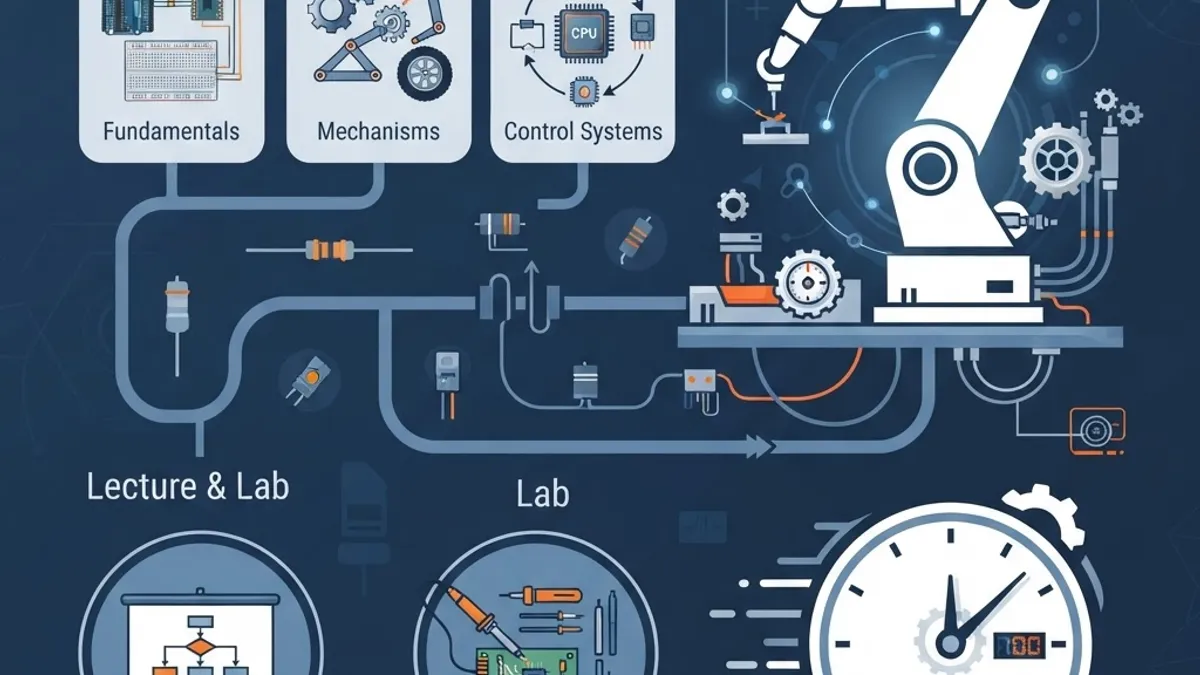
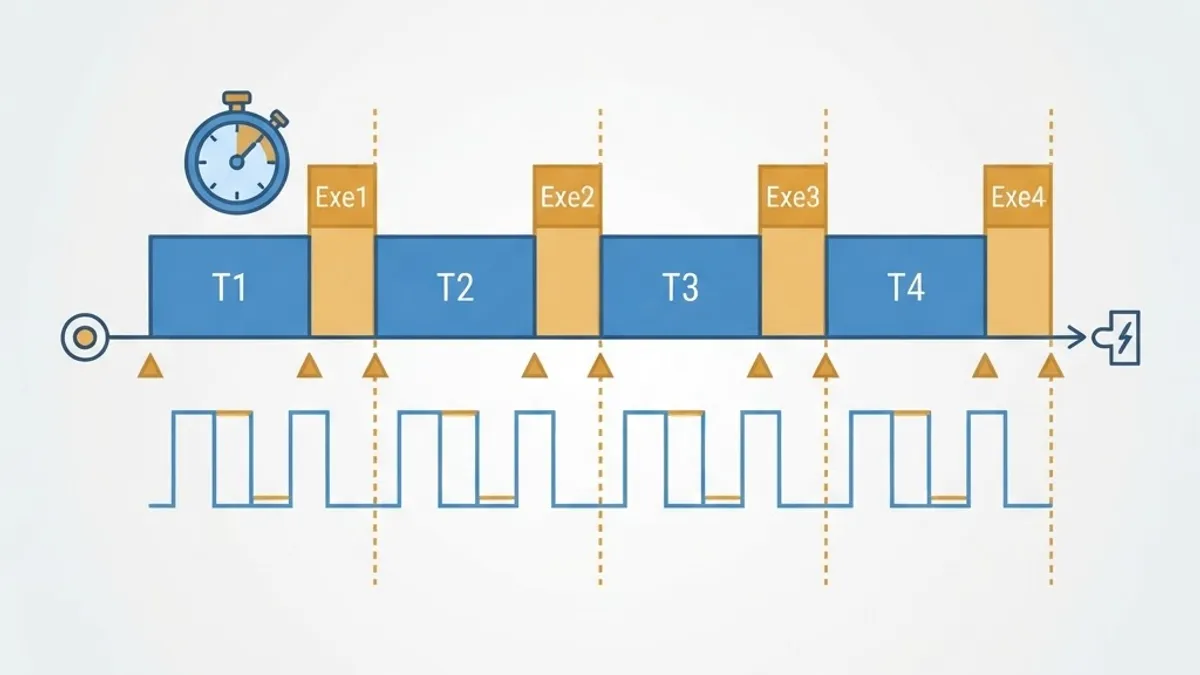
A real time system is one where correctness depends on both the result and the deadline by which that result is produced. A control output that is mathematically perfect but arrives 40 milliseconds late is a failure, not a partial success. This is the single concept that separates 5463 from a general programming course.
Engineers distinguish two categories:
- Hard real time — a missed deadline is a system failure. Airbag deployment, surgical robots, and flight control fall here.
- Soft real time — occasional missed deadlines degrade quality but do not break the system. Video streaming and most teleoperation interfaces fall here.
Standard Linux is not a hard real time operating system; timing jitter under load can exceed several milliseconds. This is why the Linux kernel community maintained the PREEMPT_RT patch set, which was merged into the mainline Linux kernel in 2024 after roughly two decades of development. Understanding why that patch exists is a genuinely useful piece of engineering literacy that this course gives you.
Prerequisites and the Math You Genuinely Need
Most catalog listings expect junior or senior standing in engineering with prior coursework in linear algebra, differential equations, and programming. In practice, three specific skills predict success more than the formal prerequisites:
- Matrix fluency. You will multiply 4x4 homogeneous transformation matrices constantly. If matrix composition order still confuses you, review it before week one.
- Comfort with the Linux command line. Building packages, sourcing environments, and reading terminal errors is daily work.
- Debugging patience. Robot bugs are rarely syntax errors. They are frame convention mistakes, unit mismatches, and timing races.
A quick honesty check: students who arrive having written at least one nontrivial C++ or Python program from scratch consistently spend less time stuck in labs. If your programming is rusty, spending ten hours on fundamentals before the semester saves you fifty hours during it.
The Software Stack: ROS, Nodes, and Message Passing
The Robot Operating System is not an operating system. It is middleware: a set of libraries and conventions that let independent programs, called nodes, exchange data over named channels called topics using a publish and subscribe model. A camera node publishes images, a perception node subscribes to them and publishes detected object positions, and a control node subscribes to those and publishes motor commands.
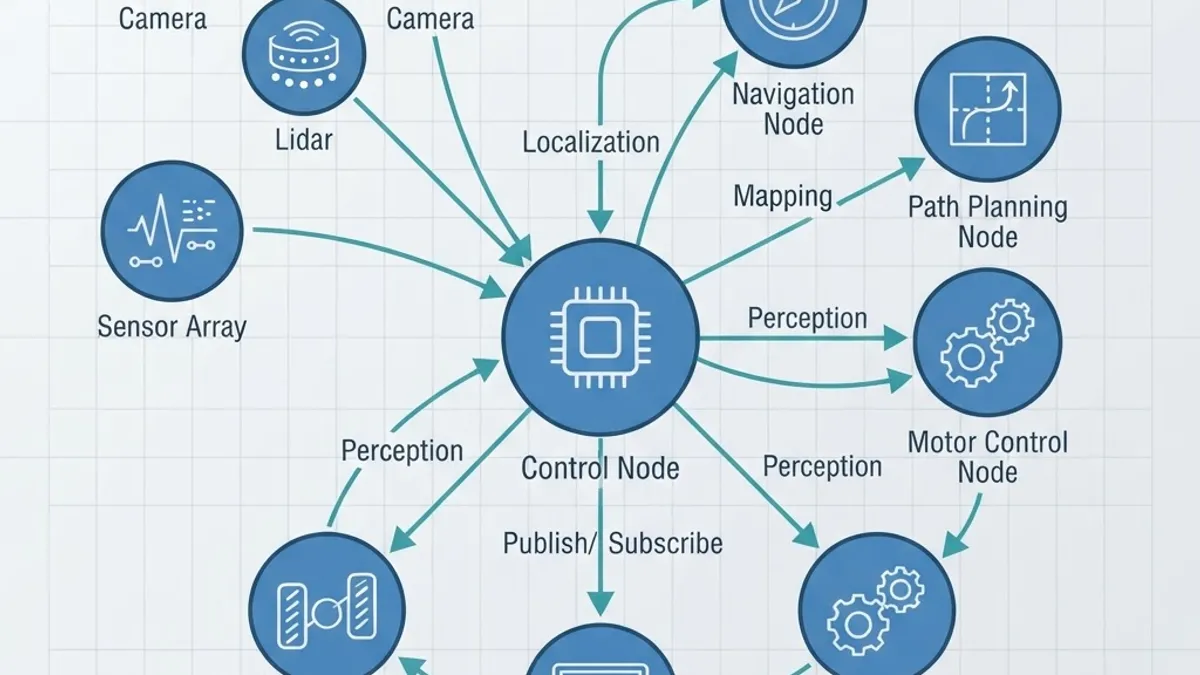
This architecture matters for a practical reason: it forces modularity. You can swap a simulated robot for a physical one by changing which node publishes joint states, without touching your controller code. That is also why the same structure appears in production autonomy stacks, warehouse robotics, and research labs worldwide.
ROS 2 replaced the original ROS master with DDS-based discovery specifically to improve real time behavior, multi-robot support, and reliability. If your section uses ROS 2, learn the concepts of quality of service settings and executors early — they directly control whether your callbacks meet their deadlines.
Where Students Lose the Most Time
From repeated patterns across robotics coursework, four issues consume the majority of lab hours:
- Frame confusion. Mixing up base, tool, and world frames produces motion that looks almost right, which is harder to debug than motion that is obviously wrong.
- Units. Degrees versus radians silently breaks trigonometry.
- Blocking code inside callbacks. A long computation in a subscriber callback starves the rest of your loop.
- Not logging timestamps. If you are not recording loop period, you cannot prove whether a problem is control tuning or missed timing.
Kinematics, Simulation, and the Lab Sequence
The kinematics portion is the mathematical backbone. Forward kinematics answers the question: given joint angles, where is the end effector? Inverse kinematics answers the harder reverse question, which may have zero, one, or infinitely many solutions. Many modern versions of this course teach the product of exponentials formulation using screw theory rather than classical Denavit-Hartenberg parameters, because it generalizes more cleanly and reduces bookkeeping errors.
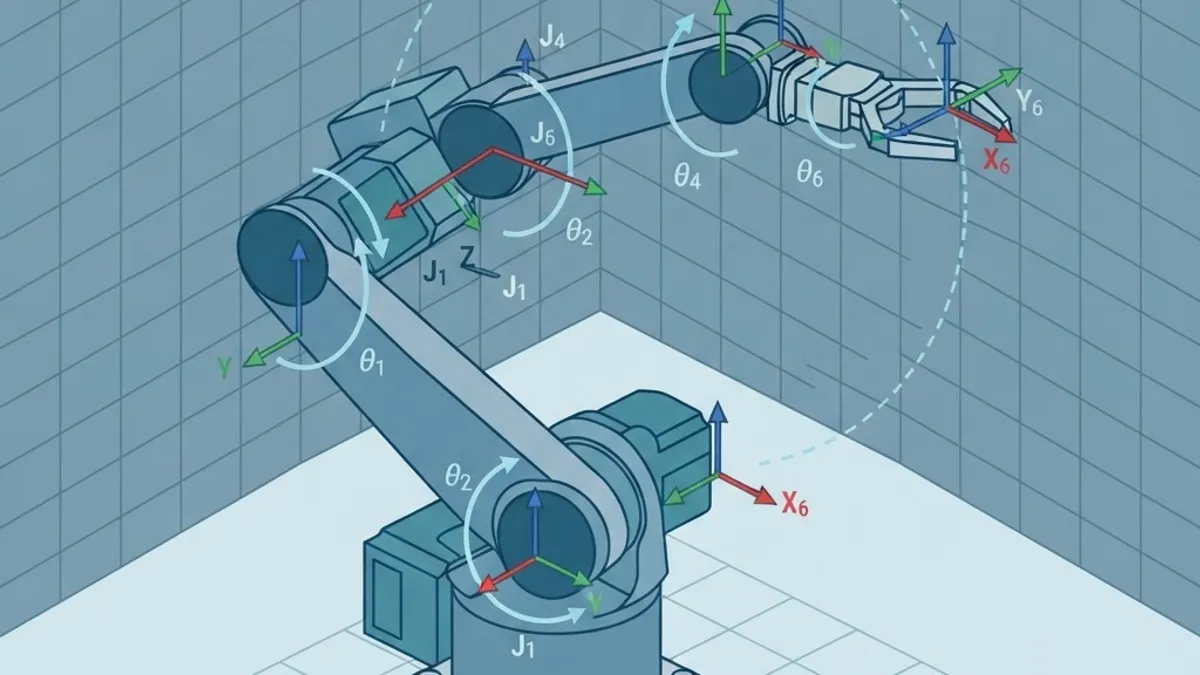
Labs generally escalate in this order:
- Environment setup, workspace creation, and building a first node.
- Publishing and subscribing with custom messages.
- Forward kinematics validated against a simulator.
- Inverse kinematics and Cartesian trajectory following.
- Sensor integration and closed loop feedback.
- Mobile robot odometry, mapping, and navigation.
- Open-ended team project.
The simulator is your friend and your alibi. Verify every controller in simulation first. Hardware time is scarce, shared, and unforgiving — a bad velocity command that costs a warning in simulation can damage a real actuator.
Mobile Robotics and SLAM
When the course moves from arms to mobile platforms, the central problem becomes state estimation. Simultaneous localization and mapping, or SLAM, is the process of building a map of an unknown environment while simultaneously tracking the robot position within that map. You will typically work with wheel odometry, an inertial measurement unit, and a lidar or depth camera, then fuse them because every individual sensor is wrong in a different way.
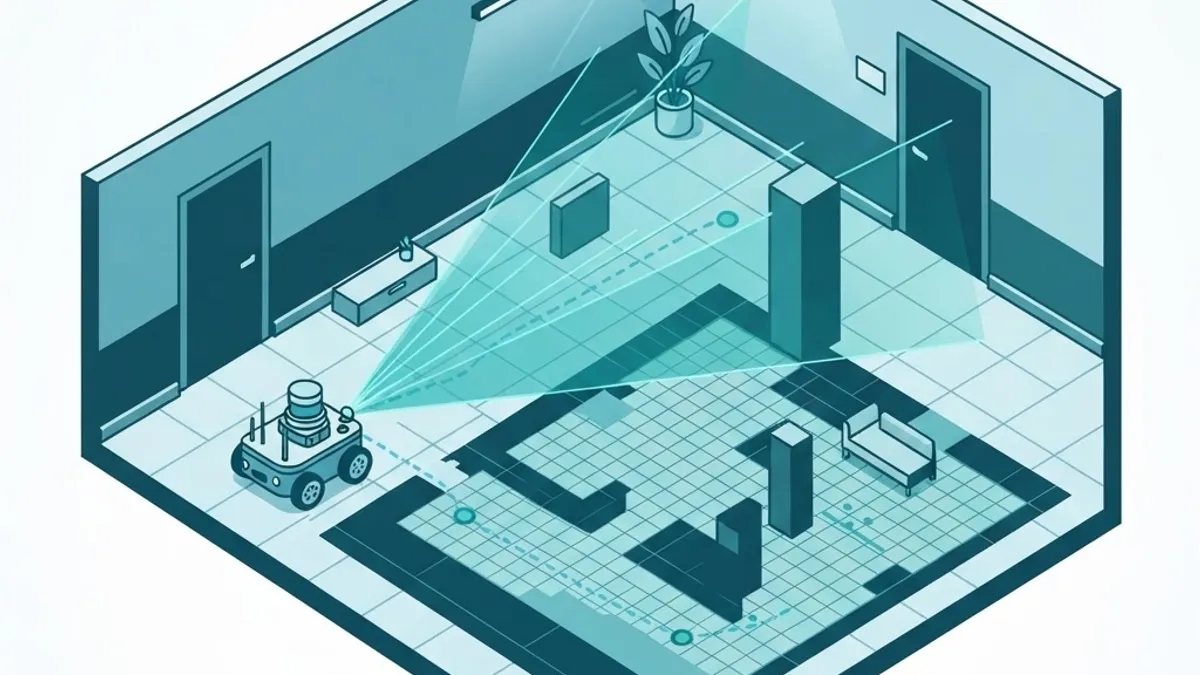
The practical lesson students take away: sensor fusion is not about finding the best sensor, it is about combining complementary error profiles. Encoders drift over distance but are smooth. Lidar is globally consistent but sparse in featureless corridors. A working estimator uses both.
Real Time Robotics Versus a Standard Robotics Course
| Aspect | ME/ECE 5463 Real Time Robotics | Typical Intro Robotics Course |
|---|---|---|
| Primary focus | Timing-correct implementation on hardware | Theory, derivations, and analysis |
| Deliverables | Working robot behavior plus code | Problem sets and exams |
| Main tools | ROS, C++, Python, Linux, simulator | MATLAB or pen and paper |
| Failure mode graded | Missed deadlines and unstable loops | Incorrect derivations |
| Debugging skill required | High | Moderate |
| Job relevance | Directly maps to robotics engineering roles | Foundational background |
The difference in the failure mode row is the one students underestimate. Your derivation can be flawless and your grade still suffer because your loop was not deterministic.
How to Succeed: A Practical Study Strategy
These tactics come from how engineering teams actually ship reliable systems, not from generic study advice:
- Version control from day one. Commit before every hardware session. When a working controller breaks, you need a known-good state to return to.
- Log everything with timestamps. Record commanded value, measured value, and loop period. Plot them. Most mystery bugs become obvious in a plot.
- Change one variable at a time. Tuning three gains simultaneously teaches you nothing about which one mattered.
- Write your derivation as a comment above the code that implements it. Six weeks later this is the difference between a five minute fix and a lost evening.
- Book lab time early. Hardware access is the real bottleneck in every robotics course.
- Read the error message completely. ROS build errors are verbose but usually precise.
The Team Project
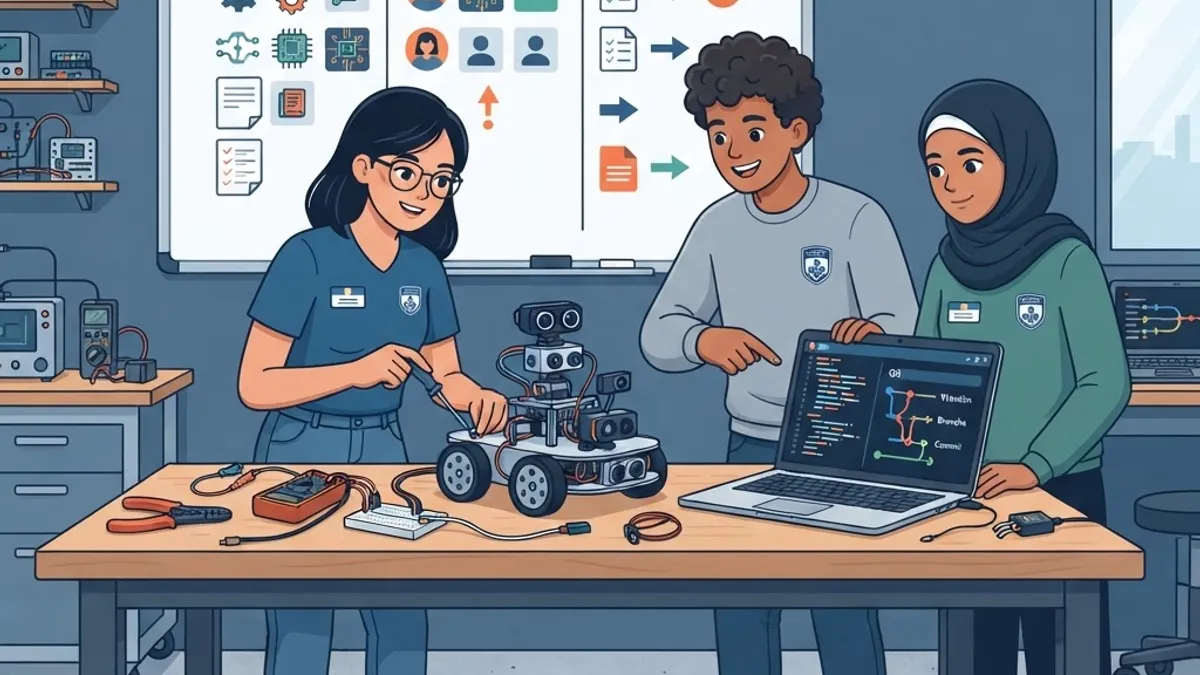
The final project is usually open-ended: pick and place with vision, autonomous navigation with obstacle avoidance, or a custom integration task. The projects that score highest are almost never the most ambitious ones. They are the ones with a demonstrable, repeatable behavior, honest documentation of limitations, and clean code separation. Scope down, then polish. A robot that reliably completes a simple task ten times in a row beats an impressive demo that works once.
Why This Course Matters for Your Career
Robotics adoption is not slowing. The International Federation of Robotics reported a global operational stock of more than 4 million industrial robots in factories worldwide, with annual installations remaining above 500,000 units. That installed base needs engineers who can write software that respects deadlines, integrate sensors, and debug systems that touch the physical world.

The transferable skills are broader than robotics alone. Deterministic scheduling, sensor fusion, state estimation, and modular message-driven architecture appear in autonomous vehicles, medical devices, drones, industrial automation, and increasingly in AI-driven physical systems. Teams building intelligent automation, including the engineering group at ZoneTechify and the specialists at WebPeak, consistently look for exactly this combination of mathematical grounding and hands-on implementation discipline. If you are exploring how these robotics and perception fundamentals extend into applied intelligent systems, our artificial intelligence services work touches many of the same patterns.
Key Takeaways
- ME/ECE 5463 is a cross-listed course combining robot kinematics and control theory with real time software implementation on actual hardware.
- A real time system is defined by correctness that depends on meeting deadlines, not just producing the right answer.
- Hard real time deadlines cause system failure when missed; soft real time deadlines only degrade quality.
- Standard Linux is not hard real time, which is why the PREEMPT_RT patch set was developed and merged into the mainline kernel in 2024.
- ROS is middleware, not an operating system: nodes communicate over topics using publish and subscribe.
- SLAM builds a map of an unknown environment while simultaneously estimating the robot pose within it.
- The four biggest time sinks are frame confusion, unit mismatches, blocking callbacks, and missing timestamped logs.
- The IFR reports more than 4 million industrial robots operating globally, sustaining strong demand for real time robotics engineers.
Frequently Asked Questions (FAQ)
Is ME/ECE 5463 hard?
It is demanding but fair. The difficulty comes from combining linear algebra, control theory, and systems programming at once rather than from any single topic. Students who are comfortable with matrices and the Linux command line before the semester starts typically find the workload manageable and the labs genuinely enjoyable.
What programming languages do I need for this course?
C++ and Python cover nearly everything. C++ is used where timing determinism matters most, and Python is used for faster prototyping, scripting, and data analysis. You also need working comfort with the Linux shell, build tools, and Git, since every lab involves compiling version-controlled code.
Do I need to buy a robot to take this class?
No. Courses provide lab hardware such as manipulator arms and mobile platforms, plus simulators like Gazebo or RViz for development. Most of your coding happens in simulation, and hardware sessions are scheduled. Owning a hobby robot helps you practice but is never a requirement for completing the coursework.
What is the difference between ROS and ROS 2?
ROS 2 removes the single master node, uses DDS for discovery and transport, and adds configurable quality of service settings. These changes improve reliability, multi-robot support, security, and real time behavior. ROS 2 is the current standard, so learn it unless your specific section explicitly requires original ROS.
How much math is in real time robotics systems?
The math load is substantial but focused. Expect heavy use of linear algebra, especially matrix transformations and Jacobians, plus trigonometry, basic differential equations, and introductory probability for sensor fusion. You do not need proof-based mathematics. You need to apply these tools correctly in code.
Will this course help me get a robotics job?
Yes, meaningfully. Employers value demonstrated ROS experience, real hardware debugging, and control implementation far more than coursework titles. Keep your lab code and final project in a public repository with clear documentation. That portfolio evidence is frequently what moves a robotics application forward to an interview.