
A practical guide to the MongoDB interview questions hiring teams actually ask in 2026, with model answers on schema design, indexing, aggregation, replication, and sharding.
Interview Questions on MongoDB

MongoDB interviews rarely fail because a candidate forgot a command. They fail because the candidate cannot explain a trade-off. After reviewing hundreds of backend hiring loops, the pattern is consistent: interviewers ask about syntax for five minutes and about judgment for forty. This guide covers the questions that decide the outcome, the reasoning interviewers listen for, and the specific answers that separate a mid-level engineer from a senior one.
Quick Answer: MongoDB interviews focus on five areas: the document data model, schema design and embedding versus referencing, indexing and query performance, the aggregation framework, and distributed behavior through replica sets and sharding. Strong candidates explain trade-offs and read patterns, not memorized commands.
What Interviewers Are Actually Testing
Every MongoDB question maps to one underlying concern: can you design data around access patterns instead of around entities? Relational training teaches normalization first. MongoDB rewards the opposite instinct, which is why interviewers probe it early.
MongoDB has ranked as the most popular non-relational database in the Stack Overflow Developer Survey for several consecutive years, with roughly a quarter of professional developers reporting they use it. That popularity means interviewers see many candidates who have used MongoDB casually and few who have operated it under load. Demonstrating operational awareness is the fastest way to stand out.
Definition: A document database stores records as self-describing BSON documents, a binary encoding of JSON that adds types such as ObjectId, Date, Decimal128, and binary data.
Core Concept Questions and Model Answers
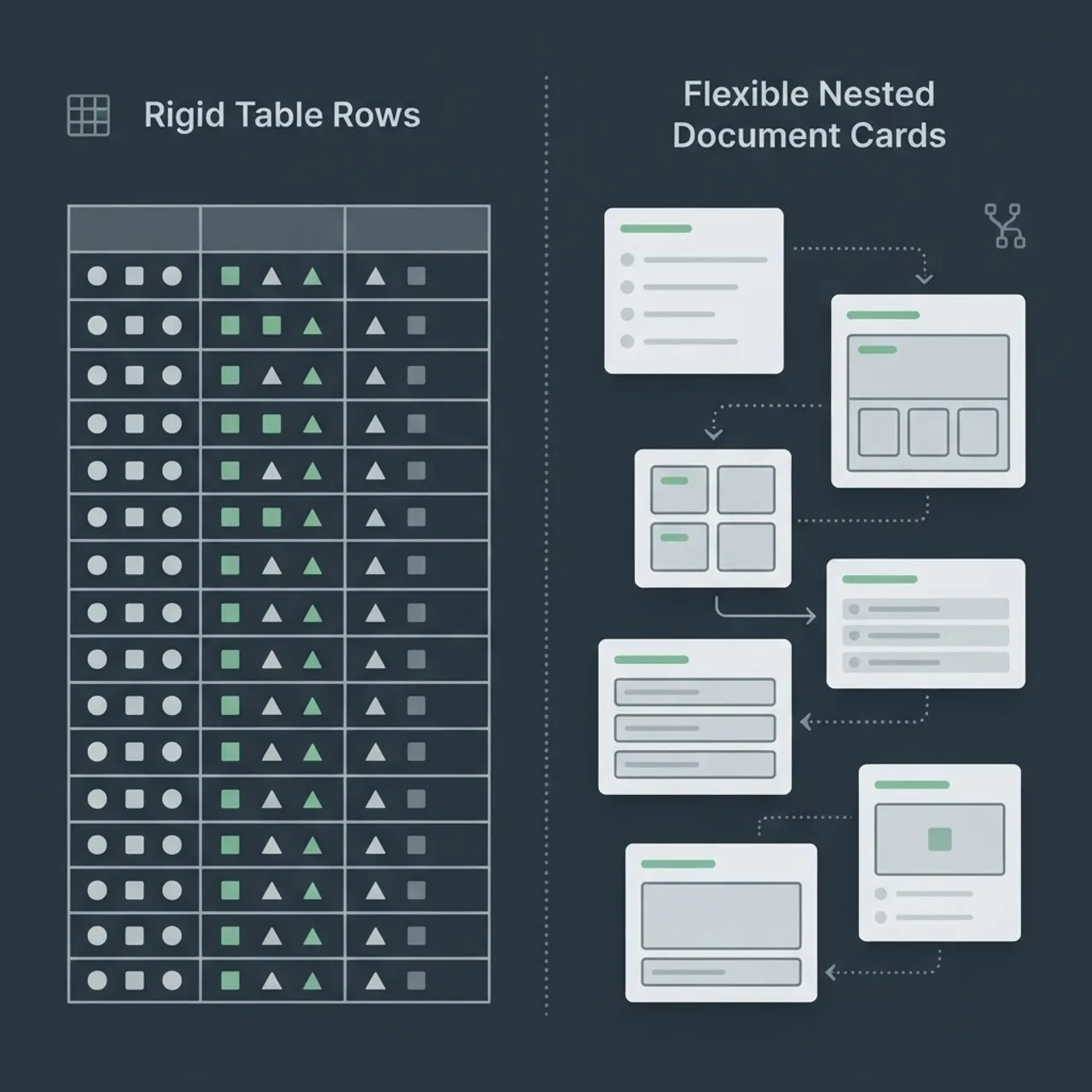
1. What is a document, a collection, and a database in MongoDB?
A document is a single record stored as BSON, a collection is a group of documents with no enforced uniform structure, and a database is a namespace holding collections. The key follow-up point to volunteer: collections are schema-flexible, not schema-free. Production systems use JSON Schema validators to enforce required fields and types at the server level.
2. How does BSON differ from JSON?
BSON is binary, traversable, and typed. It supports 64-bit integers, decimals, dates, and binary blobs that plain JSON cannot express. It also stores field lengths so the server can skip fields during scanning. Mention the 16 MB document size limit here, because interviewers almost always ask it next.
3. What is an ObjectId and why is it useful?
An ObjectId is a 12-byte identifier containing a 4-byte timestamp, a 5-byte random value, and a 3-byte counter. Because the timestamp leads, ObjectIds sort roughly in insertion order, which makes them useful for time-based pagination without an extra index.
4. When should you embed versus reference?
This is the highest-signal question in the entire loop. The answer is a rule, not a preference.
Embed when the data is read together, bounded in size, and updated as a unit. Reference when the related data grows without limit, is shared across parents, or is updated independently at high frequency. A product with five variants embeds cleanly. A product with two million reviews does not, because unbounded arrays eventually breach the 16 MB limit and cause document rewrites.
| Decision Factor | Embed | Reference |
|---|---|---|
| Read pattern | Always fetched with parent | Fetched separately |
| Growth | Bounded, small arrays | Unbounded collections |
| Update frequency | Changes with parent | Changes independently |
| Data sharing | Owned by one parent | Shared across documents |
| Query cost | One read, no join | Requires lookup or second query |
Indexing and Performance Questions

Indexing questions reveal whether a candidate has ever debugged a slow query in production.
5. What does the ESR rule mean?
ESR stands for Equality, Sort, Range, and it defines the correct field order in a compound index. Place exact-match fields first, then fields used for sorting, then range fields. A query filtering on status, sorting by createdAt, and filtering a range on price wants an index on status, createdAt, price in that order. Getting ESR wrong is the most common cause of in-memory sorts, which MongoDB aborts once they exceed 100 MB unless allowDiskUse is enabled.
6. How do you diagnose a slow query?
Walk through the sequence rather than naming one tool:
- Run explain with executionStats and compare totalDocsExamined against nReturned. A healthy ratio is close to 1:1.
- Look for a COLLSCAN stage, which means no index was used.
- Check whether the winning plan includes a SORT stage, which signals an unsupported sort.
- Enable the database profiler at a threshold such as 100 ms to capture real traffic.
- Add or reorder the index, then re-run explain to confirm the plan changed.
7. What is a covered query?
A covered query is answered entirely from an index because every requested field is present in that index and the query does not need the document itself. Covered queries avoid document fetches and are often several times faster. Note that a covered query cannot include the full document, and _id must be excluded from the projection unless it is part of the index.
8. What index types should you know?
Single field, compound, multikey for arrays, text, geospatial, hashed for even shard distribution, wildcard for unpredictable field names, and TTL for automatic document expiry. Partial and sparse indexes matter too, because they reduce index size on large collections where most documents lack the indexed field.
Aggregation Framework Questions

9. How does the aggregation pipeline work?
Documents flow through ordered stages, and each stage transforms the stream before passing it on. The practical insight interviewers want: stage order determines performance. Place match and sort as early as possible so the query planner can use indexes, and place project or unset before expensive stages to shrink the working set.
10. What is the difference between lookup and a SQL join?
lookup performs a left outer join between collections in the same database. Unlike a relational join, it executes per input document and can create large intermediate arrays, so it should run after filtering rather than before. For high-traffic reads, a well-designed embedded model usually outperforms repeated lookups.
11. When would you use a materialized view?
When an aggregation is expensive and its results tolerate slight staleness. Running a pipeline on a schedule with merge into a summary collection turns a multi-second dashboard query into a single indexed read. Teams building analytics-heavy products at agencies such as ZoneTechify rely on this pattern to keep reporting endpoints predictable under load.
Replication, Sharding, and Reliability Questions
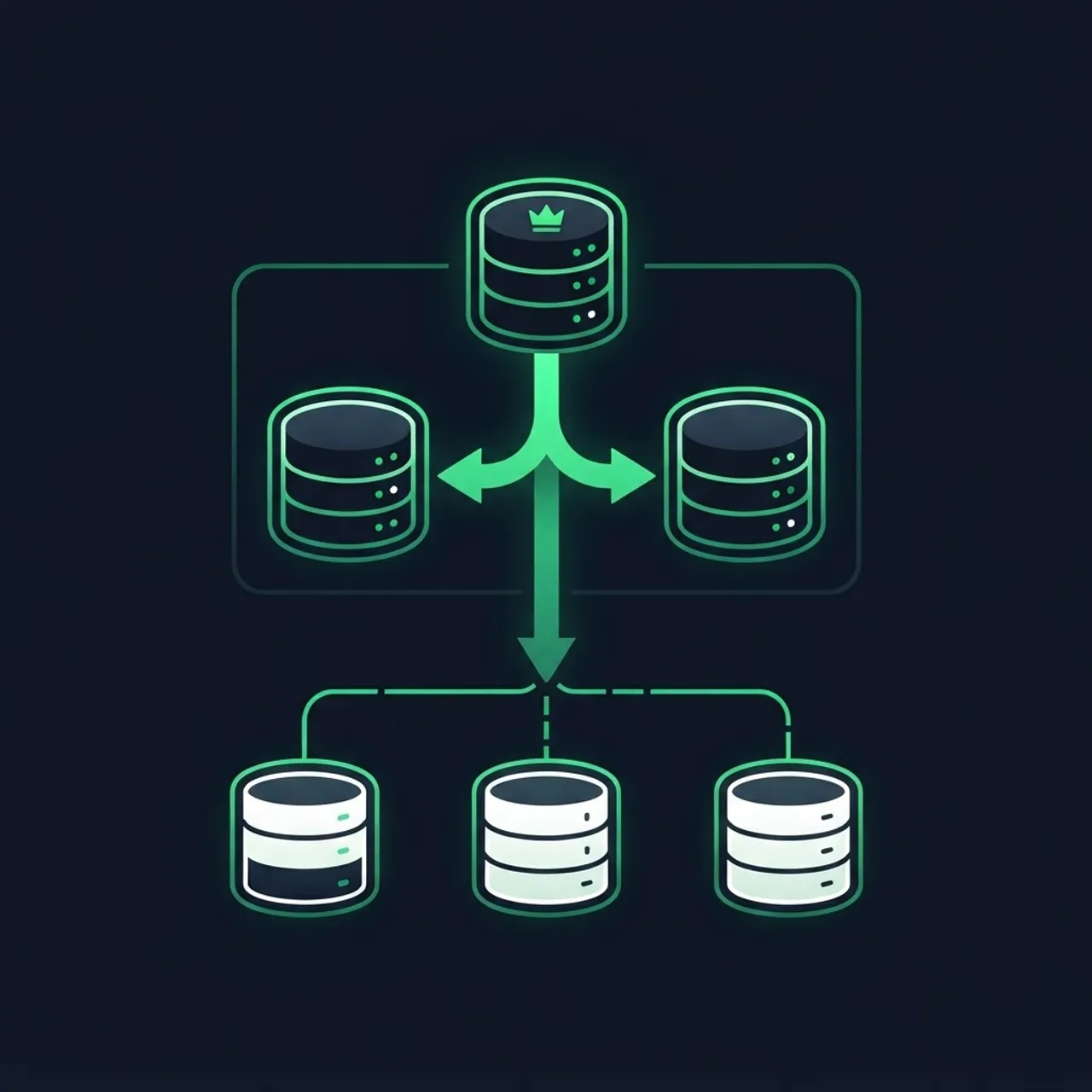
12. What is a replica set and how does failover work?
A replica set is a group of nodes holding the same data, with one primary accepting writes and secondaries replicating the oplog. If the primary becomes unreachable, the remaining nodes hold an election and promote a new primary, typically within about 12 seconds by default. Always use an odd number of voting members so elections cannot deadlock.
13. Explain write concern and read preference.
Write concern controls how many nodes must acknowledge a write. The value majority guarantees durability across a failover, while an acknowledgment from one node is faster but can be rolled back. Read preference controls which node serves reads. Reading from secondaries increases throughput but introduces replication lag, so never use it for read-after-write flows such as a checkout confirmation.
14. What makes a good shard key?
A good shard key has high cardinality, even write distribution, and appears in most queries so the router can target a single shard. Monotonically increasing keys such as raw timestamps create a hot shard because all new writes land on one range. Hashed sharding fixes distribution but breaks range queries, which is the trade-off to state out loud.
15. What is the difference between vertical and horizontal scaling here?
Vertical scaling adds CPU, RAM, or faster disks to existing nodes and is usually the correct first step, since MongoDB performance depends heavily on whether the working set fits in memory. Horizontal scaling through sharding adds operational complexity and should follow evidence, not anticipation.
Transactions, Consistency, and Schema Validation

16. Does MongoDB support ACID transactions?
Yes. Single-document operations have always been atomic, multi-document transactions arrived in version 4.0 for replica sets, and distributed transactions across shards arrived in 4.2. The senior answer adds a caveat: transactions are a correctness tool, not a design default. If your workload needs transactions on every request, the schema probably splits data that should live in one document.
17. How do you enforce structure without losing flexibility?
Use JSON Schema validation on the collection with a validationLevel of moderate during migrations, then tighten to strict. Pair it with application-level types so invalid data fails fast in code before reaching the driver. Teams shipping production grade web apps generally treat schema validators as part of the migration checklist rather than an afterthought.
18. What are change streams used for?
Change streams expose a resumable stream of database changes built on the oplog. They power cache invalidation, search index synchronization, audit logs, and event-driven services without polling. Store the resume token so a restarted consumer does not miss events.
Practical and Scenario Questions
Senior loops end with open-ended design prompts. Two common ones:
Design a schema for a chat application. Embed the last N messages in the conversation document for fast inbox rendering, and store the full history in a separate messages collection with a compound index on conversationId and createdAt. This hybrid pattern keeps the common read cheap while keeping growth unbounded safely.
Your API latency tripled after a feature launch. Check the profiler for new slow queries, confirm index usage with explain, inspect connection pool saturation, and verify the working set still fits in RAM. Latency regressions after a launch are usually a missing index or a new unbounded array, not a hardware problem.
If your team is designing these data layers alongside application code, structured web app development work makes the schema decision part of the architecture phase instead of a later refactor.
Key Takeaways

- MongoDB documents are capped at 16 MB, which is the hard constraint behind most embedding decisions.
- Compound indexes should follow the ESR order: Equality, Sort, Range.
- In-memory sorts fail beyond 100 MB unless allowDiskUse is enabled.
- Multi-document transactions arrived in MongoDB 4.0 and distributed transactions in 4.2.
- Default replica set failover completes in roughly 12 seconds, and majority write concern protects against rollback.
- A healthy query examines close to the same number of documents it returns.
Frequently Asked Questions (FAQ)
What are the most common MongoDB interview questions?
The most common questions cover documents versus rows, BSON versus JSON, embedding versus referencing, index types and the ESR rule, the aggregation pipeline, replica sets, sharding, and multi-document transactions. Interviewers weight schema design and indexing most heavily because those decisions affect production performance directly.
How do I prepare for a MongoDB interview in a week?
Spend two days on schema design patterns, two days on indexing and explain output, one day on aggregation stages, and two days on replication and sharding. Load a sample dataset of at least a million documents locally so you can run explain and see real execution statistics rather than memorizing theory.
Is MongoDB knowledge enough for a backend developer role?
No, but it is a strong differentiator. Backend roles also test API design, authentication, caching, and at least one relational database. Interviewers value engineers who can explain why they would choose MongoDB for one service and PostgreSQL for another, since that judgment matters more than tool familiarity.
What is the hardest MongoDB interview question?
Shard key selection is usually the hardest, because it has no universally correct answer. You must balance cardinality, write distribution, and query targeting for a specific workload, then explain what breaks if traffic patterns change. Strong candidates state the trade-off instead of naming a single field.
Do MongoDB interviews include live coding?
Often yes. Expect to write find queries with projections, build a three or four stage aggregation pipeline, and interpret explain output. Practice writing pipelines without autocomplete, and always narrate your reasoning aloud so the interviewer can follow your decision process even if syntax slips.
How much MongoDB experience do employers expect?
Mid-level roles typically expect one to two years of practical use including schema design and indexing. Senior roles expect operational experience: handling failovers, tuning slow queries, planning migrations, and monitoring replication lag. Documented examples of solving a real performance problem carry more weight than certifications.
Final Word
The candidates who pass MongoDB interviews are not the ones who recall the most operators. They are the ones who answer every question with a read pattern in mind and name the trade-off before being asked. Prepare with a real dataset, run explain until its output feels familiar, and practice defending one schema decision out loud. That single habit changes interview outcomes more than any list of commands.