A practical evaluation of MongoDB deployment options, comparing Atlas managed clusters, self-managed Enterprise Advanced, and Community Server on cost, control, and operational risk.
Evaluate the Database Software Company MongoDB on Deployment Options
MongoDB is usually evaluated as a data model decision, but the model is the easy part. The harder question, and the one that decides your monthly bill and your on-call schedule, is how you deploy it. MongoDB the company sells three fundamentally different operating agreements around the same database engine, and choosing the wrong one costs teams either money or sleep. This evaluation breaks down each option on the criteria that actually matter in production: control, cost predictability, compliance posture, scaling mechanics, and the engineering hours you will spend keeping the cluster alive.
Quick Answer: MongoDB offers three deployment options: Atlas (fully managed cloud across AWS, Azure, and Google Cloud), Enterprise Advanced (self-managed with commercial support and Ops Manager), and Community Server (free, self-managed, unsupported). Atlas suits most teams that value speed and automation, while self-managed deployments fit strict data-residency, air-gapped, or heavily cost-optimized workloads.
What MongoDB Actually Sells: Engine Versus Operating Model
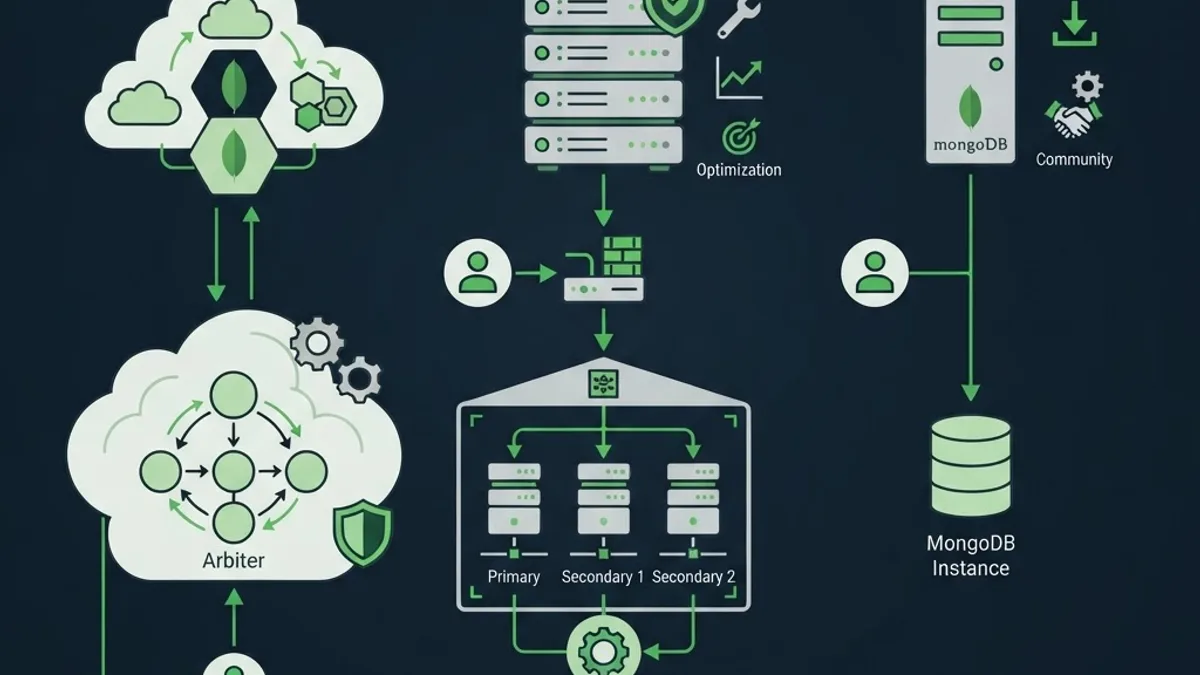
The MongoDB database engine is nearly identical across every tier. What changes is who operates it and what license governs it. Community Server ships under the Server Side Public License, which requires that if you offer the database as a service to third parties, you must open source your service management code. That single clause is why most cloud vendors cannot resell MongoDB directly, and it is why the company's revenue has shifted decisively toward its managed platform.
MongoDB's own fiscal 2024 results reported total revenue of roughly 1.68 billion dollars, with Atlas accounting for about 68 percent of that figure. That number is the most useful signal in this entire evaluation: the company's engineering investment, feature releases, and documentation quality now flow toward Atlas first. Features such as Atlas Search, Vector Search, Triggers, and Data Federation have no self-hosted equivalent. If your roadmap depends on those, the deployment decision is already made for you.
Key Terms Defined
- Replica set: A group of MongoDB nodes holding the same data, with one primary accepting writes and secondaries replicating it. This is the unit of high availability.
- Sharded cluster: A horizontally partitioned deployment where data is split across shards by a shard key, coordinated by routers and config servers.
- DBaaS: Database as a service, where the vendor operates the infrastructure, patching, and backups.
Option 1: MongoDB Atlas, the Managed Path
Atlas is MongoDB's fully managed service running on AWS, Azure, and Google Cloud in more than 100 regions. You choose a cluster tier, a region, and a cloud provider, and Atlas provisions a three-node replica set with automated failover, encrypted storage, continuous backups, and rolling version upgrades.
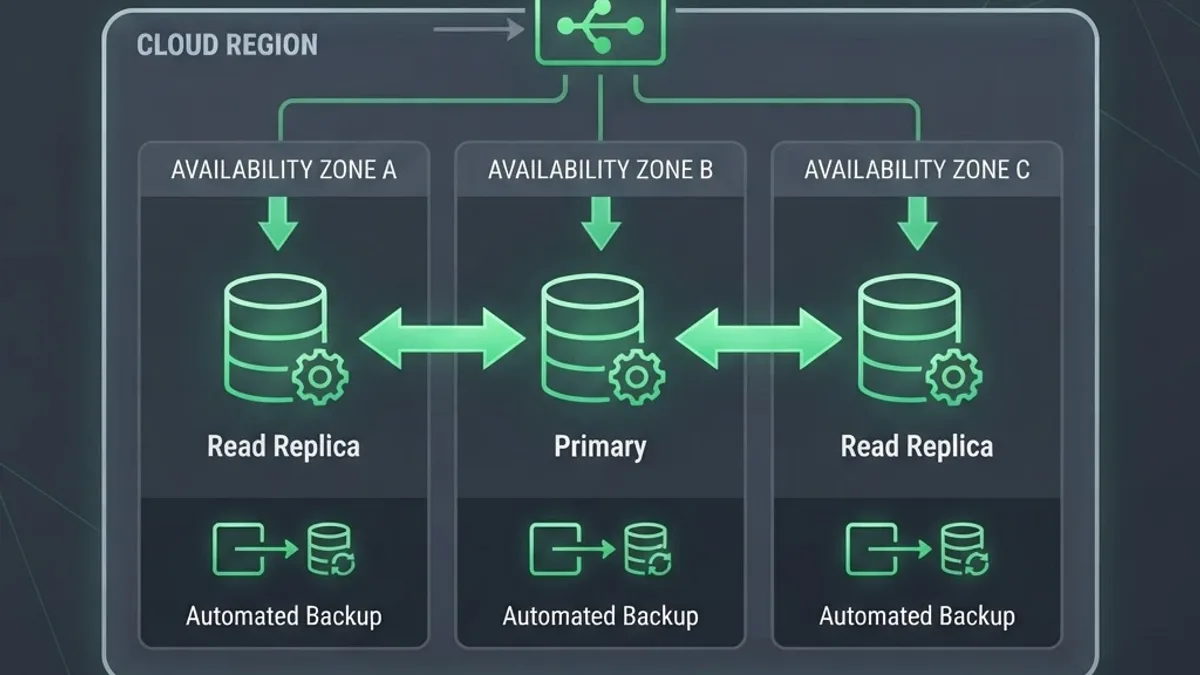
The practical value is not the provisioning speed. It is the elimination of failure modes that junior teams consistently get wrong: unpatched CVEs, missing oplog headroom, backups that were never test-restored, and replica sets running in a single availability zone. Atlas distributes nodes across zones by default and publishes a 99.995 percent uptime SLA on multi-region dedicated clusters.
Where Atlas gets expensive is predictable and avoidable. Watch three line items:
- Data transfer. Cross-region and internet egress is billed separately and often exceeds compute cost for chatty applications. Colocate your application in the same cloud region as the cluster.
- Backup retention. Continuous cloud backup with long point-in-time windows can rival compute spend on write-heavy clusters.
- Serverless and Flex billing. Read and write unit pricing looks cheap at low volume and stops being cheap the moment a bad query does a collection scan.
Atlas also has a genuinely free tier, the M0 shared cluster with 512 MB of storage. It is fine for prototypes and demos, and unsuitable for production because it lacks dedicated resources, private networking, and granular backup control.
Option 2: Enterprise Advanced, the Supported Self-Managed Path
Enterprise Advanced is a commercial subscription for running MongoDB on your own infrastructure. You get the Enterprise Server build, Ops Manager for automation and monitoring, Kubernetes Operators, in-memory storage engine options, LDAP and Kerberos authentication, auditing, encryption at rest with KMIP key management, and vendor support with contractual response times.

Choose this when a hard constraint, not a preference, rules out managed hosting. Real examples include air-gapped defense and healthcare environments, jurisdictions where no Atlas region satisfies data residency law, existing on-premise hardware with years of depreciation left, and workloads so large that reserved bare-metal economics beat managed pricing even after staffing costs.
The honest cost model is where teams miscalculate. Enterprise Advanced pricing is negotiated and typically quoted per server or per core, but the license is rarely the largest number. Budget for at least a fraction of a dedicated database engineer per production cluster, plus hardware refresh, plus the operational cost of a genuinely tested disaster recovery plan. If you cannot name the person who owns your restore drill, you are not ready to self-manage.
Option 3: Community Server, Free and Fully Your Problem
Community Server is the free SSPL-licensed build. It includes the core database, replication, sharding, aggregation, change streams, and the WiredTiger storage engine. It excludes auditing, LDAP and Kerberos integration, encryption at rest, Ops Manager, and any vendor support.
Community is the right choice for development environments, internal tools, CI pipelines, and small production workloads where a documented one-hour recovery window is acceptable and an engineer on staff genuinely understands replica set elections. It becomes the wrong choice the moment you handle regulated data, because implementing encryption at rest and audit logging yourself is expensive, error-prone, and hard to prove to an auditor.
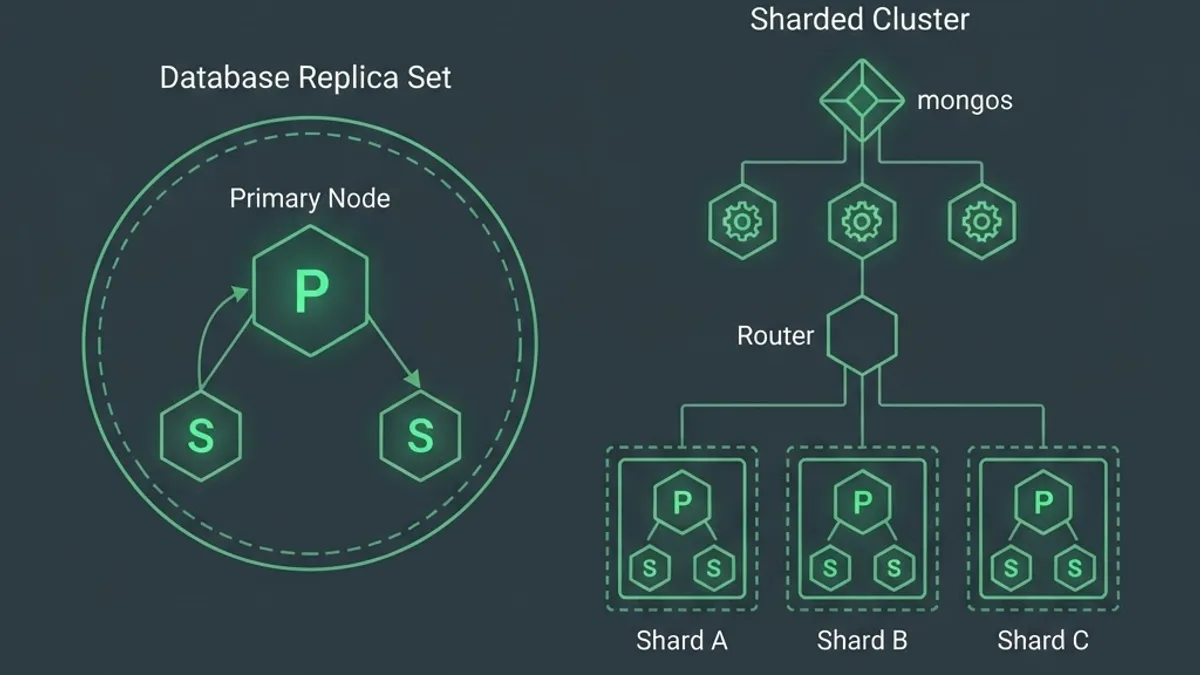
One rule applies to every self-managed tier: never run a single-node production deployment. A three-member replica set is the minimum viable topology, because a standalone node has no automatic failover and no consistent backup source.
Deployment Options Compared
| Criterion | Atlas | Enterprise Advanced | Community Server |
|---|---|---|---|
| Who operates it | MongoDB | Your team | Your team |
| License cost | Usage-based, free M0 tier | Negotiated subscription | Free (SSPL) |
| Vendor support SLA | Included by plan tier | Contractual | None |
| Automated backups | Yes, point-in-time | Via Ops Manager | Build yourself |
| Encryption at rest | Yes | Yes, with KMIP | Not included |
| Auditing, LDAP, Kerberos | Yes | Yes | No |
| Atlas Search and Vector Search | Yes | No | No |
| Data residency control | Region selection only | Full physical control | Full physical control |
| Air-gapped operation | No | Yes | Yes |
| Engineering hours required | Lowest | Highest | High |
| Best fit | Product teams shipping fast | Regulated or on-premise estates | Dev, internal, small prod |
Scaling Mechanics: Where the Options Diverge Most
Vertical scaling is trivial everywhere. Atlas resizes a cluster tier with a rolling restart and no downtime; self-managed teams do the same manually, one node at a time, starting with secondaries. The real divergence appears at horizontal scale.
Sharding is the single hardest MongoDB operation to reverse. A poorly chosen shard key, for example a monotonically increasing timestamp, funnels all writes into one shard and produces a hot spot that no amount of hardware fixes. Atlas does not choose the key for you, but it does provide balancer visibility, shard-level metrics, and zone sharding for geographic pinning, which materially shortens diagnosis time. Self-managed teams need Ops Manager or a mature Prometheus setup to see the same picture.
A practical sequence for scaling decisions:
- Fix indexes and query patterns first, since most performance complaints are missing compound indexes, not capacity.
- Scale vertically until the working set exceeds affordable RAM.
- Add read-only secondaries or analytics nodes for reporting traffic.
- Shard only when write throughput or dataset size genuinely exceeds a single replica set.
Teams building data-heavy products often pair this with application-layer decisions, and an experienced web application agency will usually push connection pooling, query shape review, and caching before any database resize is approved.

Security and Compliance Posture
Security is where MongoDB's reputation was historically damaged and where the deployment choice matters most. The infamous wave of ransomed MongoDB instances came from self-managed servers exposed to the public internet with no authentication enabled by default in older versions. Modern releases bind to localhost by default, but the lesson stands: exposure risk in self-managed deployments is a configuration responsibility, not a product feature.
Atlas closes that gap structurally. Authentication is mandatory, IP access lists are required, TLS is enforced in transit, and VPC peering or private endpoints keep traffic off the public internet. Atlas also maintains SOC 2 Type II, ISO 27001, HIPAA-eligible configurations, and PCI DSS capability, which means you inherit audited controls instead of proving your own.

Self-managed deployments can reach the same posture, but every control becomes your evidence to produce: key rotation, audit log retention, patch cadence, and network isolation. Enterprise Advanced gives you the tooling; it does not give you the auditor's sign-off. Engineering teams at WebPeak Digital typically recommend Atlas for any product handling customer payment or health data unless a residency law explicitly blocks it.
A Decision Framework You Can Apply Today
Answer these in order and stop at the first yes.
- Do you have a legal or contractual requirement for air-gapped or specific on-premise hosting? Choose Enterprise Advanced.
- Do you handle regulated data with audit and encryption requirements but no hosting restriction? Choose Atlas with private endpoints.
- Do you need Atlas Search, Vector Search, or Triggers? Choose Atlas.
- Is this a development, CI, or internal tool workload? Choose Community Server in a three-node replica set.
- Everything else, including most SaaS products and startups? Choose Atlas on a dedicated tier and revisit at scale.

Migration between options is real but not free. Atlas Live Migration moves self-managed clusters in with minimal downtime, and mongodump or mongorestore handles smaller moves in either direction. Leaving Atlas is harder specifically because Atlas-only features have no self-hosted target, so treat Atlas Search adoption as a deliberate coupling decision. Teams that document their exit path early, a practice the ZoneTechify Team applies to every database architecture review, avoid rewriting search infrastructure under pressure later.
Key Takeaways
- MongoDB offers three deployment options: Atlas managed cloud, Enterprise Advanced self-managed with support, and free Community Server.
- Atlas represented roughly 68 percent of MongoDB's approximately 1.68 billion dollars in fiscal 2024 revenue, so new platform features ship there first.
- Atlas publishes a 99.995 percent uptime SLA on multi-region dedicated clusters and carries SOC 2 Type II, ISO 27001, and HIPAA-eligible configurations.
- Community Server excludes encryption at rest, auditing, LDAP, and Kerberos, making it unsuitable for regulated production data.
- Atlas Search, Vector Search, and Triggers have no self-hosted equivalent, which creates deliberate platform coupling.
- A three-member replica set is the minimum safe production topology in every self-managed tier.
- Shard key choice is the least reversible MongoDB decision, so fix indexes and scale vertically before sharding.
Frequently Asked Questions (FAQ)
Is MongoDB Atlas cheaper than self-hosting MongoDB?
At small to mid scale, Atlas is usually cheaper once you include engineering time, backup tooling, and monitoring. Self-hosting wins on raw infrastructure cost at large, stable scale, but only if you already employ database engineers and have tested disaster recovery procedures in place.
Can I use MongoDB for free in production?
Yes. Community Server is free under the SSPL and production-capable, provided you accept no vendor support, no encryption at rest, and no auditing. The SSPL only becomes restrictive if you offer MongoDB itself as a service to third parties, which most application teams never do.
What is the difference between MongoDB Enterprise Advanced and Community Server?
Enterprise Advanced adds commercial support, Ops Manager automation, Kubernetes Operators, encryption at rest with KMIP, auditing, LDAP and Kerberos authentication, and the in-memory storage engine. Community Server includes the same core database engine, replication, and sharding, but none of those enterprise security and management features.
How many nodes do I need for a production MongoDB deployment?
Use at least three nodes in a replica set. Three members allow automatic primary election during failure, provide a consistent backup source, and tolerate losing one node. A standalone server has no failover, and a two-node set cannot reach election majority when one node fails.
When should I shard a MongoDB cluster?
Shard only after indexes are optimized and vertical scaling has hit affordable RAM limits. Sharding is warranted when your working set exceeds a single server's memory or write throughput saturates one primary. Choose a high-cardinality, evenly distributed shard key, because changing it later is extremely disruptive.
Can I move from Atlas back to self-hosted MongoDB?
Yes, using mongodump and mongorestore or replication-based migration. The complication is Atlas-exclusive features. If your application depends on Atlas Search, Vector Search, or Triggers, you must replace them with separate self-hosted services such as a dedicated search engine, which is a rewrite rather than a migration.