
A practical ethical hacking guide to testing web servers and web applications, covering attack surfaces, tools, methodology, reporting, and hardening steps.
Ethical Hacking Hacking Web Servers and Web Applications
Web servers and web applications are the two layers where most real breaches begin, and they fail for different reasons. A web server fails because of configuration, patching, and exposure. A web application fails because of logic, authorization, and trust in user input. Ethical hacking exists to find both categories before an attacker does, under written authorization, with a defined scope and a report someone can act on.
This guide walks through how professional testers approach both layers, what tools they use, how the methodology is sequenced, and what remediation actually looks like once findings land on an engineering team's board.
Quick Answer: Ethical hacking of web servers and web applications means legally testing them with the owner's written permission to find exploitable flaws. Testers map the attack surface, probe server configuration and application logic, safely prove impact, then deliver a prioritized report so the team can patch before real attackers exploit it.

What Ethical Hacking Actually Means in a Legal Sense
Ethical hacking is authorized simulation of attacker behavior. The technical skills are identical to those of a criminal attacker, but three things separate the two: written scope, agreed rules of engagement, and disclosure to the owner instead of exploitation for gain.
Key terms worth defining precisely, because teams often use them interchangeably and get the wrong deliverable:
- Vulnerability scanning: automated detection of known flaws. Fast, broad, high false-positive rate.
- Penetration testing: human-driven exploitation of findings to prove real impact within a fixed scope and window.
- Red teaming: goal-based adversary simulation, usually stealthy, testing detection and response rather than a list of bugs.
- Bug bounty: continuous crowdsourced testing under a public policy.
If you request a penetration test and receive a scanner export, you paid for the wrong thing. A real test includes chained findings, business logic abuse, and manual verification of every reported issue.
Why Web Servers and Applications Remain the Primary Entry Point
The data is consistent year over year. The Verizon Data Breach Investigations Report has repeatedly identified web applications as the single most common attack vector in confirmed breaches, with basic web application attacks accounting for a substantial share of incidents. Separately, OWASP's Top 10 research placed Broken Access Control as the most widespread category, appearing in testing data for the majority of applications reviewed.
Those two data points tell you where to spend effort. Broken access control cannot be found by a scanner, because a scanner does not know that user A should never see invoice 4471. It is found by a human comparing two authenticated sessions. That single insight explains why automated-only security programs keep getting breached despite clean scan reports.
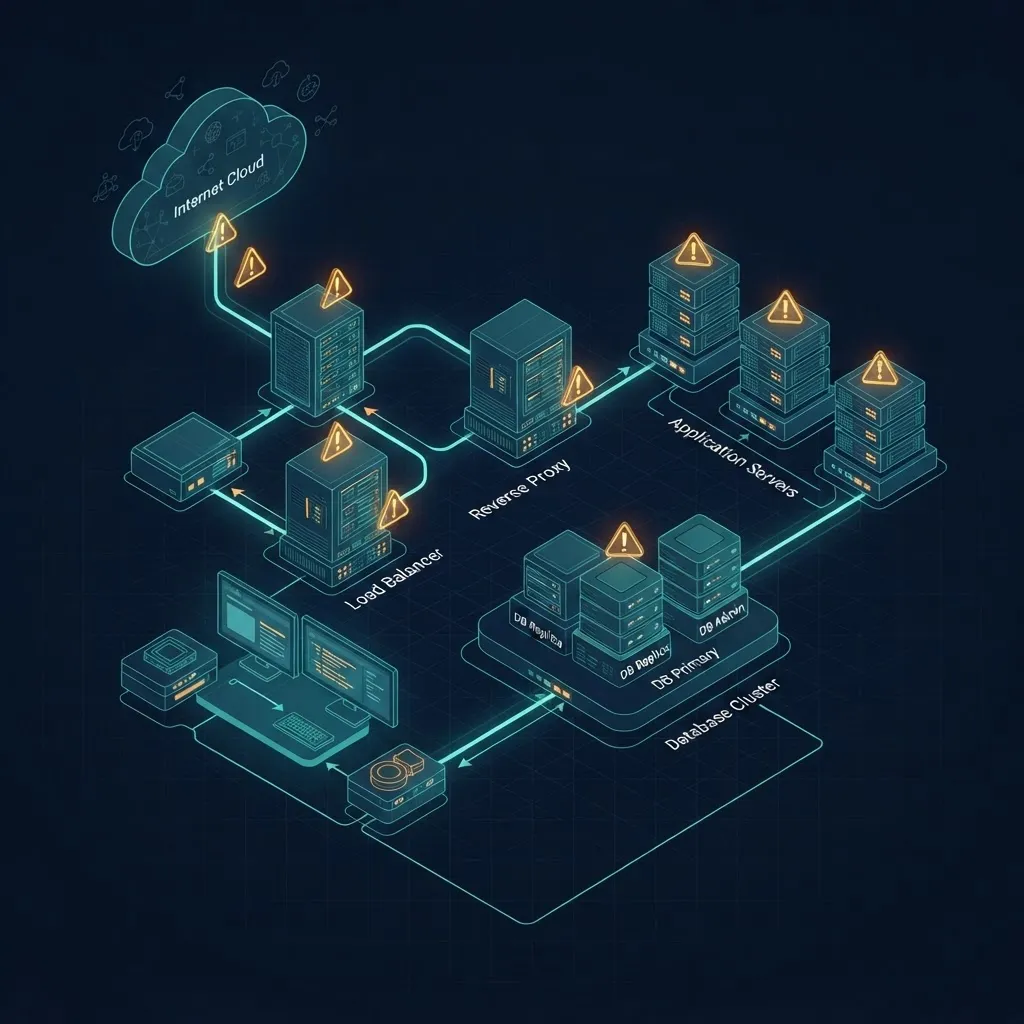
Mapping the Web Server Attack Surface
Server-layer testing is about exposure and configuration. Before touching the application, a tester enumerates what is actually reachable.
Reconnaissance and Enumeration Steps
- Resolve the real infrastructure. Identify DNS records, subdomains, CDN versus origin IPs, and any staging hosts that leaked into public DNS.
- Fingerprint the stack. Server banners, response headers, error page signatures, and TLS certificate details reveal software and often versions.
- Enumerate open services. Ports beyond 80 and 443 frequently expose admin panels, database ports, or forgotten management interfaces.
- Discover hidden content. Directory and file brute forcing surfaces backup archives, .git directories, configuration files, and old API versions still running unpatched code.
- Review TLS and header posture. Weak cipher suites, expired certificates, and missing security headers are low-severity alone but compound with other findings.
The highest-value server findings in practice are rarely exotic exploits. They are an exposed staging environment with production data, a directory listing containing a database dump, or an origin server reachable directly, bypassing the WAF entirely.
Testing the Web Application Layer
Application testing is where judgment matters most. The tester is looking for places where the application trusts something it should verify.

The Vulnerability Classes That Produce Real Impact
- Broken access control: changing an object ID, a role parameter, or a tenant identifier and receiving data that belongs to someone else. Test every endpoint with a low-privilege session, not just the UI paths.
- Injection: SQL, NoSQL, command, and template injection. Modern frameworks reduce but do not eliminate this, especially in raw query builders and reporting features.
- Authentication weaknesses: no rate limiting on login, predictable password reset tokens, sessions that survive a password change, and multi-factor flows that can be skipped by replaying a partial token.
- Server-side request forgery: the application fetches a URL you control, letting you reach internal metadata services and private networks.
- Insecure file upload: content type checked on the client, extension checked with a blacklist, or files stored in a web-executable directory.
- Business logic abuse: negative quantities, price manipulation, coupon stacking, and race conditions in checkout or wallet operations. These never appear in scanner output and are frequently the most expensive flaws.
A useful discipline: for every feature, write down what the application assumes about the user, then test that assumption directly. Most critical findings are one broken assumption away from the surface.
Tooling: What Each Tool Is Genuinely Good At
Tools do not find vulnerabilities. They accelerate the parts of testing that are mechanical, so the human can spend time on logic.

| Tool Category | Representative Tools | Best Use | Main Limitation |
|---|---|---|---|
| Network and port discovery | Nmap | Finding exposed services and versions | No application logic awareness |
| Intercepting proxy | Burp Suite, OWASP ZAP | Manual request tampering, auth testing | Requires skilled operator |
| Content discovery | ffuf, Gobuster, Feroxbuster | Hidden files, backups, old API paths | Noisy, needs good wordlists |
| Vulnerability scanning | Nikto, Nuclei | Fast checks for known issues | False positives, misses logic bugs |
| Exploitation frameworks | Metasploit, sqlmap | Verifying exploitability safely | Can cause damage if misconfigured |
| Dependency analysis | OWASP Dependency-Check, npm audit | Outdated vulnerable components | Reports unreachable code paths too |
For teams building modern stacks, the security review should sit inside the delivery process rather than after it. Agencies that ship production systems, including the senior engineering group behind web application agency work, increasingly run dependency and access-control checks in CI so findings surface at pull request time instead of during a quarterly test.
A Repeatable Methodology You Can Follow
The sequence matters. Skipping scoping produces legal risk, and skipping reporting produces zero remediation.
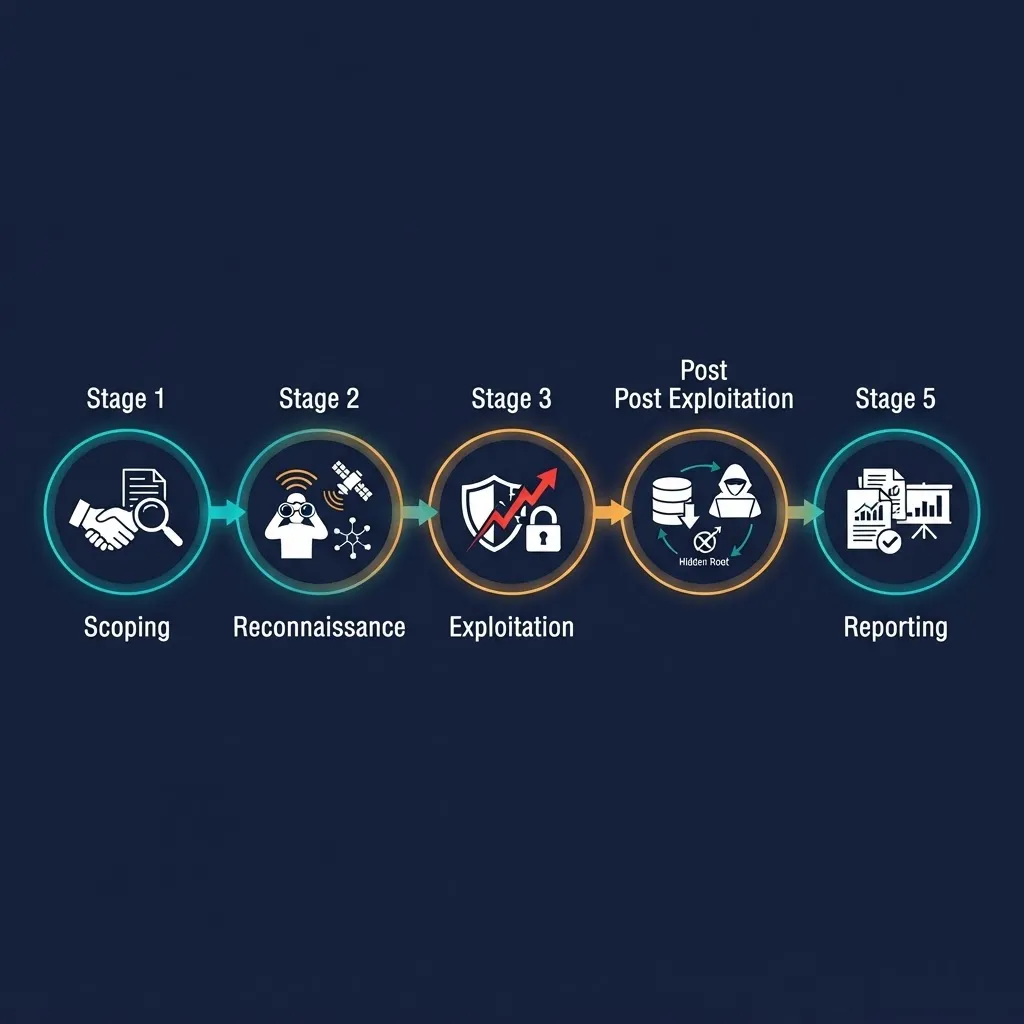
- Scoping and authorization. Define in-scope hosts, excluded systems, test windows, allowed techniques, and an emergency contact. Get it signed.
- Reconnaissance. Passive collection first, then active enumeration. Document everything discovered, including things you will not test.
- Vulnerability identification. Combine automated scanning with manual review of authentication, authorization, and state-changing endpoints.
- Controlled exploitation. Prove impact with the least invasive proof possible. Read one record, not the whole table. Never destroy data.
- Post-exploitation assessment. Determine what an attacker could reach next: internal services, credentials, other tenants, cloud metadata.
- Reporting. Every finding needs reproduction steps, evidence, business impact, severity with justification, and a specific fix.
- Retesting. Verify the fix and confirm no regression or incomplete patch.
Step six is where most engagements lose value. A finding written as "SQL injection in search" gets ignored. The same finding written as "unauthenticated SQL injection in /api/search exposes all 42,000 customer email addresses, fix by parameterizing the query in SearchRepository.find" gets fixed the same week.
Hardening: Turning Findings Into Durable Fixes
Remediation should reduce entire classes of risk, not just the reported instance.
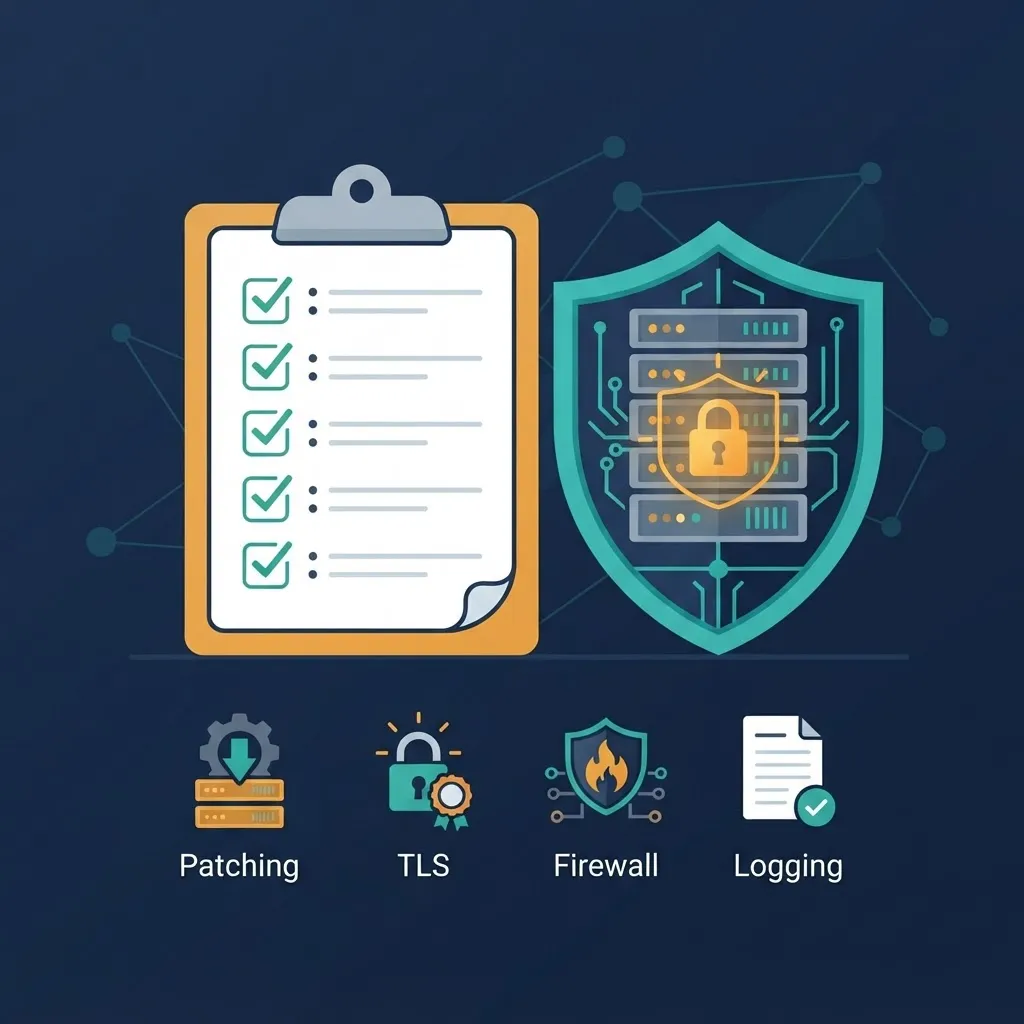
- Patch on a schedule, not on incident. Track server, runtime, and dependency versions with automated alerts.
- Enforce authorization server-side, centrally. One policy layer checked on every request beats scattered per-controller checks.
- Parameterize every query. Ban string concatenation in data access code through linting, not code review memory.
- Reduce exposure. Close unused ports, remove default pages, disable directory listing, and keep staging behind authentication.
- Set security headers. Content Security Policy, Strict-Transport-Security, X-Content-Type-Options, and a sensible referrer policy.
- Log and alert on security events. Failed authorization attempts and unusual enumeration patterns are the earliest reliable signals.
- Validate uploads by content, store outside the webroot, and serve through a handler.
Teams that publish content and applications on the same infrastructure often discover that performance and security work overlap: minimizing exposed endpoints, tightening caching rules, and cleaning dependencies improve both. Practical engineering breakdowns of that overlap are published by the ZoneTechify Team for teams maintaining their own stacks.
Building the Skill Set Legally
Practice environments matter because testing systems you do not own is a crime in most jurisdictions, including under the United States Computer Fraud and Abuse Act and the United Kingdom Computer Misuse Act.
Legitimate practice paths:
- Deliberately vulnerable applications such as OWASP Juice Shop, WebGoat, and DVWA, run locally.
- Self-hosted lab environments where you build and break your own stack.
- Public bug bounty programs, strictly within their published scope.
- Certification tracks with hands-on labs, which also signal capability to employers.
Read every bounty policy before testing. Out-of-scope testing has ended careers even when the intent was helpful.
Key Takeaways
- Web applications are consistently among the most common vectors in confirmed data breaches, according to Verizon DBIR findings.
- Broken Access Control ranks as the top OWASP Top 10 category, found in the majority of tested applications.
- Server-layer risk is mostly exposure and configuration; application-layer risk is mostly logic and authorization.
- Scanners cannot detect broken access control or business logic abuse, which require manual session comparison.
- Written authorization and defined scope are what legally separate ethical hacking from a computer crime.
- A finding is only valuable when the report includes reproduction steps, impact, and a specific code-level fix.
Frequently Asked Questions (FAQ)
Is ethical hacking of web servers legal?
Yes, when you have written authorization from the system owner that defines scope, timing, and permitted techniques. Without that document, the same activity is a criminal offense under laws like the CFAA or Computer Misuse Act. Always keep the signed agreement accessible during the engagement.
What is the difference between a vulnerability scan and a penetration test?
A vulnerability scan is automated pattern matching against known issues and produces a raw list with false positives. A penetration test adds a human who verifies each issue, chains findings together, tests business logic, and proves real impact. Scans are continuous; tests are scoped engagements.
Which vulnerability should I fix first?
Fix anything unauthenticated that exposes data or allows code execution, then broken access control affecting other users' records. Prioritize by exploitability plus business impact, not by scanner severity alone. A medium-rated flaw reachable without login usually outranks a high-rated one needing admin access.
How often should web applications be tested?
Run automated dependency and configuration checks on every deployment, and commission a manual penetration test at least annually or after any major architectural change. Applications shipping features weekly benefit from quarterly focused reviews on new functionality rather than a single yearly full-scope test.
Can I learn ethical hacking without breaking any laws?
Yes. Use deliberately vulnerable applications such as OWASP Juice Shop, WebGoat, and DVWA on your own machine, build personal lab environments, and participate in public bug bounty programs strictly within their published scope. Never test third-party systems without explicit written permission.
Do web application firewalls remove the need for testing?
No. A firewall filters known attack patterns but cannot understand your authorization model or business rules. Testers routinely bypass them by reaching origin servers directly or by abusing legitimate-looking logic flaws. Treat a firewall as one layer, never as a substitute for fixing the underlying code.