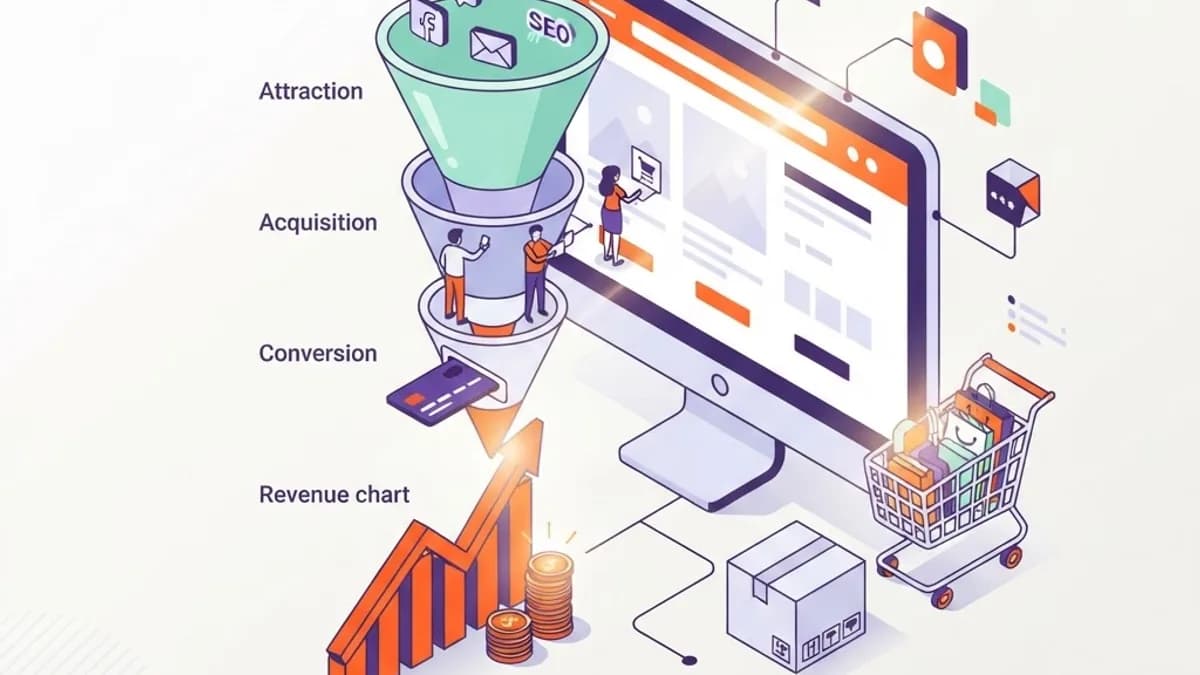
A clear breakdown of ecommerce digital marketing services, what each one delivers, realistic costs and how to sequence them for profitable growth.
Ecommerce Digital Marketing Services
Ecommerce marketing has a specific advantage over every other sector: the numbers are unambiguous. You know exactly what a customer cost, what they bought and whether the transaction was profitable. That clarity should make decisions easier, yet most stores still buy services in the wrong order and measure them with the wrong metric.
This guide explains what each ecommerce digital marketing service actually does, when it becomes worth paying for and how to sequence investment so that each stage funds the next.
Quick Answer: Ecommerce digital marketing services typically include paid media, search optimization, email and SMS lifecycle, conversion rate optimization, marketplace management and creative production. The most profitable sequence is to fix conversion and retention first, then scale acquisition, because paid traffic multiplies whatever economics already exist.
The Core Services Explained
Paid media management
Covers search, shopping, social and increasingly retail media placements. In 2026 the work is less about bid manipulation and more about feed quality, creative volume and conversion signal accuracy. Typical cost is 10 to 20 percent of ad spend or a flat fee between 1000 and 6000 monthly.
Search optimization for ecommerce
Differs substantially from general SEO. The priorities are category page architecture, faceted navigation control, product schema, indexation management across thousands of URLs and content that captures non branded discovery demand. Typical cost is 1500 to 8000 monthly.
Email and SMS lifecycle
The highest margin channel in ecommerce because there is no media cost per send. Core flows are welcome, browse abandonment, cart abandonment, post purchase, replenishment and win back. Typical cost is 1000 to 4000 monthly including campaign calendar management.
Conversion rate optimization
Structured testing and user research applied to product pages, cart and checkout. The highest leverage service for stores already receiving meaningful traffic. Typical cost is 2000 to 8000 monthly.
Marketplace and feed management
Product data optimization across shopping feeds and marketplaces. Feed quality alone frequently determines shopping campaign performance more than budget does.
Creative production
Product photography, lifestyle imagery, video and ad creative. In automated buying environments this is now the primary performance variable rather than a supporting service.
Sequencing Investment Correctly
Most stores buy paid media first because it produces immediate revenue. That is defensible only if the underlying economics work. Paid traffic amplifies existing conversion and retention performance, so scaling a store with a poor conversion rate simply buys expensive proof of the problem.
A better sequence has four stages.
- Measurement. Accurate tracking of purchases, revenue, margin and returning customer rate. Without this, every later decision is guesswork.
- Conversion. Fix site speed, product page clarity, trust signals, shipping transparency and checkout friction. Improvements here raise the return of every other channel simultaneously.
- Retention. Build lifecycle email and SMS flows. These increase customer lifetime value, which directly raises how much you can afford to pay for acquisition.
- Acquisition. Only now scale paid media and search investment aggressively, because each new customer is worth more and converts at a higher rate.
Stores that follow this order routinely achieve profitable scale at ad costs that would bankrupt a competitor who started at stage four.
What Each Service Should Deliver
| Service | Primary Metric | Reasonable Expectation | Time To Impact |
|---|---|---|---|
| Paid media | Contribution margin after ad cost | Profitable scaling within agreed target | 2 to 6 weeks |
| Ecommerce SEO | Non branded organic revenue | Steady compounding growth | 4 to 9 months |
| Email and SMS | Revenue per recipient | 20 to 35 percent of total revenue | 4 to 10 weeks |
| Conversion optimization | Conversion rate and average order value | Incremental tested gains | 6 to 12 weeks |
| Feed management | Shopping impression share and return | Improved product coverage | 2 to 4 weeks |
| Creative production | Creative win rate | Consistent new winning concepts | Ongoing |
The email row deserves emphasis. Well built lifecycle programs commonly contribute between twenty and thirty five percent of total store revenue, and because the marginal cost of sending is negligible, that revenue carries far higher margin than paid acquisition.
The Metric That Matters Most
Return on ad spend is the default ecommerce metric and the most misleading one. It ignores product margin, shipping cost, returns and the difference between new and repeat customers.
Use contribution margin instead. Take revenue, subtract cost of goods, shipping, payment fees, expected returns and advertising cost. What remains is the money the business actually keeps. A campaign at a three times return on ad spend can be unprofitable on a low margin product and highly profitable on a high margin one.
Then layer in new customer economics. Many successful stores accept break even or slight loss on first purchase because they know the second and third orders follow reliably. That decision is only safe when you can measure repeat rate accurately, which is why the measurement stage cannot be skipped.
Choosing A Provider Without Getting Burned
Ask six questions of any prospective ecommerce marketing partner.
- What contribution margin did you achieve for a comparable store, not what return on ad spend?
- How do you handle product feed optimization specifically?
- What is your creative production process and monthly output?
- How do you pass offline or delayed conversion data back to platforms?
- Which platform do you have deepest experience with, and why does that matter for my stack?
- What would you fix before spending anything on advertising?
That final question separates genuine operators from media buyers. A partner who immediately wants to increase spend without examining conversion, margin or retention is optimizing their own revenue rather than yours. Reviewing how experienced teams document their ecommerce process, such as the approach outlined by web app development specialists working on commerce platforms, gives a useful benchmark for what a thorough onboarding should cover.
Platform Considerations That Affect Marketing
Your technology stack constrains your marketing options more than most merchants realize.
Site speed directly affects both conversion and paid media efficiency, because slow pages reduce quality signals and increase abandonment. Product data structure determines feed quality, which determines shopping performance. Subscription and bundling capability determines whether retention strategies are even available. Headless and custom builds offer performance and flexibility advantages but require development capacity to maintain.
Before committing to a large marketing budget, confirm that the platform can support the tactics you intend to use. Replatforming mid campaign is expensive and usually resets learning across every channel. Merchants planning that kind of migration often engage a this agency partner for the technical build while marketing continues in parallel, which avoids a complete pause in acquisition.
Key Takeaways
- Fix measurement, conversion and retention before scaling acquisition, because paid traffic multiplies existing economics rather than fixing them.
- Email and SMS lifecycle programs commonly generate twenty to thirty five percent of ecommerce revenue at very low marginal cost.
- Contribution margin is a far more reliable decision metric than return on ad spend, which ignores product margin and returns.
- Product feed quality frequently determines shopping campaign performance more than budget allocation does.
- Creative production has become the primary performance variable in automated advertising environments.
Frequently Asked Questions (FAQ)
What services does an ecommerce marketing agency provide?
Most provide paid media management, search optimization, email and SMS lifecycle, conversion rate optimization, product feed and marketplace management, and creative production. Strong partners also handle analytics implementation, because accurate measurement underpins every other service they deliver.
How much should an ecommerce store spend on marketing?
A common range is ten to twenty percent of revenue for growing stores, weighted toward acquisition early and retention as the customer base matures. The right figure depends on product margin, repeat purchase rate and how aggressively you intend to grow.
Which channel gives ecommerce the best return?
Email and SMS usually produce the highest margin because there is no cost per impression. Paid search and shopping deliver the most scalable acquisition. The strongest stores run both, using owned channels to raise lifetime value so paid acquisition can afford higher costs.
How long does ecommerce SEO take to work?
Technical and product page improvements can show results within two to three months. Category level and content driven growth typically takes six to nine months. Ecommerce SEO compounds well because product and category pages continue earning traffic long after publication.
Should small stores hire an agency or do it themselves?
Stores below roughly twenty thousand monthly revenue usually benefit more from learning email marketing and conversion basics internally. Once monthly revenue supports a meaningful ad budget, specialist management typically pays for itself through improved efficiency and creative output.
Final Word
Ecommerce rewards operators who respect sequence. Measure accurately, convert better, retain longer, then scale acquisition. Done in that order, every dollar of media spend works harder than it would for a competitor buying services in reverse.