
A practical guide to ecommerce catalog management services, covering product data enrichment, taxonomy design, bulk listing optimization, marketplace syndication, and the KPIs that prove catalog quality drives revenue.
Ecommerce Catalog Management Services
Most online stores do not lose sales because of weak ads. They lose sales because the product catalog behind those ads is incomplete, inconsistent, or wrong. A missing size chart, a duplicated SKU, a description copied from the manufacturer, a product that shows as in stock when the warehouse is empty: each of these quietly kills conversions and trust. Ecommerce catalog management services exist to fix exactly this layer of the business, and they are one of the highest return investments a store with more than a few hundred products can make.
This guide explains what these services include, how professional teams actually structure catalog work, which metrics prove the work is paying off, and how to choose between doing it in-house or outsourcing it. Everything here is written from the operational reality of catalogs that contain thousands of SKUs across multiple sales channels, not from theory.
Quick Answer: Ecommerce catalog management services are the ongoing process of creating, enriching, structuring, and syndicating product data across your store and marketplaces. They cover SKU setup, attributes, images, categorization, pricing, inventory sync, SEO copy, and quality audits so shoppers always see accurate, complete, and findable products.
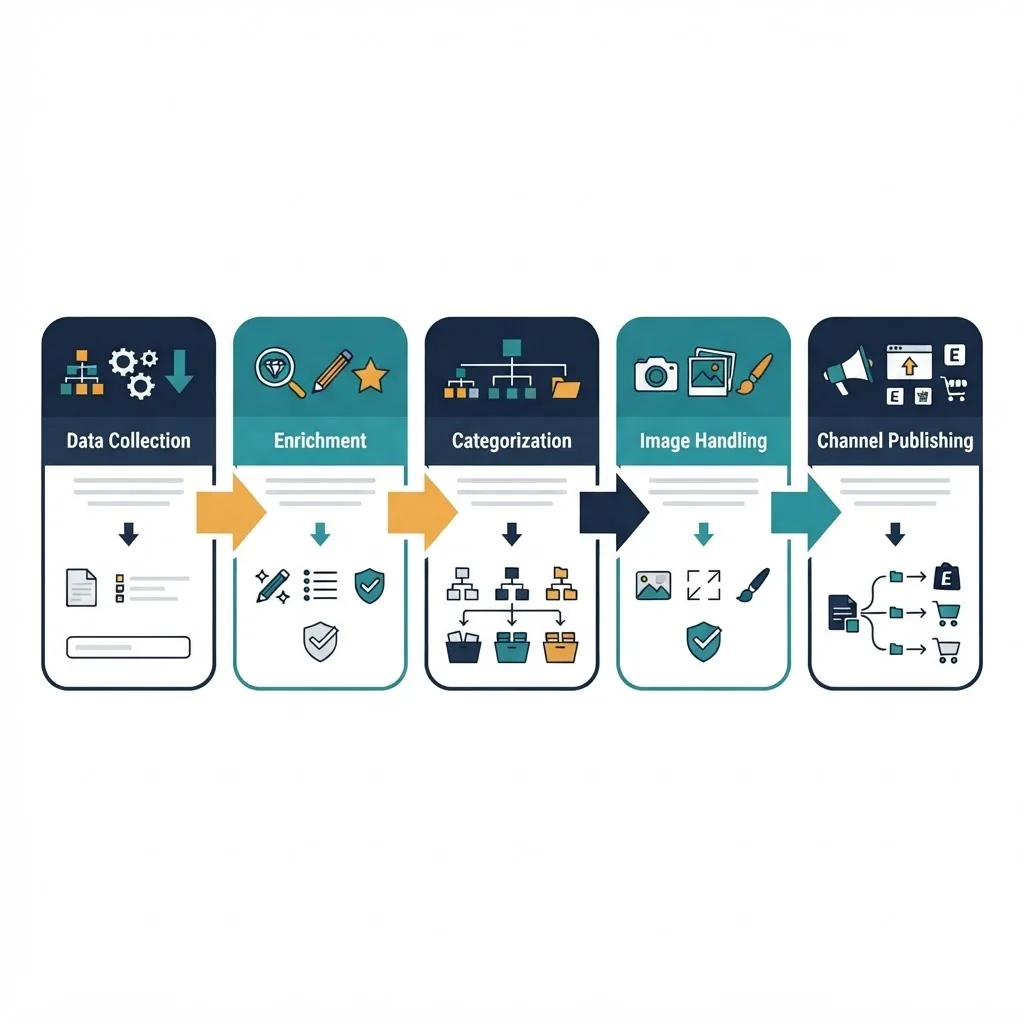
What Ecommerce Catalog Management Services Actually Cover
Catalog management is a set of repeatable operations, not a one time cleanup. A complete service scope normally includes eight workstreams:
- Product onboarding: creating SKUs, variants, parent and child relationships, and unique identifiers such as GTIN, UPC, EAN, MPN, and ASIN.
- Attribute enrichment: filling every field a shopper or filter needs, including material, dimensions, weight, compatibility, color family, and care instructions.
- Content writing: titles, bullet points, long descriptions, and specification tables written for humans and structured for search.
- Media management: image renaming, cropping to channel specs, background cleanup, alt text, and video or 360 asset attachment.
- Taxonomy and categorization: category trees, subcategories, tags, and filterable facets that match how people actually search.
- Pricing and inventory sync: keeping price, stock, and lead time consistent between the ERP, the storefront, and every marketplace.
- Channel syndication: transforming one master record into the required format for Amazon, Walmart, eBay, Google Shopping, Meta, and retail partners.
- Ongoing governance: audits, duplicate detection, error logs, and a documented rule set so quality does not decay as the catalog grows.
The distinction that matters: catalog management is the operational discipline, while a PIM (Product Information Management system) is only the software that stores the data. Buying a PIM without a process simply gives you a cleaner place to keep messy data.
Why Catalog Quality Directly Controls Revenue
Product content is a conversion asset, and the numbers support that framing. Research summarized by Salsify has repeatedly found that roughly 87 percent of shoppers rate product content as extremely or very important when deciding to buy, and a majority will abandon a purchase if the detail they need is missing. Separately, Baymard Institute puts the documented average cart abandonment rate at about 70 percent across large scale studies, with unclear product and cost information among the recurring causes.
Translate that into store mechanics and three effects appear:
- Fewer answered questions means fewer add to carts. Every unanswered attribute pushes the shopper to a competitor or to a support ticket.
- Bad attributes break discovery. If 40 percent of your products lack a color or size value, your own faceted navigation hides those items from the people most likely to buy them.
- Wrong data creates returns. Returns driven by inaccurate descriptions are pure margin loss, because you pay shipping twice and often cannot resell the item at full price.
This is why teams that specialize in structured product data, including the engineering focused practitioners at ZoneTechify, treat the catalog as core infrastructure rather than back office admin work.
The Product Data Enrichment Workflow That Actually Scales
Enrichment fails when it is treated as a writing task. It works when it is treated as a pipeline with defined stages and an owner at each stage.
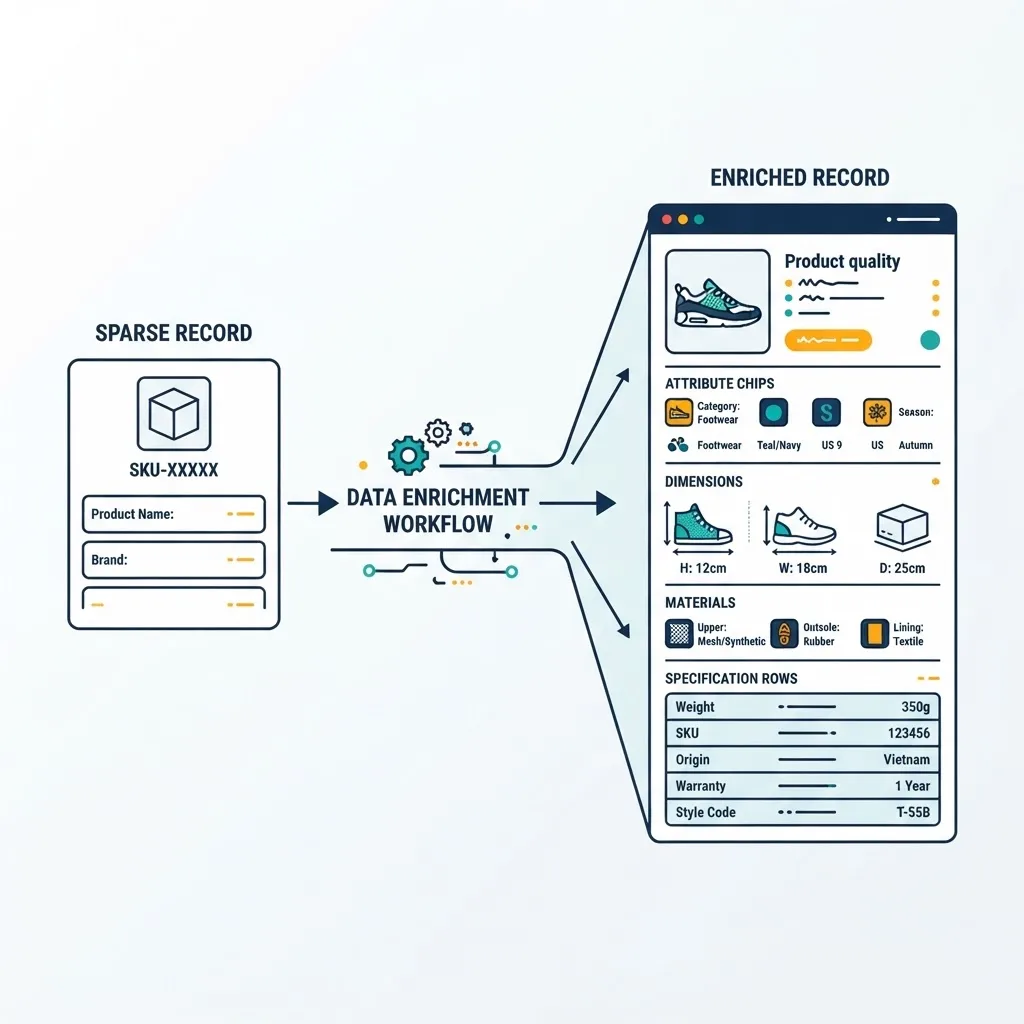
Stage 1: Collect and normalize the source
Start from supplier feeds, spec sheets, and manufacturer portals. Normalize units immediately, so every weight is in the same unit and every dimension follows the same order. Mixed units are the single most common cause of downstream filter failures.
Stage 2: Map to a master schema
Define a required attribute set per category before writing anything. A running shoe needs drop, cushioning, and width. A laptop needs processor generation, RAM, and port list. A generic schema applied to every category is why so many catalogs have half empty specification tables.
Stage 3: Write once, adapt per channel
Create a master description and a channel adaptation rule. Amazon rewards keyword rich structured titles with character limits, while your own product page rewards benefit led copy plus a full spec table. Same facts, different presentation.
Stage 4: Validate before publish
Automated validation should block a listing that has no primary image, a missing identifier, a price of zero, or a title over the channel limit. Catching this before publish is cheaper than fixing suppressed listings later.
Stage 5: Monitor and re enrich
Set a review cadence. Bestsellers get quarterly content refreshes, long tail products get annual reviews, and any product with a return rate above your threshold gets an immediate content audit.
Building a Taxonomy Shoppers and Search Engines Both Understand
Taxonomy is the skeleton of the catalog. Get it wrong and no amount of copywriting saves you.
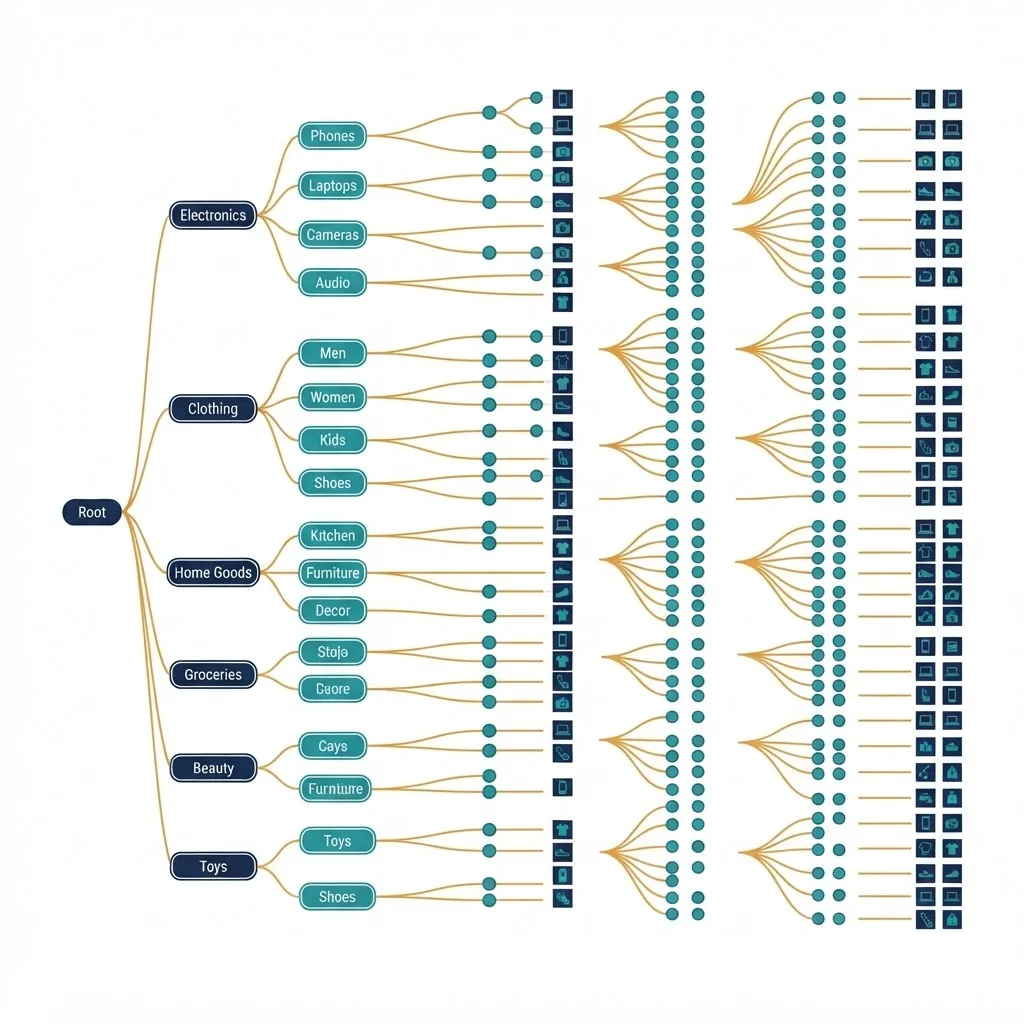
Three rules keep taxonomies healthy:
- Keep the tree shallow and the facets deep. Aim for a maximum of three category levels, then use filterable attributes for everything else. Deep nesting buries products and creates thin category pages.
- Name categories the way customers search. Use the language from your internal site search logs and search console queries, not internal product codes or supplier department names.
- One product, one canonical home. A product can appear in multiple collections, but it needs one canonical category URL to avoid duplicate content competing against itself.
A useful definition here: a facet is an attribute a shopper can filter by, such as size or brand, while a category is a permanent structural location in the tree. Treating every facet as a category is the fastest way to generate thousands of near duplicate pages.
Bulk Listing Optimization Without Losing Accuracy
When a catalog has 10,000 SKUs, manual editing is not an option. Bulk optimization is where catalog services earn their fee, and it depends on templates plus exception handling.
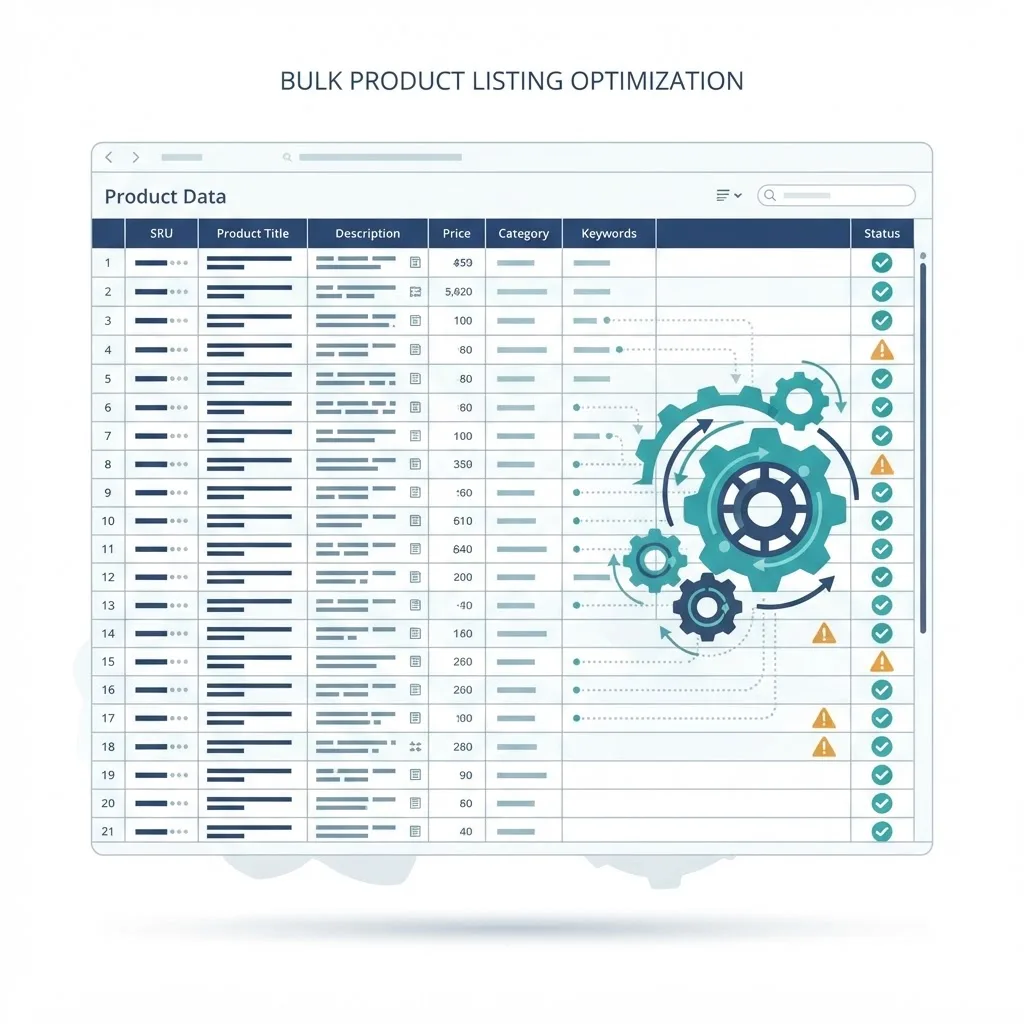
A proven approach:
- Segment the catalog into high revenue, mid tail, and long tail groups. Roughly 20 percent of SKUs usually generate the majority of revenue, and those deserve hand written content.
- Template the mid tail. Build title and description templates driven by attribute variables so structure stays consistent while the specifics stay accurate.
- Automate the long tail with rule based generation, then spot check a statistically meaningful sample rather than every record.
- Log every bulk change. Without a change log you cannot roll back a rule that damaged 4,000 listings overnight.
Stores that need this pipeline wired into a storefront and an ERP at the same time usually need engineering support alongside the content work, which is where scalable web solutions matter more than another spreadsheet.
Marketplace Syndication: One Master Record, Many Destinations
Every channel has its own required fields, character limits, image ratios, and category mapping. Syndication is the translation layer.

Key syndication decisions:
- Category mapping is the hardest part. Your internal category must map to each marketplace taxonomy, and a wrong mapping suppresses visibility even when the listing is live.
- Identifiers are non negotiable. Missing GTIN values are a leading cause of Google Merchant Center disapprovals and marketplace listing blocks.
- Image specs differ per channel. Square white background images for marketplaces, lifestyle imagery for social commerce, zoomable high resolution for your own site.
- Inventory buffers prevent oversells. Holding a small safety stock per channel is cheaper than the account health penalty of cancelled orders.
Catalog Data Quality Audit Checklist
Run this audit quarterly. It takes a day and it consistently surfaces revenue leaks.

- Percentage of SKUs with all required attributes filled
- Duplicate SKU and duplicate title detection
- Products with fewer than three images
- Products with no alt text on the primary image
- Titles exceeding channel character limits
- Price mismatches between storefront and marketplaces
- Out of stock products still indexed and advertised
- Orphan products with no category assignment
- Variants published without a parent relationship
- Descriptions identical to manufacturer boilerplate
In House, Freelancer, or Agency: Honest Comparison
| Factor | In House Team | Freelancer | Specialist Agency |
|---|---|---|---|
| Best catalog size | Under 1,000 SKUs | Under 500 SKUs | 1,000 plus SKUs |
| Setup speed | Slow, needs hiring | Fast | Fast with onboarding |
| Process documentation | Often informal | Rare | Standard deliverable |
| Multichannel syndication | Limited expertise | Usually limited | Core strength |
| Tooling and automation | You buy and maintain | You buy | Usually included |
| Cost pattern | Fixed salaries | Hourly, variable | Monthly retainer |
| Continuity risk | Medium | High | Low with SLA |
The practical rule: keep merchandising judgment and brand voice in house, and outsource the volume operations of enrichment, syndication, and audits.
Measuring Success With Catalog KPIs
Catalog work must be measured, otherwise it becomes invisible maintenance that budget owners cut first.
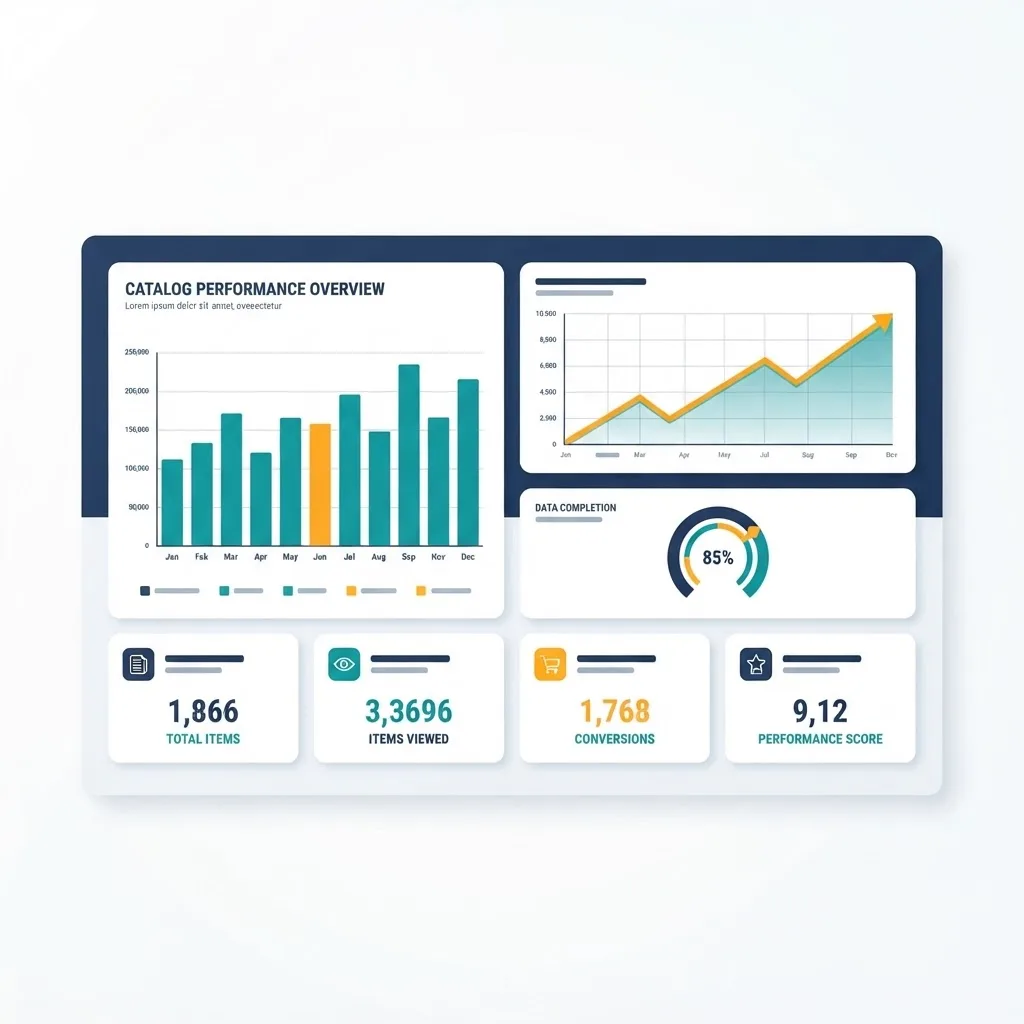
Track these seven metrics monthly:
- Attribute completeness rate: percentage of required fields filled per category. Target 95 percent or higher.
- Time to publish: hours from supplier data received to live listing. Target under 48 hours.
- Listing error rate: suppressed or disapproved listings as a share of total submissions.
- Internal search zero result rate: a direct signal of missing attributes or wrong naming.
- Product page conversion rate: compare enriched cohorts against unenriched control groups.
- Return rate attributed to product description: the clearest financial proof of data accuracy.
- Organic impressions on category and product pages: taxonomy and content improvements show here first.
Run enrichment as a controlled experiment where possible. Enrich 200 comparable products, leave a matched group untouched, and measure conversion difference over 30 days. That single test usually settles internal debates about catalog budget faster than any argument.
Mistakes That Quietly Cost the Most
- Copying manufacturer descriptions verbatim, which leaves your pages indistinguishable from every reseller.
- Treating images as decoration instead of data, so alt text and filenames carry no meaning.
- Letting each marketplace become its own manual silo instead of syndicating from one master record.
- Publishing new products faster than the quality rules can validate them.
- No ownership. When nobody owns catalog quality, it degrades by default every single quarter.
Key Takeaways
- Ecommerce catalog management services cover onboarding, enrichment, taxonomy, media, pricing and inventory sync, syndication, and ongoing governance.
- Roughly 87 percent of shoppers consider product content critical to their purchase decision, and Baymard Institute reports an average documented cart abandonment rate near 70 percent.
- Keep category trees to three levels and push detail into filterable facets to protect discovery and avoid duplicate pages.
- Segment the catalog: hand write the top 20 percent of revenue SKUs, template the mid tail, automate the long tail with sampled quality checks.
- Missing GTIN and identifier values are among the most common causes of marketplace and shopping feed disapprovals.
- Prove value with a controlled test comparing enriched and unenriched product cohorts over 30 days.
Frequently Asked Questions (FAQ)
What are ecommerce catalog management services?
They are outsourced or in house operations that build and maintain your product data. Work includes SKU creation, attribute enrichment, image handling, categorization, SEO copy, pricing and stock synchronization, marketplace syndication, and regular quality audits so every channel shows accurate, complete product information.
How much do catalog management services usually cost?
Pricing normally follows either a per SKU model or a monthly retainer. Per SKU work is common for one time onboarding, while retainers suit ongoing catalogs with frequent new products. Cost depends on attribute depth, number of sales channels, image editing needs, and required turnaround speed.
Do I need a PIM system for catalog management?
Not immediately. Below roughly 1,000 SKUs on one channel, a disciplined spreadsheet plus your platform admin can work. A PIM becomes necessary when you sell across multiple channels, manage complex variants, or need approval workflows and version history across several contributing teams.
How long does it take to clean up a messy product catalog?
A typical cleanup runs four to twelve weeks. Auditing and schema design take one to two weeks, bulk fixes and enrichment take most of the remaining time, and syndication testing follows. Large catalogs are phased by revenue priority so top selling products are corrected first.
Does catalog management improve SEO rankings?
Yes, indirectly and measurably. Complete attributes create richer product pages, valid structured data enables product rich results, clean taxonomy produces crawlable category pages, and unique descriptions remove duplicate content. Combined with better engagement signals, these improvements typically lift organic impressions within a few months.
How often should product data be audited?
Quarterly for the full catalog and monthly for bestsellers and newly added products. Automated checks for missing images, price mismatches, and broken identifiers should run continuously so errors are caught before customers see them rather than after sales are lost.
Final Thoughts
Catalog management is unglamorous and it is where a lot of ecommerce growth is actually decided. The stores that win are rarely the ones with the cleverest campaign. They are the ones where a shopper can find a product, understand it in ten seconds, trust that it is in stock, and receive exactly what the page described. Build the schema, document the rules, automate the validation, measure the result, and the catalog stops being a liability and becomes a compounding asset.