
A practical, hiring-focused comparison of the BA and BS in Computer Science, covering curriculum, math load, career outcomes, and how to choose the right one for your goals.
BA vs BS in Computer Science

Every year, thousands of students discover halfway through the application process that their target university offers two computer science degrees instead of one: a Bachelor of Arts (BA) and a Bachelor of Science (BS). The course catalog rarely explains the difference in plain language, and academic advisors often default to "they both work." That answer is technically true and practically useless. The two degrees route you through different math requirements, different elective structures, and different research access, and those differences compound over four years.
This guide breaks down what actually separates a BA from a BS in Computer Science, what hiring managers do and do not check, and how to pick based on your specific goals rather than on prestige assumptions.
Quick Answer: A BS in Computer Science is math- and science-heavy with more required technical depth, while a BA pairs core CS courses with liberal arts breadth and more free electives. Both qualify you for software engineering roles. Choose a BS for graduate school, systems, or machine learning; choose a BA for interdisciplinary or product-facing careers.
What Is a BA in Computer Science?
A BA in Computer Science is a computer science major housed within a college of arts and sciences, where the CS core is combined with substantial humanities, social science, and foreign language requirements. You still take data structures, algorithms, operating systems, and discrete mathematics. What changes is the ratio: a BA typically requires 10 to 14 CS courses instead of 16 to 20, and it replaces the extra technical credits with breadth requirements and free electives.
The misconception worth killing early is that a BA is a "CS-lite" or non-technical degree. At most institutions, both degrees share the same introductory sequence, the same professors, and the same core courses. The BA is not an easier version of the major; it is a narrower technical core surrounded by a wider intellectual footprint.

Who the BA Genuinely Suits
The BA is the stronger choice in four concrete situations:
- You want a real second discipline. The 20 to 30 free credits a BA frees up are enough for a full minor or even a double major in economics, linguistics, design, or biology.
- You are aiming at product, UX, or technical writing roles. These jobs reward communication and domain knowledge as much as coding ability.
- You need schedule flexibility. Athletes, students working significant hours, and transfer students often finish a BA on time when a BS would require an extra semester.
- You decided on CS late. A BA's shorter prerequisite chain makes a sophomore-year or junior-year switch mathematically possible.
What Is a BS in Computer Science?
A BS in Computer Science is a technically concentrated degree that adds required calculus, linear algebra, probability, statistics, and laboratory science on top of an expanded CS core. Expect two to four semesters of calculus, at least one physics or chemistry sequence with labs, and required upper-division technical electives in areas such as compilers, computer architecture, networks, or machine learning.
The BS is usually the degree accredited by ABET, the organization that accredits computing and engineering programs in the United States. ABET accreditation matters for a narrow but important set of paths: some government and defense employers, some professional licensure tracks, and a few international credential-recognition processes reference it directly.

Where the Extra Math Actually Pays Off
The extra quantitative load is not academic decoration. It becomes load-bearing in specific fields:
- Machine learning and AI: Linear algebra and multivariable calculus are prerequisites for understanding gradient descent, backpropagation, and optimization rather than just calling a library.
- Computer graphics and simulation: Matrix transformations, vector math, and numerical methods are used daily.
- Cryptography and security research: Number theory and discrete probability are foundational.
- Quantitative finance: Stochastic processes and statistics are gatekeeping requirements at most quant desks.
- PhD programs: Admissions committees read transcripts for proof-based math courses and undergraduate research.
If your target work lives in one of these areas, the BS is not a preference. It is the practical path.
BA vs BS in Computer Science: Side-by-Side Comparison
| Factor | BA in Computer Science | BS in Computer Science |
|---|---|---|
| Typical CS courses required | 10 to 14 | 16 to 20 |
| Math requirement | Discrete math, often one calculus course | Calculus I to III, linear algebra, statistics |
| Lab science requirement | Usually one course or none | Typically two semesters with labs |
| Free electives available | High (20 to 30 credits) | Low (6 to 12 credits) |
| Foreign language requirement | Often required | Rarely required |
| ABET accreditation | Rarely | Commonly |
| Second major or minor feasibility | Easy | Difficult |
| Best fit for graduate research | Possible with planning | Strongest default |
| Software engineering job eligibility | Yes | Yes |
| Average time to graduate | 4 years | 4 to 4.5 years |
The table clarifies the real trade-off: a BS buys technical depth by spending your elective budget, while a BA buys breadth by narrowing the technical core.

Do Employers Care Whether You Have a BA or a BS?
For mainstream software engineering roles, the answer is no. Applicant tracking systems and recruiters screen for the field of study and the institution, not the two-letter prefix. What decides interviews is your project portfolio, internship history, and performance in technical screens.
The evidence supports this. According to the U.S. Bureau of Labor Statistics, software developer employment is projected to grow 17 percent from 2023 to 2033, far faster than the average for all occupations, and the standard entry requirement is listed as a bachelor's degree in computer science or a related field, with no distinction between degree types. Separately, the National Association of Colleges and Employers has consistently found that problem-solving, teamwork, and communication rank among the competencies employers most want in new graduates, which is precisely where BA breadth earns its keep.
Where the prefix does matter is narrow and predictable:
- Defense and federal contractors that require ABET-accredited degrees for specific job classifications.
- Research labs and PhD admissions, where committees audit your math and research transcript line by line.
- Immigration and credential evaluation in a handful of countries that map a BS more cleanly to local engineering equivalents.

Career Outcomes and Salary Reality
Neither degree carries an inherent salary premium. Compensation in technology tracks role, location, company tier, and demonstrated skill. A BA graduate who completed three internships and shipped production code will out-earn a BS graduate with no internships almost every time.
What differs is the default gravity of each degree, meaning where graduates land when they do not actively steer:
- BS default paths: backend and systems engineering, machine learning engineering, embedded development, security engineering, graduate research.
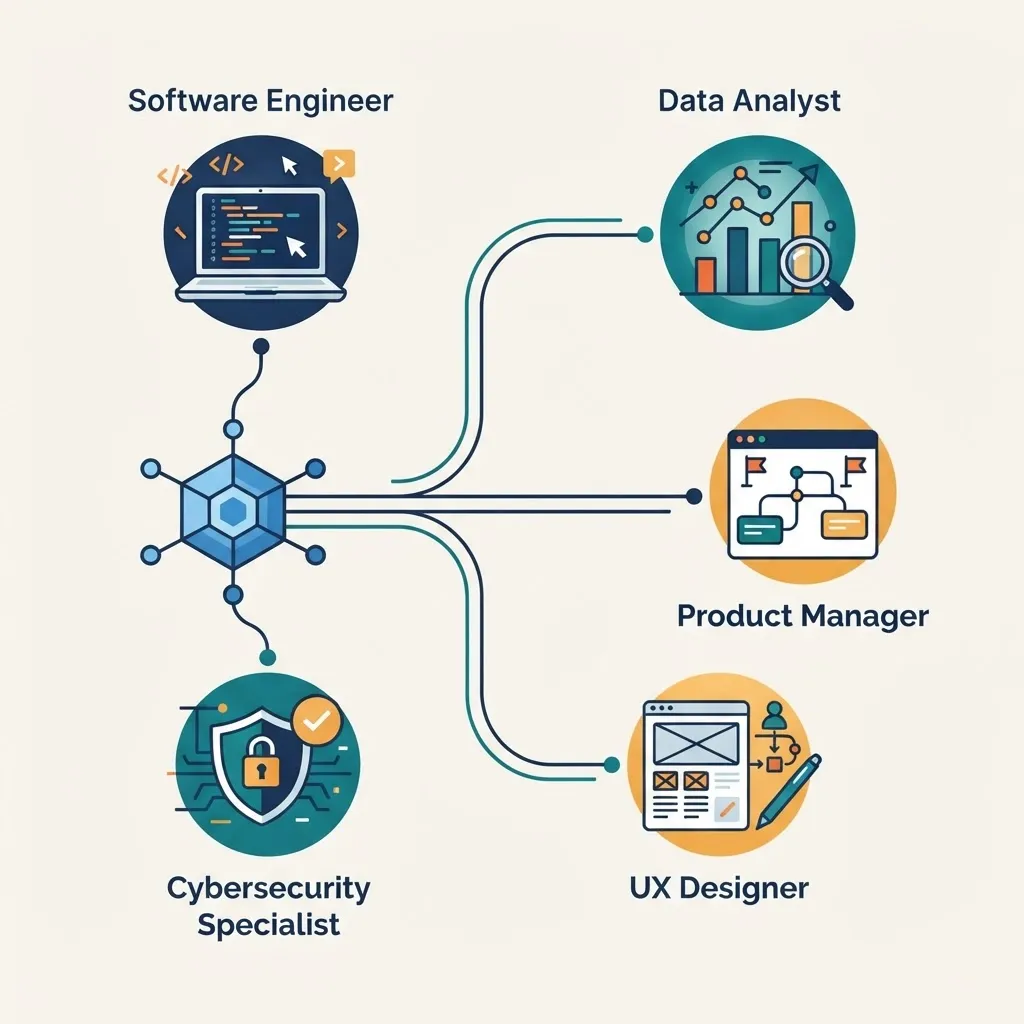
- BA default paths: full-stack and frontend development, product management, technical program management, developer relations, solutions engineering, data analysis.
Both sets of paths overlap heavily, and both can be redirected with intentional coursework. A BA student who elects linear algebra and probability can compete for machine learning roles. A BS student who takes writing-intensive courses and leads a student organization can compete for product roles. The degree sets the default, not the ceiling.
This is the same pattern we see across the technology industry, where teams building modern products need engineers, designers, and strategists who can speak each other's language. Agencies like ZoneTechify and WebPeak staff projects on demonstrated capability and portfolio evidence, not on which prefix appears on a diploma.
How to Choose: A Five-Question Framework
Skip the prestige debate and answer these five questions honestly. Your answers will point clearly to one degree.
1. Do You Want a PhD or a Research Career?
If yes, choose the BS. Graduate admissions committees expect proof-based mathematics, upper-division theory, and undergraduate research experience. A BA can get you there, but you will need to add those courses voluntarily, and advisors will not schedule them for you.
2. Is There a Second Field You Genuinely Care About?
If you can name it specifically, such as cognitive science, economics, music technology, or public policy, the BA gives you the credit room to pursue it properly. A vague desire for "flexibility" is not a reason to pick the BA.
3. How Do You Actually Perform in Math?
Be honest, not aspirational. A BS with three calculus courses you struggle through and a 2.6 GPA is worse for your career than a BA with a 3.7 and two strong internships. Recruiters see grades; they do not see difficulty adjustments.
4. Does Your Target Employer Require ABET Accreditation?
Spend twenty minutes checking. Search three to five job postings at companies you actually want to work for and look for the phrase "ABET-accredited." If it appears, that settles the question.
5. Which Specific Courses Differ at Your University?
This is the step almost everyone skips. Pull up both degree requirement sheets side by side and highlight the differences. Degree structures vary dramatically between institutions, and at some schools the two programs differ by only three courses.

Practical Steps to Strengthen Either Degree
The degree type explains a small fraction of career outcomes. These actions explain far more, and they apply regardless of which path you choose.
- Ship three portfolio projects that solve real problems. A deployed application with actual users outperforms ten tutorial clones.
- Secure an internship by the summer after sophomore year. Internship-to-offer conversion is the single most reliable entry route into technology.
- Take data structures and algorithms seriously. Technical interviews still center on this material at nearly every company.
- Add the highest-leverage courses your degree does not require. BA students should consider linear algebra and probability. BS students should consider technical writing and a systems elective outside their comfort zone.
- Build one non-CS skill deliberately. Writing, public speaking, or design will differentiate you in promotion conversations for the next twenty years.
- Keep a version-controlled record of everything you build. A public commit history is verifiable evidence of consistency.

Key Takeaways
- A BS in Computer Science requires 16 to 20 CS courses plus calculus, linear algebra, statistics, and lab sciences; a BA requires 10 to 14 CS courses plus liberal arts breadth.
- For mainstream software engineering roles, employers do not distinguish between a BA and a BS. Portfolio, internships, and interview performance decide outcomes.
- ABET accreditation is typically attached to the BS and matters mainly for defense, government, and certain international credential-recognition paths.
- The U.S. Bureau of Labor Statistics projects 17 percent growth in software developer employment from 2023 to 2033, with a bachelor's degree in CS or a related field as the standard entry requirement.
- Choose the BS for machine learning, systems, graphics, cryptography, quantitative finance, or PhD ambitions. Choose the BA for interdisciplinary, product-facing, or communication-heavy careers.
- Requirements vary significantly by university. Always compare both official degree sheets at your specific institution before deciding.
Frequently Asked Questions (FAQ)
Is a BA in computer science respected by employers?
Yes. Employers hiring software engineers screen for a computer science degree, not the BA or BS prefix. Interview performance, internships, and portfolio projects determine outcomes. The BA is only a disadvantage for roles that explicitly require ABET accreditation, which is a small minority of postings.
Can I get a software engineering job with a BA in computer science?
Absolutely. BA graduates work as software engineers at every tier of the industry, including major technology companies. Both degrees cover data structures, algorithms, and systems fundamentals, which is what technical interviews test. Complete internships and build shipped projects, and the degree prefix becomes irrelevant to recruiters.
Which degree is harder, a BA or a BS in computer science?
The BS is generally harder because it requires more calculus, linear algebra, statistics, and lab sciences alongside additional upper-division CS courses. The BA is not easier academically in its CS core; it simply substitutes some technical depth for humanities and language breadth requirements instead.
Do I need a BS in computer science for machine learning jobs?
Not strictly, but the BS math sequence gives you a real advantage. Machine learning roles expect fluency in linear algebra, multivariable calculus, and probability. BA students can compete by electively taking those exact courses, which most BA programs permit within their free elective allowance.
Can I switch from a BA to a BS in computer science later?
Usually yes, but timing matters. Switching before the end of sophomore year is normally straightforward. Later switches often add a semester because the BS calculus and lab science sequences are prerequisite chains that cannot be compressed. Confirm the deadline with your department advisor early.
Does a BA or BS in computer science affect graduate school admission?
The BS is the stronger default for research-oriented graduate programs because committees look for proof-based mathematics, theory coursework, and research experience. BA applicants are admitted regularly when they deliberately add those courses, secure faculty research positions, and earn strong recommendation letters.
Final Verdict
There is no universally superior choice between a BA and a BS in Computer Science. There is only the better fit for your goals. Pick the BS if your ambitions live in mathematically dense fields or academic research. Pick the BA if you want to combine computing with a second discipline or move toward product and communication-heavy roles.
Then stop worrying about it. Four years from now, no interviewer will ask which prefix your diploma carried. They will ask what you built, what broke, and how you fixed it. Spend your energy on having good answers to those three questions.