A practical look at how AI is compressing research and product cycles in 2026, with real workflows, measurable gains, and the guardrails teams need to keep results trustworthy.
How AI Is Accelerating Scientific Discovery and Product Innovation in 2026
AI stopped being a research novelty and became lab infrastructure. In 2026, the meaningful change is not that models can write hypotheses, it is that they can rank thousands of them before a single experiment consumes reagents, compute budget, or engineering hours. The same shift is reshaping product teams: instead of guessing which three features to build this quarter, teams simulate demand, generate variants, and validate against real usage data in days.
This article explains exactly where the acceleration comes from, what the measurable gains look like, and where AI still fails. Every section is written for people who have to make decisions with budgets attached.
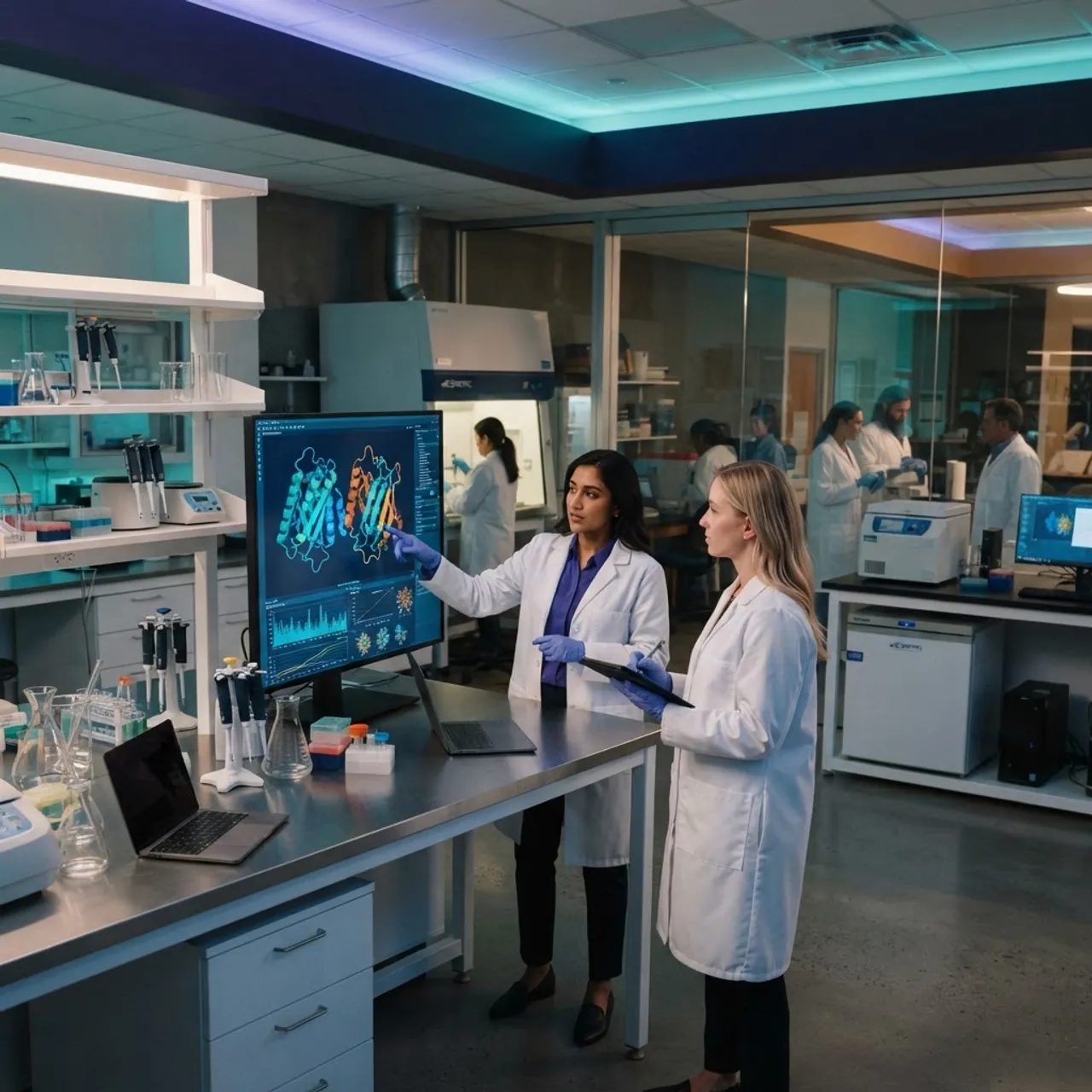
Quick Answer: AI accelerates discovery and innovation in 2026 by shrinking the search space before physical work begins. Models predict structures, simulate materials, and rank candidates so labs test the best options first. Product teams use the same pattern to prototype, forecast, and validate faster, cutting cycle times from months to weeks.
What Changed Between 2023 and 2026
The difference is closed loops. Early generative AI produced suggestions that humans had to manually verify, which limited real speed gains. Modern research stacks connect prediction, execution, and measurement into one loop, so each experiment automatically improves the next round of predictions.
Three concrete shifts drive this:
- Prediction quality crossed a usable threshold. DeepMind's AlphaFold released predicted structures for over 200 million proteins in 2022, effectively covering nearly every catalogued protein known to science and removing structure determination as a routine bottleneck.
- Compute became elastic. Simulation workloads that once required an institutional cluster now run as scheduled cloud jobs, so a five person team can evaluate candidate sets that previously demanded a national lab.
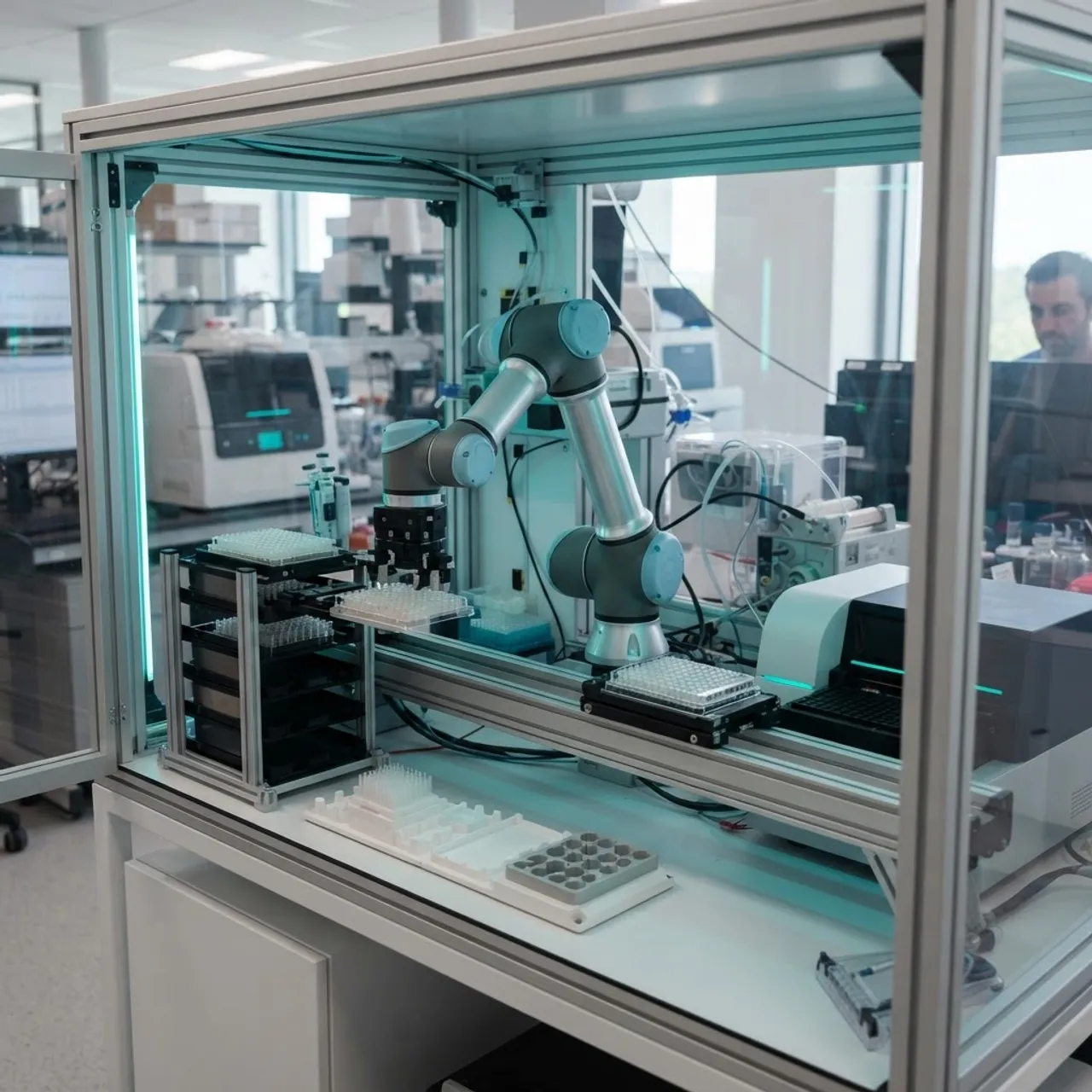
- Instruments became programmable. Liquid handlers, plate readers, and characterization tools expose APIs, which means a model can propose an experiment and trigger it without a human transcribing values.
The original insight worth stating plainly: AI does not make experiments faster. It makes fewer experiments necessary. That distinction determines whether a team actually saves money or just adds another software subscription.
Key Terms, Defined Clearly
Surrogate model: A fast machine learning model trained to approximate the output of an expensive simulation or physical experiment, used to screen candidates cheaply.
Active learning: A loop where the model chooses which experiment to run next based on where its own uncertainty is highest, maximizing information gained per test.
Self driving lab: A facility where AI selects experiments and robotic hardware executes them with minimal human intervention between cycles.
Generative design: Using AI to produce many candidate designs constrained by real engineering requirements such as weight, cost, thermal limits, or manufacturability.
Drug Discovery: The Clearest Proof Case
Biology is where AI acceleration is easiest to measure, because the traditional baseline is painfully well documented. Bringing a single new drug to market has historically taken roughly ten to fifteen years, with capitalized costs commonly estimated in the billions of dollars, and the majority of that waste concentrated in candidates that fail late.
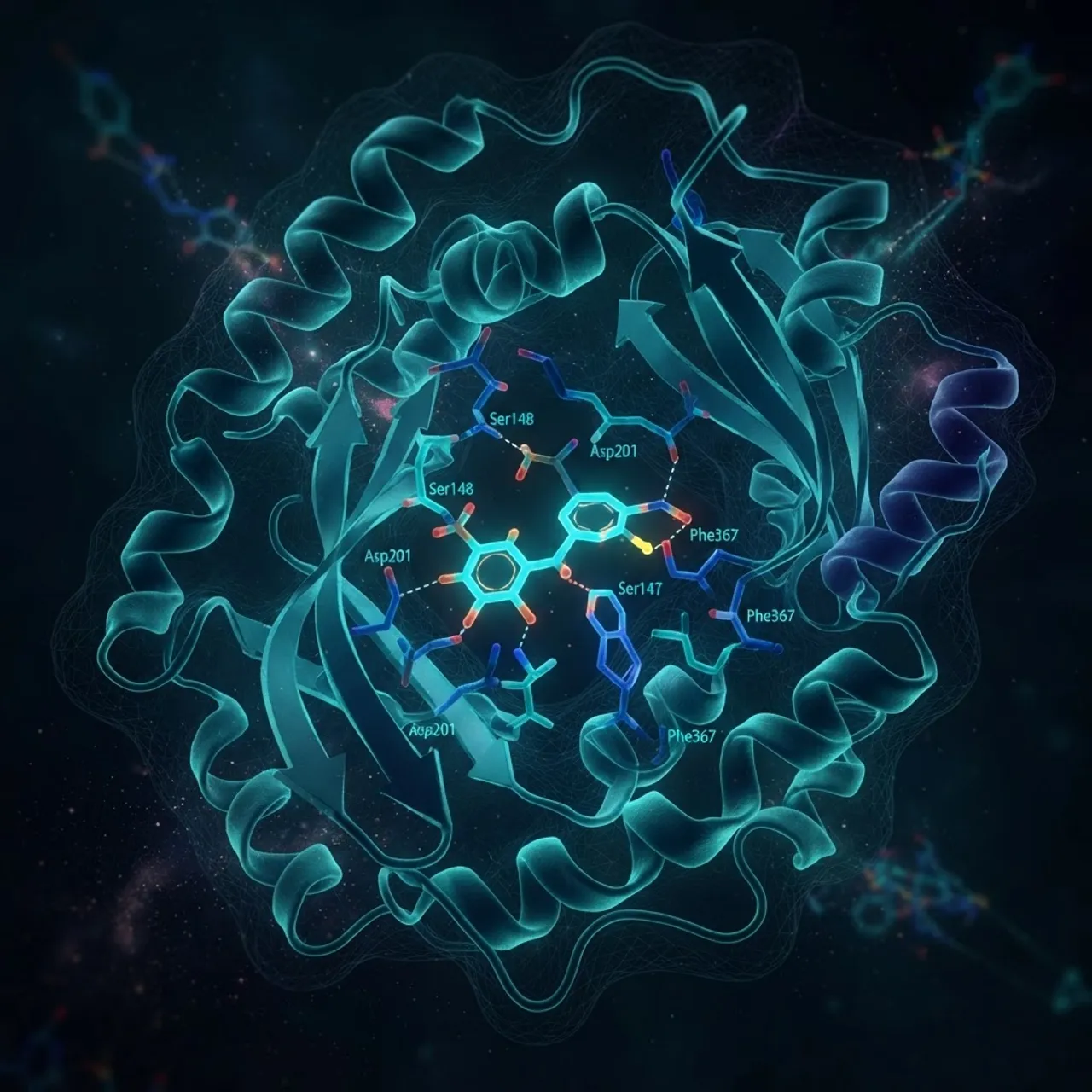
AI attacks the front of that pipeline in four ways:
- Target identification. Models trained on multi omics data rank which biological targets are plausibly causal rather than merely correlated with disease.
- Structure prediction. Predicted protein structures let chemists reason about binding pockets without waiting on crystallography.
- Virtual screening. Millions of compounds are scored computationally, so wet lab work starts with a shortlist of hundreds.
- Toxicity flagging. Early liability prediction kills bad candidates before they consume years of preclinical work.
The honest caveat: discovery speed has improved far more than approval speed. Clinical trials remain rate limited by biology, recruitment, and regulation. Teams that promise AI shortened trials are overselling. Teams that promise a shorter path to a defensible candidate are describing something real.
Materials Science and Chemistry
Materials research benefits most from the surrogate model pattern. Density functional theory calculations are accurate but slow, so groups train fast models on existing calculation databases and use them to screen enormous candidate spaces before committing real simulation time.

A typical 2026 workflow looks like this:
- Define the target property window, for example ionic conductivity above a threshold with no cobalt content.
- Generate candidate compositions with a generative model constrained by known chemistry rules.
- Score all candidates with a surrogate model in minutes.
- Run rigorous simulation only on the top fraction of one percent.
- Synthesize the handful of survivors and feed measured results back into training.
The leverage is in step three and step four. Screening ten thousand candidates cheaply and simulating twenty carefully is a fundamentally different economic proposition than simulating two hundred and hoping.
How Product Teams Use the Same Playbook
Product innovation is a search problem too. The candidate space is features, layouts, pricing, and positioning, and the expensive step is engineering time rather than reagents.

High performing teams in 2026 apply four moves:
- Prototype breadth, then narrow. Generate five working interface variants instead of debating one mockup, then test them against real users in a week.
- Synthetic pre testing. Use models to surface obvious usability failures and edge cases before recruiting human testers, saving research sessions for questions only humans can answer.
- Instrumented rollouts. Ship behind flags, measure activation and retention deltas, and let the data end the argument.
- Automated research synthesis. Compress hundreds of support tickets and interview transcripts into ranked, evidence linked problem statements.
Agencies that build these loops for clients treat AI as delivery infrastructure rather than a feature. The team at ZoneTechify applies this pattern through its AI workflow solutions, wiring prediction and measurement into the same release process so results compound instead of resetting each quarter.
Measurement Is the Real Bottleneck
Acceleration without measurement produces confident nonsense at scale. The teams getting genuine returns instrument three things before they scale any AI workflow: baseline cycle time, cost per validated result, and the false positive rate of model predictions against physical outcomes.

That third metric is the one most organizations skip, and it is the one that determines trust. A model that shortlists candidates with a sixty percent hit rate transforms a lab. The same model at five percent quietly wastes more time than manual selection, because every false positive still consumes full experimental cost.
Where AI Helps and Where It Still Fails
| Workflow Stage | AI Impact in 2026 | Realistic Limitation |
|---|---|---|
| Literature and prior art review | Very high, hours instead of weeks | Citation errors require human verification |
| Hypothesis generation and ranking | High, broad coverage of candidates | Novelty is bounded by training data |
| Structure and property prediction | High for well studied domains | Accuracy drops on rare chemistries |
| Physical experimentation | Moderate, via lab automation | Hardware and reagent costs are unchanged |
| Clinical or field validation | Low | Regulation and biology set the pace |
| Product prototyping | Very high, days instead of sprints | Still needs real user validation |
| Manufacturing and scale up | Moderate | Physical supply chains dominate timelines |
Building the Loop: A Practical Sequence
Organizations that succeed follow a consistent order. Skipping steps is the most common failure mode.
- Digitize your data first. Models cannot learn from results locked in spreadsheets on personal drives. Structured, queryable experiment records are the prerequisite.
- Start with screening, not autonomy. Let AI rank candidates while humans decide. Prove the hit rate before automating execution.
- Close the feedback loop. Every physical result, including failures, must flow back into training. Discarded negative results are the most undervalued asset in most labs.
- Automate the repetitive middle. Sample prep, data capture, and report generation are safer automation targets than judgment calls.
- Keep a human accountable for every published claim. Attribution and review are non negotiable for credibility.
The Team Structure That Actually Works
The organizational pattern matters as much as the tooling. Effective 2026 research and product teams are small, senior, and mixed. A domain scientist, a data engineer, and a software engineer working in one loop consistently outperform larger groups that hand work across departmental boundaries.
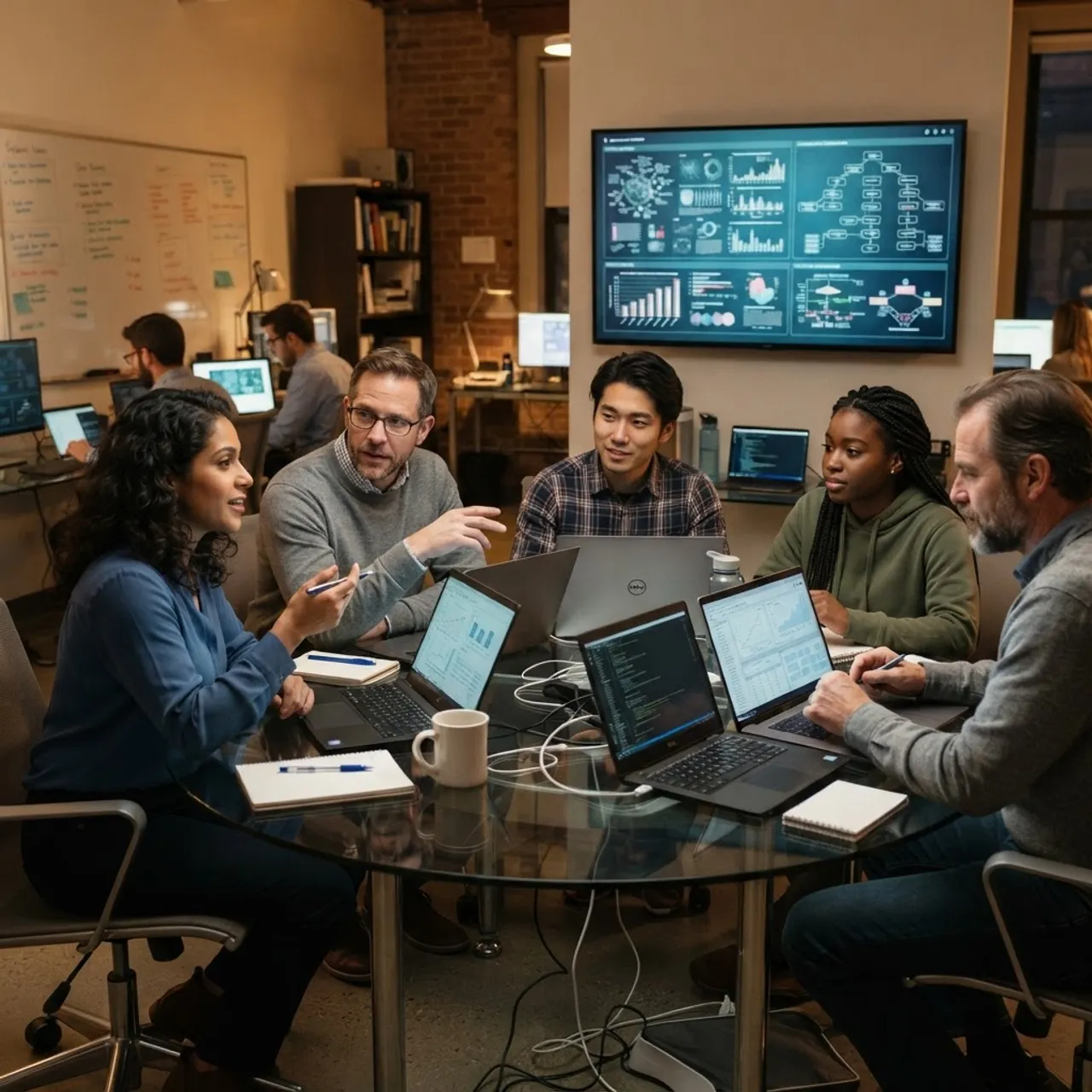
The reason is latency. Every handoff adds days and strips context. When the person who understands the chemistry sits next to the person who owns the data pipeline, a failed prediction becomes a fixed model the same afternoon. Teams that lack in house engineering depth often partner with a senior only build team such as WebPeak to stand up the data and application layer, then keep domain judgment internal where it belongs.
Key Takeaways
- AI accelerates discovery primarily by reducing the number of experiments needed, not by making individual experiments faster.
- AlphaFold released predicted structures for over 200 million proteins in 2022, removing structure determination as a routine bottleneck.
- Traditional drug development has spanned roughly ten to fifteen years per approved therapy, and AI compresses the discovery phase far more than the clinical phase.
- Surrogate models plus active learning are the core technical pattern behind materials and chemistry gains.
- Product teams apply the identical pattern: generate many candidates, screen cheaply, validate the survivors with real users.
- Track false positive rate against physical outcomes. Without it, apparent acceleration can increase total cost.
- Negative results are training data. Labs that discard failures lose their strongest competitive asset.
Frequently Asked Questions (FAQ)
Is AI actually making scientific discovery faster, or is it just hype?
It is genuinely faster in specific stages. Literature review, candidate screening, and structure prediction have improved dramatically and measurably. Physical experimentation, clinical validation, and manufacturing scale up are still governed by real world constraints, so total time to market improves less than headlines suggest.
Do small companies need supercomputers to use AI for research?
No. Most 2026 workflows run on elastic cloud compute billed by the job, and many foundation models for biology and chemistry are openly available. The practical barrier is data quality and engineering capacity, not hardware access, which is why small senior teams often move fastest.
Can AI replace scientists or product managers?
No. AI expands the number of options a team can evaluate, but it cannot decide which problems are worth solving or take accountability for a claim. The role shifts toward framing questions well, validating outputs rigorously, and interpreting results in context.
What is the single biggest mistake teams make when adopting AI for innovation?
Automating before measuring. Teams deploy models without recording a baseline cycle time or checking prediction accuracy against physical outcomes. Without those numbers you cannot tell whether the system saves resources or quietly wastes them on confident false positives.
How long does it take to see real results from an AI research workflow?
Expect a few weeks for literature and analysis gains, and roughly one to two quarters for screening loops that measurably reduce experiment counts. The timeline depends far more on how organized your existing data is than on which model you choose.
Which industries are seeing the strongest gains in 2026?
Pharmaceuticals, battery and materials research, semiconductor design, and software product development lead, because each has large searchable candidate spaces and well instrumented feedback. Fields dominated by physical logistics or heavy regulation see slower end to end acceleration despite strong early stage improvements.