
Discover how AI-powered regulatory affairs services automate submissions, compliance monitoring, and pharmacovigilance to cut timelines, reduce errors, and speed approvals.
Artificial Intelligence Powered Regulatory Affairs Services
Regulatory affairs has always been the gatekeeper between a finished product and the patients who need it. For decades, that gate was managed by armies of specialists manually assembling dossiers, cross-checking guidelines, and racing submission deadlines. Today, artificial intelligence is rewriting that workflow. AI-powered regulatory affairs services use machine learning, natural language processing, and intelligent automation to handle the repetitive, error-prone, and document-heavy work that once consumed entire teams.
This guide explains exactly what these services do, where they deliver measurable value, and how life sciences and tech-driven companies can adopt them responsibly. Whether you are a startup preparing your first FDA submission or an enterprise managing thousands of global filings, understanding this shift is no longer optional.

Quick Answer: AI-powered regulatory affairs services use machine learning and natural language processing to automate submissions, compliance monitoring, document management, and safety reporting. They reduce manual errors, accelerate approval timelines, and help companies stay continuously aligned with evolving global regulations like those from the FDA and EMA.
What Are AI-Powered Regulatory Affairs Services?
AI-powered regulatory affairs services are technology-enabled solutions that apply artificial intelligence to the planning, preparation, submission, and maintenance of regulatory documentation. In simple terms, they combine human regulatory expertise with software that can read, classify, generate, and validate compliance content at machine speed.
Traditional regulatory affairs relied on manual interpretation of guidelines and painstaking document assembly. AI changes the equation by automating pattern recognition across thousands of pages, flagging inconsistencies, and predicting which submission strategies are most likely to succeed. The human expert remains in control, but the grunt work moves to the machine.
These services typically span four pillars: regulatory submissions, compliance monitoring, pharmacovigilance and safety, and regulatory intelligence. Each pillar benefits from a different flavor of AI, from generative models that draft narrative text to predictive models that forecast approval risk.
Why AI Matters in Regulatory Affairs Today
The regulatory landscape is growing more complex every year. According to industry analysis published by Deloitte, the average cost to bring a new drug to market exceeds $2 billion, and regulatory delays are a leading contributor to that figure. Even a few months saved on submission cycles can translate into millions in recovered revenue and faster patient access.
There is also a documentation explosion. A single new drug application can contain hundreds of thousands of pages across eCTD modules. Reviewing that volume manually invites human error, and even minor formatting mistakes can trigger costly rejections. Research from the FDA has repeatedly shown that a significant share of submission deficiencies stem from quality and completeness issues rather than the science itself.
AI directly attacks both problems. It compresses timelines and dramatically improves consistency. Companies investing in digital transformation, such as those working with specialized partners like ZoneTechify and WebPeak, are increasingly treating regulatory automation as a strategic advantage rather than a back-office cost.
How AI Automates Regulatory Submissions

Submission preparation is the most visible win for AI in regulatory affairs. Assembling an electronic Common Technical Document (eCTD) traditionally requires manually organizing files, validating hyperlinks, checking formatting, and ensuring every module aligns with agency specifications.
AI-powered systems streamline this through several capabilities:
- Automated document classification — Machine learning sorts incoming files into the correct eCTD modules without manual tagging.
- Intelligent content generation — Generative AI drafts repetitive sections such as summaries, justifications, and cover letters from structured data.
- Validation and gap detection — The system checks completeness against agency rules before submission, flagging missing elements early.
- Cross-document consistency checks — NLP compares terminology, dosages, and claims across the entire dossier to catch contradictions.
The practical result is faster turnaround and fewer rejections. Teams that once spent weeks formatting can redirect that time to scientific strategy and agency negotiation.
Real-Time Compliance Monitoring With Machine Learning

Regulations are not static. Agencies update guidance documents, regional requirements shift, and a change in one market can ripple across global filings. Manually tracking these changes across dozens of jurisdictions is nearly impossible at scale.
Machine learning solves this with continuous monitoring. AI systems ingest regulatory updates from sources like the FDA, EMA, and MHRA, then automatically map each change to the products and submissions it affects. Instead of a quarterly manual review, compliance teams receive prioritized alerts the moment a relevant rule changes.
Key definition: Continuous compliance is the practice of maintaining real-time alignment with current regulations rather than checking compliance only at fixed intervals. AI makes continuous compliance feasible by scanning, interpreting, and routing regulatory changes automatically.
This proactive posture reduces the risk of non-compliance penalties and prevents the expensive scramble that happens when a requirement changes shortly before a deadline.
AI in Pharmacovigilance and Drug Safety

Pharmacovigilance, the monitoring of adverse drug events, is one of the most data-intensive areas in regulatory affairs. Safety teams must process individual case safety reports (ICSRs) from clinical trials, patients, social media, and medical literature, often under strict reporting deadlines.
AI transforms this workflow in three ways. First, NLP extracts adverse event details from unstructured text, including emails and scanned forms. Second, machine learning prioritizes cases by seriousness so urgent signals reach reviewers faster. Third, signal detection algorithms identify emerging safety patterns across large datasets that humans might miss.
The stakes are high: late or missed safety reporting can lead to regulatory action and, more importantly, patient harm. By automating intake and triage, AI helps safety teams focus their expertise where human judgment matters most while ensuring nothing slips through the cracks.
Regulatory Intelligence and Predictive Insights
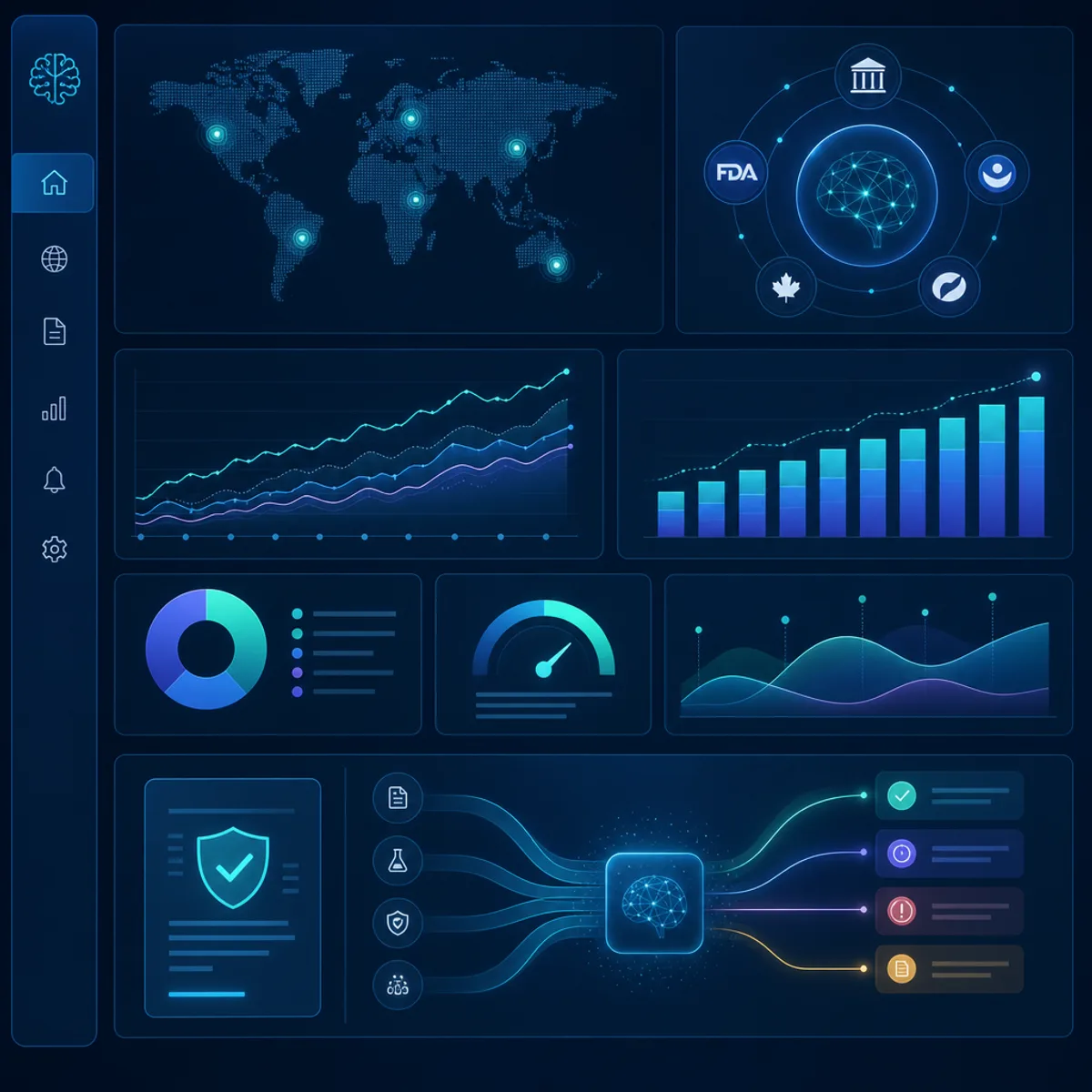
Beyond automation, AI delivers foresight. Regulatory intelligence platforms aggregate historical submission data, approval timelines, and agency feedback to predict outcomes before a filing is made.
For example, predictive models can estimate the likelihood of a first-cycle approval based on the completeness of a dossier and historical patterns for similar products. This lets companies fix weaknesses before submitting rather than after receiving a deficiency letter. Dashboards visualize where each submission stands globally, turning fragmented data into a single source of truth.
This is where AI shifts from a cost-saving tool to a strategic asset. Companies offering dedicated artificial intelligence services help regulatory teams build these predictive models on top of their existing data, while AI consultancies such as WebPeak's AI services focus on integrating intelligent automation into established compliance workflows.
Intelligent Document Management

Document management sounds mundane, but in regulatory affairs it is mission-critical. A single labeling document may exist in dozens of language variants, versions, and regional formats. Losing track of the correct version can cause serious compliance failures.
AI-powered document management uses optical character recognition and semantic search to make every document instantly findable and traceable. It automatically applies version control, detects duplicates, and links related documents across submissions. When a regulator requests a specific revision history, the system reconstructs it in seconds instead of days.
This capability also strengthens audit readiness. Because every change is logged and searchable, organizations can demonstrate a clear, defensible compliance trail whenever inspectors arrive.
Traditional vs. AI-Powered Regulatory Affairs
| Factor | Traditional Approach | AI-Powered Approach |
|---|---|---|
| Submission prep time | Weeks of manual assembly | Days with automated drafting |
| Error detection | Manual, late-stage review | Continuous, automated validation |
| Compliance tracking | Periodic manual checks | Real-time monitoring and alerts |
| Safety report intake | Manual data entry | NLP-driven extraction and triage |
| Scalability | Limited by headcount | Scales with data volume |
| Predictive insight | Minimal | Approval-risk forecasting |
Best Practices for Adopting AI in Regulatory Affairs
Adopting AI responsibly requires more than buying software. Based on real implementation experience, the following practices separate successful rollouts from stalled pilots:
- Start with a high-volume, low-risk process such as document classification before automating safety reporting.
- Keep humans in the loop. AI should augment regulatory experts, not replace their final judgment, especially for legally binding decisions.
- Validate your models. Regulators expect documented evidence that AI tools perform reliably and consistently.
- Prioritize data quality. AI is only as good as the structured, clean data feeding it.
- Ensure transparency. Choose explainable systems so you can justify every automated decision during an audit.
The Future of AI in Regulatory Affairs

The trajectory is clear. Agencies themselves are exploring AI to speed reviews, and structured data standards are making submissions increasingly machine-readable. In the near future, we can expect cloud-based regulatory platforms where AI drafts, validates, and submits filings with minimal manual touchpoints, all while maintaining a fully auditable human-oversight layer.
The regulatory professional of tomorrow will spend less time formatting documents and more time on strategy, agency relationships, and scientific interpretation. That is a healthier, higher-value use of expensive human expertise, and it ultimately gets safe products to patients faster.
Key Takeaways
- AI-powered regulatory affairs services automate submissions, compliance monitoring, pharmacovigilance, and document management.
- Bringing a drug to market can exceed $2 billion, and AI directly reduces the regulatory delays that inflate that cost.
- Continuous compliance, enabled by machine learning, replaces risky periodic manual checks with real-time alerts.
- Predictive intelligence forecasts approval risk so teams fix issues before submitting.
- Human oversight, model validation, and clean data remain essential for responsible AI adoption.
Frequently Asked Questions (FAQ)
What does AI do in regulatory affairs?
AI automates document-heavy and repetitive regulatory tasks. It classifies and drafts submission content, validates dossiers for completeness, monitors changing regulations in real time, and extracts adverse event data for safety reporting. This reduces errors, accelerates approval timelines, and lets human experts focus on strategy and scientific judgment.
Can AI replace regulatory affairs professionals?
No. AI augments regulatory professionals rather than replacing them. It handles repetitive tasks like formatting, data extraction, and validation, but final legal and scientific decisions still require human expertise. The most effective model keeps humans firmly in the loop while AI accelerates the supporting work behind every submission.
Is AI safe and compliant for regulatory submissions?
Yes, when implemented responsibly. Regulators expect documented validation showing that AI tools perform consistently and transparently. Companies should use explainable systems, maintain audit trails, and keep human oversight on binding decisions. Done correctly, AI improves compliance accuracy rather than introducing risk into the submission process.
How much time can AI save in regulatory submissions?
AI can compress submission preparation from weeks to days by automating document assembly, drafting, and validation. While exact savings vary by organization and submission type, teams commonly redirect significant hours away from formatting and toward scientific strategy, agency communication, and higher-value regulatory decision-making.
Which regulatory tasks should you automate first?
Start with high-volume, low-risk tasks such as document classification, version control, and completeness validation. These deliver fast, measurable wins with minimal compliance exposure. Once your team trusts the system and validates its accuracy, you can extend automation to more sensitive areas like pharmacovigilance and predictive submission analytics.