A practical review of how artificial intelligence is transforming satellite communication, from signal processing and spectrum management to autonomous constellations and security.
Artificial Intelligence for Satellite Communication a Review
Satellite communication has quietly become the backbone of modern connectivity, carrying everything from global broadband and military links to weather data and emergency response signals. Yet the systems running these networks were, until recently, built on rigid, manually tuned rules. As constellations grow from dozens of satellites into thousands, that old approach simply cannot keep up. This is where artificial intelligence steps in, turning slow, human-dependent operations into fast, adaptive, and largely autonomous systems.
This review examines how AI is reshaping satellite communication in 2026, what genuinely works today, where the technology still struggles, and what teams building space-connected products should expect next. The goal is simple: give you a clear, expert-level picture you can actually act on.
Quick Answer: Artificial intelligence improves satellite communication by automating signal processing, managing spectrum and bandwidth in real time, coordinating large constellations autonomously, predicting hardware failures, and defending against cyber threats. It boosts throughput, reduces interference and latency, and lets operators run thousands of satellites that humans alone could never manage.

What Is AI for Satellite Communication?
AI for satellite communication refers to the use of machine learning, deep learning, and intelligent automation to operate, optimize, and protect satellite networks. Instead of following fixed engineering rules, these systems learn from live telemetry and historical data to make decisions on their own.
In practice, that means an algorithm can detect interference and re-route a signal in milliseconds, allocate bandwidth to the busiest region of the planet without an operator pressing a button, or flag a failing component weeks before it breaks. The defining trait is adaptability: the network responds to changing conditions rather than waiting for a human in a control room.
This shift matters because satellite environments are unpredictable. Weather, orbital mechanics, solar activity, and sudden spikes in user demand all affect link quality. Rule-based systems handle the average case; AI handles the messy, real-world exceptions.
Why Satellite Networks Need AI Now
The scale of modern space infrastructure has outgrown manual control. According to the European Space Agency, there are now more than 11,000 active satellites in orbit, and that number is climbing fast as low-Earth-orbit (LEO) broadband constellations expand. Coordinating thousands of fast-moving objects, each handing off connections every few minutes, is beyond practical human management.
Demand is climbing just as quickly. Analysts at McKinsey estimate that the space economy could reach roughly $1.8 trillion by 2035, with connectivity services as a major driver. More satellites and more users mean more interference, more spectrum congestion, and more failure points, exactly the conditions where AI delivers measurable value.
There is also a cost angle. Every minute of manual troubleshooting or under-used bandwidth is wasted money. Automating these decisions improves both reliability and return on a very expensive asset.
How AI Improves Satellite Communication
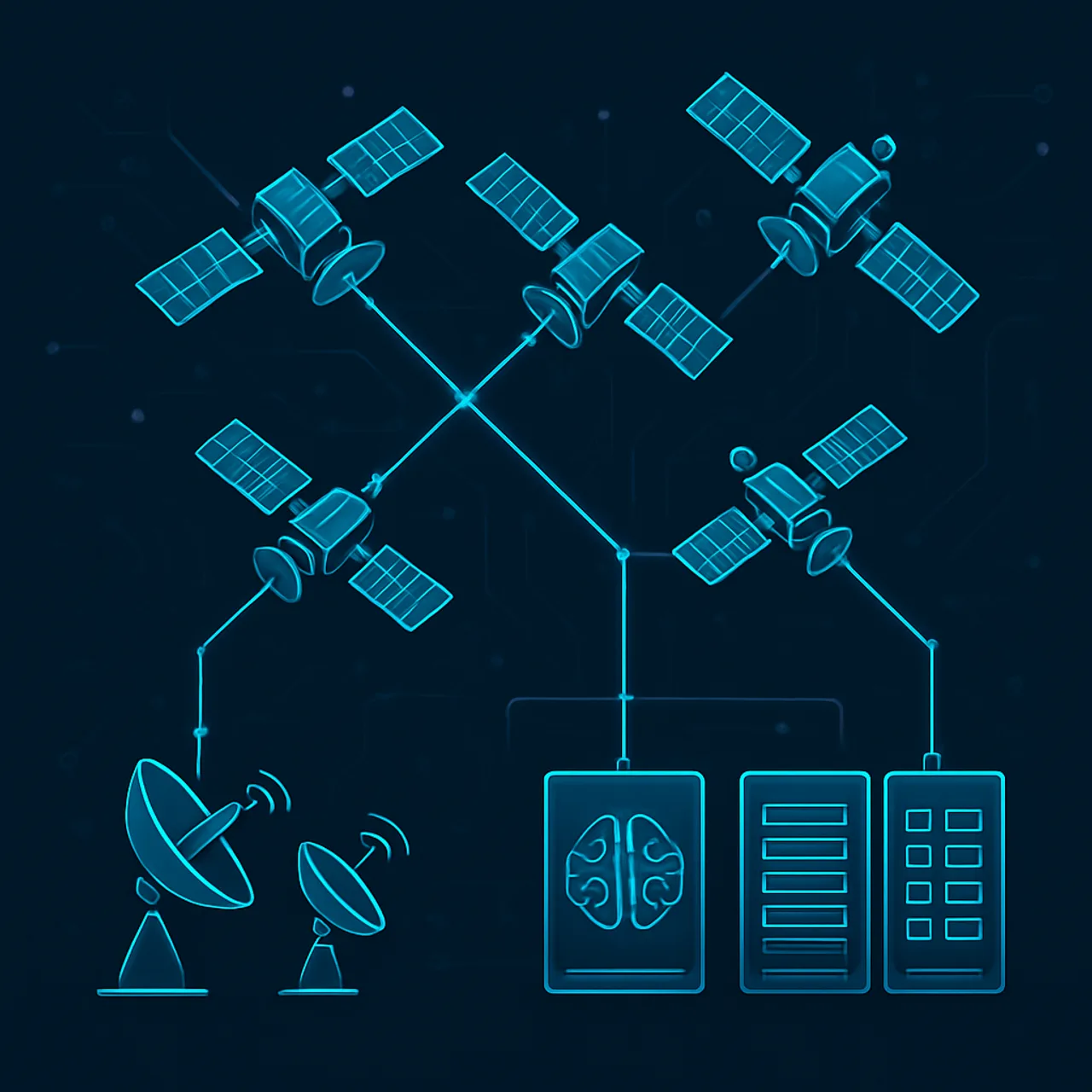
AI is not a single feature bolted onto a satellite. It is a layer of intelligence applied across the entire communication chain. The most impactful applications today fall into four areas:
- Signal processing and interference mitigation
- Dynamic spectrum and bandwidth management
- Autonomous constellation management
- Predictive maintenance and anomaly detection
Each of these solves a specific, expensive problem, and together they explain why nearly every major operator now invests in machine learning. Companies that build these intelligent systems, such as the teams behind ZoneTechify's artificial intelligence services, increasingly treat AI as core infrastructure rather than an experiment.
Signal Processing and Interference Mitigation
Signal quality is the single biggest factor in satellite performance, and it is where AI shows its clearest wins. Machine learning models trained on millions of waveform samples can separate a clean signal from noise far better than fixed filters. They identify interference patterns, including deliberate jamming, and adjust modulation or routing instantly.
The practical result is higher throughput on the same hardware. Operators report that adaptive, AI-assisted coding and modulation can squeeze meaningfully more data through a link during poor weather, when traditional systems would simply drop the connection or slow to a crawl.
Dynamic Spectrum and Bandwidth Management
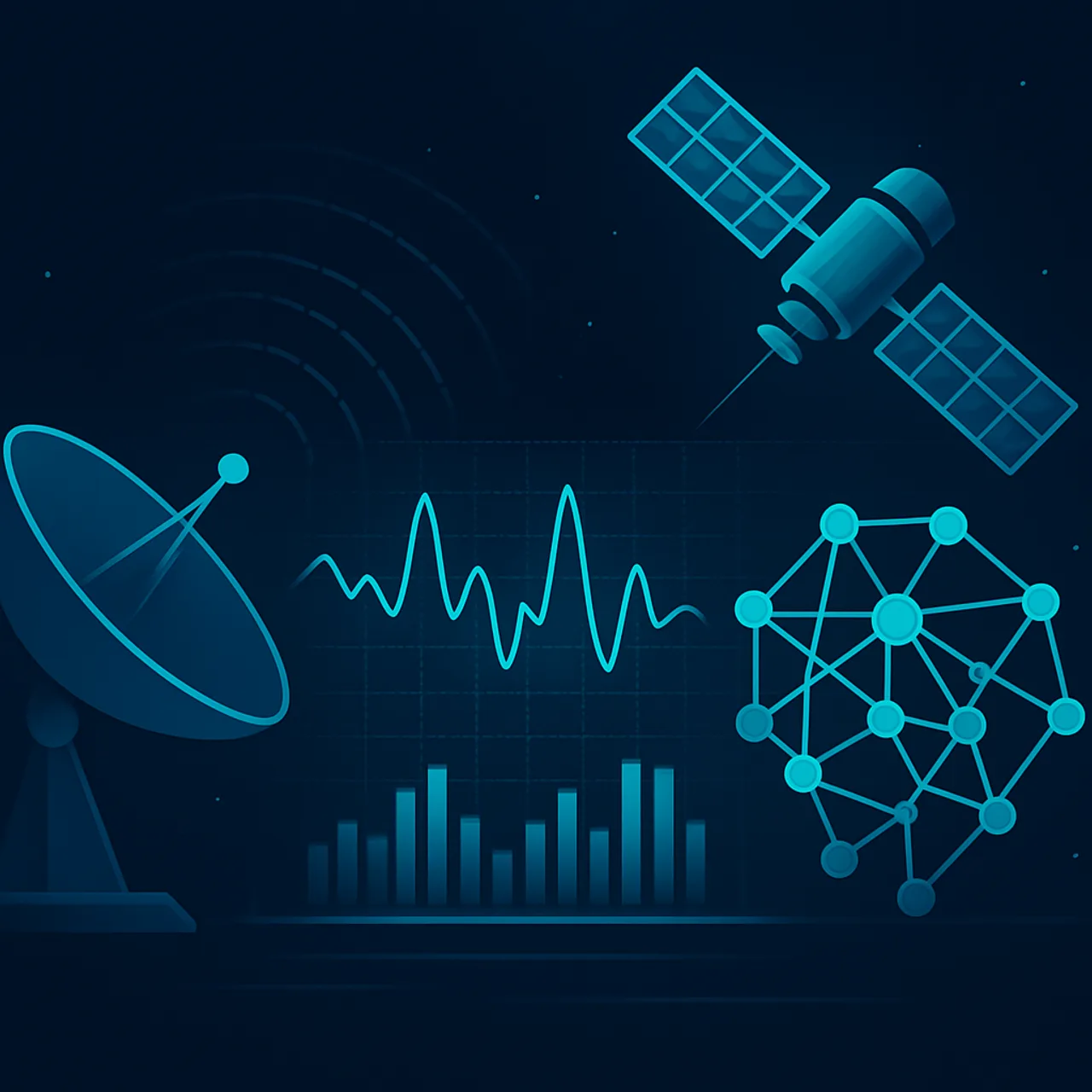
Radio spectrum is a scarce, shared resource, and wasting it is expensive. AI enables dynamic spectrum management, where the network continuously reallocates frequency and bandwidth based on real-time demand. When a storm grounds flights in one region and traffic surges in another, the system shifts capacity automatically.
This matters because static allocation leaves bandwidth idle over empty oceans while cities go congested. Reinforcement learning models predict demand minutes or hours ahead and pre-position capacity, smoothing the experience for end users and increasing the revenue an operator earns from every megahertz.

Autonomous Constellation Management
Managing a single satellite is hard. Managing a constellation of thousands, each with its own orbit, battery state, and connection load, is impossible by hand. AI coordinates these fleets, deciding which satellite serves which user, when to hand off a connection, and how to avoid collisions and debris.
Autonomous handover is the headline capability. As LEO satellites cross the sky in minutes, your connection must jump between them seamlessly. AI predicts the best next satellite based on geometry, load, and link quality, keeping latency low and sessions stable, something users now expect for video calls and live streaming.

Predictive Maintenance and Anomaly Detection
Satellites cannot be repaired by hand once launched, so preventing failure is everything. AI monitors thousands of telemetry signals, temperature, power, attitude, and component wear, to spot anomalies long before they become outages. A subtle drift in a power reading that a human would miss can trigger an early warning.
This predictive approach extends asset life and prevents costly service interruptions. Detecting a degrading reaction wheel early lets operators adjust workloads and plan around it, rather than losing a multi-million-dollar satellite to a sudden, unmonitored fault.
AI vs Traditional Satellite Systems
The difference between AI-driven and conventional satellite operations is stark once you compare them side by side. The table below summarizes the practical contrasts operators care about most.
| Capability | Traditional Systems | AI-Driven Systems |
|---|---|---|
| Interference response | Manual, minutes to hours | Automatic, milliseconds |
| Bandwidth allocation | Static, pre-planned | Dynamic, demand-based |
| Constellation handover | Rule-based, limited scale | Predictive, thousands of nodes |
| Fault detection | Reactive, after failure | Predictive, before failure |
| Security monitoring | Signature-based | Behavior and anomaly-based |
| Operating cost at scale | High, labor-intensive | Lower, largely automated |
The pattern is consistent: AI replaces slow, reactive, human-bound processes with fast, proactive, scalable ones. For networks of any real size, this is no longer optional.
Security: AI as a Shield
Satellite networks are high-value targets, and security is now an AI battleground. Traditional defenses rely on known threat signatures, which miss novel attacks. AI-based security instead learns the normal behavior of a network and flags anything unusual, catching jamming, spoofing, and intrusion attempts that signature systems overlook.
This behavioral approach is critical for protecting critical infrastructure, where a single compromised link can disrupt aviation, finance, or defense. Specialist providers such as WebPeak's artificial intelligence services build exactly these adaptive monitoring systems, pairing anomaly detection with automated response so threats are contained before they spread.

Challenges and Limitations
AI is powerful, but it is not magic, and an honest review must say so. Three limitations stand out today.
First, data and compute constraints onboard satellites are real. Running heavy models in space is limited by power and radiation-hardened hardware, so many systems still process data on the ground, adding latency.
Second, trust and explainability remain open problems. Operators are rightly cautious about handing critical decisions to a model they cannot fully interpret, especially for collision avoidance or defense links.
Third, training data is often scarce for rare events like specific failure modes or novel attacks, which can make models less reliable exactly when they are needed most. These are solvable problems, but they explain why human oversight still surrounds most deployments.
The Future of AI in Satellite Communication
The trajectory points toward greater onboard autonomy. As radiation-tolerant AI chips improve, more processing will move into orbit, cutting latency and letting satellites make decisions without waiting for ground stations. Edge AI in space is the next frontier.
Expect tighter integration with terrestrial 5G and emerging 6G networks, where satellites and ground towers act as one intelligent fabric that automatically routes traffic through whichever path is best. AI will also drive connectivity to underserved regions, using demand prediction to deliver affordable access where laying cable was never viable.

Key Takeaways
- AI automates satellite signal processing, spectrum management, constellation control, maintenance, and security.
- There are over 11,000 active satellites in orbit, a scale that requires AI to manage effectively.
- The space economy could reach around $1.8 trillion by 2035, with connectivity as a key driver.
- AI responds to interference in milliseconds versus minutes or hours for manual systems.
- Predictive maintenance detects faults before failure, protecting expensive, unrepairable assets.
- Behavior-based AI security catches novel threats that signature systems miss.
- Onboard edge AI and satellite-5G/6G integration are the next major developments.
Frequently Asked Questions
How does AI improve satellite communication?
AI improves satellite communication by processing signals, allocating bandwidth, and managing constellations in real time. It detects interference in milliseconds, predicts hardware failures before they happen, and defends against cyber threats. The result is higher throughput, lower latency, and the ability to operate thousands of satellites reliably and efficiently.
Is artificial intelligence used in satellites today?
Yes, AI is actively used in satellite operations today. Major operators apply machine learning for adaptive signal coding, dynamic spectrum allocation, autonomous handover between satellites, anomaly detection, and security monitoring. While many heavy models still run on the ground, onboard AI is expanding rapidly as space-grade processing hardware improves.
What problems does AI solve in satellite networks?
AI solves four core problems: interference and signal degradation, inefficient bandwidth use, coordinating large fast-moving constellations, and predicting equipment failures. It also strengthens security by spotting unusual behavior. Together these reduce outages, cut operating costs, and let networks scale to thousands of satellites that humans could not manage manually.
What are the limitations of AI in satellite communication?
The main limitations are restricted onboard computing power, limited explainability of AI decisions, and scarce training data for rare events like novel attacks or unusual failures. Because of these constraints, critical decisions still keep humans in the loop, and much processing remains on the ground rather than in orbit.
Will AI replace human satellite operators?
AI will not fully replace human operators in the near term. It automates routine, high-speed tasks and handles scale that humans cannot, but people still oversee critical decisions, set strategy, and handle edge cases AI cannot interpret. The realistic model is collaboration, with AI augmenting expert teams rather than removing them.
Conclusion
Artificial intelligence has moved from a promising experiment to an operational necessity in satellite communication. It makes networks faster, more efficient, more secure, and large enough to serve a connected planet. The technology still has real limits around onboard compute, explainability, and data, but its direction is unmistakable. For any organization building in this space, investing in AI capability now, whether in-house or with experienced partners at ZoneTechify and WebPeak, is the difference between keeping pace and falling behind.