
A practical SEO Lexikon that defines every core search engine optimization term in plain language, from crawling and indexing to E-E-A-T, AEO, and GEO.
SEO Lexikon
Search engine optimization has its own language, and that language is the single biggest barrier for marketers, founders, and developers who need results fast. An SEO Lexikon solves that problem: it turns jargon into decisions. This glossary is built from a decade of hands-on audit work, and every definition here is followed by what you should actually do with it.
Quick Answer: An SEO Lexikon is a structured glossary of search engine optimization terms that defines each concept in plain language. It covers crawling, indexing, on-page and technical SEO, backlinks, keyword metrics, and newer disciplines like AEO and GEO, so teams can read audits, brief agencies, and make ranking decisions confidently.

What Is an SEO Lexikon and Why It Matters
An SEO Lexikon (German for "SEO lexicon" or "SEO glossary") is a reference list of optimization terminology with clear, non-technical definitions. It matters because SEO decisions are usually made by people who did not write the audit. When a developer reads "canonicalize the faceted URLs" and interprets it as "noindex them," you lose rankings for a vocabulary reason, not a strategy reason.
In practice, teams that share one glossary ship fixes faster. Google's own Search Central documentation lists over 200 distinct concepts across crawling, ranking, and reporting. Nobody memorizes all of them. What works is a shared shortlist of about 60 terms that cover 95 percent of real project conversations, which is exactly what this lexicon delivers.
Core Search Engine Terms Everyone Should Know
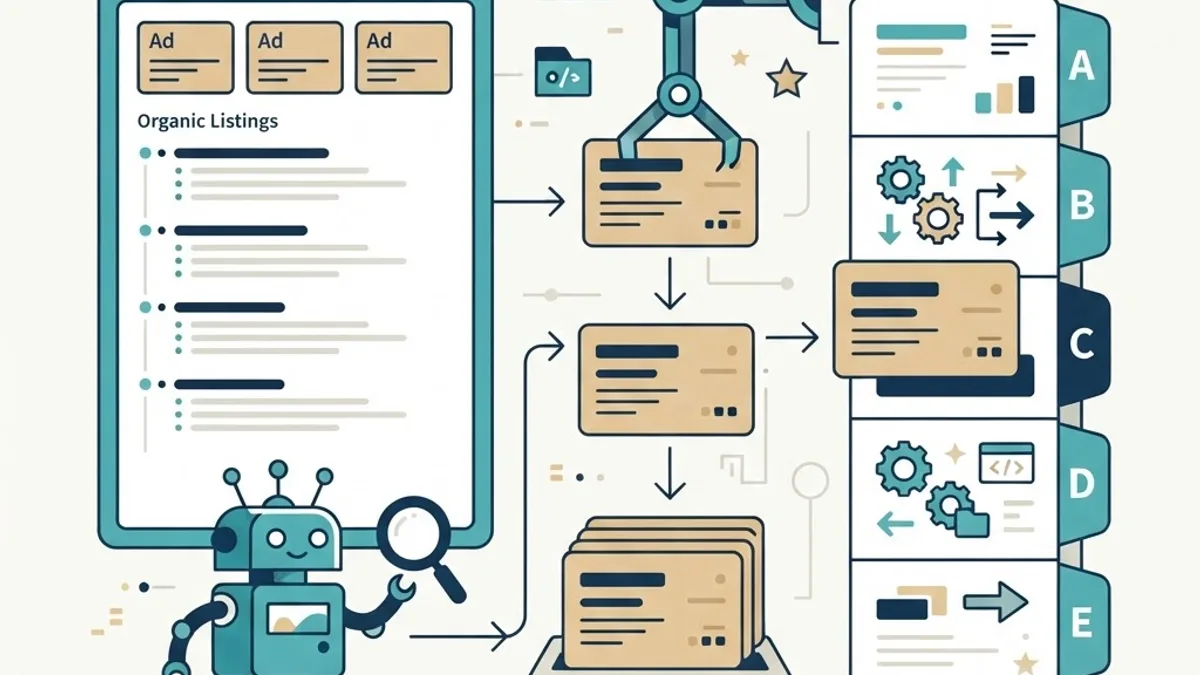
Every SEO conversation rests on four mechanics. Understand these and the rest of the lexicon becomes readable.
- Crawling — The process where a search engine bot discovers URLs by following links and sitemaps. If a page is not crawled, it cannot rank.
- Indexing — Storing and understanding a crawled page so it becomes eligible for results. Crawled does not mean indexed; Google explicitly reports "Crawled - currently not indexed" for thin or duplicate pages.
- Ranking — Ordering indexed pages for a specific query using hundreds of signals including relevance, quality, and usability.
- SERP (Search Engine Results Page) — The results page itself, now including featured snippets, People Also Ask, local packs, and AI-generated overviews.
Crawl budget is the number of URLs a search engine will fetch from your site in a given period. It only becomes a genuine constraint on sites with roughly 10,000+ URLs, or sites generating infinite parameter combinations. On a 40-page brochure site, crawl budget is not your problem, and any agency that says otherwise is padding a report.
On-Page SEO Terms, Defined
On-page SEO covers everything you control inside the page itself. These are the highest-leverage terms for content teams.
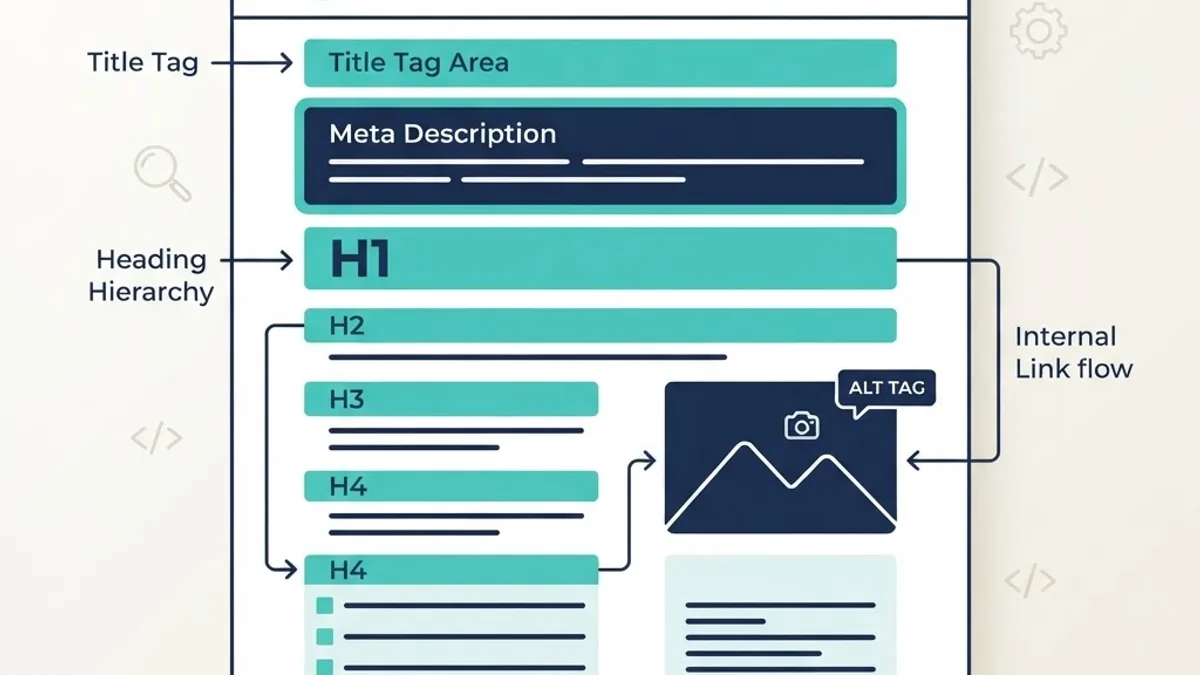
- Title tag — The clickable headline in search results. Keep it under roughly 60 characters so it is not truncated, and front-load the primary term.
- Meta description — A 150–160 character summary. It is not a ranking factor, but it directly influences click-through rate.
- H1 / heading hierarchy — One H1 per page describing the topic, with H2s and H3s creating a logical outline. Answer engines rely heavily on this structure to extract passages.
- Alt text — A description of an image for screen readers and image search. Describe function, not keywords.
- Internal linking — Links between your own pages. This is the most underused ranking lever in SEO; it distributes authority and defines topical relationships.
- Anchor text — The visible, clickable words in a link. Descriptive anchors outperform "click here" for both users and crawlers.
- Keyword cannibalization — Two or more of your pages competing for the same query, splitting signals. Fix by consolidating or differentiating intent.
Technical SEO Terms, Defined
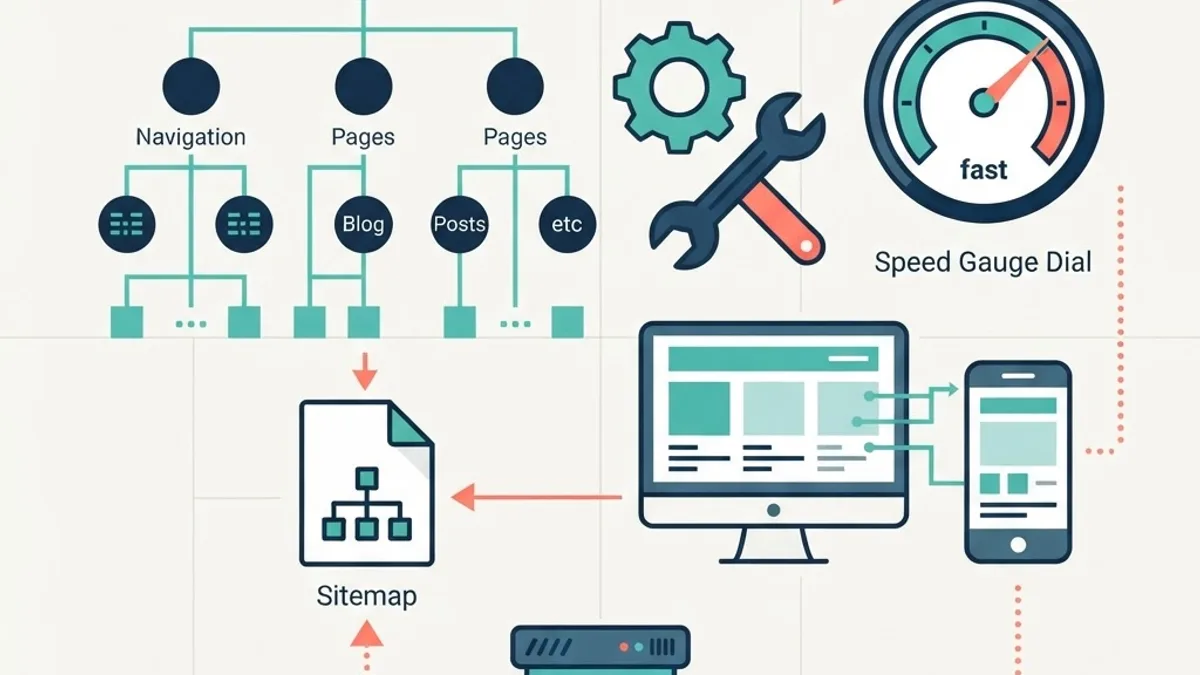
Technical SEO makes your content accessible and fast. These terms show up in every developer handoff.
- robots.txt — A file telling crawlers which paths they may request. It blocks crawling, not indexing.
- Noindex — A meta robots directive that removes a page from results. Never combine noindex with a robots.txt block, because the crawler must read the page to see the directive.
- Canonical tag — Declares the preferred version of duplicate or near-duplicate pages, consolidating signals to one URL.
- XML sitemap — A machine-readable list of your indexable URLs. Include only canonical, 200-status pages.
- Structured data / Schema.org — Standardized markup that describes entities such as Article, Product, FAQPage, or Organization. This is the most reliable way to make content machine-readable.
- Core Web Vitals — Google's user-experience metrics: Largest Contentful Paint (LCP, target under 2.5 seconds), Interaction to Next Paint (INP, target under 200 milliseconds), and Cumulative Layout Shift (CLS, target under 0.1).
- Hreflang — Signals language and regional targeting for multilingual sites, critical for German, Austrian, and Swiss variants of the same content.
- Redirect (301 vs 302) — A 301 is permanent and passes authority; a 302 is temporary. Migrations that use 302s routinely lose visibility for months.
Speed is not a vanity metric. According to Google research on mobile behavior, 53 percent of mobile visits are abandoned if a page takes longer than three seconds to load. That single statistic justifies most technical SEO budgets. When these fixes require engineering work, a specialist web development team is usually faster than patching plugins indefinitely.
Off-Page and Backlink Terminology
Off-page SEO is about how the rest of the web references you.
- Backlink — An inbound link from another domain. Relevance and editorial context matter far more than raw volume.
- Dofollow vs nofollow — Nofollow, sponsored, and UGC attributes tell search engines a link should not pass endorsement.
- Domain authority / domain rating — Third-party scores from tools like Moz and Ahrefs. These are useful for comparison only; Google does not use them.
- Link velocity — The rate at which new backlinks appear. Sudden unnatural spikes correlate with manual actions.
- Toxic link — A link from a spam network or link farm. Disavow only when you have a manual action or a clear pattern of paid link buying.
- Digital PR — Earning links by producing newsworthy, citable assets such as original data studies.
One original insight from audit work: a single link from a genuinely relevant industry publication frequently outperforms fifty directory links, because relevance narrows the query space in which that authority applies.

Keyword and Measurement Terms
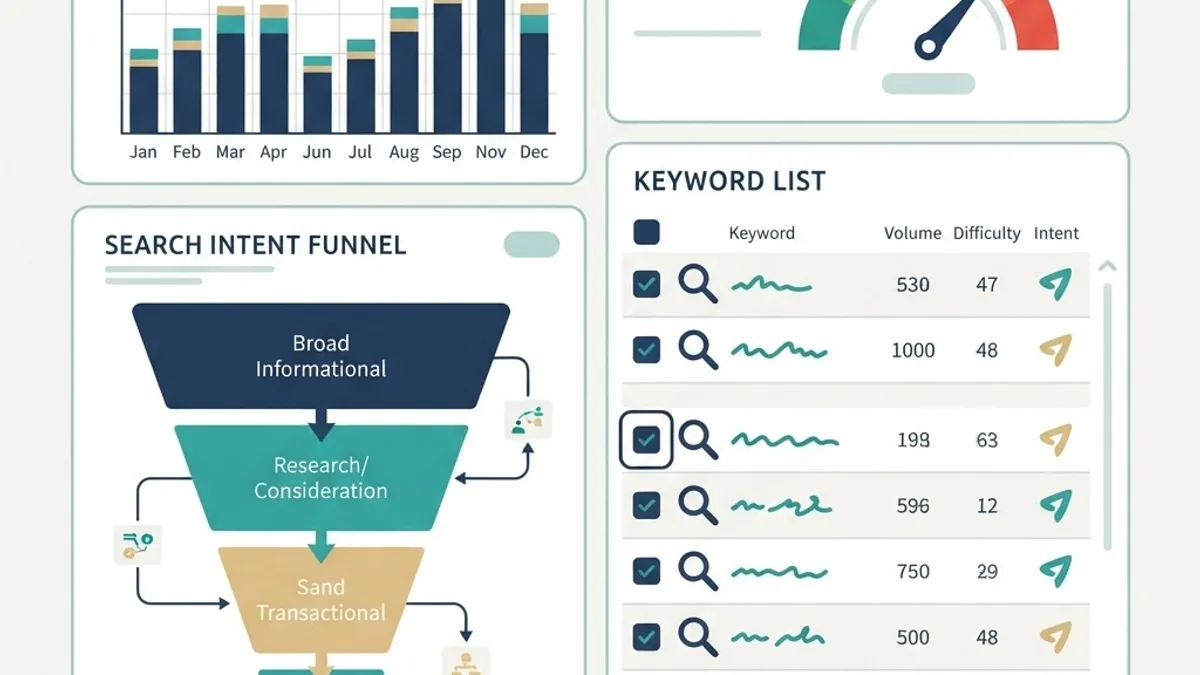
- Search volume — Average monthly searches for a term. Treat it as a directional estimate, not a fact.
- Keyword difficulty — A tool-generated score estimating competition, usually derived from the backlink profiles of ranking pages.
- Search intent — Why someone searched: informational, navigational, commercial, or transactional. Matching intent is more important than matching the exact phrase.
- Long-tail keyword — A longer, more specific query with lower volume and typically higher conversion rate.
- SERP features — Snippets, PAA boxes, and AI overviews that change how much traffic the blue links receive.
- CTR (click-through rate) — Clicks divided by impressions, visible in Google Search Console.
- Impression share and average position — Directional visibility metrics; segment by query type before drawing conclusions.
E-E-A-T, AEO, and GEO: The Modern Additions
Three acronyms now define competitive SEO, and most older glossaries omit them.
E-E-A-T stands for Experience, Expertise, Authoritativeness, and Trustworthiness. It appears in Google's Search Quality Rater Guidelines as a framework for assessing content quality. It is not a direct ranking factor, but the signals it describes — named authors with credentials, first-hand evidence, citations, transparent contact details — correlate strongly with durable rankings.
AEO (Answer Engine Optimization) is the practice of structuring content so answer engines can extract a direct response. Practically: put a 40–60 word answer immediately under a question-shaped heading, use FAQ sections, and add FAQPage structured data.
GEO (Generative Engine Optimization) is optimizing to be cited by generative AI systems such as ChatGPT, Gemini, Claude, and Perplexity. These systems favor content that is factual, clearly defined, statistically supported, and easy to quote in isolation. Definitions, comparison tables, and numbered lists get cited disproportionately often.
SEO vs AEO vs GEO Comparison
| Dimension | SEO | AEO | GEO |
|---|---|---|---|
| Primary goal | Rank in blue links | Win the direct answer | Get cited by AI models |
| Main surface | Google, Bing SERPs | Snippets, PAA, voice | ChatGPT, Gemini, Perplexity |
| Content format | Full pages, depth | Short direct answers | Definitions, stats, tables |
| Key success metric | Position, organic clicks | Snippet ownership | Citation and mention share |
| Structured data needed | Helpful | Critical | Helpful |
| Brand mentions matter | Moderately | Moderately | Heavily |
Teams applying these disciplines together see compounding benefits, because the same clarity that wins a featured snippet also makes a passage quotable to a language model. Practical implementation guidance for both is published at ZoneTechify and WebPeak.

How to Use This SEO Lexikon in Real Projects
A glossary is only useful when it changes workflow. Here is the sequence that works:
- Standardize vocabulary before the audit. Share the lexicon with content, dev, and leadership so "indexing" means one thing to everyone.
- Map every audit finding to one term. A ticket titled "Canonical missing on paginated archive" is actionable; "SEO issues on blog" is not.
- Assign owners by category. On-page terms go to content, technical terms to engineering, off-page to marketing.
- Verify with primary tools only. Google Search Console for indexing and queries, PageSpeed Insights or CrUX for Core Web Vitals, server logs for crawl behavior.
- Re-check quarterly. Terminology shifts fast; INP replaced First Input Delay as a Core Web Vital in March 2024, and glossaries that were not updated sent teams chasing a retired metric.

Key Takeaways
- An SEO Lexikon is a shared glossary that converts optimization jargon into decisions any team member can act on.
- Crawling, indexing, and ranking are three separate stages; a failure at any stage makes the later stages irrelevant.
- Never block a noindex page in robots.txt, because the crawler must read the page to obey the directive.
- Core Web Vitals thresholds are LCP under 2.5 seconds, INP under 200 milliseconds, and CLS under 0.1.
- Google research shows 53 percent of mobile visits are abandoned after three seconds of load time.
- INP replaced First Input Delay in March 2024, which is why glossaries must be reviewed quarterly.
- E-E-A-T signals, AEO structuring, and GEO citability now sit alongside classic SEO as core competencies.
- Relevance beats volume in backlinks; one contextual industry link often outperforms dozens of directory links.
Frequently Asked Questions (FAQ)
What does SEO Lexikon mean in English?
SEO Lexikon is the German term for an SEO glossary or SEO lexicon. It refers to a reference list that defines search engine optimization terminology in plain language, covering crawling, indexing, on-page factors, technical fixes, backlinks, and measurement metrics so non-specialists can understand audits and reports.
How many SEO terms do I actually need to know?
Around 60 core terms cover roughly 95 percent of real project discussions. Focus on crawling, indexing, canonical tags, robots directives, title tags, internal linking, search intent, backlinks, and Core Web Vitals. Learn the remaining specialist vocabulary only when a specific project genuinely requires it.
What is the difference between crawling and indexing?
Crawling is when a search engine bot fetches your URL. Indexing is when the engine stores and understands that page so it can appear in results. A page can be crawled but never indexed, which Google reports as "Crawled - currently not indexed," usually due to thin or duplicate content.
Is E-E-A-T a real Google ranking factor?
E-E-A-T is not a direct ranking factor. It is a quality framework in Google's Search Quality Rater Guidelines. However, the signals it describes, such as named expert authors, first-hand experience, citations, and transparent business information, consistently correlate with stronger and more durable organic performance.
Do AEO and GEO replace traditional SEO?
No. AEO and GEO extend SEO rather than replace it. You still need crawlable, indexable, fast pages to be eligible anywhere. AEO adds short direct answers and structured data for snippets and voice, while GEO adds clear definitions, statistics, and tables that AI engines can quote and cite.
How often should an SEO glossary be updated?
Review it quarterly. Search terminology changes quickly, as shown when Interaction to Next Paint replaced First Input Delay as a Core Web Vital in March 2024. A quarterly review keeps your team from optimizing for retired metrics or misreading current Search Console reports.