
A practical guide to e marketing search engine optimization, covering keyword intent, on-page and technical SEO, content funnels, local visibility, and ROI measurement.
E Marketing Search Engine Optimization
E marketing search engine optimization is the practice of using search visibility as the engine that powers your entire electronic marketing system, rather than treating SEO as an isolated checklist. Most businesses fail at this not because they lack knowledge of title tags, but because their search work is disconnected from their email, content, paid, and social programs. After auditing hundreds of campaigns, the pattern is consistent: companies that connect search data to every marketing channel outperform those that silo it.
This guide explains exactly how to build that connected system, in the order that actually works.

Quick Answer: E marketing search engine optimization means integrating SEO into your full digital marketing system so organic search feeds content, email, paid, and social performance. It combines keyword intent research, on-page optimization, technical health, authority building, and analytics to attract qualified traffic and convert it into measurable revenue.
What Is E Marketing Search Engine Optimization?
E marketing (electronic marketing) is the full set of digital channels a business uses to reach customers: search, email, social media, paid ads, and owned content. Search engine optimization is the process of improving a website so search engines rank it higher for queries that matter commercially.
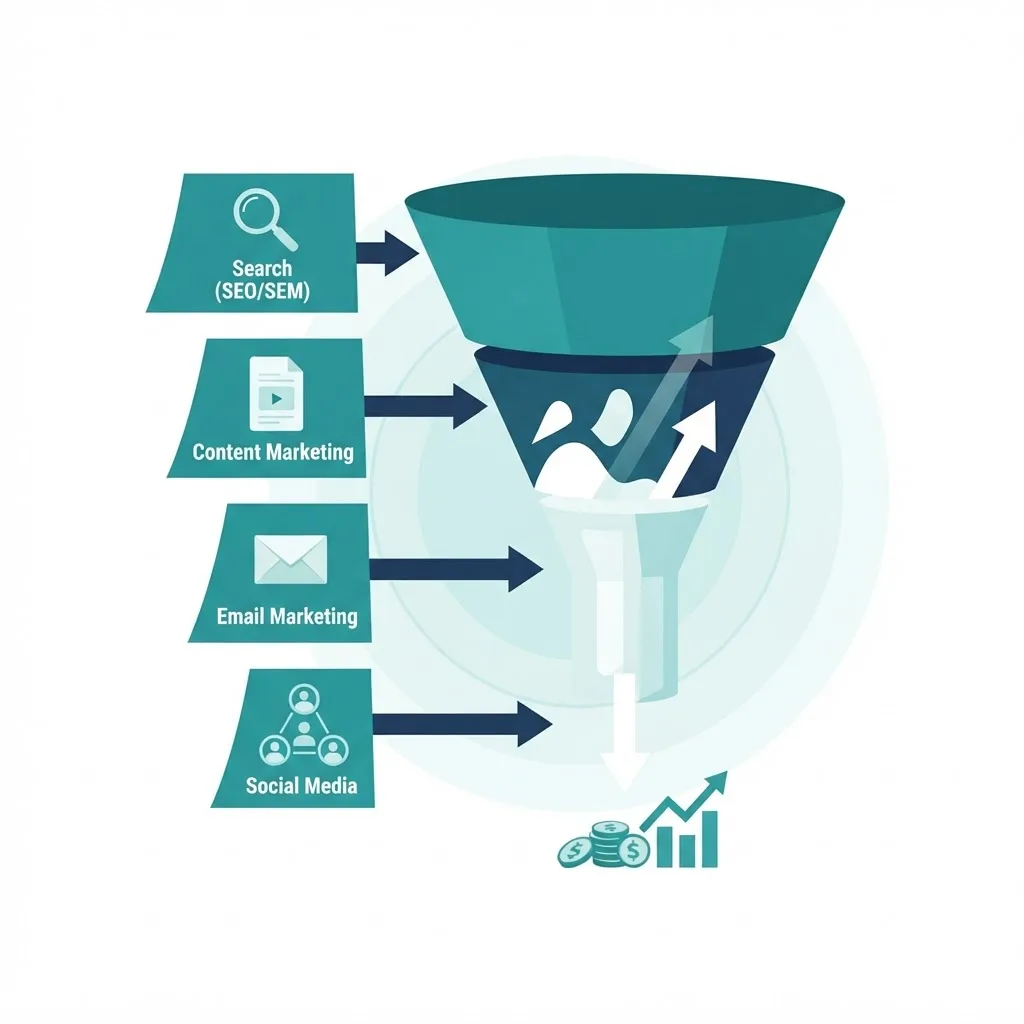
E marketing search engine optimization is the intersection: using search demand data as the strategic input for all digital channels, and using every channel to reinforce search performance. In practice, that means the keyword research that shapes your blog also shapes your email subject lines, your ad copy, and your product page structure.
The distinction matters because SEO in isolation optimizes for rankings. Integrated e marketing SEO optimizes for pipeline.
Why Search Still Anchors Every Digital Marketing Channel
Search remains the highest-intent channel in digital marketing because the user initiates the interaction. Nobody types a query unless they want something.
Two data points frame the opportunity. According to Google, 53% of mobile site visitors leave a page that takes longer than three seconds to load — meaning technical performance directly caps how much of your search traffic ever converts. And according to BrightEdge research, organic search drives roughly 53% of all trackable website traffic, making it the single largest acquisition source for most businesses.
The practical implication: if you spend on paid ads, email, or social without fixing search fundamentals, you are paying repeatedly for traffic that organic search could deliver as a compounding asset.
Step 1: Build Keyword Research Around Intent, Not Volume
The most common mistake in e marketing SEO is chasing high-volume head terms. Volume tells you how many people search. Intent tells you whether they will buy.
Sort every keyword into one of four intent buckets:
- Informational — "what is e marketing" (top of funnel, builds authority)
- Commercial investigation — "best SEO agency for small business" (comparison stage)
- Transactional — "hire SEO consultant" (ready to convert)
- Navigational — branded searches (protect and capture)
A realistic allocation for a growing business is roughly 50% informational, 30% commercial, and 20% transactional content. Informational content builds the topical authority that makes your commercial pages rank at all.
How to Find Keywords Competitors Are Missing
Export your competitors' ranking keywords, then filter for queries where the top-ranking page is a homepage or a generic category page. Those are gaps — a dedicated, genuinely useful page will usually outrank a page that only ranks by domain strength.
Also mine your own site search queries and support tickets. These reveal the exact language customers use, which no keyword tool can fully replicate.

Step 2: On-Page Optimization That Reflects How Search Works Now
On-page SEO is no longer about keyword density. Search engines evaluate whether a page comprehensively satisfies the query.
Work through this checklist for every commercially important page:
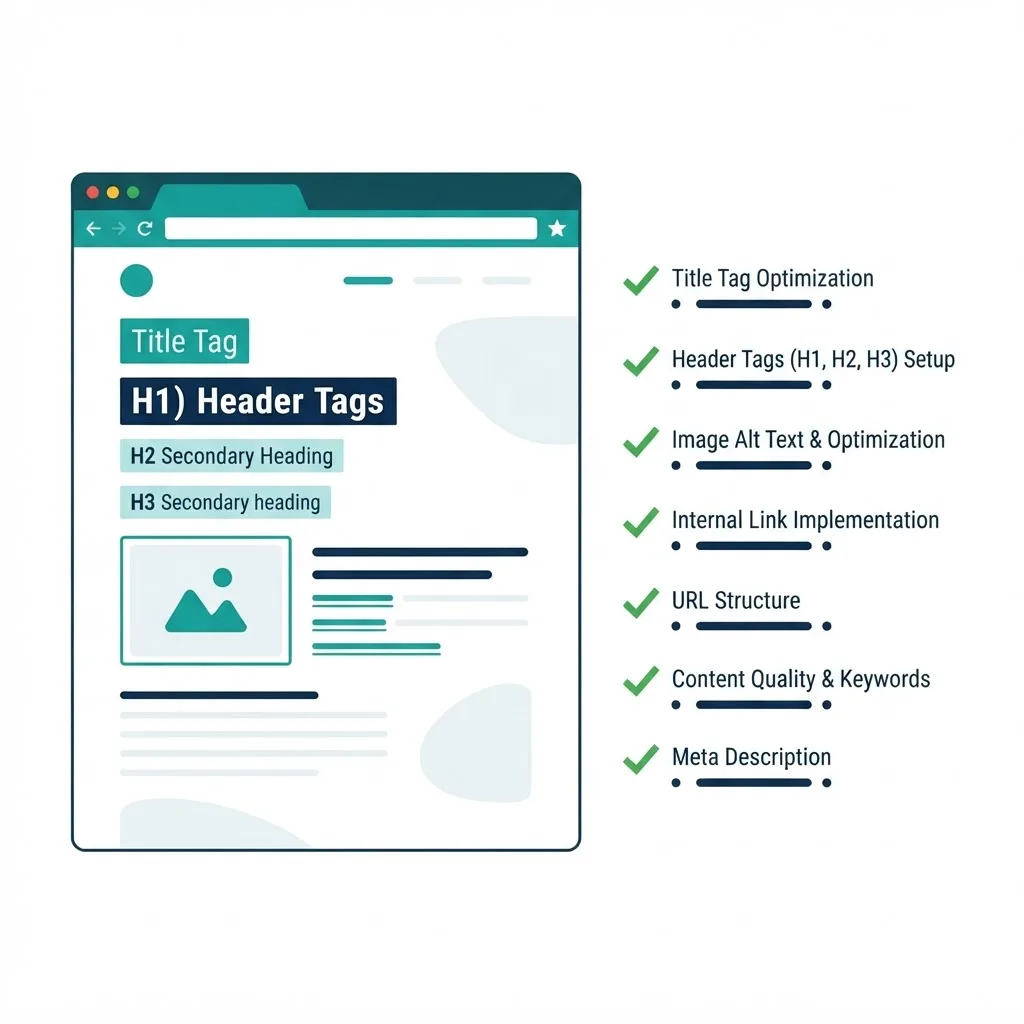
- Title tag: 50–60 characters, primary keyword near the front, written to earn a click
- Meta description: 150–160 characters, includes the benefit and an implicit call to action
- One H1 per page that matches the search intent, with H2s covering the natural subquestions
- First 100 words should answer the query directly — this is what answer engines extract
- Internal links from related content using descriptive anchor text, not "click here"
- Image alt text that describes the image for screen readers and search crawlers
- Structured data (Article, FAQPage, Product, LocalBusiness) to qualify for rich results
A specific tactic that reliably works: add a short, direct 40–60 word answer immediately under each H2. This structure wins featured snippets and gets cited by AI answer engines like ChatGPT, Gemini, and Perplexity.
Step 3: Fix Technical SEO Before Scaling Content
Publishing content on a technically broken site is like advertising a store with a locked door. Fix the foundation first.
Prioritize in this order:
- Crawlability — ensure important pages are not blocked in robots.txt and are present in your XML sitemap
- Indexation — check Google Search Console for "Discovered but not indexed" pages, which usually signal thin content or crawl budget waste
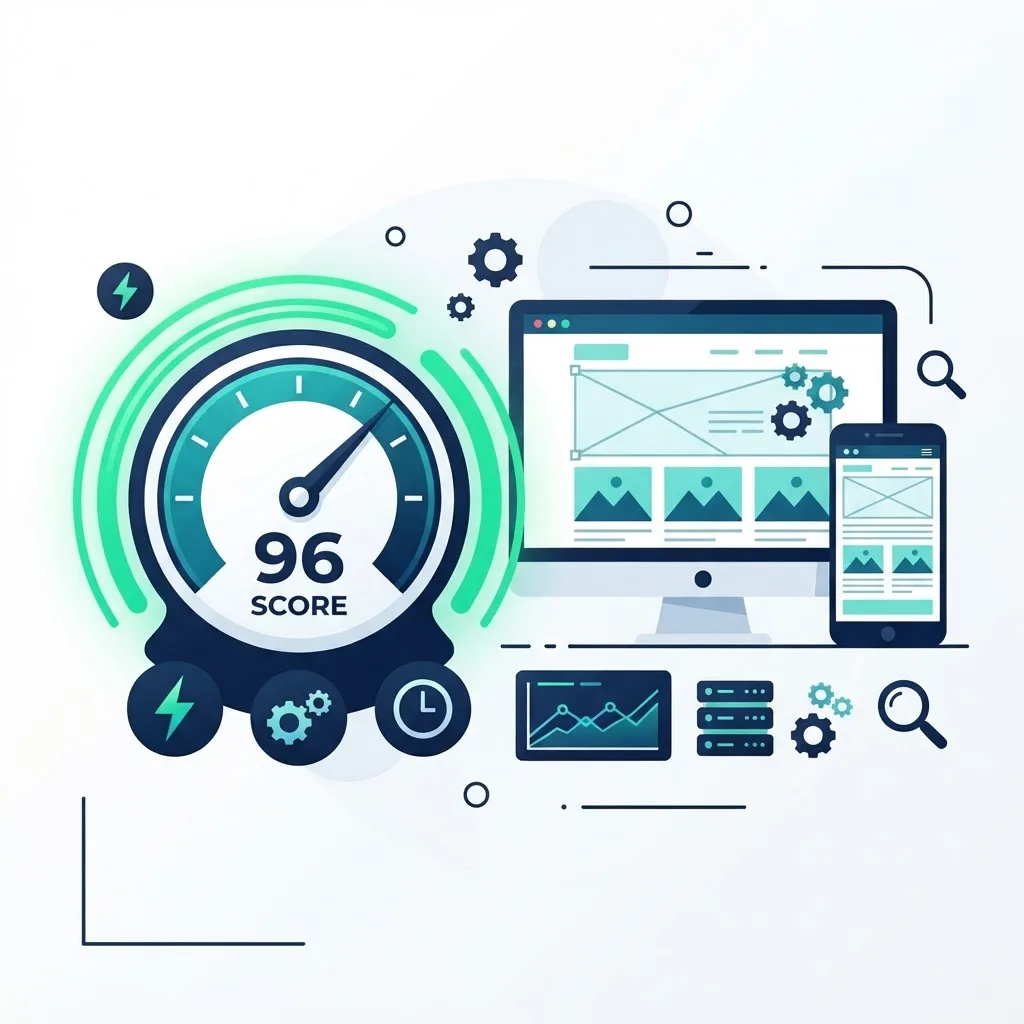
- Core Web Vitals — target LCP under 2.5 seconds, INP under 200 milliseconds, and CLS under 0.1
- Mobile rendering — Google indexes the mobile version of your site, so mobile is the source of truth
- Canonicalization — eliminate duplicate URLs from parameters, pagination, and trailing slashes
- HTTPS and redirects — no mixed content, no redirect chains longer than one hop
The highest-ROI technical fix for most sites is image optimization. Converting images to WebP or AVIF and serving responsive sizes frequently cuts page weight by 40–60% with no design compromise. If your site needs structural work rather than patching, a rebuild handled by an experienced web development team is usually cheaper than years of workarounds.
Step 4: Connect Content to the Conversion Funnel
Content that ranks but never converts is a reporting problem disguised as a marketing win. Every piece of content needs a defined next step.
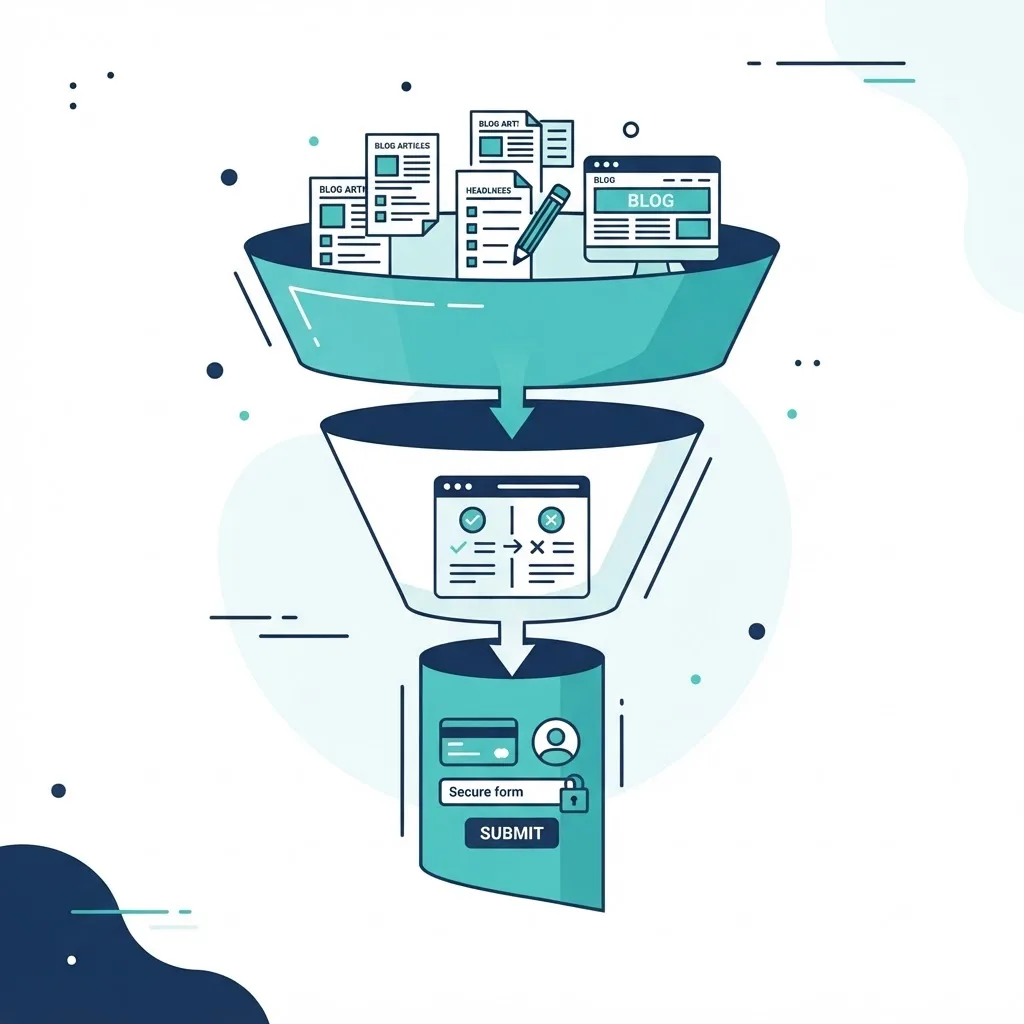
Map content to funnel stages deliberately:
- Awareness content → next step is an email subscription or a related guide
- Consideration content → next step is a comparison page, case study, or calculator
- Decision content → next step is a quote request, demo, or purchase
The compounding mechanic in e marketing is the loop: search brings a stranger to a blog post, the post captures an email, email nurtures the reader, and the nurtured reader returns via a branded search — which itself is a positive ranking signal. Brand search volume growth is one of the most underrated SEO metrics.
Channel Comparison: Where SEO Fits in Your Marketing Mix
| Channel | Time to Results | Cost Over Time | Intent Quality | Compounds |
|---|---|---|---|---|
| Organic search (SEO) | 3-6 months | Decreasing | High | Yes |
| Paid search (PPC) | Immediate | Increasing | High | No |
| Email marketing | Days | Low | Medium-High | Yes |
| Organic social | Weeks | Low | Low-Medium | Partly |
| Paid social | Immediate | Increasing | Low | No |
The honest read: SEO is the slowest channel to start and the cheapest channel to sustain. Paid search is the reverse. The correct answer for most businesses is running paid to learn which keywords convert, then investing SEO effort into those proven terms.
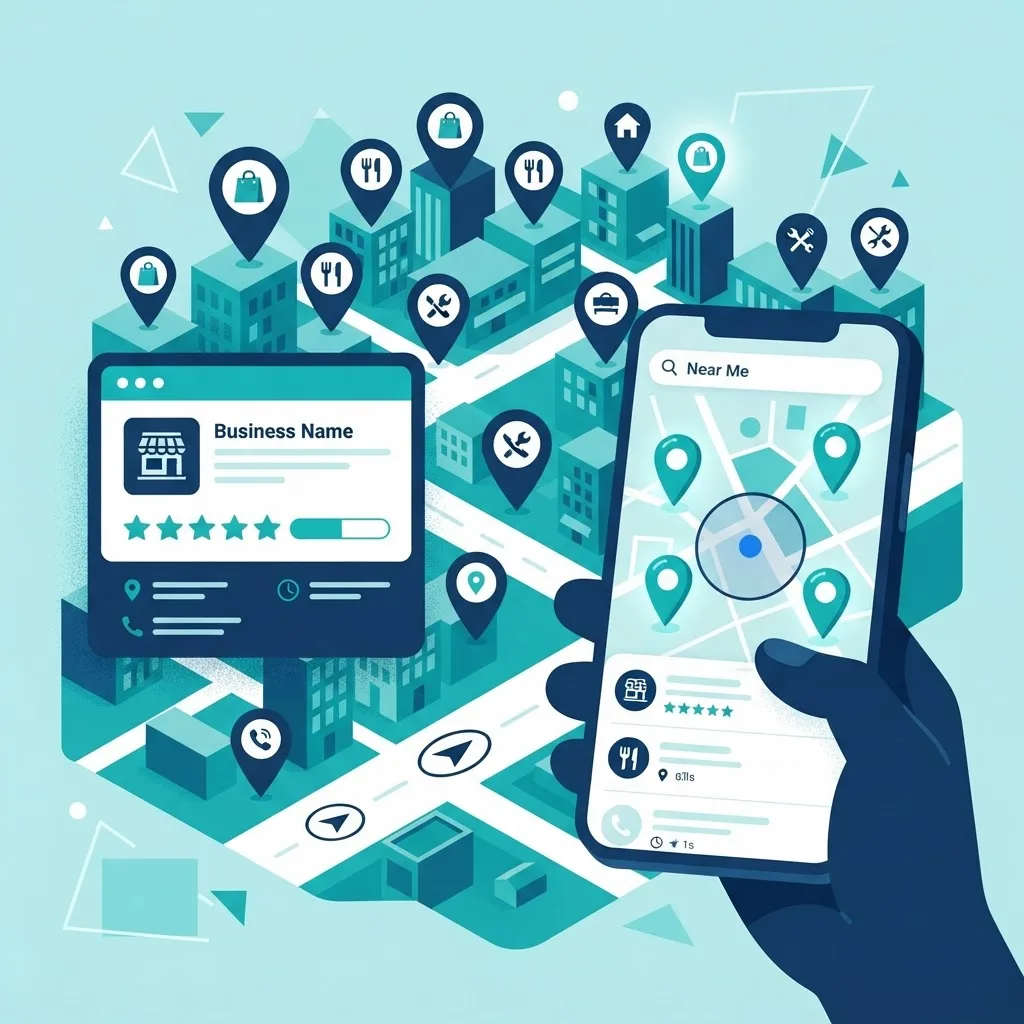
Step 5: Capture Local and Location-Based Search Demand
If you serve customers in a specific geography, local SEO is often the fastest path to revenue because commercial intent is unusually high.
The essentials:
- Claim and fully complete your Google Business Profile, including categories, services, and hours
- Keep your name, address, and phone number identical across every directory
- Publish location-specific service pages with genuinely unique content, not templated city swaps
- Actively request reviews and respond to every one, positive or negative
- Add LocalBusiness structured data with accurate geo-coordinates
Review velocity and recency influence local rankings more than most businesses expect. A steady trickle of new reviews outperforms a large batch collected once.
Step 6: Measure What Actually Matters
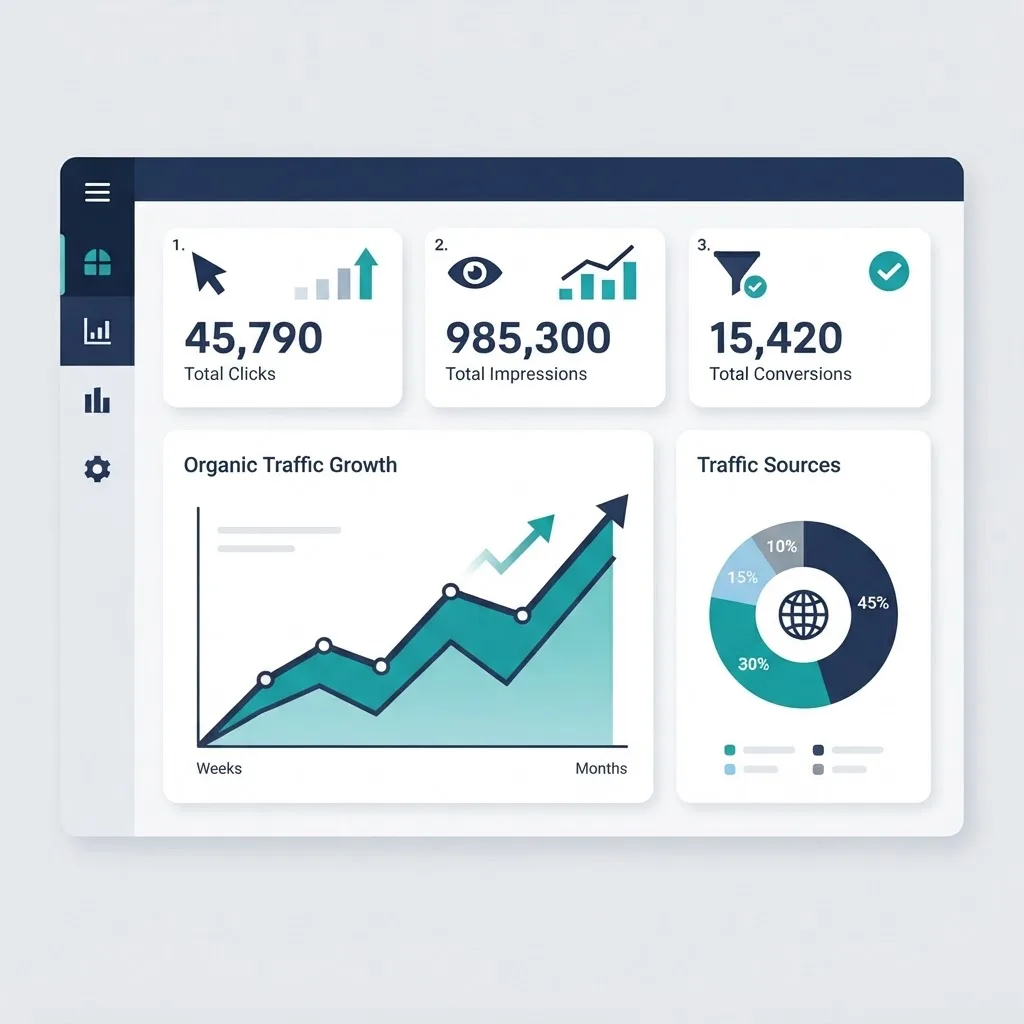
Rankings are a diagnostic, not a goal. Track the metrics that connect search activity to business outcomes.
Build your reporting around these five:
- Organic sessions by landing page — reveals which pages carry the site
- Assisted conversions from organic — captures SEO's role in multi-touch journeys
- Click-through rate by query in Search Console — low CTR at high positions means weak titles, not weak rankings
- Branded search volume — the clearest proxy for brand equity growth
- Revenue per organic visitor — the number that justifies budget
Review quarterly, not weekly. Search data is noisy at short intervals, and reacting to weekly fluctuations causes more damage than inaction. Teams at ZoneTechify and WebPeak consistently find that stable, quarterly-reviewed strategies outperform reactive ones.
Common E Marketing SEO Mistakes to Avoid
- Publishing volume without depth. Ten thorough, genuinely useful articles outperform fifty shallow ones.
- Ignoring existing content. Updating and expanding pages that already rank on page two is the fastest ranking gain available.
- Buying links. The short-term lift rarely survives the next algorithm update.
- Optimizing for tools instead of readers. A green score in an SEO plugin is not a ranking factor.
- Separating SEO from the rest of marketing. This is the core failure this entire guide exists to fix.
Key Takeaways
- E marketing search engine optimization integrates SEO with email, content, paid, and social rather than running it as a standalone channel.
- Organic search drives roughly 53% of trackable website traffic, making it the largest acquisition source for most businesses.
- Google reports that 53% of mobile visitors abandon pages loading slower than three seconds, so speed directly limits SEO ROI.
- Sort keywords by intent, not volume, and aim for roughly 50% informational, 30% commercial, and 20% transactional content.
- Fix crawlability, indexation, and Core Web Vitals before scaling content production.
- Target LCP under 2.5 seconds, INP under 200 milliseconds, and CLS under 0.1.
- Track revenue per organic visitor and branded search volume, not rankings alone.
- Expect meaningful organic results in three to six months; costs decrease as results compound.
Frequently Asked Questions (FAQ)
What is the difference between e marketing and SEO?
E marketing is the umbrella term for all digital marketing channels, including email, social, paid ads, and search. SEO is one discipline inside it, focused specifically on earning organic search visibility. SEO supplies the intent data and organic traffic that make the other e marketing channels more efficient.
How long does e marketing search engine optimization take to work?
Most sites see early movement in six to twelve weeks and meaningful traffic growth in three to six months. Newer domains with little authority typically need six to twelve months. Technical fixes and updates to existing content produce the fastest results, while new content on competitive topics takes longest.
Is SEO better than paid advertising for e marketing?
Neither is universally better. Paid ads deliver immediate traffic but stop the moment you stop spending. SEO takes months to build but compounds and lowers cost per acquisition over time. The strongest approach uses paid search to identify converting keywords, then builds durable SEO around those proven terms.
How much should a small business spend on SEO?
Most small businesses see results with a monthly budget between 800 and 3,000 US dollars, depending on competition and how much technical work the site needs. Spend it on content quality, technical fixes, and analytics rather than on link packages, which carry real risk of manual penalties.
Do I need to blog for search engine optimization to work?
Not always, but usually. Blogging builds the topical authority that helps commercial pages rank and captures informational queries you cannot target with product pages. If you cannot commit to consistent quality, focus first on optimizing your existing service and product pages thoroughly instead.
Does AI content hurt search rankings?
Google judges content by helpfulness and quality, not by how it was produced. AI-assisted content ranks fine when it demonstrates real experience, original analysis, and accuracy. Unedited, generic AI output typically fails because it adds nothing a reader cannot find elsewhere, which is the actual ranking problem.
Final Thoughts
The businesses that win at e marketing search engine optimization treat search as infrastructure rather than a campaign. They fix the technical foundation, research intent before writing a word, connect every page to a next step, and measure revenue instead of rankings.
Start with the single highest-impact action available to you: audit your five most commercially important pages against the on-page checklist above, then fix your slowest-loading template. Those two moves alone typically surface more gains than a quarter of new content production.