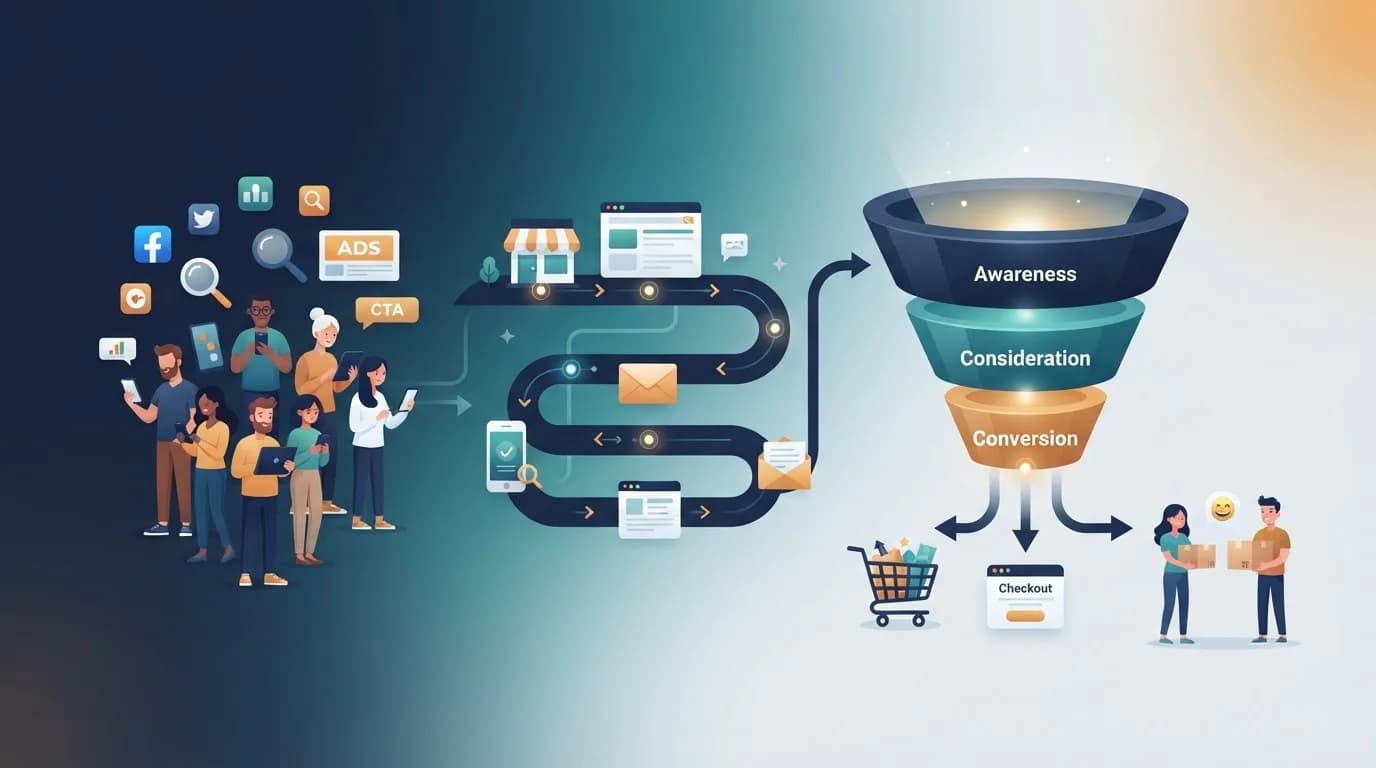
Partner with a top B2C digital marketing agency to boost consumer engagement, optimize paid media conversions, and generate sustainable multi-channel revenue.
B2C Digital Marketing Agency
Consumer buying behavior moves at lightning speed, driven by instant digital gratification and algorithmic feeds. For consumer-facing brands, maintaining market share requires far more than sporadic promotional posts. Modern shoppers evaluate alternatives within seconds, demanding cohesive touchpoints across search engines, short-form video platforms, email, and retail marketplaces. Navigating this ecosystem demands deep domain expertise, robust analytics infrastructure, and continuous creative testing.
A specialized business-to-consumer agency bridges the gap between brand vision and scalable retail revenue. Rather than treating advertising as a discretionary expense, leading brands use dedicated external teams to accelerate customer acquisition, maximize customer lifetime value, and protect gross margins. These agencies integrate creative production with technical conversion tracking, ensuring every deployed dollar produces measurable commercial impact.
Selecting the ideal partner requires understanding consumer acquisition dynamics, conversion optimization, and omnichannel retention. The right agency does not simply buy traffic. Instead, they engineer predictable customer acquisition engines aligned with cash flow cycles, transforming casual digital scrollers into devoted, repeat brand advocates.
Quick Answer: A B2C digital marketing agency is an external firm specializing in customer-facing growth strategies, including paid social media, search engine optimization, influencer marketing, conversion rate optimization, and retention automation. These agencies help consumer brands acquire shoppers at scale, lower customer acquisition costs, and maximize customer lifetime value across competitive retail marketplaces.
Understanding the Role of a B2C Digital Marketing Agency
A business-to-consumer marketing agency focuses exclusively on promoting products and services directly to individual shoppers rather than corporate committees. While corporate purchases involve extended sales cycles and formal procurement workflows, consumer purchasing decisions stem from personal emotion, immediacy, and convenience. A qualified consumer marketing partner operates across the entire consumer journey, capturing initial awareness, facilitating smooth checkout transactions, and driving post-purchase retention.
Modern consumer agencies combine creative storytelling with quantitative data analysis. While traditional advertising relied on television campaigns with imprecise measurement, modern agencies leverage first-party customer data platforms, server-side tracking, and multi-touch attribution models. By merging consumer psychology with automated testing frameworks, these agencies systematically reduce friction along the digital path to purchase.
Furthermore, emerging answer engine optimization and predictive commerce have expanded the agency mandate. An effective partner optimizes brand visibility across generative artificial intelligence platforms, conversational search engines, and social commerce feeds. This omnichannel presence guarantees that the brand remains discoverable wherever consumer purchase intent arises.
Strategic Differences: B2C vs B2B Digital Marketing
Understanding the contrasts between consumer and business marketing is essential when evaluating agency capabilities. Consumer marketing prioritizes transaction velocity, personalization, and emotional connection, whereas corporate marketing focuses on multi-stakeholder consensus. A dedicated consumer firm structures creative testing, media spend allocation, and tracking technology around these behavioral realities.
Consumer transactions carry lower average order values but far higher purchase volumes. Because buying cycles span minutes or days rather than quarters, consumer agencies execute rapid creative testing cycles, evaluating dozens of visual hooks and messaging angles weekly. In contrast, corporate marketing targets specialized industry buyers with dense white papers and relationship-driven outbound cadences.
To visualize these operational differences, consider how core marketing components diverge between business-to-business and business-to-consumer deployments:
| Strategic Pillar | B2C Digital Marketing | B2B Digital Marketing |
|---|---|---|
| Target Audience | Individual consumers and households | Professional teams and decision makers |
| Decision Drivers | Emotion, urgency, identity, lifestyle | Logic, return on investment, operational efficiency |
| Sales Cycle Length | Minutes, hours, or days | Months to more than a year |
| Average Order Value | Low to moderate ($20 to $500 typical) | High to enterprise-tier ($5,000 to $100,000+) |
| Primary Marketing Channels | TikTok, Meta, Instagram, Google Ads, SMS | LinkedIn, webinars, email cadences, industry events |
| Content Format | Short-form video, lifestyle visuals, user reviews | Case studies, technical white papers, webinars |
| Conversion Goal | Direct checkout, app install, subscription | Qualified lead submission, sales discovery call |
These distinctions dictate everything from team structure to analytics configurations. While a corporate agency focuses on lead scoring and account-based marketing, an agency specializing in direct consumer commerce prioritizes frictionless checkout workflows, dynamic product feeds, mobile responsiveness, and automated retention loops.
Core Service Pillars of a Modern Consumer Marketing Agency
Achieving sustained consumer brand expansion requires a unified operational framework. Leading consumer agencies do not operate in departmental silos. Instead, they synchronize paid media acquisition, organic search visibility, conversion optimization, and customer retention into a self-reinforcing flywheel.
Performance Paid Media and Social Acquisition
Paid advertising forms the frontline of consumer customer acquisition. Agencies manage complex paid campaigns across Meta, TikTok, Google Search, YouTube, and retail media networks like Amazon Advertising. High-performing teams implement consolidated campaign structures that feed algorithmic machine learning models with rich first-party conversion data.
Modern practitioners leverage automated bidding mechanisms combined with aggressive creative diversification. They produce high volumes of authentic creator content, motion graphics, and direct-response product demonstrations. By systematically rotating creative assets, agencies prevent ad fatigue and stabilize acquisition costs across large budgets. Brands seeking structured acquisition frameworks often collaborate with an experienced growth marketing agency to scale ad expenditure profitably while preserving baseline contribution margins.
Search Engine Optimization and Answer Engine Discovery
Organic search remains a pillar of sustainable customer acquisition, providing high-margin traffic that offsets rising media inflation. Consumer search optimization encompasses technical crawlability, category page architecture, dynamic product schema markup, and high-intent informational content that addresses pre-purchase queries.
Beyond traditional Google search results, contemporary agencies practice answer engine optimization and generative search visibility. When consumers query generative artificial intelligence engines or conversational assistants for product recommendations, the agency ensures the brand is indexed, cited, and recommended. This requires earning digital PR placements on authoritative review portals, structuring product metadata cleanly, and generating high volumes of verified third-party customer reviews across independent platforms.
Conversion Rate Optimization and Checkout Architecture
Driving qualified traffic represents only half the commercial battle. Conversion rate optimization converts visitors into paying customers by systematically identifying and eliminating friction points across the user interface.
Agencies conduct quantitative funnel analyses and user session recordings to uncover drop-off zones. They execute controlled split tests on product pages, cart drawers, and checkout funnels. Key optimization variables include mobile page speed, trust badges, alternative payment options, sticky purchase buttons, and transparent shipping policies. Practitioner benchmarks show that optimizing product pages and checkout flows can increase aggregate conversion rates by 15 to 30 percent without extra ad spend.
Lifecycle Retention and Direct Messaging Automation
Sustainable direct-to-consumer profitability relies heavily on repeat purchases. Because initial customer acquisition costs often consume the entire gross margin of a first order, customer lifetime value determines long-term commercial viability.
Specialized agencies build sophisticated email and SMS automation sequences tailored to shopper behavior. These workflows include replenishment reminders, cart recoveries, browse abandonment alerts, and loyalty sequences. By segmenting subscriber databases based on purchase recency, frequency, and monetary value, agencies deliver personalized offers that lift lifetime order metrics and minimize churn.
Key Performance Benchmarks and Industry Data
Evaluating agency performance requires setting realistic expectations against established industry standards. Operating without accurate benchmarks exposes brands to misguided budget allocations and unrealistic return timelines.
According to established research by the Baymard Institute, the average documented online shopping cart abandonment rate across industries stands at 70.19 percent. This metric underscores why consumer agencies dedicate substantial resources to automated checkout recovery sequences and friction-free payment integrations. In practitioner experience, implementing multi-stage cart recovery through SMS and automated email sequences regularly recovers between 8 and 15 percent of abandoned sessions.
Furthermore, global retail benchmarks indicate that median direct-to-consumer conversion rates typically hover between 1.8 percent and 2.8 percent, depending on vertical positioning and price point. Luxury goods operate on the lower end, while replenishment items often exceed 4.0 percent. When partnering with high-caliber teams like WEBPEAK Agency, consumer brands work to systematically push their conversion efficiency into the upper quartile of these market distributions.
How to Evaluate and Select the Right B2C Agency
Selecting a digital marketing agency requires thorough due diligence to avoid costly misalignments. Brands must look past polished pitch presentations and scrutinize operational mechanics, creative production pipelines, and commercial frameworks.
First, demand verified case studies within your specific product category and price tier. Scaling a replenishment brand requires vastly different funnel mechanics than selling high-ticket durable goods. Second, inspect their creative production capabilities. Consumer advertising algorithms require continuous asset testing; agencies unable to produce short-form video in-house face diminishing returns. Finally, demand complete data ownership, ensuring your brand retains direct access to ad accounts, tracking pixels, and customer datasets.
Key Takeaways
- Consumer marketing strategies require high transaction velocity, emotional connection, and frictionless checkout experiences, contrasting sharply with lengthy corporate sales cycles.
- Average global shopping cart abandonment rates sit at approximately 70 percent, making post-cart retention and SMS automation critical agency deliverables.
- Baseline consumer e-commerce conversion rates range between 1.8 and 2.8 percent across standard retail verticals.
- Creative diversification and short-form video testing represent the primary performance levers for scaling paid consumer social acquisition.
- Direct brand ownership of advertising accounts, customer data, and tracking pixels is essential during agency engagements.
Frequently Asked Questions (FAQ)
What does a B2C digital marketing agency do?
A B2C digital marketing agency builds and manages consumer-facing marketing programs to increase direct online product sales. These firms execute paid social advertising, search engine optimization, conversion rate optimization, influencer collaborations, and lifecycle email retention. Their core objective is acquiring retail customers efficiently while maximizing ongoing customer lifetime value.
How much do B2C digital marketing agencies charge?
Agency pricing generally ranges between 3,000 and 15,000 dollars monthly for retainer-based management services, depending on operational scope. Many performance agencies charge a base fee alongside a performance incentive, such as a percentage of ad spend or net revenue generated above an agreed historical commercial baseline.
How long does it take to see results?
Paid media advertising campaigns usually generate initial shopper traffic and conversion data within two to four weeks of launch. However, comprehensive optimization cycles, including organic search rankings, automated customer retention flows, and statistical conversion rate testing, typically require three to six months to reach stable, profitable scaling velocity.
What metrics should I track with my agency?
Track customer acquisition cost, return on ad spend, customer lifetime value, average order value, and site conversion rate. Additionally, monitor the blended marketing efficiency ratio, which divides total gross revenue by total advertising investment, to evaluate true macro profitability across all promotional marketing channels.
Can an agency help lower our customer acquisition costs?
Yes, an experienced agency lowers acquisition costs through continuous creative testing, refined audience segmentation, and checkout funnel optimization. By improving on-site conversion rates and boosting average order values, agencies ensure that every paid visitor produces maximum gross revenue, effectively offsetting rising advertising bids across competitive ad networks.
Conclusion
Navigating today direct-to-consumer landscape demands a calculated balance of creative innovation and analytical rigor. Partnering with a specialized B2C digital marketing agency allows consumer brands to scale customer acquisition, insulate margins against rising media costs, and build enduring customer loyalty. By aligning internal operational capabilities with specialized external channel expertise, consumer brands secure sustainable market share across an increasingly competitive digital marketplace.