
Learn how an artificial intelligence opportunity assessment helps you identify, score, and prioritize high-value AI use cases before you invest a single dollar.
Artificial Intelligence Opportunity Assessment
Artificial intelligence is no longer a futuristic experiment reserved for tech giants. It is a practical tool that cuts costs, speeds up decisions, and opens new revenue streams when applied correctly. Yet most organizations rush into AI projects without answering the single most important question first: where will AI actually create value? An artificial intelligence opportunity assessment answers that question. It is a structured evaluation that identifies, scores, and prioritizes the AI use cases most likely to deliver measurable returns for your specific business. Drawing on real implementation experience, this guide breaks down exactly how to run one and avoid the costly mistakes that quietly derail most AI initiatives.
Quick Answer: An artificial intelligence opportunity assessment is a structured evaluation that identifies and prioritizes where AI can deliver the most business value. It reviews your goals, data readiness, use cases, ROI potential, and risks, then produces a ranked roadmap so you invest in high-impact AI projects instead of costly experiments.

What Is an Artificial Intelligence Opportunity Assessment?
An artificial intelligence opportunity assessment is a systematic process for discovering, evaluating, and ranking potential AI applications across an organization. Instead of chasing hype, it maps your business challenges to specific AI capabilities — such as machine learning, natural language processing, computer vision, or predictive analytics — and measures each opportunity against value, feasibility, and risk.
Think of it as due diligence before investment. Rather than asking "How do we use AI?" the assessment asks "Which problems are worth solving with AI, and in what order?" The output is a prioritized portfolio of use cases backed by data, not guesswork.
In practice, the assessment combines stakeholder interviews, data audits, and structured scoring frameworks into a single report. It is deliberately capability-agnostic at the start: you describe the business pain, and only then decide whether predictive analytics, a language model, or simple automation is the right fit. This discipline keeps the focus on results and prevents teams from forcing a trendy technology onto a problem that never needed it.
Why an AI Opportunity Assessment Matters in 2026
The cost of skipping this step is steep. According to S&P Global Market Intelligence, roughly 42% of companies abandoned the majority of their AI initiatives in 2025 — a sharp rise from 17% the year before. The most common reason was not bad technology; it was poor problem selection and unclear value.
Meanwhile, McKinsey research found that 78% of organizations now use AI in at least one business function, meaning competitive pressure is intensifying. A disciplined assessment helps you join the winners rather than the abandoned-project statistics. It forces alignment between business leaders and technical teams, exposes data gaps early, and replaces 'shiny object' decisions with a clear, defensible investment plan.
There is also a timing advantage. Early, well-targeted AI adopters compound their lead because each successful project generates data and organizational confidence that make the next one easier. Conversely, a high-profile failure can sour leadership on AI for years. A rigorous assessment protects that goodwill by ensuring the first projects you greenlight are the ones most likely to succeed.
The Six Core Phases of an AI Opportunity Assessment
A reliable assessment follows six connected phases. Skipping any one of them is where most projects quietly fail.
1. Business Goal Alignment
Start with outcomes, not algorithms. Document the measurable goals that matter most — reducing churn, shortening response times, increasing margin, or scaling output without adding headcount. Every candidate AI use case must trace back to one of these goals; if it cannot, it does not belong on the list. Quantify each goal with a baseline and a target so success is unambiguous later.
2. AI Readiness Evaluation
Next, assess whether your organization can actually support AI. Readiness spans four dimensions: data quality, technical infrastructure, team skills, and leadership buy-in. A use case may be valuable in theory but impossible to deliver if your data is fragmented or your team lacks machine learning experience.
3. Use Case Identification and Mapping
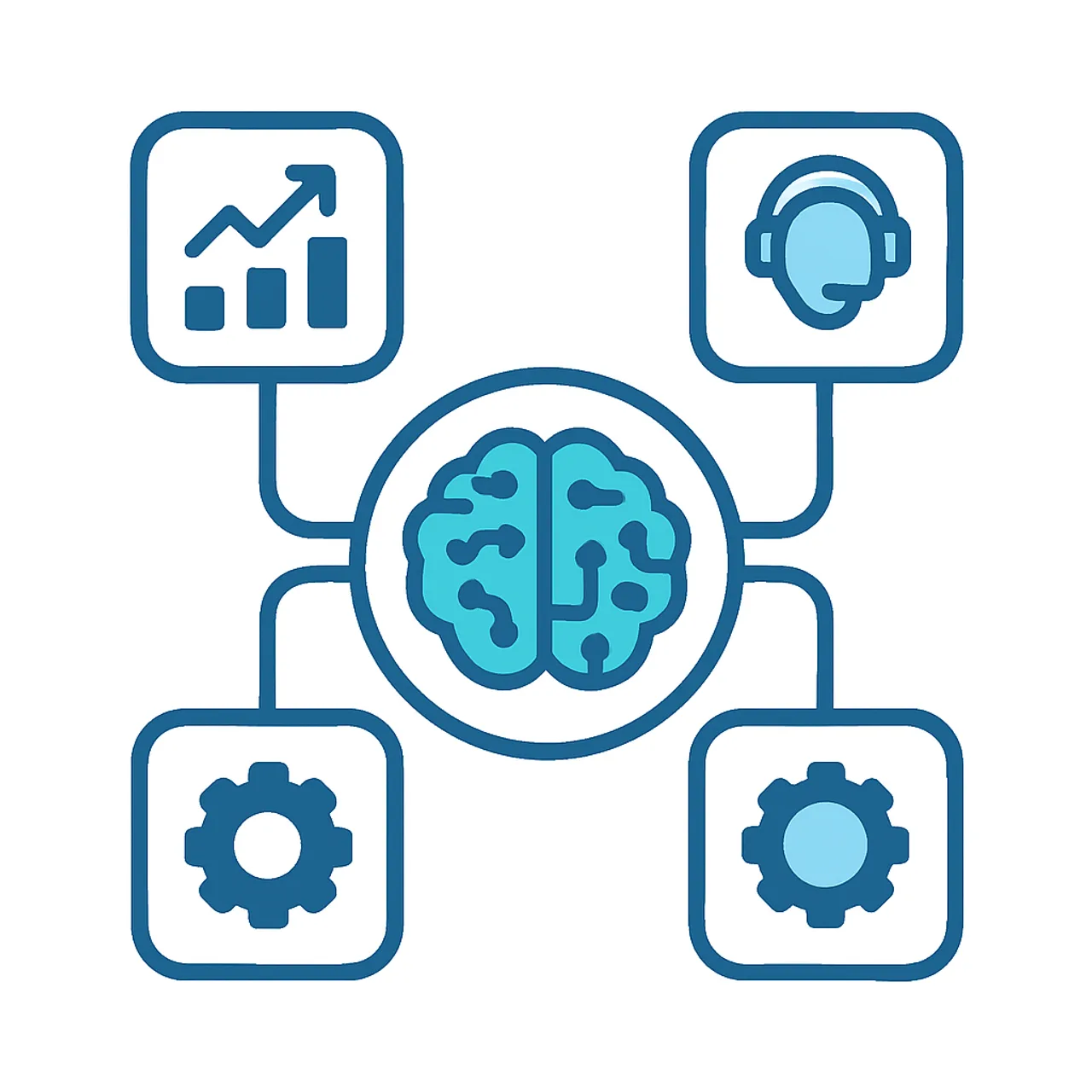
With goals and readiness understood, run structured workshops across departments to surface candidate use cases. Map each one to the AI capability it requires and the business function it serves. A single workshop often surfaces dozens of ideas — the assessment's job is to filter them down to the ones worth pursuing.
4. Data and Infrastructure Audit
AI runs on data. Audit the volume, quality, accessibility, and governance of the data each use case depends on. Identify gaps now, because acquiring or cleaning data is often the longest and most expensive part of any AI project. Document data ownership and access rights too, since legal and privacy constraints frequently block otherwise promising use cases.
5. ROI and Feasibility Analysis
Score every viable use case on two axes: business value and implementation feasibility. Estimate the cost, time, expected return, and payback period for each. This is where vague enthusiasm becomes hard numbers that executives can approve or reject with confidence.
6. Risk, Ethics, and Governance Review
Finally, evaluate each opportunity for compliance, bias, security, and ethical risk. Regulations like the EU AI Act now impose real obligations, and a use case with high regulatory exposure may need extra controls or a deliberately lower priority until safeguards are in place.

AI Opportunity Assessment vs Traditional IT Assessment
| Factor | AI Opportunity Assessment | Traditional IT Assessment |
|---|---|---|
| Primary focus | Business value from AI use cases | System functionality and uptime |
| Data emphasis | Critical — quality and volume drive feasibility | Secondary consideration |
| Risk scope | Bias, ethics, model drift, compliance | Security and reliability |
| Output | Ranked AI use case roadmap | Technical recommendations |
| Success metric | Measurable ROI and adoption | Stable, working systems |
How to Prioritize AI Opportunities
Once scored, rank opportunities using a simple value-versus-feasibility matrix:
- Quick wins — high value, high feasibility. Start here to build momentum and prove ROI fast.
- Strategic bets — high value, lower feasibility. Plan these for later phases once capability grows.
- Incremental gains — lower value, high feasibility. Useful fillers that require little effort.
- Avoid for now — low value, low feasibility. Park these until conditions change.
This approach prevents the common trap of starting with the most ambitious, hardest project first. Document the reasoning behind each ranking, too. When priorities are transparent, stakeholders trust the roadmap and resist the temptation to reshuffle it on a whim.
Common Mistakes to Avoid
- Leading with technology, not problems. Tools should follow needs, never the reverse.
- Ignoring data readiness. The best model still fails on poor data.
- Skipping baseline metrics. Without a 'before' measurement, you cannot prove the 'after' improvement.
- Underestimating change management. Adoption, not deployment, ultimately determines ROI.
- Treating it as one-and-done. Reassess regularly as capabilities and tools evolve.
Partnering with experienced specialists can shortcut this learning curve. Teams such as those at ZoneTechify and WebPeak help organizations run assessments that connect AI ambition to measurable outcomes.
Building Your AI Implementation Roadmap
The assessment culminates in a roadmap — a sequenced plan that turns prioritized use cases into delivery phases. A strong roadmap defines owners, budgets, success metrics, and checkpoints for each initiative, and it schedules quick wins early to fund larger bets later.

For organizations without in-house expertise, professional artificial intelligence services can deliver this end-to-end, while specialized AI solutions from WebPeak help operationalize the roadmap. The goal is the same: a documented, fundable plan that replaces uncertainty with direction.
Key Takeaways
- An AI opportunity assessment identifies and ranks where AI delivers the most value before you invest.
- S&P Global found about 42% of companies abandoned most AI initiatives in 2025, usually due to poor problem selection.
- McKinsey reports 78% of organizations already use AI in at least one business function.
- The process has six phases: goal alignment, readiness, use case mapping, data audit, ROI analysis, and governance.
- Prioritize quick wins first to prove ROI and fund larger strategic bets.
Frequently Asked Questions (FAQ)
How long does an AI opportunity assessment take?
Most assessments take four to eight weeks, depending on company size and the number of departments involved. Smaller organizations can complete a focused assessment in two to three weeks, while enterprises with complex data landscapes may need longer to audit infrastructure and align stakeholders properly.
Who should be involved in an AI opportunity assessment?
Include business leaders who own outcomes, department heads who understand daily workflows, data and IT teams who know the infrastructure, and ideally an AI specialist. This mix ensures use cases are valuable, feasible, and grounded in real operational needs rather than isolated assumptions.
How much does an AI opportunity assessment cost?
Costs vary widely based on scope, from a few thousand dollars for a focused small-business review to larger enterprise engagements. The investment is small compared with the cost of a failed AI project, which can waste months of effort and substantial budget on the wrong problems.
What is the difference between an AI assessment and an AI strategy?
An AI opportunity assessment identifies and prioritizes specific use cases based on value and feasibility. An AI strategy is the broader long-term plan covering vision, governance, talent, and budget. The assessment feeds the strategy by supplying the evidence needed to make confident, data-driven decisions.
Can small businesses benefit from an AI opportunity assessment?
Yes. Small businesses often gain the most because they have limited budgets and cannot afford failed experiments. A lean assessment helps them target one or two high-impact, affordable use cases — like automating customer support or forecasting demand — that deliver quick, measurable returns.
How often should we repeat the assessment?
Repeat your assessment at least once a year, or quarterly in fast-moving industries. AI tools, costs, and regulations change rapidly, so opportunities that were unfeasible last year may now be practical. Regular reassessment keeps your roadmap current and your investments aligned with new capabilities.
Conclusion
An artificial intelligence opportunity assessment is the difference between AI that drains budgets and AI that drives growth. By aligning goals, auditing readiness, scoring use cases, and managing risk, you build a roadmap grounded in evidence rather than hype. Start with a focused assessment, prove value with quick wins, and scale confidently from there.