
Explore how artificial intelligence connects with Sanskrit, from Panini's grammar to modern NLP, translation tools, and the future of AI-powered language research.
Artificial Intelligence in Sanskrit

Artificial intelligence and Sanskrit may sound like opposites — one is the newest frontier of computing, the other is among the oldest documented languages on earth. Yet researchers, linguists, and engineers increasingly study them together. Sanskrit's rigorously structured grammar makes it unusually compatible with the logic that powers modern machine learning. This article explains, in plain terms, what "artificial intelligence in Sanskrit" actually means, why it matters, and where the field is heading.
At ZoneTechify and WebPeak, we work with language technology daily, and the Sanskrit–AI relationship is one of the most fascinating intersections of heritage and innovation we encounter.
Quick Answer: Artificial intelligence in Sanskrit refers to using AI and natural language processing to read, translate, and analyze Sanskrit, while also studying how Sanskrit's precise grammar inspires computational logic. Its rule-based structure makes it a natural fit for algorithms and knowledge systems.
What Does "Artificial Intelligence in Sanskrit" Mean?
The phrase carries two distinct meanings, and both are important. First, it describes the practical effort to build AI tools that can process Sanskrit text — translation engines, optical character recognition for manuscripts, and search systems for ancient libraries. Second, it refers to the academic argument that Sanskrit's grammar is so systematic it resembles a programming language, making it a useful model for designing AI.
In Sanskrit itself, artificial intelligence is often rendered as "कृत्रिम बुद्धि" (Kritrima Buddhi), meaning "artificial intellect." The term captures the idea of created, engineered reasoning — a concept the language has had vocabulary for long before computers existed.
Why Sanskrit Is Uniquely Suited to AI
Sanskrit is governed by an exceptionally consistent set of rules. Unlike English, where exceptions and irregular spellings are everywhere, Sanskrit follows predictable patterns for word formation, sound changes, and sentence structure. This consistency is gold for computer scientists, because machines thrive on rules without ambiguity.
A frequently cited milestone is a 1985 paper by NASA researcher Rick Briggs in AI Magazine, which argued that Sanskrit's grammatical tradition already contained methods similar to the "knowledge representation" schemes AI researchers were inventing. While the claim that Sanskrit is the single "best" computer language is overstated, the underlying observation — that its grammar is remarkably formal and unambiguous — remains widely respected.
Key Linguistic Strengths
- Rule-based grammar: Word forms are generated systematically, which maps cleanly to algorithms.
- Low ambiguity: Precise case endings reduce the guesswork that confuses NLP models in other languages.
- Compositional structure: Complex meanings are built from smaller, predictable units — ideal for parsing.
Panini's Grammar: An Ancient Algorithm
No discussion of AI and Sanskrit is complete without Panini, the scholar who, around the 5th–4th century BCE, wrote the Ashtadhyayi — a grammar of roughly 4,000 concise rules. What astonishes modern computer scientists is that these rules behave like a formal generative system: they take inputs, apply ordered transformations, and produce valid outputs, much like a function in code.

Panini even used techniques resembling meta-rules, recursion, and conditional ordering — concepts that wouldn't formally appear in Western mathematics until the 20th century with figures like Backus and Naur, whose notation (BNF) underpins programming language design. Linguists have noted striking parallels between the Ashtadhyayi and modern formal grammars, making Panini a genuine ancestor of computational thinking.
This is why Sanskrit appears in computer science discussions far more often than its number of speakers would suggest: it offers a real-world example of a language engineered with near-mathematical precision.
How AI Actually Processes Sanskrit Today
Modern AI handles Sanskrit using the same broad techniques applied to any language, with adaptations for its structure. The core methods include tokenization, morphological analysis, and machine learning models trained on digitized texts.

A major challenge is sandhi — the way Sanskrit fuses words together at their boundaries, changing sounds in the process. A sentence can read as one long unbroken string, and AI must learn to split it correctly before any analysis begins. Researchers have built dedicated sandhi-splitting tools, many using neural networks, that now achieve high accuracy and make downstream tasks like translation possible.
The Typical AI Pipeline for Sanskrit
- Digitization: Scanning manuscripts and applying OCR to convert images into machine-readable text.
- Sandhi splitting: Separating fused words into their components.
- Morphological analysis: Identifying roots, tenses, and grammatical cases.
- Parsing and translation: Mapping meaning into another language or structured data.
If your organization needs custom language or automation systems built on these principles, professional artificial intelligence services can turn research-grade techniques into production-ready tools.
AI-Powered Sanskrit Translation and Tools
Translation is where most people first encounter AI and Sanskrit together. Projects from institutions such as the University of Hyderabad, IIT Kharagpur, and the Sanskrit Library have produced readers, dictionaries, and analyzers that automatically tag and explain text. Tools like the Digital Corpus of Sanskrit host hundreds of thousands of analyzed sentences used to train and evaluate models.
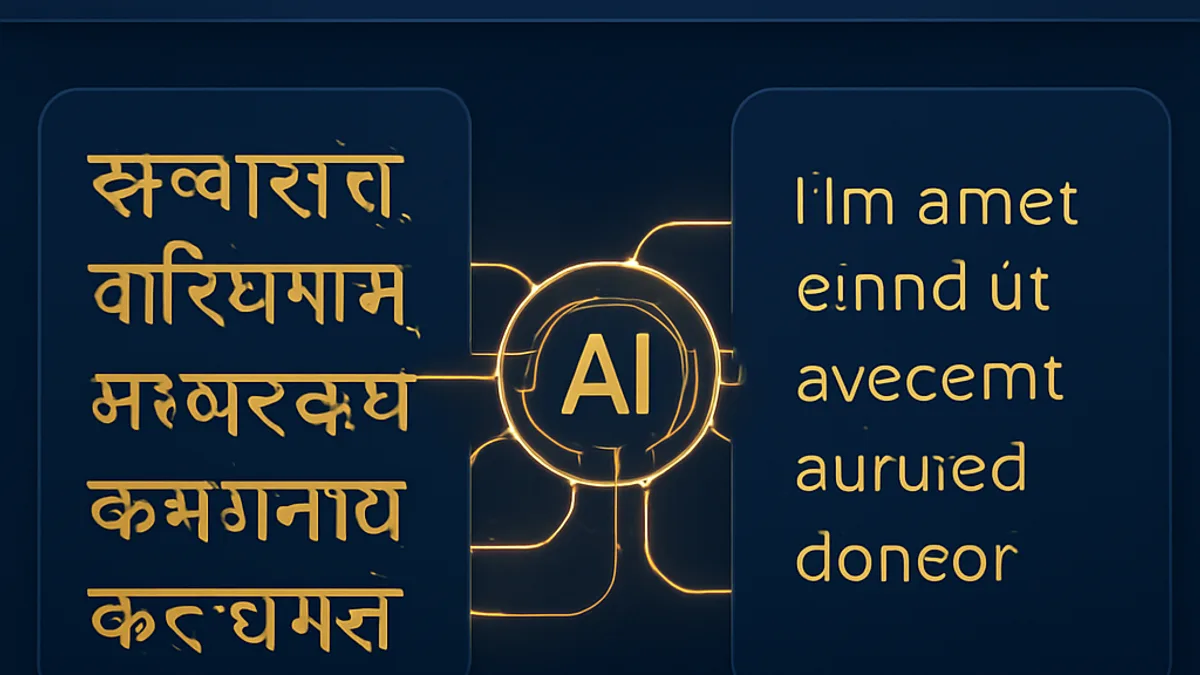
Large language models have improved Sanskrit handling, but accuracy still lags behind high-resource languages like English or Spanish. The reason is data: AI quality depends heavily on training volume, and digitized, annotated Sanskrit remains comparatively scarce. Every newly digitized manuscript directly improves what these systems can do.
Sanskrit and Knowledge Representation
Beyond translation, Sanskrit influences how AI organizes meaning. Its grammar encodes relationships — who did what to whom — directly into word endings, which resembles how modern AI uses semantic networks and knowledge graphs to store facts as connected nodes.
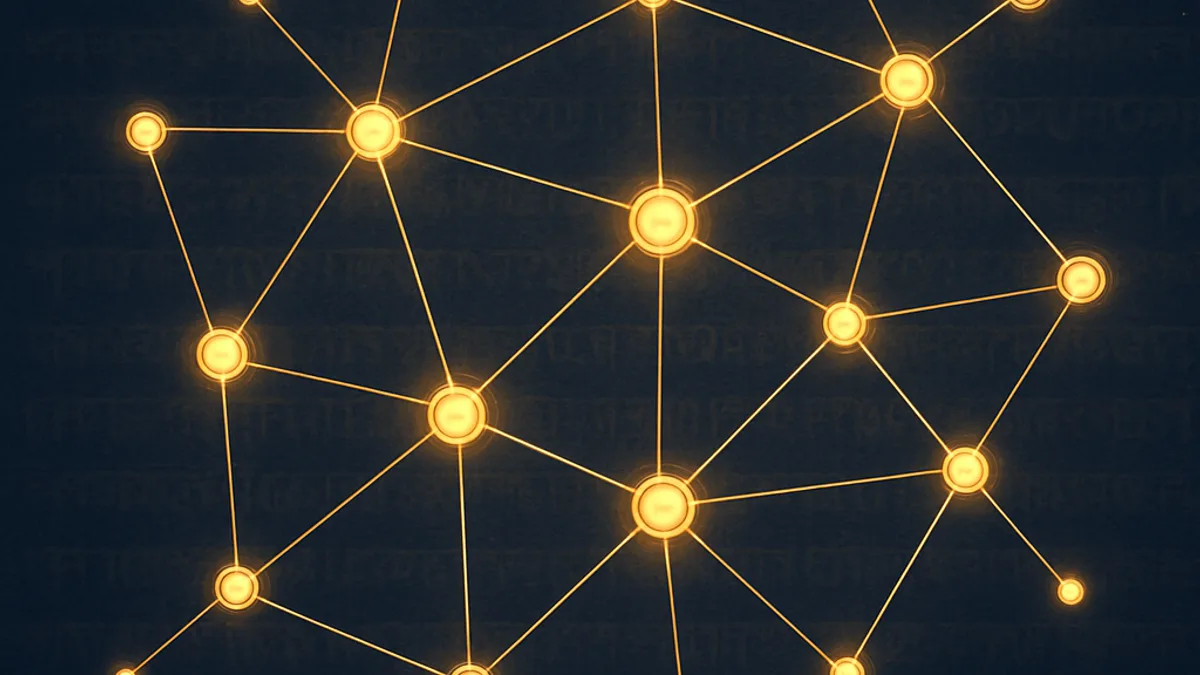
Knowledge representation is the AI subfield concerned with encoding information so machines can reason about it. Sanskrit's case system effectively labels each word's role in an action, which is conceptually close to how an AI tags entities and relationships. This is the kernel of truth behind claims that Sanskrit is "AI-friendly": not that it runs on computers, but that its design philosophy anticipated structured, unambiguous meaning representation.
Comparing Sanskrit With Other Languages for AI
The table below summarizes how Sanskrit compares with two widely used languages across factors that matter for AI development.
| Factor | Sanskrit | English | Mandarin Chinese |
|---|---|---|---|
| Grammar consistency | Very high | Moderate | Moderate |
| Ambiguity in structure | Low | High | High |
| Available training data | Limited | Very large | Large |
| Rule-based parsing ease | Excellent | Difficult | Difficult |
| Active everyday speakers | Few | Very many | Very many |
The takeaway is balanced: Sanskrit is structurally ideal but data-poor, while English is structurally messy but data-rich. Real-world AI performance depends on data volume, which is why English models outperform Sanskrit ones today despite English being far less regular.
The Future of AI and Sanskrit
The future is promising and practical. As digitization accelerates and transfer learning lets models share knowledge across languages, Sanskrit tools will keep improving. The most exciting work lies in digital preservation — using AI to read crumbling manuscripts, reconstruct damaged text, and make millennia of philosophy, science, and literature searchable.
We also expect more educational applications: AI tutors that teach Sanskrit grammar interactively, voice assistants that understand Sanskrit commands, and research engines that link related ideas across ancient texts. For teams building such products, specialized AI services help bridge linguistic research and scalable engineering.
Real-World Applications Already in Motion
Sanskrit AI is not purely theoretical. Several applications are already live or in advanced development.

- Manuscript digitization by national archives and universities.
- Automated commentary linking that connects verses to their classical interpretations.
- Speech recognition experiments for chanting and recitation accuracy.
- Educational apps that parse and explain verses for learners worldwide.
Each application proves the same point: when you combine a highly structured language with modern computation, you unlock value that neither could deliver alone.
Key Takeaways
- Artificial intelligence in Sanskrit means both building AI tools to process Sanskrit and studying how its grammar informs computational logic.
- In Sanskrit, AI is expressed as "Kritrima Buddhi" (कृत्रिम बुद्धि), meaning artificial intellect.
- A 1985 AI Magazine paper by Rick Briggs highlighted Sanskrit's similarity to knowledge representation systems.
- Panini's Ashtadhyayi (around 4,000 rules) functions like a formal generative grammar, predating modern computer science notation.
- Sanskrit's strength is its rule-based, low-ambiguity grammar; its main limitation for AI is scarce digitized training data.
Frequently Asked Questions (FAQ)
What is artificial intelligence called in Sanskrit?
Artificial intelligence is commonly translated as "Kritrima Buddhi" (कृत्रिम बुद्धि) in Sanskrit, meaning "artificial intellect" or "created intelligence." The term combines kritrima (artificial or man-made) with buddhi (intellect or reasoning), accurately capturing the modern concept of engineered machine intelligence.
Is Sanskrit really the best language for AI?
Not exactly. Sanskrit has unusually consistent, rule-based grammar that suits algorithms, which inspired claims of being "AI-friendly." However, practical AI depends on large training datasets, and Sanskrit has limited digitized text. So it is structurally excellent but currently data-poor compared with English or Mandarin.
How does AI translate Sanskrit text?
AI translates Sanskrit through a pipeline: it digitizes text, splits fused words (sandhi), analyzes morphology to find roots and grammatical cases, then maps the meaning into another language. Neural networks trained on annotated corpora handle each step, though accuracy still trails high-resource languages due to limited data.
Who was Panini and why does AI mention him?
Panini was an ancient Indian grammarian who, around the 5th–4th century BCE, wrote the Ashtadhyayi, a grammar of roughly 4,000 rules. AI researchers cite him because his rules work like a formal generative system, using recursion and ordered transformations that strongly resemble modern computational logic.
Can AI help preserve ancient Sanskrit manuscripts?
Yes. AI is increasingly used to digitize, read, and reconstruct fragile Sanskrit manuscripts through optical character recognition and machine learning. These tools make millennia of texts searchable, repair damaged passages, and link related ideas, helping institutions preserve cultural heritage that would otherwise risk being lost.
Final Thoughts
Artificial intelligence in Sanskrit is a meeting point of deep history and cutting-edge technology. The language's mathematical precision, embodied in Panini's timeless grammar, offers genuine lessons for how we design intelligent systems, while AI returns the favor by preserving and reviving Sanskrit for new generations. As digitization grows, expect this partnership to produce smarter tools and richer access to an extraordinary body of knowledge.