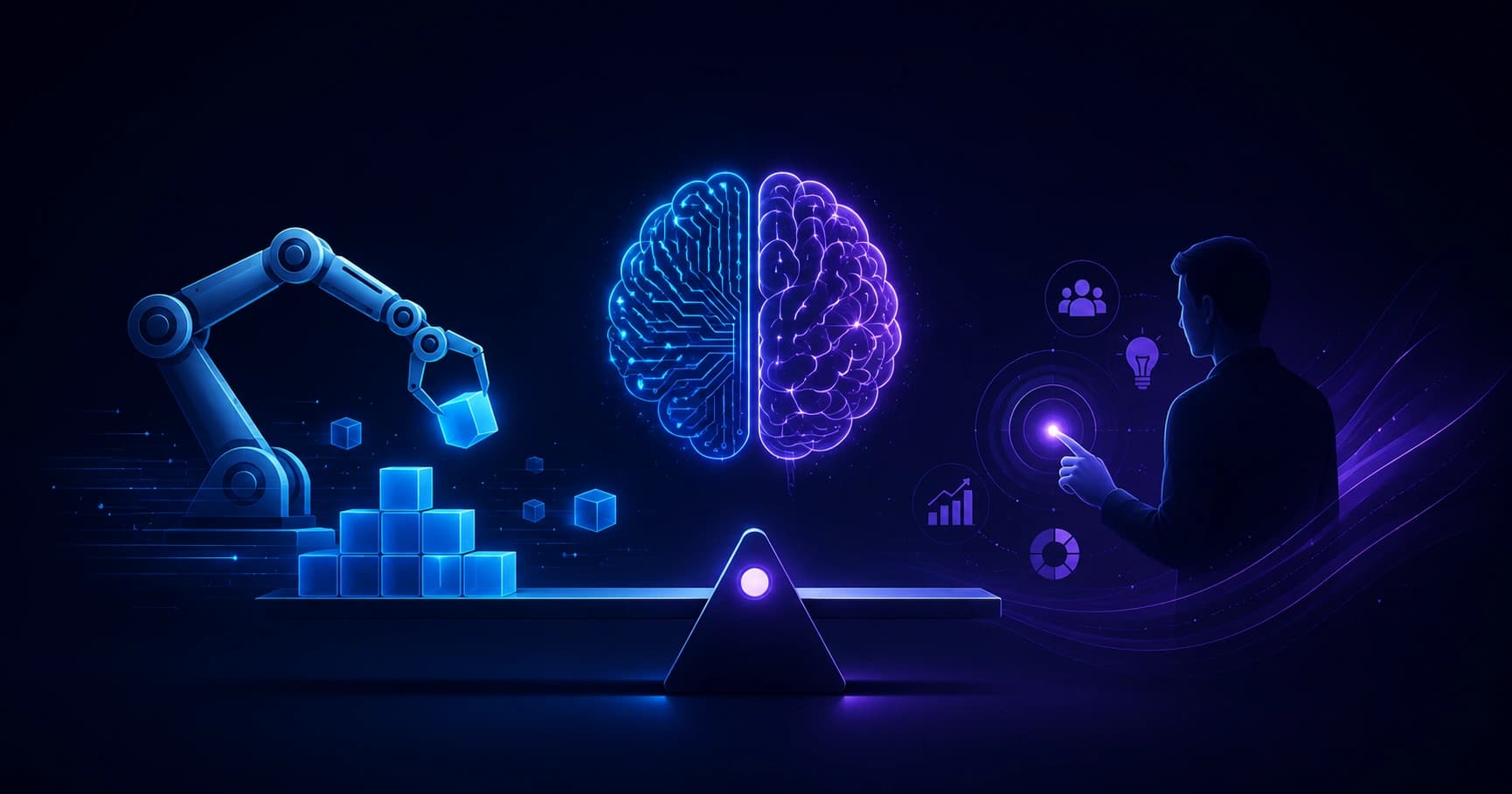
A practical, expert guide to the automation augmentation paradox in AI management, showing when to replace tasks with machines and when to amplify human judgment.
Artificial Intelligence and Management: The Automation Augmentation Paradox

Every manager adopting artificial intelligence eventually collides with the same tension. Should AI replace the work people do, or should it amplify the people who do it? This is the automation augmentation paradox, and how you resolve it determines whether your AI investment builds a resilient organization or a brittle one. After a decade advising teams through digital transformation, I can tell you the answer is rarely either or.
The paradox is deceptively simple to state and genuinely hard to live with. Automation promises cost reduction and speed. Augmentation promises better decisions and happier, more capable teams. Pursue automation too aggressively and you hollow out the human expertise your organization depends on. Lean only on augmentation and you leave obvious efficiency gains on the table. This article shows you how to hold both ideas at once and act on them deliberately.
Quick Answer: The automation augmentation paradox is the management tension between using AI to replace human tasks (automation) and using AI to enhance human capability (augmentation). The best approach blends both: automate repetitive, rule-based work while augmenting complex judgment, creativity, and relationship-driven decisions that need human context.
What Is the Automation Augmentation Paradox?
The automation augmentation paradox is the strategic conflict between replacing human labor with AI and enhancing human labor with AI. Automation removes the person from a task entirely. Augmentation keeps the person central and gives them AI-powered leverage. Both use the same underlying technology, but they lead to very different organizations, cultures, and cost structures.
The paradox is that these two goals often compete for the same budget, the same processes, and the same executive attention. A finance leader automating invoice processing and a sales leader augmenting reps with AI insights are pulling the same technology in opposite directions. Good management does not pick a side ideologically. It decides task by task, based on evidence.
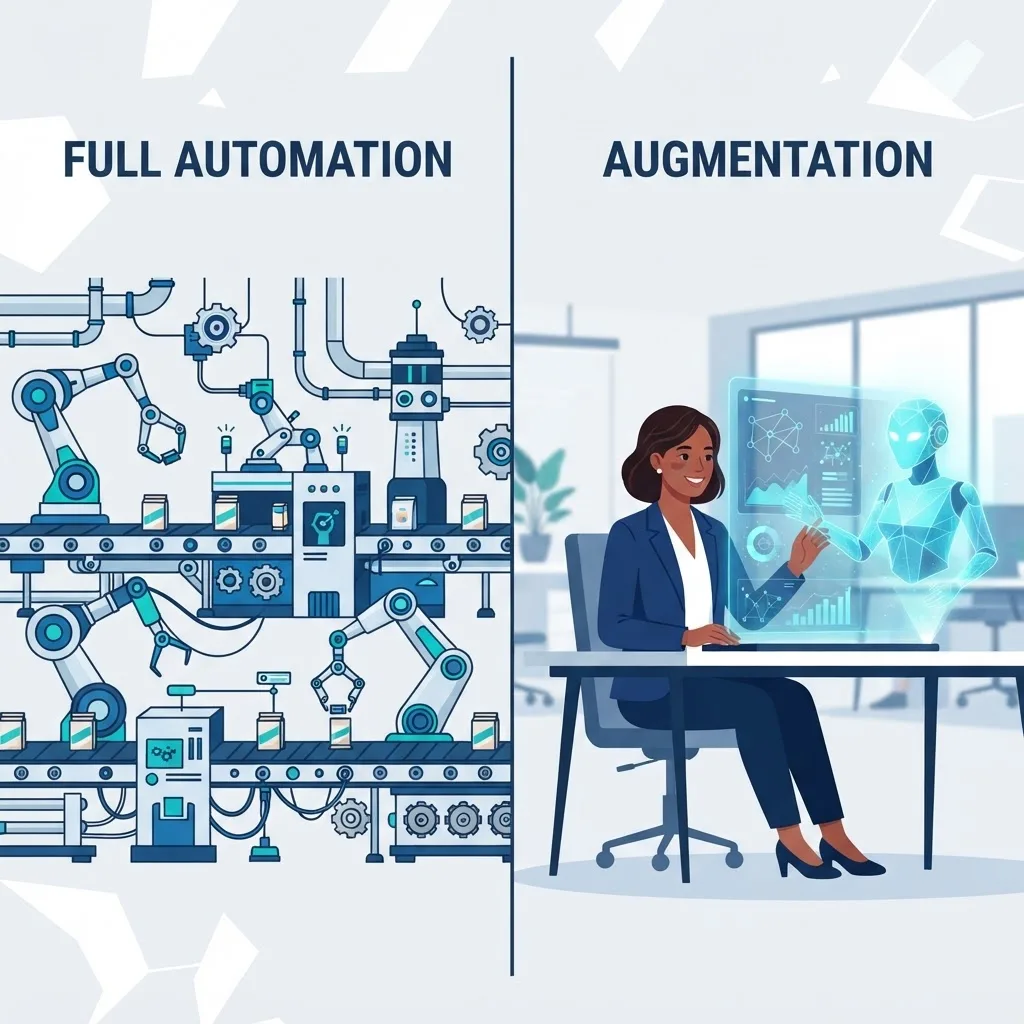
Definitions That Matter
- Automation: AI or software completes a task from start to finish with little or no human involvement. Example: automatically categorizing support tickets.
- Augmentation: AI assists a human who remains the decision-maker. Example: an AI drafting a reply that an agent reviews, edits, and sends.
- The paradox: Optimizing purely for one degrades the value of the other over time.
Why Managers Keep Getting This Wrong
Most failed AI initiatives fail not because the technology is weak, but because leadership never decided which mode they were pursuing. According to McKinsey's global AI research, a large majority of organizations now use AI in at least one business function, yet only a minority report meaningful bottom-line impact. That gap is a management problem, not a model problem.
The common mistake is treating every process as an automation candidate. When you strip humans out of work that requires judgment, you lose institutional knowledge, reduce accountability, and create systems no one fully understands. I have watched companies automate customer escalations only to rebuild human teams eighteen months later after churn spiked.
The opposite error is quieter but just as costly. Teams add AI "assistants" everywhere without ever removing the manual work underneath, so costs rise while nobody's day actually gets easier. Augmentation without redesign is just extra software.

The Task Spectrum: A Practical Decision Framework
The most useful mental model I have found is to place every task on a spectrum rather than in a binary bucket. On one end sit repetitive, high-volume, rule-based tasks with clear right answers. On the other sit ambiguous, high-stakes, context-heavy decisions. Automation belongs on the left. Augmentation belongs on the right. Most work sits somewhere in the middle and needs a deliberate blend.

To place a task, ask four questions:
- How predictable is the input? Consistent, structured data favors automation.
- What is the cost of an error? High-consequence mistakes favor human oversight.
- Does the task require empathy or negotiation? Relationship work favors augmentation.
- How often do the rules change? Volatile rules favor a human in the loop.
Run these questions across a real workflow and the strategy becomes obvious. You will typically automate the intake and sorting, augment the analysis and decision, and keep humans fully in charge of the relationship and the exception handling.
Automation vs Augmentation: A Side-by-Side Comparison
| Factor | Automation | Augmentation |
|---|---|---|
| Human role | Removed from task | Central decision-maker |
| Best for | Repetitive, rule-based work | Complex, judgment-based work |
| Primary benefit | Speed and cost reduction | Better decisions and capability |
| Main risk | Lost expertise, rigidity | Higher cost, slower adoption |
| Error handling | Needs strong monitoring | Human catches errors live |
| Culture impact | Can create fear | Builds trust and skills |
| Time to value | Fast for narrow tasks | Compounds over time |
The table makes the trade-offs concrete. Notice that neither column is strictly better. A mature AI strategy uses both columns intentionally, matching the mode to the task rather than to a slogan.
How to Implement the Blend Without Chaos
Adopting AI in management works best as a staged rollout, not a big bang. The organizations that see real returns treat AI like a capability they build, not a product they buy. Here is the sequence I recommend to teams, refined across dozens of implementations.
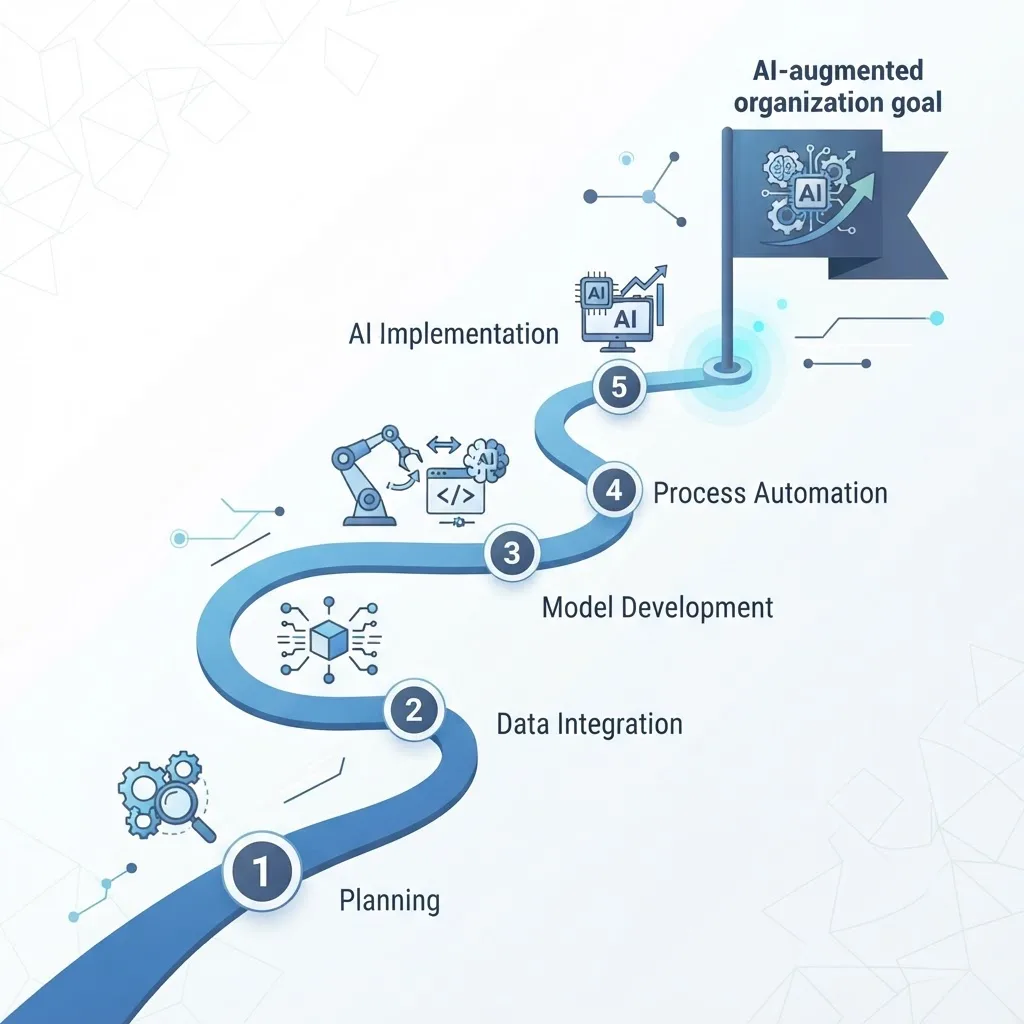
- Map the work first. Document your actual workflows before touching any tool. You cannot automate or augment a process you have not defined.
- Score each task on the spectrum. Use the four questions above to label tasks as automate, augment, or leave alone.
- Start with augmentation on high-value work. It builds trust quickly and lets people see AI as a partner, not a threat.
- Automate the boring middle. Once teams trust the tools, remove the low-judgment tasks that drain hours.
- Instrument everything. Track accuracy, time saved, and error rates so decisions stay evidence-based.
- Retrain roles, not just tools. Redirect freed-up hours toward strategy, customers, and creativity.
This staged approach reduces resistance because employees experience AI first as help, not as a pink slip. Trust earned early makes later automation far less contentious. If you want expert support structuring this rollout, ZoneTechify's artificial intelligence services help teams design and deploy AI that balances automation and augmentation responsibly.
The Human Element: Why Augmentation Usually Wins Long Term
Here is my honest, experience-backed opinion: in knowledge work, augmentation tends to create more durable value than pure automation. Automation caps out at the efficiency of a fixed process. Augmentation compounds, because your people get smarter, faster, and more capable while the AI improves alongside them.

Google's research on workplace productivity has repeatedly shown that time spent on repetitive tasks is time not spent on high-value creative and strategic work. When you augment a skilled employee, you are not just saving minutes. You are unlocking the judgment, relationships, and creativity that competitors cannot easily copy. Automation is imitable. A well-augmented expert team is a genuine moat.
That said, augmentation demands discipline. It only pays off when leaders redesign the role around the new capability. Giving someone an AI tool and expecting magic is like handing someone a faster car with no destination. The manager's job is to define where that new speed should go.
Real-World Signals You Chose the Wrong Mode
Trust the data, but also watch for these practical warning signs. If automated systems generate a growing pile of exceptions that humans scramble to fix, you automated a task that needed augmentation. If your AI-assisted teams are slower than before, you augmented a task that should have been fully automated or left alone.
Another reliable signal is morale. Automation done to people breeds anxiety and quiet resistance. Augmentation done with people builds advocates. When employees start asking for more AI tools rather than fearing them, you know your blend is working. Learn more about balanced, human-centered digital strategy at WebPeak and the broader work at ZoneTechify.
The Future of AI-Augmented Management
The managers who thrive in the next decade will be fluent in this paradox. They will not ask "Can we automate this?" as their first question. They will ask "What is the best division of labor between people and machines for this specific outcome?" That subtle shift changes everything downstream.

We are moving toward organizations where AI handles the predictable and people handle the meaningful. In that world, the scarcest management skill will be judgment about where those boundaries sit, and the willingness to move them as the technology and the business evolve. The paradox never fully resolves. You manage it continuously.
Key Takeaways
- The automation augmentation paradox is the tension between replacing human work with AI and enhancing human work with AI.
- Automation suits repetitive, rule-based, low-consequence tasks; augmentation suits complex, high-stakes, relationship-driven work.
- Most organizations use AI in at least one function, but only a minority report significant financial impact, revealing a management gap.
- Use a four-question spectrum test: input predictability, error cost, empathy needs, and rule volatility.
- Start with augmentation to build trust, then automate the low-judgment middle, and always retrain roles.
- Augmentation tends to create a more durable competitive advantage than automation in knowledge work.
Frequently Asked Questions (FAQ)
What is the difference between AI automation and AI augmentation?
Automation uses AI to complete a task fully without human involvement, ideal for repetitive rule-based work. Augmentation uses AI to assist a person who stays in control, ideal for complex judgment. Automation optimizes speed and cost; augmentation optimizes decision quality and human capability.
Should managers automate or augment first?
Most teams should augment first. Starting with augmentation on high-value tasks builds employee trust and shows AI as a helpful partner rather than a job threat. Once people trust the tools, automating repetitive low-judgment tasks faces far less resistance and delivers cleaner, more reliable results.
Does AI automation replace management jobs?
AI rarely replaces whole management jobs, but it does replace specific tasks within them. Routine reporting, scheduling, and data sorting get automated, while judgment, coaching, negotiation, and strategy stay human. Managers who redirect freed time toward these high-value activities become more valuable, not less.
How do I know if a task should be automated or augmented?
Ask four questions: Is the input predictable? Is the cost of an error low? Does it avoid needing empathy? Are the rules stable? Multiple yes answers point to automation. Any strong no, especially around error cost or empathy, points toward augmentation with a human in the loop.
Why do so many AI projects fail to deliver results?
Many AI projects fail because leaders never decide whether they are automating or augmenting. They add tools without redesigning workflows, so costs rise without real gains. Success comes from mapping processes first, scoring tasks deliberately, measuring outcomes, and retraining roles around the new capabilities.
Is augmentation always better than automation?
No. Augmentation usually wins for complex knowledge work because it compounds human skill over time. But for high-volume, predictable, low-risk tasks, full automation is faster and cheaper. The strongest strategy blends both, matching each task to the right mode instead of applying one philosophy everywhere.