
A practical, evidence-based guide to how artificial intelligence raises firm-level productivity, with data, an adoption roadmap, ROI metrics, and expert insights.
Artificial Intelligence and Firm Level Productivity
Artificial intelligence has moved from experimental pilots to a measurable driver of business performance. For company leaders, the real question is no longer whether AI works in a lab, but how much it lifts output, margins, and speed inside a single organization. Firm-level productivity, the value a company produces per unit of labor and capital, is where AI either proves its worth or quietly drains budgets. Having advised teams through dozens of AI rollouts, I have seen the same pattern repeat: firms that treat AI as a workflow redesign win, while those that bolt it on as a gadget stall. This guide breaks down exactly how AI improves firm-level productivity, what the data shows, and how to capture measurable gains. Learn more about digital transformation at ZoneTechify.

Quick Answer: Artificial intelligence raises firm-level productivity by automating repetitive tasks, augmenting skilled workers, and speeding decision-making. Studies show AI-assisted employees complete work 10 to 40 percent faster, but real firm-wide gains depend on redesigned workflows, clean data, staff training, and disciplined measurement rather than isolated tools.
What Is Firm-Level Productivity in the AI Era?
Firm-level productivity is the ratio of output a business generates to the inputs it consumes, typically labor hours, capital, and materials. Unlike broad economy-wide productivity, it measures performance inside one organization, which is where managers can actually influence results.
AI changes this equation in two ways. First, it reduces the input side by automating tasks that once required human hours. Second, it raises the output side by helping employees produce higher-quality work faster. The distinction matters: a firm that only cuts costs may look efficient, but a firm that also increases output value builds durable competitive advantage.
The key term to define here is total factor productivity (TFP), the portion of output growth not explained by adding more labor or capital. AI's most valuable contribution is lifting TFP, meaning the same team and budget produce noticeably more.
How Artificial Intelligence Drives Firm-Level Productivity
AI improves productivity through three reinforcing mechanisms: automation, augmentation, and acceleration of decisions. Understanding each helps leaders invest where returns are highest.
1. Automation of Repetitive Work
Automation removes low-value, rules-based tasks from human workloads. Invoice processing, data entry, ticket routing, and report generation are prime candidates because they are frequent, structured, and error-prone when done manually.

The productivity gain here is direct: hours saved are hours redirected toward revenue-generating work. In my experience, firms that map their top ten repetitive processes before buying any tool capture savings within a single quarter, while firms that automate randomly rarely see measurable impact.
2. Augmentation of Skilled Workers
Augmentation is where AI amplifies human expertise rather than replacing it. A support agent using an AI assistant resolves tickets faster, a developer with code completion ships features sooner, and a marketer drafts campaigns in minutes instead of hours.
A landmark 2023 field study by researchers at Stanford and MIT found that customer support agents using a generative AI assistant handled 14 percent more issues per hour on average, with the least experienced workers gaining the most. This pattern, where AI narrows the gap between novice and expert, is one of the most reliable productivity effects observed to date.
3. Faster, Data-Driven Decisions
AI shortens the time between question and answer. Predictive analytics, demand forecasting, and anomaly detection let managers act on signals in hours instead of weeks. Faster decisions reduce waste, cut inventory costs, and improve capacity planning, all of which flow directly into firm-level productivity.
The Data: What Research Says About AI and Productivity
The evidence for AI-driven productivity is now substantial, though uneven across industries. Two figures are worth citing with context.
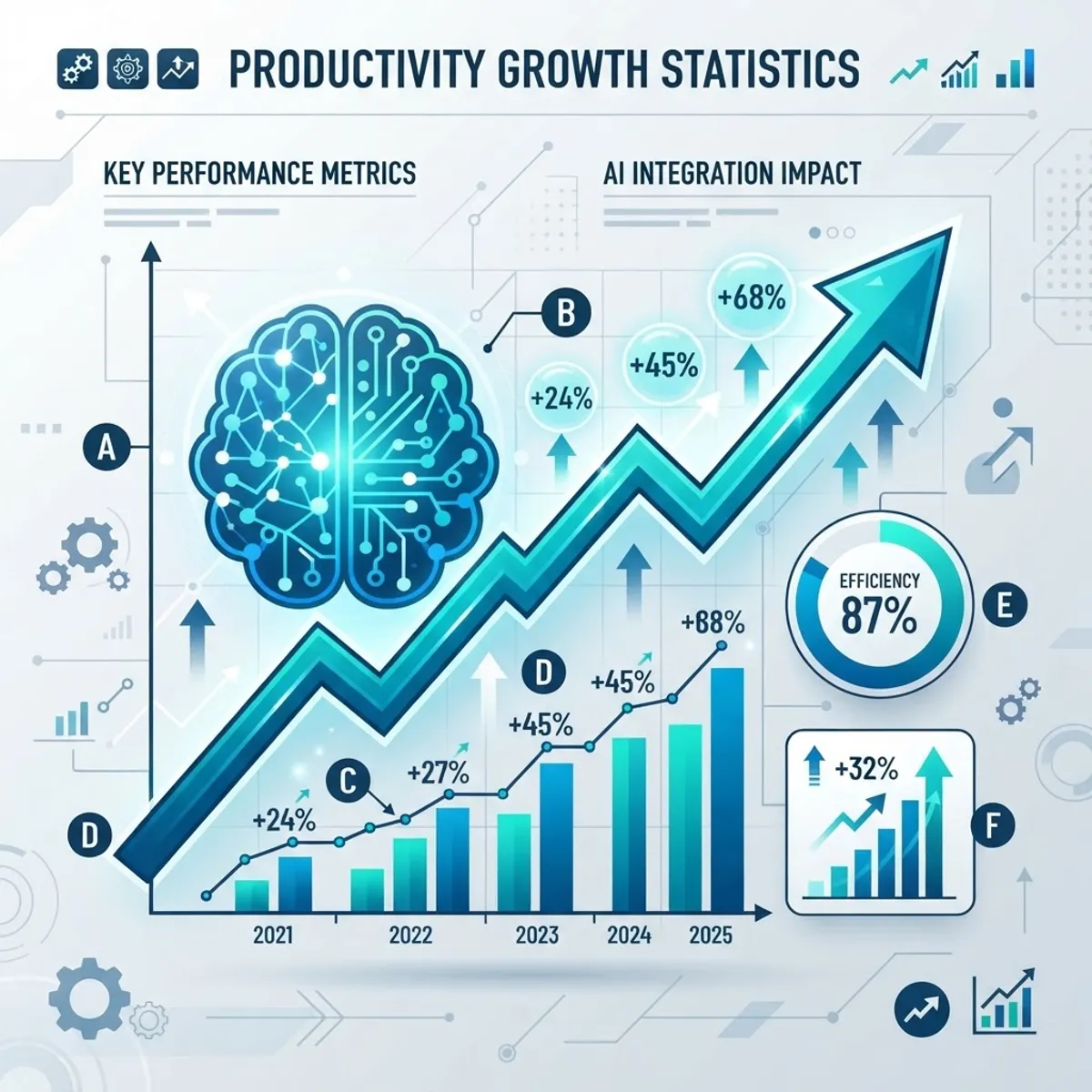
According to a 2023 National Bureau of Economic Research study, generative AI raised worker productivity by 14 percent on average in a large customer-service deployment. Separately, McKinsey estimates that generative AI could add the equivalent of 2.6 to 4.4 trillion dollars in annual value across the global economy, with productivity gains concentrated in customer operations, marketing, software engineering, and R&D.
The important nuance is that these are potential gains, not guaranteed ones. Firm-level results vary widely because outcomes depend on data quality, workflow integration, and adoption discipline. A tool that works in one company can underperform in another with messy data or resistant teams.
AI Productivity Impact by Business Function
| Business Function | Typical Productivity Lift | Primary AI Mechanism | Time to Measurable ROI |
|---|---|---|---|
| Customer Support | 14 to 40 percent | Augmentation | 1 to 3 months |
| Software Development | 20 to 55 percent | Augmentation | 2 to 4 months |
| Marketing and Content | 15 to 30 percent | Automation and augmentation | 1 to 2 months |
| Finance and Operations | 10 to 25 percent | Automation | 3 to 6 months |
| Sales | 10 to 20 percent | Decision support | 2 to 5 months |
These ranges reflect commonly reported outcomes across published studies and enterprise case reports. Treat them as planning benchmarks, not promises.
Building an AI Adoption Roadmap That Actually Raises Productivity
Productivity gains come from disciplined rollout, not from purchasing the most advanced model. A clear roadmap prevents the common failure of scattered, unmeasured experiments.

Follow these five steps in order:
- Audit your workflows. Identify the ten most time-consuming, repetitive, or error-prone tasks across departments.
- Prioritize by value and feasibility. Target tasks that are high-volume and have clean, accessible data.
- Start with augmentation pilots. Give a small team AI assistants and measure output before and after.
- Redesign the workflow, not just the tool. The biggest gains come from rethinking the process around AI, not inserting AI into an old process.
- Scale what works and retire what does not. Expand proven use cases and cut experiments that show no measurable lift.
Firms that need help designing this roadmap often partner with specialists. You can explore ZoneTechify's artificial intelligence services for implementation support, and WebPeak's AI services for automation and model integration.
Measuring the ROI of AI on Productivity
You cannot manage what you do not measure, and AI productivity is easy to overstate without hard metrics. The goal is to isolate AI's contribution from other changes.

Track these four metrics before and after deployment:
- Output per employee hour, the clearest measure of labor productivity.
- Cycle time, how long a task or process takes end to end.
- Error and rework rate, since AI that increases speed but adds mistakes is not a real gain.
- Cost per unit of output, which captures whether savings reach the bottom line.
A practical rule I apply: run a controlled comparison where one team uses AI and a similar team does not, over the same period. This A/B approach filters out seasonal noise and reveals the true incremental lift. Without a baseline, reported productivity gains are usually guesses.
Why Some Firms Fail to Capture AI Productivity Gains
Not every AI investment pays off, and the reasons are predictable. Recognizing these pitfalls protects your budget.
The most common failure is poor data. AI trained on incomplete or inconsistent internal data produces unreliable output, forcing employees to double-check everything and erasing time savings. The second failure is skipping change management. Tools go unused when staff are not trained or when incentives still reward the old way of working. The third is measuring activity instead of outcomes, celebrating how many prompts were run rather than whether output actually increased.
Avoiding these traps is less about technology and more about disciplined execution, which is why leadership commitment matters as much as software quality.
The Future Outlook for AI and Firm Productivity
The trajectory points toward AI becoming a standard layer of business operations rather than a differentiator. As models grow more capable and cheaper to run, the productivity advantage will shift from having AI to using it well.

Expect three shifts over the next few years: AI agents that complete multi-step tasks autonomously, tighter integration between AI and existing business software, and a growing premium on employees who can direct and verify AI output. Firms that build internal AI literacy now will compound their advantage, because productivity gains accumulate as teams learn to delegate more effectively. For ongoing guidance on digital growth, resources like WebPeak track these developments closely.
Key Takeaways
- Firm-level productivity measures output per unit of input inside one organization, and AI's biggest contribution is lifting total factor productivity.
- AI improves productivity through automation, augmentation, and faster decisions, with augmentation delivering the most reliable gains.
- A 2023 NBER study found a 14 percent average productivity lift for AI-assisted support agents, with the least experienced benefiting most.
- McKinsey estimates generative AI could add 2.6 to 4.4 trillion dollars in annual global value.
- Real gains require workflow redesign, clean data, staff training, and controlled measurement, not just tool purchases.
Frequently Asked Questions (FAQ)
Does AI really increase productivity at the firm level?
Yes, when implemented well. Multiple studies show AI-assisted workers complete tasks 10 to 40 percent faster, but firm-wide productivity only rises when companies redesign workflows, train staff, and measure outcomes. Isolated tools without process change rarely produce measurable firm-level gains.
How long does it take to see productivity gains from AI?
Most firms see measurable results within one to six months, depending on the function. Customer support and content teams often show gains in weeks, while finance and operations take longer because they require data cleanup and process integration before benefits appear.
Will AI replace employees or make them more productive?
In most firms AI augments employees rather than replacing them outright. It removes repetitive tasks and boosts output per worker, letting staff focus on higher-value work. Research shows the largest gains often go to less experienced employees, narrowing skill gaps across teams.
What is the best way to measure AI productivity ROI?
Compare output per employee hour, cycle time, error rate, and cost per unit before and after deployment. The most reliable method runs one team with AI against a similar team without it over the same period, isolating AI's true incremental contribution.
Why do some AI investments fail to improve productivity?
Most failures come from poor data quality, weak change management, and measuring activity instead of outcomes. AI trained on messy data produces unreliable results, and untrained staff avoid new tools. Success depends more on disciplined execution and leadership commitment than on the technology itself.
Conclusion
Artificial intelligence is one of the most powerful levers available for raising firm-level productivity, but it rewards discipline over hype. The firms winning today are not those with the most advanced models, they are the ones that audited their workflows, ran controlled pilots, cleaned their data, and measured real output. Treat AI as a redesign of how work happens, invest in training, and hold every deployment to hard productivity metrics. Do that, and the gains move from theoretical potential to a durable competitive edge.