Discover what graphic designers do on a daily basis, from client briefs and concept work to revisions, collaboration, and the tools that shape their day.
What Do Graphic Designers Do on a Daily Basis
Ask ten graphic designers to describe their workday and you will get ten different answers, yet the core rhythm is surprisingly consistent: interpret a problem, translate it into visuals, gather feedback, and refine until the work communicates clearly. Having managed design teams at ZoneTechify, we can tell you the job is far less about waiting for inspiration and far more about disciplined, repeatable process. This guide breaks down the actual hour-by-hour reality of the profession, based on how working designers structure their days in 2026.
Quick Answer: Graphic designers spend their days reviewing creative briefs, sketching and building concepts in tools like Adobe Illustrator and Figma, revising work based on client or stakeholder feedback, collaborating with marketers and developers, preparing final files for print or web, and managing project timelines. Roughly 60% of their time goes to hands-on design; the rest goes to communication and administration.
The Core Definition: What a Graphic Designer Actually Is
A graphic designer is a visual communication professional who combines typography, color, imagery, and layout to convey specific messages for brands, products, and publications. That definition matters because it separates designers from artists: designers solve a client's communication problem with measurable goals, while artists express personal vision. Every daily task on this list flows from that problem-solving mandate.
The demand behind the role is real. According to the U.S. Bureau of Labor Statistics, roughly 288,100 graphic design jobs existed in the United States as of 2023, with about 20,800 openings projected each year through 2033. And the stakes for their output are high: research from Stanford's Web Credibility Project found that 75% of users judge a company's credibility based on its website design alone.
A Typical Daily Schedule, Hour by Hour
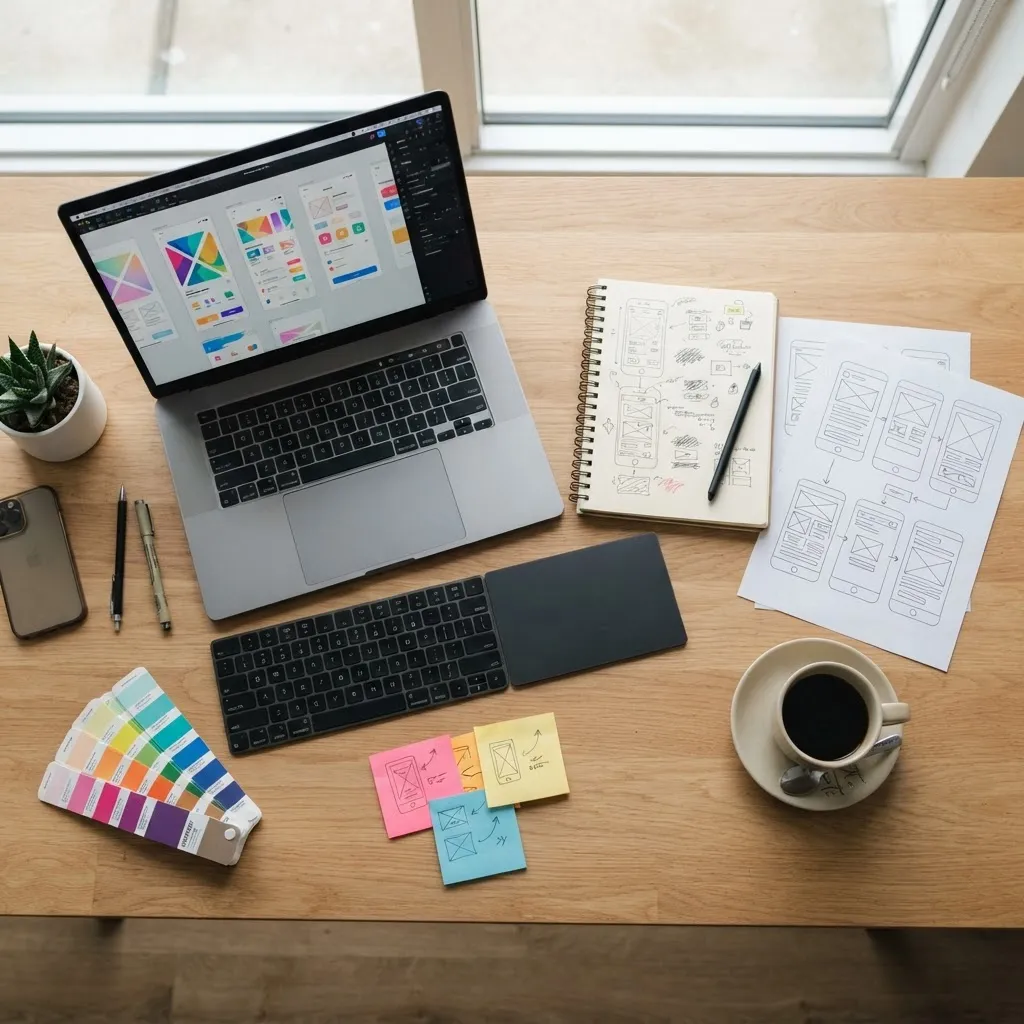
While every studio differs, most in-house and agency designers follow a pattern close to this:
- 9:00–9:30 — Inbox and brief triage. Reviewing client emails, new project briefs, and overnight feedback before opening any design file.
- 9:30–10:00 — Standup or priority check. A short sync with the team or project manager to confirm what ships today.
- 10:00–13:00 — Deep design work. The protected block for concepting, layout, and production, when creative focus is highest.
- 13:00–14:00 — Lunch and visual research. Many designers browse references, competitor work, or trend reports during this window.
- 14:00–16:00 — Revisions and feedback rounds. Applying stakeholder notes, preparing v2 and v3 iterations.
- 16:00–17:00 — File prep, handoffs, and admin. Exporting assets, updating project boards, logging hours, and archiving files.
The single biggest differentiator between junior and senior designers is how fiercely they protect that morning deep-work block. Fragmented design time produces fragmented design.
Morning: Briefs, Emails, and Setting Priorities

The first hour of a designer's day is rarely spent designing. It is spent reading. A creative brief — the document defining the project's goal, audience, deliverables, and constraints — determines whether the next six hours are productive or wasted. Experienced designers interrogate the brief before touching software: Who is the audience? What action should the design trigger? What are the brand's non-negotiables?
This is also when designers prioritize. A working designer typically juggles three to six active projects, so mornings involve deciding which deadline is genuinely closest and which client is waiting on a blocker. Designers who skip this triage step consistently miss deadlines, which is why studios like WebPeak build brief reviews directly into their project kickoff process.
Midday: Hands-On Design and Production Work
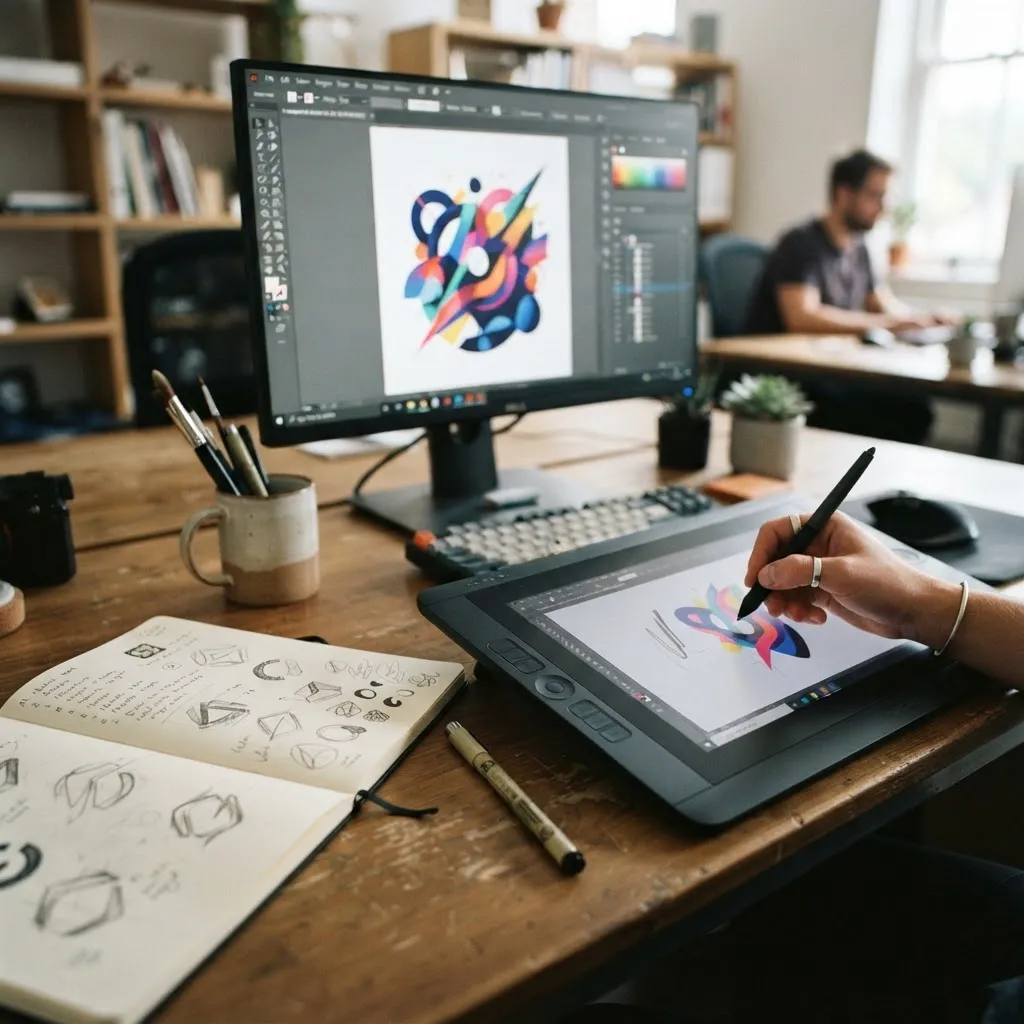
The midday block is where the visible work happens. Depending on the designer's specialty, this includes:
- Brand identity work: logos, color systems, typography scales, and brand guideline documents
- Marketing collateral: social media graphics, email headers, display ads, brochures, and packaging
- Digital product design: website layouts, landing pages, app screens, and icon sets
- Editorial design: magazine spreads, reports, whitepapers, and infographics
The toolset in 2026 centers on a predictable stack: Adobe Illustrator for vector work, Photoshop for imagery, InDesign for print layouts, and Figma for anything web or product related. AI-assisted features now handle repetitive production tasks — background removal, asset resizing, batch exports — which shifts more of the designer's day toward concept and art direction rather than mechanical execution.
A definition worth knowing here: production design is the process of preparing approved concepts for final output, including setting correct color profiles (CMYK for print, RGB for screens), bleed margins, and export formats. It is unglamorous, but errors at this stage are the most expensive mistakes in the profession — a misprinted 10,000-unit packaging run cannot be undone with an undo shortcut.
Afternoon: Feedback, Revisions, and Client Communication

Revisions consume more of a designer's week than most outsiders expect. Industry surveys consistently show client work averaging two to four revision rounds per deliverable, and managing those rounds well is a distinct professional skill. A structured revision process looks like this:
- Collect all feedback in one document or annotation tool rather than scattered emails.
- Separate objective notes ("the logo violates our brand guide") from subjective ones ("make it pop").
- Ask clarifying questions before revising — vague feedback executed literally wastes a full round.
- Present the revision with a short rationale explaining each change.
The designers who advance fastest are not always the most visually talented; they are the ones who translate ambiguous stakeholder language into concrete design decisions. "Make it pop" usually means "increase contrast between the focal element and its background" — knowing that translation is daily-use expertise.
Collaboration: The Hidden Half of the Job

Graphic design is a team sport disguised as a solo craft. On any given day, a designer coordinates with:
- Marketers, who define campaign goals and messaging hierarchy
- Copywriters, whose word counts directly shape layout decisions
- Developers, who need assets exported at exact sizes with usable naming conventions
- Project managers, who track scope and flag when a "small tweak" is actually a new deliverable
- Printers and vendors, who confirm technical specs for physical production
In-house designers typically attend two to four meetings daily; agency designers slightly fewer but with more client-facing calls. This is why communication skills appear in nearly every senior design job posting — the portfolio gets you the interview, but the collaboration gets you the promotion. Teams that pair strong design with strong process, like the graphic design services at ZoneTechify, deliberately structure these touchpoints so designers spend less time chasing approvals and more time designing.
In-House vs. Agency vs. Freelance: How the Daily Reality Differs
The same job title produces very different days depending on the employment model:
| Aspect | In-House Designer | Agency Designer | Freelance Designer |
|---|---|---|---|
| Brand variety per day | One brand, deep focus | Multiple brands daily | Multiple, self-selected |
| Meeting load | High (2-4 daily) | Medium | Low, but client calls |
| Deadline pressure | Steady, predictable | High, fast-paced | Variable, self-managed |
| Admin and invoicing | Handled by company | Handled by agency | Done personally |
| Creative direction | Follows brand guide | Follows creative director | Sets own direction |
| Income stability | Salaried, stable | Salaried, stable | Project-based, variable |
Freelancers face the widest daily scope: on top of design work, they handle proposals, contracts, invoicing, and marketing themselves, which typically claims 20–30% of their working hours. In-house designers trade creative variety for stability and deeper brand knowledge.
Continuous Learning: The Daily Habit That Separates Professionals

Design trends and tools change fast enough that skill maintenance is a genuine daily task, not an occasional one. Working designers commonly reserve 20–30 minutes a day for deliberate practice: studying strong work on portfolio platforms, testing a new Figma feature, practicing typography pairings, or learning motion design basics. In 2026, the highest-leverage learning areas are AI-assisted workflows, accessibility standards (WCAG-compliant color contrast is now a client expectation, not a bonus), and basic motion graphics — three skills that measurably increase a designer's rate.
End of Day: File Management and Project Administration

The last hour of a designer's day is administrative, and skipping it creates compounding chaos. Standard end-of-day tasks include exporting final assets in every required format, archiving working files with consistent naming conventions (a real system looks like client_project_deliverable_v03_20260724), updating task boards so project managers see accurate status, and logging billable hours. Designers who maintain clean file hygiene save themselves hours weekly — the number one time sink in studios is hunting for the "real" final version of a file.
Key Takeaways
- Graphic designers split their day roughly 60/40 between hands-on design and communication or administration.
- The U.S. had about 288,100 graphic design jobs in 2023, with roughly 20,800 annual openings projected through 2033 (Bureau of Labor Statistics).
- 75% of users judge a company's credibility by its website design alone (Stanford Web Credibility Project).
- Client deliverables average two to four revision rounds; managing feedback well is a core daily skill.
- Freelance designers spend 20–30% of working hours on non-design business tasks.
- The 2026 skill priorities are AI-assisted workflows, accessibility compliance, and motion design.
Frequently Asked Questions (FAQ)
How many hours a day do graphic designers actually spend designing?
Most full-time designers spend four to five hours of an eight-hour day in active design work. The remainder goes to meetings, feedback reviews, file management, and email. Senior designers often design less than juniors because art direction, mentoring, and client communication take a growing share of their schedule.
Do graphic designers work with clients every day?
Agency and freelance designers usually have some client contact daily, whether calls, feedback emails, or presentations. In-house designers interact less with external clients but communicate constantly with internal stakeholders like marketing and product teams. Either way, expect communication to be a daily, unavoidable part of the role.
What software do graphic designers use daily?
The daily core stack is Adobe Illustrator for vectors and logos, Photoshop for image editing, InDesign for print layouts, and Figma for web and product design. Most designers also touch project management tools like Asana or Trello and use AI-assisted features for repetitive production tasks such as resizing and background removal.
Is graphic design a stressful job day to day?
It can be, mainly from deadline stacking and subjective feedback rather than the design work itself. Agency roles carry the fastest pace, while in-house positions offer steadier rhythms. Designers who set clear revision limits and protect focused work blocks report significantly lower daily stress than those who react to every request instantly.
Can graphic designers work from home every day?
Yes, and many do. Design work transfers well to remote setups because deliverables are digital and feedback tools like Figma comments replace over-the-shoulder reviews. Hybrid arrangements are the most common model in 2026, with teams meeting in person for kickoffs and brainstorms while production work happens remotely.
Do graphic designers draw every day?
Not necessarily. Sketching remains useful for rapid concepting, and many designers rough out ideas on paper or a tablet daily, but polished drawing ability is not required for most roles. Layout judgment, typography skill, and color theory matter far more in day-to-day work than illustration talent.
Final Thoughts
The daily life of a graphic designer is a structured cycle of interpreting briefs, producing focused creative work, absorbing feedback without ego, and shipping files that function flawlessly in the real world. The craft is visual, but the profession is operational — and the designers who master both sides build the longest careers.