
A practical, engineering-led comparison of small language models and full-size LLMs for internal document search, covering accuracy, latency, cost, privacy, and hybrid routing.
Small Language Models vs Full LLM for Internal Document Search
Internal document search is the single most requested AI project inside mid-size companies, and it is also the one most often over-engineered. Teams assume they need the largest frontier model available, sign a six-figure inference contract, and then discover that 80 percent of employee queries were simple lookups a 3-billion-parameter model could have answered on a single GPU. The choice between a small language model (SLM) and a full large language model (LLM) is not a question of prestige. It is a question of query distribution, retrieval quality, latency budgets, and where your data is legally allowed to live.
This guide is written from hands-on deployment experience building retrieval systems over SharePoint exports, Confluence spaces, contract repositories, and support knowledge bases. It gives you the decision framework, the numbers, and the architecture patterns that actually hold up in production.

Quick Answer: Use a small language model for internal document search when queries are factual lookups, latency must stay under one second, or data cannot leave your infrastructure. Use a full LLM when queries require multi-document reasoning, synthesis, or nuanced instruction following. Most mature deployments route both, sending roughly 70 to 80 percent of traffic to the SLM.
What Counts as a Small Language Model?
A small language model is a transformer-based model, typically between 300 million and 8 billion parameters, that can run inference on a single consumer or mid-tier data-center GPU, or in some cases on CPU alone. Examples in this class include Phi-family models, Llama 3.2 1B and 3B, Qwen 2.5 1.5B and 3B, Gemma 2B, and distilled or quantized derivatives of larger models.
A full LLM, by contrast, is a frontier or near-frontier model with tens to hundreds of billions of parameters, served through an API or a multi-GPU cluster. It offers stronger reasoning, longer effective context handling, and better instruction adherence, at meaningfully higher cost and latency.
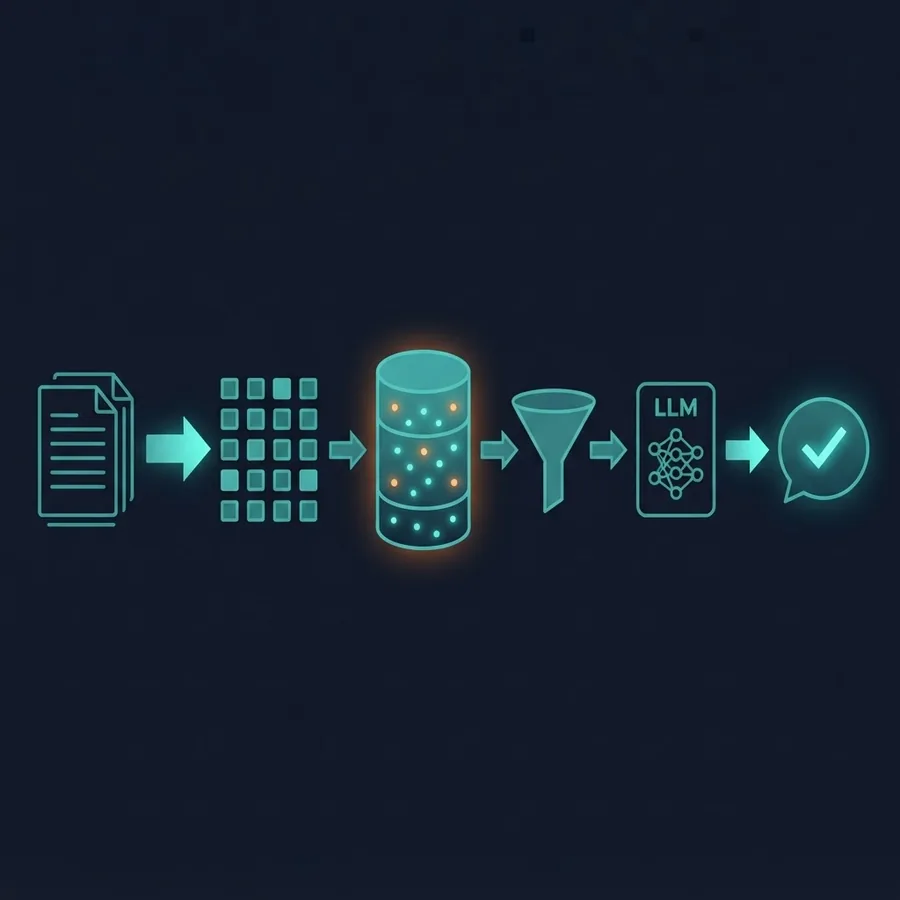
The key insight most teams miss: in a document search system, the model is not the knowledge source. The retriever is. The model's job is to read retrieved passages and phrase an answer. That job is far easier than open-domain reasoning, which is precisely why smaller models punch above their weight here.

Why Retrieval Quality Matters More Than Model Size
If your retriever surfaces the wrong three chunks, a frontier model will produce a confident, well-written, wrong answer. If your retriever surfaces the right three chunks, a 3B model will usually produce a correct one. In practice, moving from naive vector-only search to hybrid search plus reranking improves end-to-end answer accuracy far more than upgrading the generation model.
A concrete ordering of where engineering effort pays off, based on repeated internal audits:
- Chunking strategy — semantic or heading-aware chunks of 300 to 600 tokens with 10 to 15 percent overlap.
- Hybrid retrieval — combine BM25 keyword scoring with dense embeddings, since internal docs are dense with product codes, ticket IDs, and acronyms that embeddings alone miss.
- Reranking — a cross-encoder reranker over the top 50 candidates to select the final 5.
- Metadata filtering — department, document date, access level, and document type.
- Generation model choice — the last lever, not the first.
According to Google's own research on enterprise search behaviour, users abandon results pages that take longer than a few seconds, and Google has published that 53 percent of mobile visits are abandoned when a page takes over three seconds to load. Internal tools inherit that expectation. A technically superior answer delivered in nine seconds loses to a good answer delivered in one.
Head-to-Head Comparison
| Dimension | Small Language Model (1B to 8B) | Full LLM (70B to frontier) |
|---|---|---|
| Typical first-token latency | 80 to 250 ms self-hosted | 400 ms to 2 s via API |
| Cost per 1,000 queries | Fixed GPU cost, effectively cents at scale | Metered per token, dollars at scale |
| Factual lookup accuracy with good retrieval | High | High |
| Multi-document synthesis | Moderate | Strong |
| Long-chain reasoning over policies | Weak | Strong |
| Instruction following and formatting | Adequate with tight prompts | Excellent |
| Runs fully on-premise or air-gapped | Yes | Rarely practical |
| Fine-tuning feasibility | Yes, LoRA on a single GPU | Expensive or unavailable |
| Hallucination risk when retrieval fails | High | High |
| Predictable monthly spend | Yes | No |
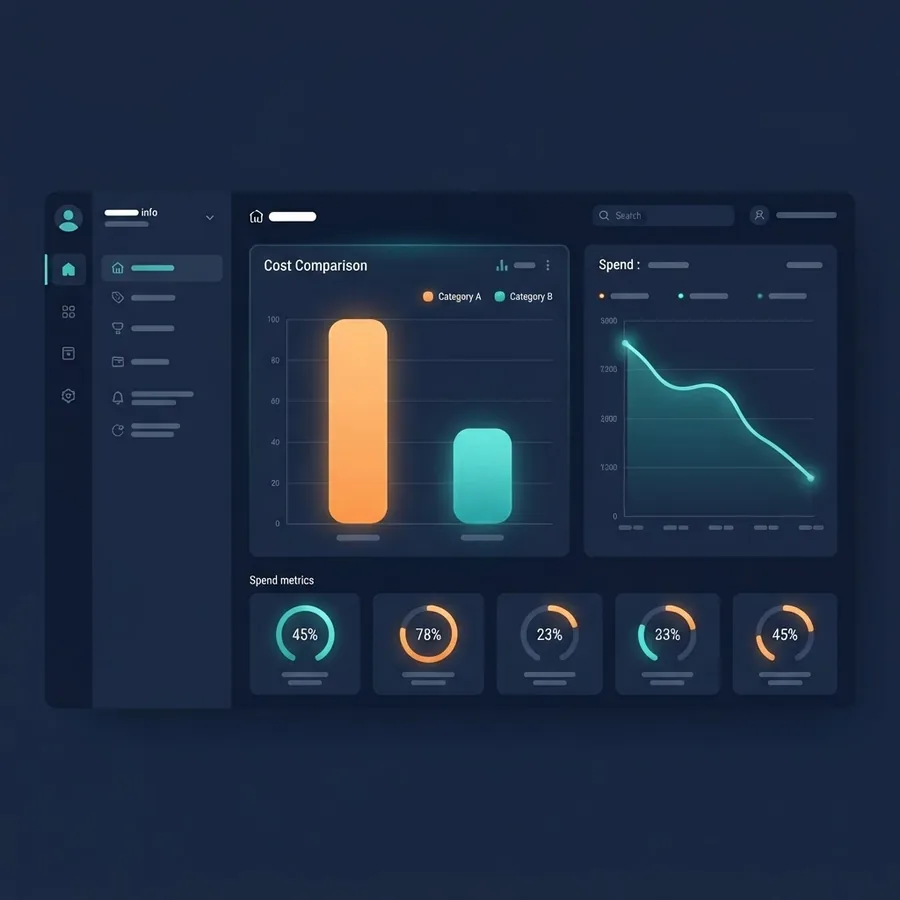
The row that changes most decisions is the last one. Token-metered pricing means an internal tool's cost scales with employee enthusiasm. Teams that succeed at driving adoption are then punished by their invoice. A self-hosted SLM converts a variable cost into a fixed one, which finance teams consistently prefer.
Where Small Language Models Clearly Win
SLMs win on any query that is fundamentally an extraction task. In audited query logs from internal knowledge bases, the majority of traffic falls into a narrow set of shapes:
- "What is the current PTO carryover limit?"
- "Which SKU replaced part 4471-B?"
- "Who approves purchase orders above 10,000?"
- "What is the SLA for a P2 incident?"
- "Where is the onboarding checklist for contractors?"
Each of these is answered by one paragraph in one document. Once the retriever finds that paragraph, generation is near-trivial. Running these through a frontier model is paying reasoning prices for a copy-editing job.
SLMs also win decisively on three structural constraints:
Data residency and privacy. Regulated industries, defense suppliers, healthcare providers, and law firms frequently cannot send document contents to a third-party inference endpoint. A quantized 3B model on an internal GPU keeps every token inside the network perimeter. This is not a theoretical concern — it is the most common reason enterprise search projects stall in procurement.
Latency-sensitive embedded search. When search lives inside a CRM sidebar or an IDE panel, sub-second response is a usability requirement. SLMs deliver it consistently.
Domain fine-tuning. A LoRA fine-tune on 2,000 curated internal question-answer pairs takes a few GPU hours and teaches the model your acronyms, tone, and document conventions. That kind of targeted adaptation is impractical on frontier models and often closes the remaining accuracy gap.

Where a Full LLM Is Worth the Money
Full LLMs earn their cost on queries that require reasoning across multiple documents with conflicting or conditional information. Real examples where smaller models measurably degrade:
- "Compare our 2023 and 2025 vendor security requirements and list what changed."
- "Given this client's contract, are we obligated to provide weekend support?"
- "Summarize every incident post-mortem from last quarter and identify recurring root causes."
- "Draft a policy-compliant response to this customer complaint, citing the relevant sections."
These demand holding six to fifteen retrieved passages in working memory, resolving contradictions, applying conditional logic, and producing structured output. Small models drop constraints, conflate sources, and lose track of which document said what. The failure mode is subtle: the answer reads plausibly but silently ignores an exception clause.
Full LLMs are also better at knowing when to refuse. Stronger instruction adherence means a well-prompted frontier model is more likely to say "the provided documents do not specify this" instead of inventing a number. In compliance contexts, that single behaviour can justify the price difference.
If your team is scoping this kind of reasoning-heavy deployment, the engineering side of model selection, evaluation harnesses, and infrastructure is covered in depth by the artificial intelligence services team at ZoneTechify.

The Hybrid Router Pattern That Wins in Production
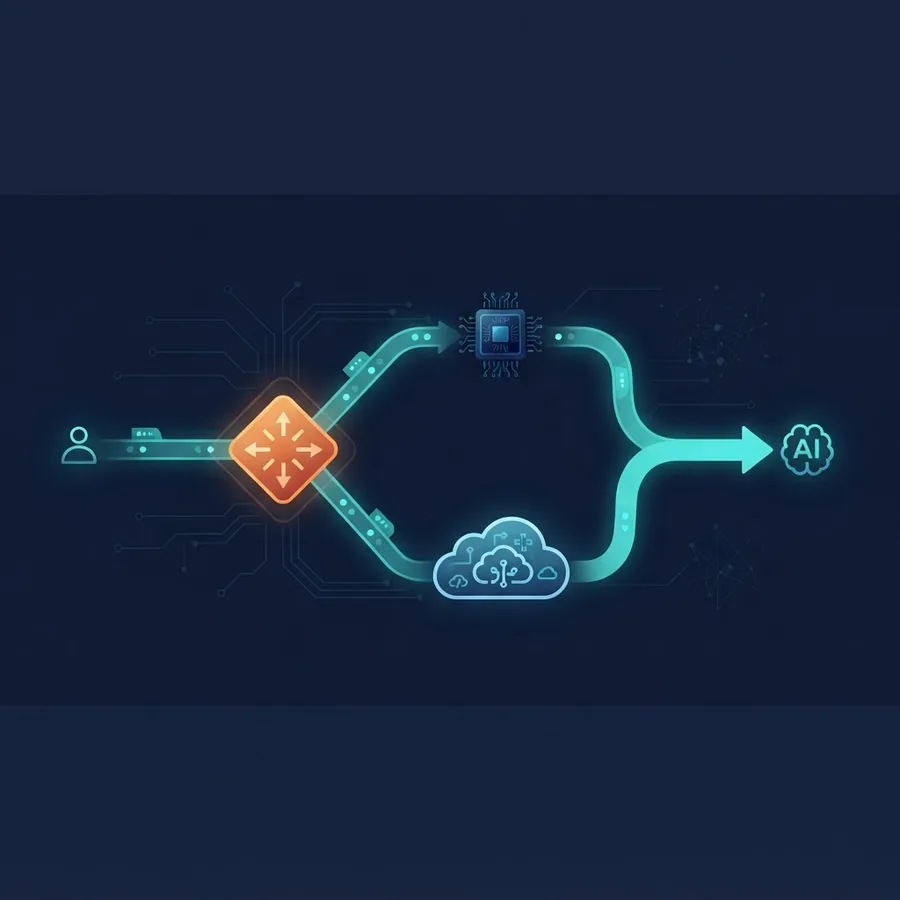
The strongest architecture is not a choice — it is a classifier in front of two models.
How to build it in five steps:
- Log real queries for two weeks before choosing any model. Do not guess your query distribution.
- Label 300 queries as simple lookup, moderate, or complex reasoning. This becomes both your router training set and your evaluation set.
- Route by intent, using a tiny classifier or heuristics such as query length, presence of comparative words like "compare" or "difference", and number of retrieved documents needed.
- Send lookups to the SLM and reasoning queries to the full LLM.
- Add an escalation path — if the SLM's answer confidence is low or the user clicks "not helpful", silently retry on the full LLM.
In deployments following this pattern, 70 to 80 percent of traffic typically resolves on the small model, cutting inference spend dramatically while preserving quality on the queries that matter most. The escalation path is what makes it safe: users never get stuck with a weak answer, they just occasionally wait longer.
How to Evaluate Before You Commit
Do not benchmark on public leaderboards. They measure general capability, not your documents. Build a 100-question golden set drawn from real employee queries, with human-verified answers and the specific source passage for each.
Measure four things:
- Retrieval recall at 5 — is the correct passage in the top five? If this is below 90 percent, fix retrieval before touching the model.
- Answer faithfulness — does every claim trace to a retrieved passage?
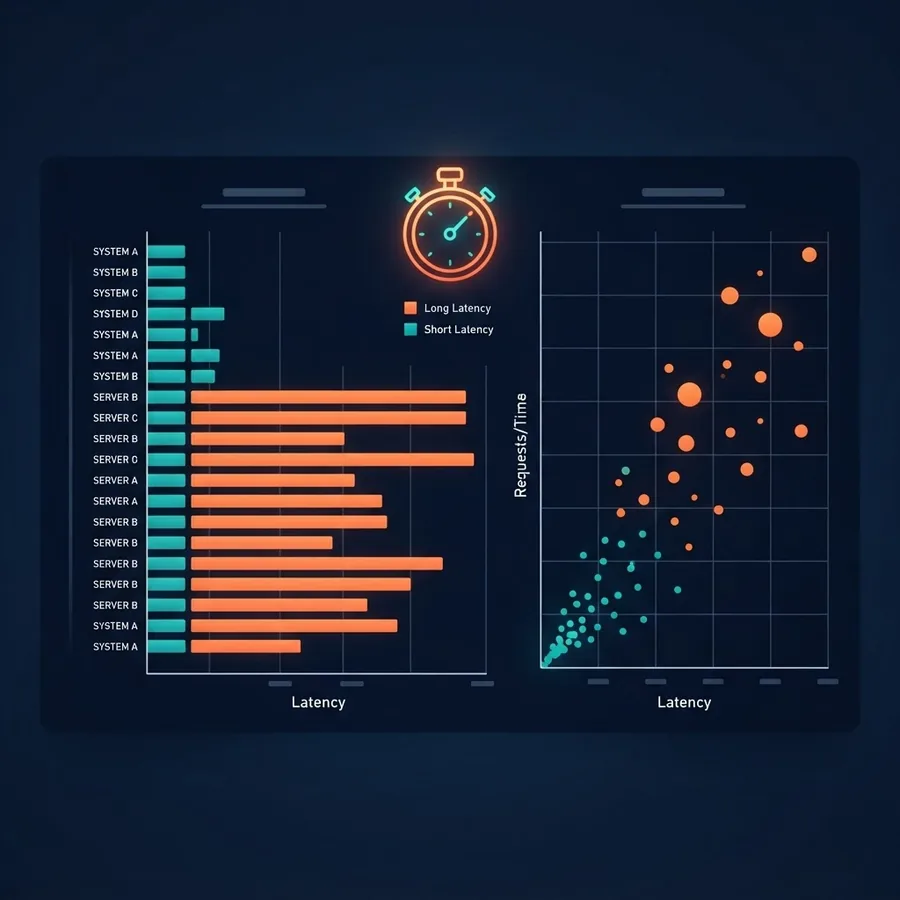
- P95 latency, not average. Averages hide the slow tail that users actually complain about.
- Cost per resolved query, including escalations and retries.
Run the same golden set against both model tiers. In most audits, the accuracy gap on lookup queries is within a few percentage points while the cost gap is an order of magnitude. Teams building the surrounding search interface and analytics layer often pair this evaluation work with front-end delivery support from WebPeak, and broader platform strategy from ZoneTechify.
Key Takeaways
- A small language model is roughly 300 million to 8 billion parameters and runs on a single GPU; a full LLM needs API access or a multi-GPU cluster.
- In retrieval-augmented search, retrieval quality affects accuracy more than model size — fix chunking, hybrid search, and reranking first.
- Google reports 53 percent of mobile visits are abandoned past three seconds; internal search inherits that latency expectation, favouring SLMs for interactive use.
- SLMs win on factual lookups, sub-second latency, on-premise data residency, and affordable LoRA fine-tuning.
- Full LLMs win on multi-document synthesis, conditional policy reasoning, structured output, and knowing when to refuse.
- Hybrid routing sends roughly 70 to 80 percent of internal queries to the SLM with escalation to the LLM, giving the best cost-to-quality ratio.
- Evaluate on a 100-question golden set from your own query logs, measuring recall at 5, faithfulness, P95 latency, and cost per resolved query.
Frequently Asked Questions (FAQ)
Can a small language model really answer questions about my company documents accurately?
Yes, provided your retrieval layer is solid. The model does not store your knowledge — it reads passages your retriever supplies. With hybrid search and reranking delivering the right passage, small models handle factual lookups at accuracy close to frontier models on the same inputs.
How much cheaper is a small language model for internal document search?
Self-hosted SLMs convert per-token API spend into a fixed GPU cost, which is typically an order of magnitude cheaper at moderate to high query volume. The savings grow with adoption, because your cost stays flat while metered API pricing rises directly with employee usage.
Do I need a GPU to run a small language model on-premise?
Not always. Quantized 1B to 3B models run acceptably on modern server CPUs for low-concurrency use. For interactive search with several simultaneous users, a single mid-tier GPU such as an L4 or A10 delivers comfortable sub-second responses and is the practical baseline.
When should I upgrade from a small model to a full LLM?
Upgrade when your evaluation set shows failures on multi-document reasoning, conditional policy logic, comparisons across versions, or long structured outputs. If failures instead trace to the wrong passages being retrieved, a bigger model will not help — improve retrieval first.
Is fine-tuning a small model better than using a bigger model with prompting?
For narrow internal domains, often yes. A LoRA fine-tune on a few thousand real question-answer pairs teaches your acronyms, formatting, and tone cheaply. For open-ended reasoning tasks, prompting a larger model still outperforms a fine-tuned small one.
Can I use both models in the same system?
Yes, and it is the recommended architecture. Place a lightweight intent classifier in front, route lookups to the small model, route reasoning queries to the full LLM, and escalate low-confidence small-model answers automatically so users never receive a weak final response.
Final Word
The honest answer to "SLM or full LLM" is that model size is the least interesting variable in your document search system. Query distribution decides your architecture, retrieval decides your accuracy, and latency decides your adoption. Log your queries, build your golden set, fix retrieval, then pick the smallest model that clears your accuracy bar — and keep a bigger one on the escalation path for the questions that genuinely deserve it.