
A practical, experience-based guide to outsourcing website development: engagement models, real cost benchmarks, vetting criteria, contracts, and the management systems that keep remote builds on schedule.
Outsourcing Website Development
Outsourcing website development is no longer a cost-cutting shortcut — it is now the default delivery model for most mid-market companies that need production-grade web software without maintaining a permanent engineering payroll. Deloitte's Global Outsourcing Survey has consistently found that cost reduction is the top driver for roughly 70 percent of organizations, but the second and third drivers — flexibility and access to skills that do not exist locally — are what actually determine whether the project succeeds.
After delivering hundreds of outsourced builds, one pattern stands out: the projects that fail almost never fail because of the developers' coding skill. They fail because of undefined scope, unclear ownership of code, and no shared definition of "done." This guide is written to fix exactly those failure points.

Quick Answer: Outsourcing website development means hiring an external agency or dedicated remote team to design, build, and maintain your website instead of using in-house staff. It works best when you define scope in writing, own your code repository and domains, pick a fixed-price or dedicated-team model deliberately, and review working software every two weeks.
What Outsourcing Website Development Actually Means
Definition: Outsourcing website development is the practice of contracting an external company or independent team to handle part or all of a website's design, engineering, quality assurance, deployment, and ongoing maintenance, under a commercial agreement rather than an employment relationship.
This differs from freelancing in one important way: an agency assumes delivery responsibility for an outcome, whereas a freelancer typically sells hours. That distinction matters legally and practically. When a sprint slips, an agency reassigns capacity internally; a single freelancer simply has no capacity to reassign.
There are three geographic variants worth naming precisely:
- Onshore — the vendor is in your own country. Highest cost, easiest legal enforcement, no timezone friction.
- Nearshore — the vendor is in a nearby country within two to four hours of your timezone. Balanced cost with meaningful real-time overlap.
- Offshore — the vendor is eight or more hours away. Lowest cost, requires the strongest written process to work well.
In-House vs Outsourced: An Honest Comparison
The real comparison is not "cheap vs expensive." It is fixed cost versus variable cost, and institutional knowledge versus speed of access.

| Factor | In-House Team | Outsourced Team |
|---|---|---|
| Time to start building | 6 to 12 weeks (hiring cycle) | 1 to 3 weeks |
| Cost structure | Fixed salary, benefits, equipment | Variable, per project or per sprint |
| Ability to scale down | Slow and expensive | Fast, contract-dependent |
| Access to niche skills | Limited to who you can hire locally | Broad, global talent pool |
| Long-term product knowledge | Strong | Moderate, needs documentation |
| Management overhead | Lower, same building and hours | Higher, needs written process |
| Code ownership risk | None | Real, must be handled in contract |
The honest conclusion from this table: outsourcing wins decisively on speed and flexibility, in-house wins on retained knowledge. Companies that get the best of both keep one internal technical owner — even a part-time fractional CTO — and outsource the build capacity. That single internal role is the highest-leverage decision in the entire model.
The Real Cost of Outsourcing Website Development
Rates vary by region more than by skill. As a working benchmark drawn from current market ranges, senior full-stack web development bills roughly 100 to 200 USD per hour in North America and Western Europe, 45 to 90 USD in Eastern Europe and Latin America, and 25 to 60 USD in South and Southeast Asia.

But hourly rate is the wrong number to optimize. The number that matters is cost per shipped feature. A 30 USD per hour team that needs three rounds of rework on every ticket is more expensive than a 70 USD per hour team that ships correctly the first time. Track this by dividing total spend by the count of features accepted into production each month, then compare quarter over quarter.
Budget realistically for these line items that clients routinely forget:
- Discovery and specification — typically 8 to 12 percent of total build cost, and the single best money you will spend.
- Quality assurance — 15 to 20 percent. If a proposal has no QA line, QA is not happening.
- Third-party services — hosting, CDN, email, analytics, payment fees.
- Post-launch maintenance — plan for 15 to 20 percent of the build cost annually. Software does not stay working on its own.
Speed is also a budget item with direct revenue consequences. Google's research on mobile experience found that as page load time goes from one second to three seconds, the probability of a bounce increases by 32 percent. Performance is not a polish task you add at the end — it is a requirement you write into the contract, with a measurable Core Web Vitals threshold as an acceptance condition.
The Four Engagement Models, and When Each One Fits
Choosing the wrong engagement model is the most common structural mistake in outsourcing. Each model solves a different problem.

1. Fixed Price
One agreed price for a fully specified scope. Best for marketing sites, brochure sites, and well-understood rebuilds. It fails badly when requirements are still moving, because every change becomes a commercial negotiation instead of a product decision.
2. Time and Materials
You pay for actual hours worked at agreed rates. Best for evolving products and long discovery phases. Protect yourself with a written monthly spend cap and a weekly burn-rate report — not just an invoice at month end.
3. Dedicated Team
You retain a set number of named engineers at a monthly rate. This is the strongest model for products under continuous development, because the team accumulates knowledge of your codebase. Insist that the named engineers in the proposal are the ones who actually work on your project.
4. Staff Augmentation
External developers join your existing team and your existing process. Best when you already have technical leadership in-house and only need extra hands in specific skills.
A practical rule from experience: if you cannot write a specification detailed enough that two different vendors would build roughly the same thing, you are not ready for fixed price. Run a paid discovery engagement first, then decide.
How to Vet an Outsourcing Partner in Five Steps
Most buyers evaluate portfolios, which mainly measure a vendor's designers. Evaluate their engineering instead.

- Ask for a live URL, then test it yourself. Run the site through PageSpeed Insights and an accessibility checker. Real quality shows up in measurements, not screenshots.
- Request a code sample or repository walkthrough. Look for tests, meaningful commit messages, and a readable README. Vendors who cannot show a repo usually do not keep clean ones.
- Interview the actual lead developer, not just the salesperson. Ask how they handled a project that went off track. Specific answers indicate real experience; generic answers indicate a script.
- Verify references independently. Contact a past client via LinkedIn rather than the vendor-supplied contact list, and ask one question: what surprised you after signing?
- Start with a small paid pilot. A two-week, tightly scoped module tells you more about communication and code quality than a two-month evaluation.
Teams like ZoneTechify and WebPeak publish process documentation and named delivery teams precisely because buyers should be able to verify these things before signing. If a vendor cannot describe its sprint cadence, QA process, and handover deliverables in writing, treat that as disqualifying.
If you are scoping a build now, a structured discovery conversation with an experienced website development team will usually surface requirements you had not documented yet — which reduces change orders later.
Contracts and Risk: What Must Be in Writing
This is where outsourcing projects are actually won or lost, and it takes one afternoon to get right.

- Intellectual property assignment. The contract must state that all code, designs, and assets transfer to you on payment. Without this clause, in many jurisdictions the creator retains copyright by default.
- Your accounts, your ownership. Register the domain, hosting, repository, and analytics accounts under your own organization, then invite the vendor. Never let a vendor hold your domain.
- Acceptance criteria per deliverable. Define "done" measurably: passes defined test cases, meets a stated Lighthouse score, works on named browsers.
- Data protection terms. If you handle EU or UK user data, a Data Processing Agreement and documented sub-processors are legally required, not optional.
- Exit and handover clause. Specify what you receive if the relationship ends: repository access, deployment documentation, environment variables, and credentials.
- Warranty period. Thirty to ninety days of free bug fixing after launch is standard and reasonable to request.
Managing the Project So It Actually Ships
Outsourced teams do not fail from lack of talent; they fail from lack of feedback loops. Install these four systems on day one.
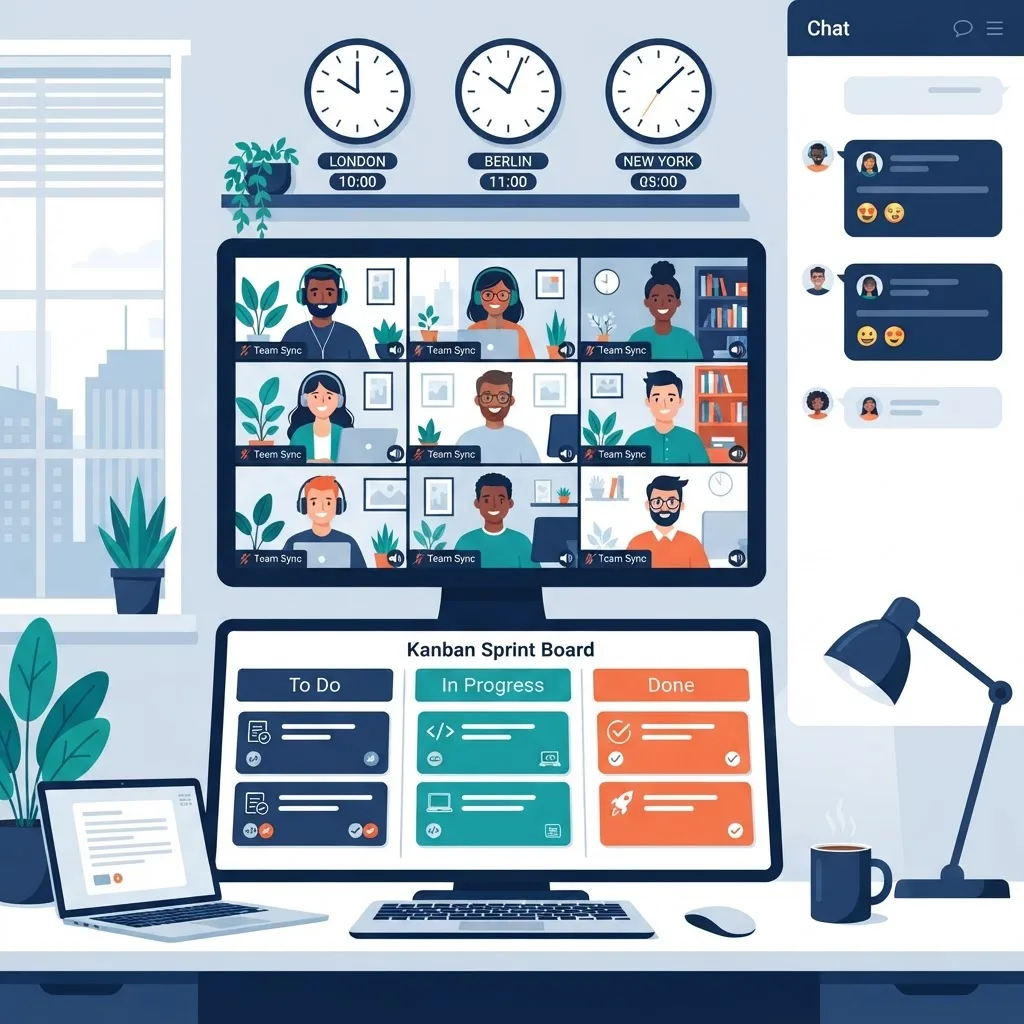
- Two-week sprints ending in a working demo. Not a status report — a clickable environment. Written updates hide problems; demos cannot.
- A staging environment from week one. Continuous deployment to staging means you see real progress instead of trusting percentages.
- Two to four hours of daily timezone overlap. Protect this window for questions. Offshore projects stall when a single blocking question costs a full day.
- One decision-maker on your side. Multiple stakeholders sending conflicting feedback is the fastest way to burn a budget.
Write down decisions in a shared document as you make them. Six weeks later, nobody remembers why you chose one payment provider over another, and rediscovering that reasoning is expensive.
A Realistic Project Timeline
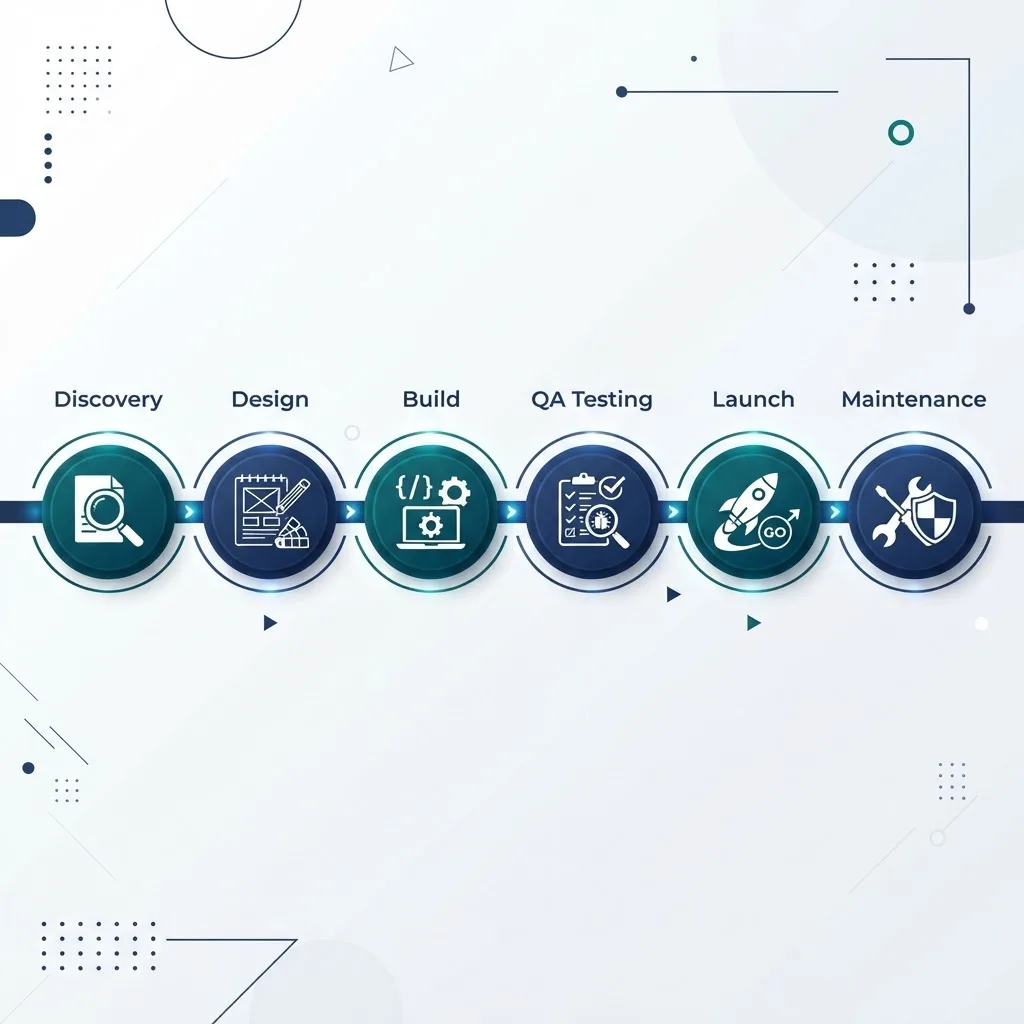
For a typical mid-sized business website with a CMS, integrations, and custom design:
- Weeks 1 to 2 — Discovery. Requirements, sitemap, technical architecture, acceptance criteria.
- Weeks 3 to 5 — Design. Wireframes, then high-fidelity mobile and desktop screens.
- Weeks 6 to 11 — Build. Frontend, backend, CMS, integrations, delivered in sprints.
- Weeks 12 to 13 — QA. Cross-browser, accessibility, performance, and security testing.
- Week 14 — Launch. Deployment, redirects, analytics verification, monitoring.
- Ongoing — Maintenance. Updates, patches, and iterative improvement.
Any vendor promising a complex custom site in three weeks is either skipping QA or reusing a template. Both are fine if disclosed, and dangerous if not.
Key Takeaways
- Cost reduction drives roughly 70 percent of outsourcing decisions according to Deloitte's Global Outsourcing Survey, but flexibility and skill access determine actual project success.
- Google reports bounce probability rises 32 percent when load time goes from one second to three seconds, so performance targets belong in the contract as acceptance criteria.
- Optimize cost per shipped feature, not hourly rate. Cheap teams with high rework are more expensive overall.
- Fixed price requires a complete specification; use time and materials or a dedicated team when requirements are still evolving.
- IP assignment, client-owned accounts, and a written handover clause are non-negotiable contract terms.
- Two-week sprints ending in a live demo, plus a staging environment from week one, are the two highest-impact management controls.
- Keep one internal technical owner. It is the single best safeguard against vendor dependency.
Frequently Asked Questions (FAQ)
How much does it cost to outsource website development?
A professional business website typically costs 5,000 to 25,000 USD outsourced, while complex custom platforms range from 40,000 to 150,000 USD or more. Rates depend heavily on region, from about 25 USD per hour in South Asia to 200 USD per hour onshore in North America.
Is outsourcing website development safe?
Yes, when contracts are handled properly. Safety comes from written IP assignment, registering your own domain and hosting accounts, using a repository you own, and running a small paid pilot first. Most outsourcing disasters trace back to missing paperwork rather than bad developers.
What is the difference between offshore and nearshore outsourcing?
Offshore vendors are eight or more hours from your timezone and cost the least, while nearshore vendors sit within two to four hours and offer real-time collaboration. Choose nearshore when daily interaction matters and offshore when your specifications and process are strongly documented.
Who owns the website code after outsourcing?
You own it only if your contract explicitly assigns intellectual property to you on payment. Without that clause, the developer may legally retain copyright in many jurisdictions. Always require written IP transfer plus repository, hosting, and domain accounts registered under your own organization.
How do I make sure an outsourced team delivers on time?
Use two-week sprints that end in a working demo on a staging environment, not a written status report. Add measurable acceptance criteria per deliverable, protect two to four hours of daily timezone overlap, and assign one decision-maker on your side to approve work.
Should I outsource website maintenance too?
Usually yes. Maintenance costs roughly 15 to 20 percent of the build cost annually and covers security patches, dependency updates, and performance monitoring. Keeping the same team that built the site preserves context, but insist on documentation so you can transfer the work if needed.
Final Word
Outsourcing website development is a management discipline, not a purchasing decision. The vendor you choose matters less than the clarity you bring: a specification with acceptance criteria, a contract that transfers ownership, accounts registered in your name, and a two-week demo cadence you never skip. Get those four right and outsourcing becomes the fastest, most flexible way to build web software. Get them wrong and no hourly rate is low enough to save the project.