
A practical, experience-based guide to outsourced web development: real cost benchmarks, engagement models, vetting checklists, contract protections, and QA standards that keep quality high.
Outsourced Web Development
Outsourced web development has moved from a cost-cutting tactic to a mainstream operating model. In the last decade, the teams building the fastest-shipping products are rarely fully in-house. They are hybrids: a small internal core owning product decisions, and an external engineering partner owning execution velocity. The difference between the companies that get excellent results and the ones that get expensive rewrites is almost never the country they hired from. It is the quality of their brief, their vetting, and their contract.
This guide is written from the perspective of people who have sat on both sides of the table: shipping client work and cleaning up other agencies' abandoned codebases. It covers what outsourcing actually costs, which engagement model fits which project, how to vet a vendor in under two weeks, and the specific contract clauses that prevent the worst outcomes.

Quick Answer: Outsourced web development is hiring an external agency or dedicated team to build, maintain, or scale your website or web app instead of employing in-house developers. It works best when you define scope tightly, vet technical skill with a paid trial, and secure IP ownership plus repository access in writing.
What Outsourced Web Development Actually Means
Outsourced web development is the practice of contracting an external company or team to design, build, test, and maintain web software that your organization owns. It is distinct from staff augmentation, where individual contractors join your existing team under your management, and from freelancing, where you coordinate independent individuals yourself.
The distinction matters because it determines who is accountable for delivery. In true outsourcing, the vendor owns the outcome: architecture decisions, sprint planning, QA, and delivery dates. In staff augmentation, you own the outcome and rent the hands. Confusing the two is the single most common source of failed engagements — clients expect vendor accountability while buying augmentation, then wonder why nobody is driving.
Three Terms Worth Defining Precisely
- Onshore: The vendor is in your own country. Highest cost, zero time-zone friction, strongest legal recourse.
- Nearshore: The vendor is in a nearby country with a 1–4 hour time difference. Moderate cost, near-real-time collaboration.
- Offshore: The vendor is 5+ hours away, typically in South Asia, Southeast Asia, or Eastern Europe. Lowest cost, requires disciplined asynchronous process.
Why Companies Outsource: The Honest Reasons
Cost is the reason people say out loud. Speed is usually the real one. Hiring a mid-level full-stack engineer in a competitive market routinely takes 60 to 90 days from job posting to first commit, and that is before onboarding. A vetted external team can be reviewing your requirements within a week.
According to Deloitte's Global Outsourcing Survey, cost reduction remains the top driver for roughly 70% of organizations that outsource, but capacity and access to specialized skills rank close behind. That second motive is underrated. If you need one WebGL specialist for six weeks, hiring is irrational. Renting expertise is not.
The third reason is risk transfer on non-core work. Your marketing site, your customer portal integrations, your CMS migration — these are essential but rarely your competitive moat. Teams at ZoneTechify and WebPeak see the same pattern repeatedly: internal engineers should own the differentiated product surface, and outsourced teams should own the supporting infrastructure that still has to be excellent.

What Outsourced Web Development Costs in Practice
Published hourly rates are misleading because they ignore rework, management overhead, and onboarding. A more useful metric is fully loaded cost per shipped feature. Still, rate ranges give you a sanity check on any proposal you receive.
| Model | Typical Hourly Rate | Best For | Management Overhead | Rework Risk |
|---|---|---|---|---|
| In-house senior hire | 70–120 USD equivalent | Core product, long-term ownership | Low | Low |
| Onshore agency | 120–250 USD | Regulated industries, complex stakeholders | Low | Low |
| Nearshore team | 45–85 USD | Agile products needing daily overlap | Medium | Medium |
| Offshore team | 25–55 USD | Well-specified builds, maintenance, migrations | High | Medium to high |
| Individual freelancer | 20–90 USD | Small isolated tasks under 80 hours | High | High |
Two cost realities most proposals hide. First, an in-house employee's salary is roughly 60–70% of their true cost once benefits, equipment, payroll tax, and recruiting fees are included — so comparing an agency's hourly rate to a salary-derived hourly figure is not apples to apples. Second, cheap engagements fail expensively. A 30 USD-per-hour team that needs 400 hours to deliver what an 80 USD-per-hour team delivers in 120 hours costs more, and you also paid for the delay.
The practical benchmark: a well-scoped marketing website with a CMS lands between 8,000 and 35,000 USD depending on custom design depth. A production-grade web application with authentication, payments, an admin dashboard, and integrations rarely finishes under 40,000 USD anywhere in the world, regardless of what a proposal claims.
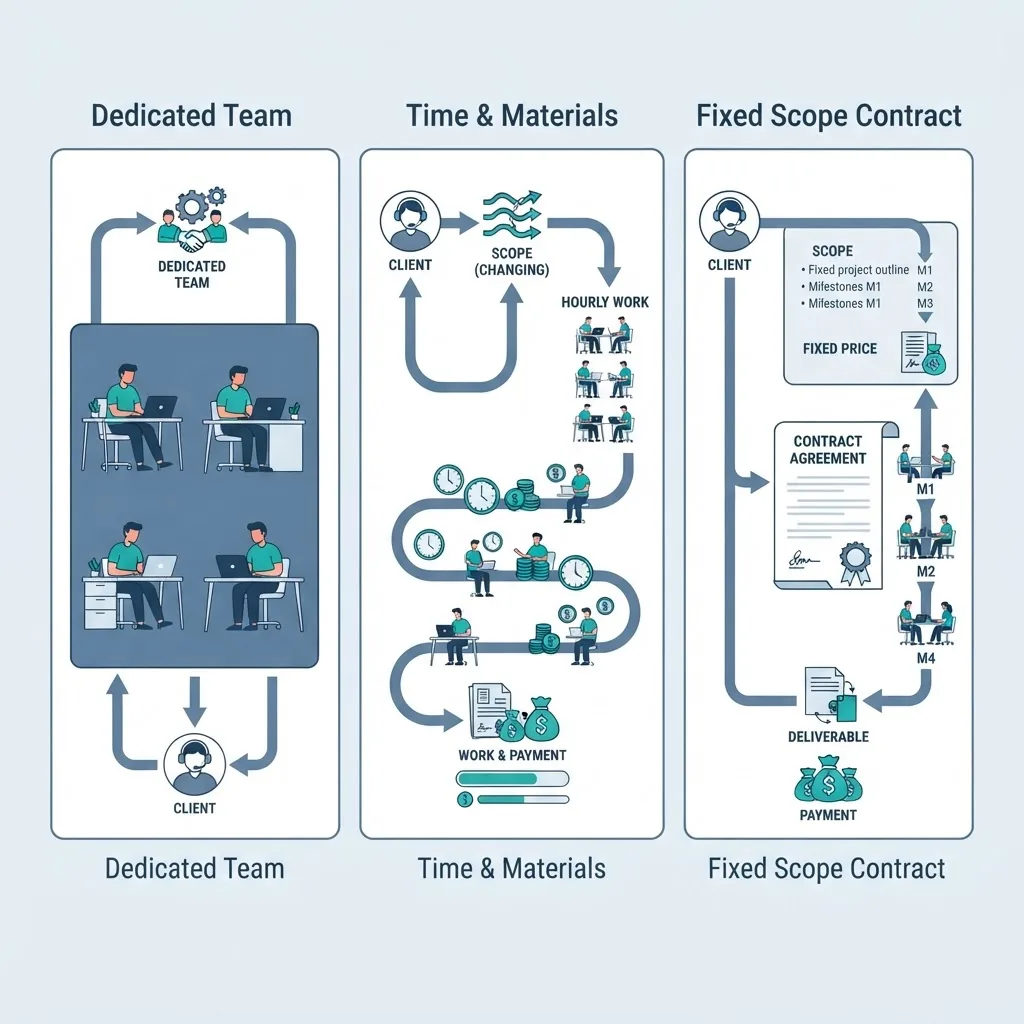
Choosing the Right Engagement Model
The contract structure you choose determines who absorbs uncertainty. Pick it based on how well you can specify the work today, not on which option sounds cheapest.
- Fixed price. Use only when requirements are genuinely frozen and documented: a brochure site, a defined migration, a design-to-code build from finished Figma files. Vendors price uncertainty into fixed bids, so you pay a risk premium of roughly 20–40%. Change requests become adversarial negotiations.
- Time and materials with a cap. The best default for products that will evolve. You pay for actual work, but a monthly or phase-level cap protects your budget. Require weekly burn reports so the cap is never a surprise.
- Dedicated team. A fixed monthly fee for a named group of engineers working only on your product. Correct choice past roughly six months of continuous work — you get accumulated context, which is the most valuable and least transferable asset in software.
- Outcome or milestone based. Payments tied to acceptance of defined deliverables. Strong alignment, but only workable when acceptance criteria are objective and testable.
My recommendation after many engagements: start with a small fixed-price paid pilot (one or two weeks, one real feature), then convert winners to time and materials or a dedicated team. The pilot costs less than a bad three-month commitment and tells you more than any reference call.

How to Vet a Web Development Partner
Most buyers evaluate portfolios and price. Both are weak signals. Portfolios show what a vendor's best designer produced under ideal conditions, and price tells you nothing about throughput. Evaluate the engineering process instead.
The Ten-Point Technical Vetting Checklist
- Ask to see a real repository. Commit frequency, branch naming, and pull request descriptions reveal discipline instantly. Vendors who cannot show any sanitized repo are a red flag.
- Ask who reviews code. If the answer is nobody, or only the developer who wrote it, expect defects.
- Request their test approach. You do not need 100% coverage. You do need critical-path automated tests and a documented manual QA pass.
- Check live performance of their claimed work. Run their shipped sites through a Core Web Vitals tool. Google's own research found that as page load time goes from one second to three seconds, the probability of a mobile visitor bouncing rises sharply — a vendor shipping slow sites is shipping lost revenue.
- Interview the actual developers, not just the sales lead. Confirm the people you meet are the people assigned.
- Ask about the last project that went wrong and what changed afterward. Honest answers indicate maturity; "none" indicates either inexperience or evasion.
- Verify English or shared-language fluency in writing, since most collaboration is asynchronous text.
- Confirm handover practice: documentation, environment setup instructions, and architecture notes as deliverables, not favors.
- Check retention. Teams with high churn will lose your project's context repeatedly.
- Run a paid trial task. Two or three days of real work predicts fit better than a month of calls.
If you are building a business-critical platform rather than a marketing page, involve a specialist team that treats architecture as a first-class deliverable — that is exactly the scope covered by professional web development services.
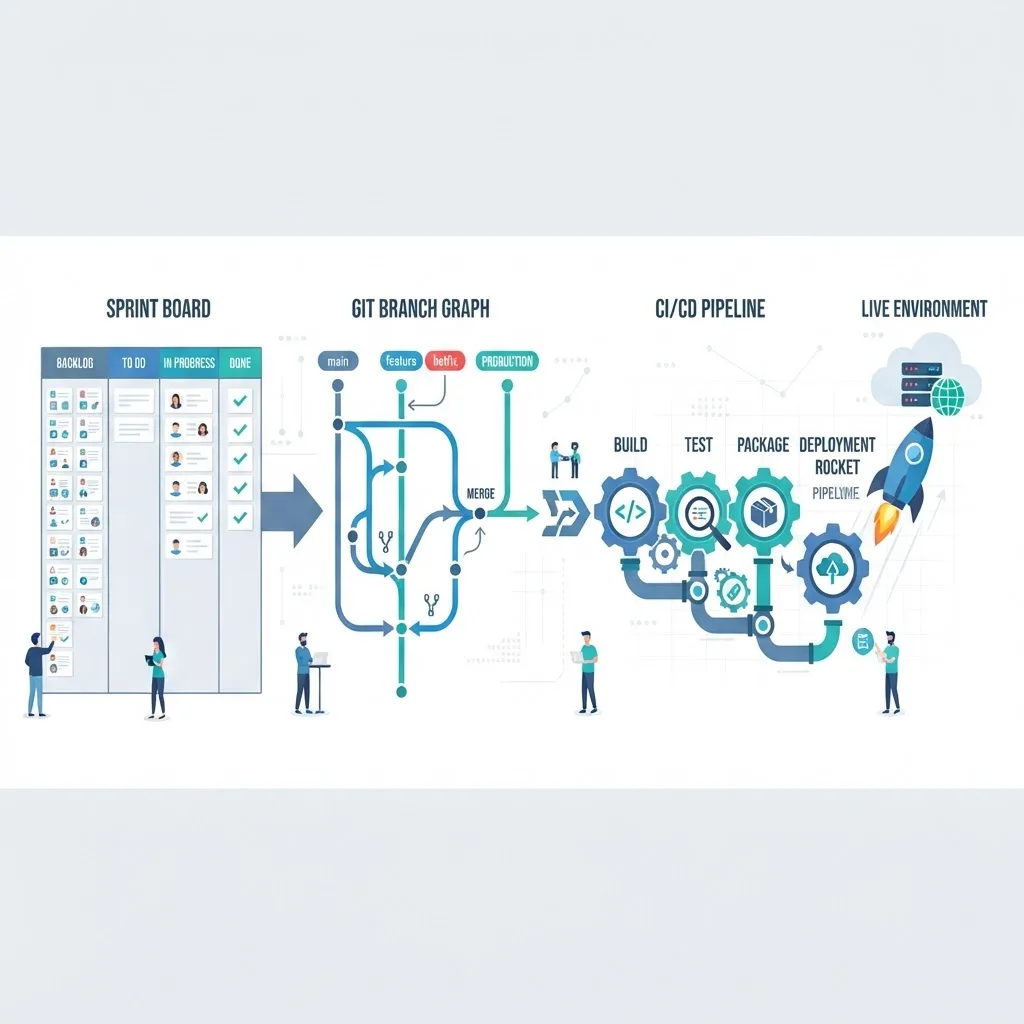
Managing an Outsourced Project Without Micromanaging
Outsourcing does not remove management work; it changes its shape. You stop managing individuals and start managing interfaces: requirements in, working software out.
Write acceptance criteria before work starts. Every ticket should state what the user can do when it is done and how you will verify it. Ambiguity is the currency of scope disputes.
Insist on demo-based progress reporting. Percentage-complete status reports are unfalsifiable. A working deployment on a staging URL every week is not. This single practice catches almost every schedule problem early.
Own the repository and the cloud accounts yourself. Grant the vendor access rather than the reverse. This is non-negotiable and prevents the most damaging failure mode in outsourcing: losing access to your own product.
Protect a daily overlap window. Even two hours of shared working time reduces decision latency dramatically. Long asynchronous loops turn a one-minute clarification into a lost day.
Keep one accountable owner internally. Committee-driven feedback produces contradictory instructions, and vendors will build the average of your conflicting opinions.

Contract Clauses That Prevent Disasters
The contract is where outsourcing risk is actually managed. Five provisions matter more than the rest.
- Work-for-hire IP assignment, explicitly transferring copyright in all deliverables to you on payment, including designs, code, and configuration.
- Third-party and open-source disclosure, requiring a list of licenses used so you do not inherit a copyleft obligation you cannot comply with.
- Source code and credential handover at any termination point, with defined timelines, plus documentation as a named deliverable.
- Defined warranty or bug-fix window — 30 to 90 days after acceptance for defects in delivered functionality, at no extra cost.
- Data protection terms covering where data is processed and stored, especially if you handle EU or health-related data.
One clause to avoid: a blanket non-compete restricting the vendor from serving your industry. It rarely holds up, inflates your price, and signals mistrust before work begins.

The Quality Standard You Should Demand
Define "done" as a measurable bar, written into the statement of work, not a subjective judgment made at delivery. A reasonable baseline for any modern web build:
- Core Web Vitals passing on mobile for all key templates, not just the homepage.
- WCAG 2.1 AA compliance for keyboard navigation, focus states, contrast, and form labels.
- Automated tests covering authentication, payment, and data-submission paths.
- No secrets committed to the repository, and server-side validation on every input.
- A README that lets a new developer run the project locally in under 30 minutes.
That last item is the most reliable proxy for overall quality I have found. Teams that document setup properly tend to do everything else properly too.
Common Failure Modes and How to Avoid Them
Vague scope. Fix by writing user stories with acceptance criteria before signing anything.
Bait-and-switch staffing, where senior engineers pitch and juniors deliver. Fix by naming assigned individuals in the contract.
No handover plan. Fix by making documentation a payment-gated deliverable.
Choosing on price alone. Fix by comparing total cost to a working, tested outcome rather than hourly rates.
Treating the vendor as a black box. Fix with weekly demos and direct access to the engineers doing the work.
Key Takeaways
- Outsourced web development means an external team owns delivery of software you own; staff augmentation means you keep ownership of delivery.
- Cost reduction drives roughly 70% of outsourcing decisions per Deloitte's Global Outsourcing Survey, but access to specialized skills and faster capacity are frequently the stronger business case.
- Google's research links rising page load time to sharply higher mobile bounce probability, making measured performance a legitimate vendor selection criterion.
- Fixed price suits frozen scope; capped time and materials suits evolving products; dedicated teams win past six months.
- A two-to-three-day paid trial task is the highest-signal, lowest-cost vetting method available.
- Always own your repository and cloud accounts, and contract for IP assignment, license disclosure, handover, and a defect warranty window.
- Define "done" numerically: Core Web Vitals, WCAG 2.1 AA, tested critical paths, and a working local setup guide.
Frequently Asked Questions (FAQ)
Is outsourced web development cheaper than hiring in-house?
Usually yes for defined projects, because you avoid recruiting fees, benefits, equipment, and idle capacity between projects. In-house becomes cheaper for continuous long-term product work, typically past twelve to eighteen months, when accumulated product context outweighs the flexibility premium you pay an external partner.
How do I know if an outsourcing company is any good?
Judge process, not portfolio. Ask to see a sanitized repository, confirm who performs code review, test their live shipped sites for Core Web Vitals, interview the assigned developers directly, and buy a two-to-three-day paid trial task. Real work predicts fit far better than sales calls or references.
Who owns the code in an outsourced web development project?
You own it only if your contract says so. Insist on an explicit work-for-hire intellectual property assignment covering code, designs, and configuration, transferring on payment. Also require disclosure of third-party and open-source licenses, plus full repository and credential handover at any termination point.
What is the difference between outsourcing and staff augmentation?
Outsourcing transfers accountability for the outcome to the vendor, who manages planning, architecture, and QA. Staff augmentation adds external developers to your existing team under your management, leaving delivery accountability with you. Choose outsourcing when you lack engineering leadership; choose augmentation when you have it.
How long does an outsourced website or web app take to build?
A well-scoped marketing website with a CMS typically takes four to eight weeks. A production web application with authentication, payments, an admin dashboard, and integrations generally needs three to six months. Timelines slip most often from unclear requirements and slow client feedback, not developer speed.
Can I outsource only part of my web development work?
Yes, and hybrid models often perform best. Keep your differentiated product surface in-house and outsource supporting work such as marketing sites, CMS migrations, integrations, and maintenance. Define clear ownership boundaries per repository or service so nobody is uncertain about who fixes what.
Final Word
Outsourced web development is neither a shortcut nor a compromise. It is a management discipline. Vendors respond to the clarity you provide: a precise brief, objective acceptance criteria, weekly demos, and a contract that protects ownership will produce good software almost regardless of geography. A vague brief and a race to the lowest rate will produce rework almost regardless of geography too. Choose the partner whose process you can inspect, and start with a small paid engagement before you commit to a large one.