
Wondering if a graphic design degree is worth it? Compare real tuition costs, salary data, and self-taught paths to decide which route fits your career goals.
Is Graphic Design Degree Worth It
Every year, thousands of creative students face the same decision: spend four years and tens of thousands of dollars on a graphic design degree, or skip formal education and build skills independently. The answer matters more than ever because hiring practices in the design industry have shifted dramatically over the past decade. Portfolios now carry more weight than diplomas at many companies, yet degrees still unlock specific career doors that self-taught designers struggle to open. This guide breaks down the actual costs, salary data, employer expectations, and alternative paths so you can make a decision based on evidence rather than opinion. Teams like ZoneTechify hire and work alongside designers from every background, and the patterns are clearer than most articles admit.
Quick Answer: A graphic design degree is worth it if you want structured training, agency or corporate roles, or plan to work internationally where credentials matter. It is not required for freelance, startup, or portfolio-driven jobs. Most employers prioritize a strong portfolio over a diploma, so weigh the cost against your specific career target.
What a Graphic Design Degree Actually Teaches You
A graphic design degree is a structured 2-to-4-year academic program covering design theory, typography, color systems, layout, branding, and industry software, typically ending in an associate or bachelor of fine arts credential. Understanding what the curriculum includes is the first step in judging its value.

The strongest argument for a degree is not software training. Tutorials on YouTube teach Photoshop faster than most professors. What a degree program uniquely provides is critique culture: several years of having your work publicly evaluated by instructors and peers, then defending or revising your decisions. That feedback loop builds visual judgment that self-taught designers often take five or more working years to develop.
Degree programs also force breadth. A typical BFA curriculum includes design history, print production, packaging, motion basics, and user interface fundamentals. Self-directed learners tend to specialize early in whatever pays first, which can leave gaps that surface later in senior roles where art direction requires range.
The weakness is speed. Accredited curricula update slowly, so tools like Figma, generative AI workflows, and modern design systems often reach classrooms two or three years after agencies adopt them. Graduates frequently need a self-directed skills sprint immediately after graduation.
The Real Cost of a Graphic Design Degree
Cost is where most worth-it calculations fall apart, so let us use actual numbers instead of vague warnings about student debt.

According to the College Board, average published tuition and fees for the 2024-25 academic year were about $11,610 per year at public four-year in-state institutions and roughly $43,350 per year at private nonprofit four-year schools. Over four years, that puts a public in-state design degree near $46,000 in tuition alone, and a private design school degree well above $170,000 before housing, materials, and software.
The Opportunity Cost Nobody Mentions
Tuition is only half the equation. Four years spent in school are four years not spent earning junior designer income. A self-taught designer who lands a junior role after 12 to 18 months of focused portfolio building can earn two to three years of salary and real client experience before a degree student graduates. When you compare paths honestly, you must count both the money spent and the money not earned.
That said, opportunity cost cuts both ways. Degree students gain internship pipelines, campus recruiting, and alumni networks that shorten the job hunt after graduation. Career services at strong design schools regularly place graduates into agencies that never post junior openings publicly.
Graphic Design Salaries: What the Data Says
Salary data helps you measure the payback period on tuition. According to the U.S. Bureau of Labor Statistics, the median annual wage for graphic designers was $58,910 as of May 2023, with the top 10 percent earning more than $100,450. The BLS also projects graphic design employment to grow about 2 percent from 2023 to 2033, slower than the average for all occupations, which means competition for the best roles stays high.
Two salary patterns matter for the degree decision. First, entry-level pay differs very little between degree holders and portfolio-only hires at most studios; hiring managers pay for demonstrated skill. Second, degrees influence ceilings more than floors. Creative director, design educator, and in-house leadership roles at large corporations frequently list a bachelor degree as a requirement, and government or international visa-sponsored positions almost always do.
Specialization changes the math further. Designers who move toward UX, product design, or motion graphics routinely out-earn the graphic design median regardless of education path, because those adjacent fields have stronger demand growth.
Can You Succeed Without a Degree?
Yes, and the evidence is overwhelming: a large share of working designers, especially freelancers and startup designers, have no formal design degree. The self-taught path is a legitimate route, not a consolation prize, but it succeeds only under specific conditions.

Self-taught designers who break in successfully share three habits. They ship real projects for real clients or nonprofits instead of endless practice mockups. They seek harsh critique from working designers through communities, mentorship platforms, and portfolio reviews to replace the classroom feedback loop. And they study fundamentals, typography, hierarchy, grid systems, deliberately rather than only learning tools.
The failure mode is equally consistent: learners who collect tutorial certificates but never produce a cohesive portfolio of 6 to 10 strong case studies. Employers do not read certificates. They read case studies that explain the problem, the process, and the measurable outcome.
If you go this route, expect 12 to 24 months of disciplined work before your portfolio competes with graduate portfolios. That is faster and dramatically cheaper than a degree, but it demands self-management that structured programs supply externally.
Degree vs. Bootcamp vs. Self-Taught: Side-by-Side Comparison
Choosing a path is easier when the trade-offs sit in one table.
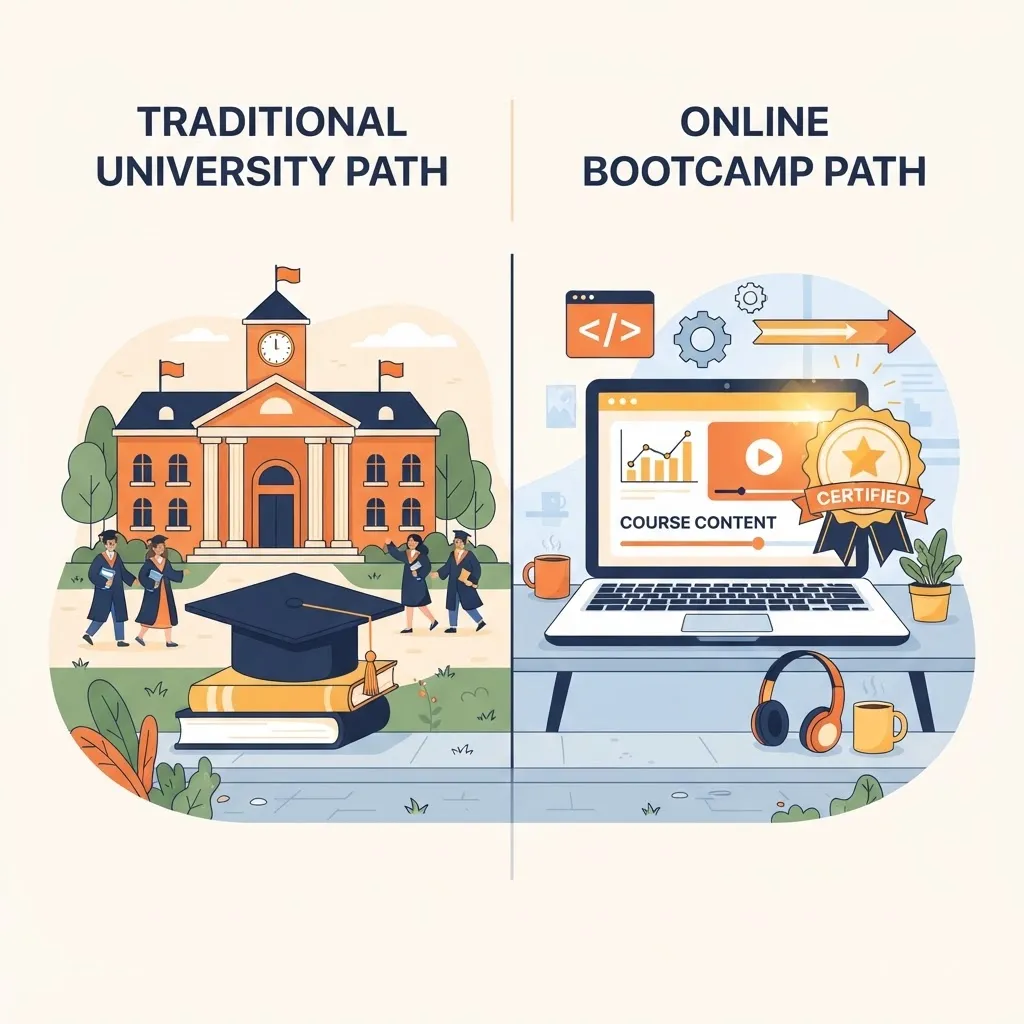
| Factor | Design Degree | Design Bootcamp | Self-Taught |
|---|---|---|---|
| Typical cost | $46,000 to $170,000+ | $5,000 to $15,000 | $0 to $2,000 |
| Time to job-ready | 4 years | 3 to 9 months | 12 to 24 months |
| Structured critique | Yes, extensive | Yes, limited | No, must self-arrange |
| Alumni and recruiting network | Strong | Moderate | None built in |
| Credential for corporate or visa roles | Yes | Rarely | No |
| Curriculum currency | Often outdated | Usually current | You control it |
| Discipline required | Moderate | Moderate | Very high |
| Portfolio by completion | Usually strong | Variable | Depends entirely on you |
No single column wins universally. The degree wins on depth, network, and credentials. Bootcamps win on speed with structure. Self-teaching wins on cost and flexibility. Your target job decides which column matters most.
Career Paths a Degree Opens (and Ones It Does Not)
Mapping the destination before choosing the vehicle prevents expensive mistakes.
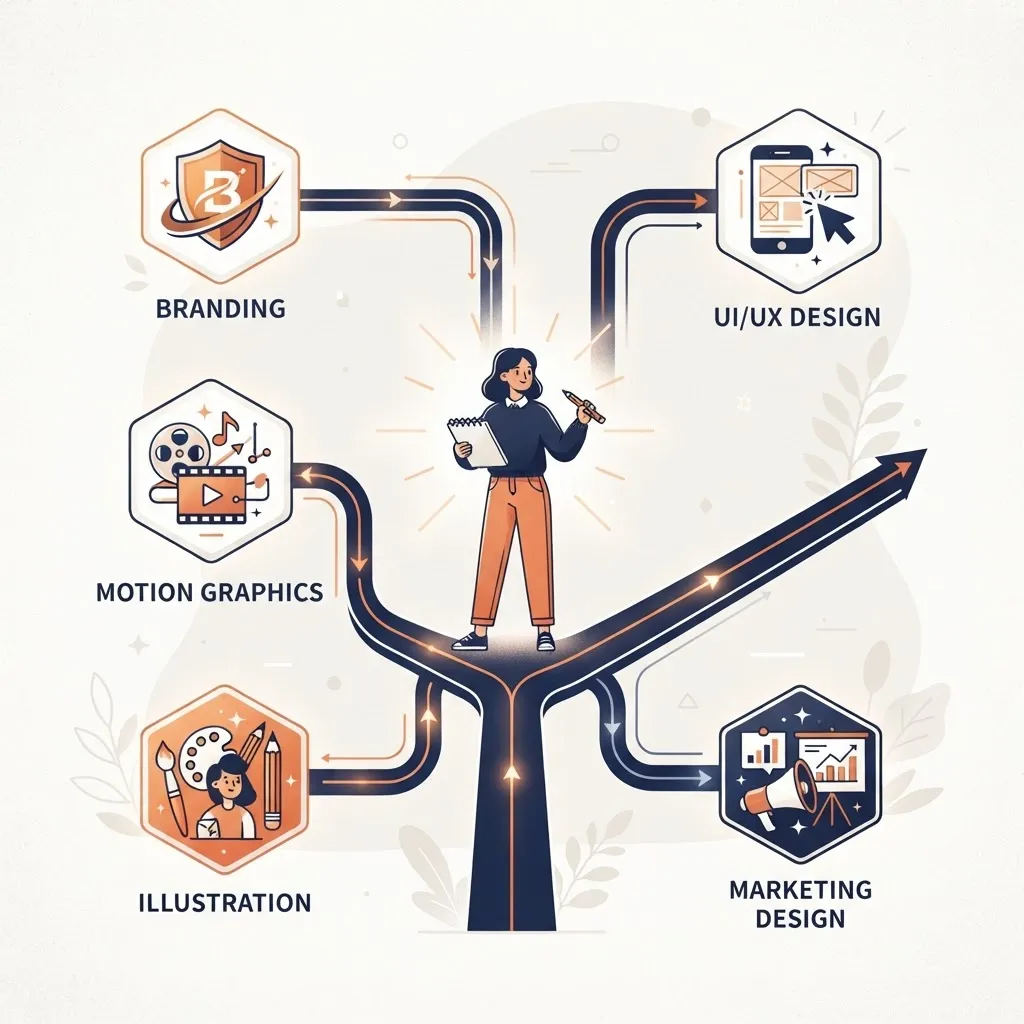
A degree measurably helps for these destinations:
- In-house roles at large corporations and government agencies, where HR software filters applications by education before a human sees your portfolio.
- International work requiring visa sponsorship, since most skilled-worker visas require a relevant bachelor degree.
- Teaching and academia, where a BFA is the minimum and an MFA is standard.
- Traditional agency ladders in markets where prestige schools feed recruiting pipelines.
A degree matters far less for these destinations:
- Freelancing and contract work, where clients evaluate portfolios and reviews, never transcripts.
- Startups and small studios, which hire for immediate skill and cultural fit.
- Adjacent digital fields like UX, product, and marketing design, where skills assessments dominate hiring. Agencies such as WebPeak evaluate design partners on demonstrated output, a pattern repeated across the modern web industry.
What Employers Actually Look For
Hiring criteria are the most practical lens for this decision, and they are remarkably consistent across studios and in-house teams.

Based on what design leads consistently report, the evaluation order at most companies looks like this: portfolio quality first, relevant experience second, communication and process third, and formal education fourth. A degree acts as a tiebreaker between similar candidates and a filter at credential-heavy organizations, not a primary selector.
The skills that dominate 2026 hiring criteria are typography and layout fundamentals, brand systems thinking, competence in Figma and the Adobe ecosystem, working fluency with AI-assisted design tools, and the ability to present work clearly to non-designers. Notice that only some of these are guaranteed by a degree, and all of them can be demonstrated without one. Businesses that invest in professional graphic design services apply the same standard: they buy proven visual results, not credentials.
How to Decide: A 5-Step Framework
Use this sequence to turn a vague worth-it question into a concrete answer for your situation.

- Name your target role. Corporate in-house, agency, freelance, or a UX-adjacent path. Look up 10 real job postings for that role and count how many require a degree.
- Calculate your true cost. Add tuition, housing, and materials, then add the income you would forgo. Compare against the bootcamp and self-taught totals in the table above.
- Audit your self-discipline honestly. If you have never finished a self-directed project, structure has real value for you, and a degree or bootcamp may be worth the premium.
- Test before committing. Spend 90 days on free fundamentals courses and produce two portfolio pieces. Your enjoyment and progress in that window predict success on any path.
- Choose the cheapest path that reaches your specific target. If your target roles demand credentials, an affordable in-state public program beats an expensive private one in return on investment nearly every time.
Key Takeaways
- Median graphic designer pay was $58,910 per year as of May 2023, per the U.S. Bureau of Labor Statistics, with the top 10 percent above $100,450.
- BLS projects only about 2 percent employment growth for graphic designers from 2023 to 2033, so differentiation through portfolio quality is essential on every path.
- A four-year public in-state degree costs roughly $46,000 in tuition; private design schools can exceed $170,000 before living costs.
- Portfolios outrank diplomas in most design hiring; degrees function as tiebreakers and as hard requirements at corporations, in academia, and for visa sponsorship.
- Self-taught designers typically need 12 to 24 months of disciplined portfolio building to compete with graduates, at a fraction of the cost.
- The right question is not whether the degree is worth it in general, but whether your specific target role requires it.
Frequently Asked Questions (FAQ)
Do employers care if you have a graphic design degree?
Most employers care about your portfolio first and your degree fourth, behind experience and communication skills. Degrees matter most at large corporations, government agencies, and companies sponsoring work visas, where applications are filtered by education. Small studios, startups, and freelance clients almost never require one if your work is strong.
Can I become a graphic designer without a degree?
Yes. Many working designers, especially freelancers and startup designers, have no formal design education. You need 12 to 24 months of focused learning, a portfolio of 6 to 10 real case studies, and regular critique from experienced designers. The path is cheaper but demands strong self-discipline and deliberate study of design fundamentals.
How much does a graphic design degree cost?
Based on College Board 2024-25 figures, expect roughly $46,000 in tuition for four years at a public in-state university and over $170,000 at private design schools, before housing and materials. Community college associate degrees cost significantly less and can transfer, making them the most affordable credentialed route into design.
Is graphic design a dying career?
No, but it is changing. The Bureau of Labor Statistics projects about 2 percent growth through 2033, slower than average, while demand shifts toward digital, UX, motion, and AI-assisted work. Designers who adapt their skills toward these growth areas continue to find strong opportunities; those who only do static print work face shrinking demand.
Is a graphic design bootcamp better than a degree?
A bootcamp is better if you need job-ready skills quickly and cheaply, typically in 3 to 9 months for $5,000 to $15,000. A degree is better if you want deep fundamentals, a strong alumni network, or roles that require formal credentials. Neither replaces a great portfolio, which decides most hiring outcomes.
The Final Verdict
A graphic design degree is worth it for a specific person: someone targeting credential-gated roles, someone who thrives with external structure, or someone who can attend an affordable program without heavy debt. It is not worth it as a default purchase made from uncertainty, because the industry rewards demonstrated skill over paperwork. Run the five-step framework above, price out every path, and pick the cheapest route that reaches your actual target role. Whichever path you choose, your portfolio, not your diploma, will do the heavy lifting for the rest of your career.