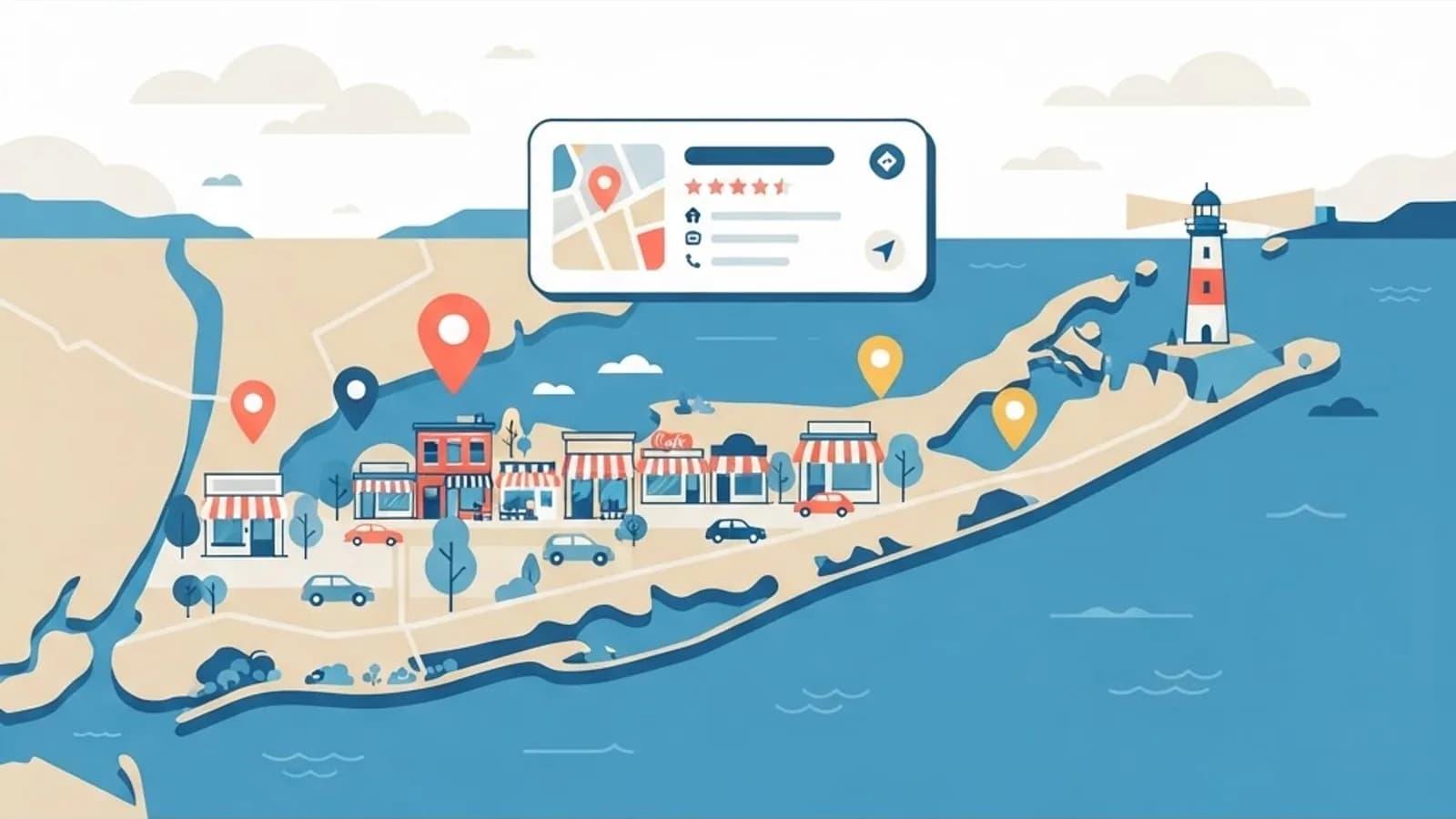
Digital marketing on Long Island explained: hamlet-level SEO, Nassau and Suffolk targeting, seasonal budgets, and picking an agency that reports booked jobs.
Digital Marketing Long Island
Long Island is not one market. It is hundreds of tightly packed hamlets, villages, and school districts stretched across Nassau and Suffolk counties, each with its own search behavior, price sensitivity, and competitive density. A marketing plan that treats the region as a single geography will overspend in areas you cannot serve profitably and underperform in the neighborhoods where you already have referral strength.
This guide explains how to run digital marketing on Long Island the way successful local operators actually run it: hamlet by hamlet, season by season, and measured by booked jobs rather than impressions.
Quick Answer: Digital marketing on Long Island works best when campaigns are built at the hamlet and school district level rather than for the region as a whole. Prioritize Google Business Profile optimization, service area pages for Nassau and Suffolk towns, review velocity, and seasonal budget shifts tied to local demand cycles.
Why Long Island Rewards Hyper-Local Strategy
With roughly three million residents across Nassau and Suffolk, Long Island is one of the densest suburban markets in the United States. That density creates two effects that shape strategy.
First, competition is intense but uneven. A plumber in Garden City faces a completely different competitive set than one in Riverhead, even though both sit on the same island. Second, residents identify strongly with their hamlet. People search Massapequa deck builder or Huntington orthodontist, not Long Island deck builder. Matching that language is the single cheapest ranking advantage available.
Map Your Profitable Service Radius First
Before any campaign, plot your last one hundred jobs on a map and calculate profit per job by area. Most local businesses discover that a drive across the island destroys margin. The Long Island Expressway at rush hour can turn a thirty mile job into a two hour commitment. Draw a realistic radius, then only advertise inside it. Cutting unprofitable geography typically improves return faster than any creative change.
Local Search Is the Core Channel
Google handles roughly 90 percent of global search, and local service queries carry some of the highest commercial intent of any search type. For Long Island businesses, local search visibility is the difference between a full schedule and a quiet phone.
Google Business Profile Optimization
Your Google Business Profile drives map pack visibility, which sits above organic results on mobile. Optimization priorities:
- Choose the most specific primary category available, then add secondary categories carefully.
- Define your service areas by town rather than a broad radius, listing the specific Nassau and Suffolk communities you serve.
- Upload geotagged job photos weekly. Profiles with fresh imagery consistently outperform static ones.
- Use the products and services fields to list every offering with its own description.
- Post seasonal offers tied to local events and weather patterns.
Build Real Town Pages, Not Thin Duplicates
Service area pages work when they are genuinely different. A useful Levittown page mentions the housing stock, typical property age, local permit requirements, and shows completed work in that community. A thin page that swaps a town name into a template gets filtered out of results and can harm the rest of the site.
Prioritize pages by three criteria: search volume, proximity to your base, and existing customer concentration. Ten strong town pages beat sixty weak ones.
Reviews Decide Close Rates
On Long Island, where neighborhood reputation travels fast, review count and recency function as a local ranking factor and a conversion factor simultaneously. Build a process: request a review within two hours of job completion via text with a direct link, and respond to every review within a day. Aim for steady velocity rather than bursts, since a sudden spike looks inorganic.
Seasonality Drives Budget Allocation
Long Island has sharp seasonal demand swings that most flat monthly budgets ignore. Aligning spend to the calendar is one of the easiest wins available.
| Season | Demand Surges | Recommended Budget Focus |
|---|---|---|
| Late winter | Roof and storm damage, tax and legal services | Search ads on emergency terms, fast response |
| Spring | Landscaping, pools, remodeling, real estate | Heavy search plus neighborhood social targeting |
| Summer | Hamptons hospitality, HVAC, events, tourism | Mobile-first campaigns, extended service hours |
| Fall | Home maintenance, school services, insurance | Content and retargeting to capture planners |
| Holiday period | Retail, restaurants, professional services renewals | Local inventory ads and offer promotion |
The East End adds its own layer. Businesses serving the South Fork see demand concentrate from Memorial Day through Labor Day, with a wealthier and more design-conscious buyer. Messaging and pricing that works in Hicksville often needs a different tone in Sag Harbor.
Paid Media That Fits a Suburban Market
Three tactics deliver reliable returns for Long Island advertisers.
- Geofenced search campaigns built per town cluster, with bid adjustments based on profitability rather than volume. Separate Nassau and Suffolk campaigns so you can read performance clearly.
- Local Services Ads for licensed trades, where the Google Guaranteed badge meaningfully lifts call rates and you pay per lead rather than per click.
- Radius-based social advertising around recently completed job sites, showing real before and after work to neighbors who have the same house type.
Retargeting matters here too. Suburban homeowners research for days before calling. A visitor who read your pricing page and left is worth pursuing with a modest, frequency-capped retargeting budget.
Website Requirements for Local Conversion
More than half of web traffic is mobile, and local service searches skew even more mobile than average. Your site needs to convert a distracted person standing in their driveway.
Essentials:
- A tap-to-call button fixed in the mobile viewport
- Service area list visible without scrolling far
- Load time under three seconds on a mid-range phone
- Licensing, insurance, and local credentials shown prominently
- Real photos of your team and vehicles, not stock imagery
- A short form with three fields maximum
Choosing a Long Island Digital Marketing Partner
The regional agency market ranges from one-person operations to full service firms in Melville and Hauppauge. Ask any prospective partner these questions:
- Which specific Long Island towns have you ranked clients in, and can you show the map pack results?
- Do you report booked jobs and revenue, or only traffic and rankings?
- Who executes the work, and are they in-house or subcontracted?
- What happens to the website, accounts, and data if we leave?
- How do you handle seasonality in the budget?
An agency that cannot answer the fifth question does not understand this market. Whether you engage a local firm, a remote specialist team such as those offering technical SEO services, or build capability internally with support from partners like ZoneTechify, insist on ownership of your own accounts and data. You can learn more about structuring that kind of engagement before signing anything.
Citations, Directories, and Local Signals
Consistency across local directories still influences how confidently search engines associate your business with a location. The requirement is simple and frequently violated: identical business name, address, and phone number everywhere. Suite numbers written three different ways across listings create ambiguity that suppresses map pack performance.
Prioritize these listings in order:
- Google Business Profile, which carries the most weight by a wide margin
- Apple Business Connect, increasingly relevant as more searches originate on iPhones
- Bing Places, small in volume but simple to maintain
- Industry-specific directories relevant to your trade or profession
- Local chambers of commerce and business associations in your towns
Skip mass citation submission services. They generate low quality listings you cannot control and often introduce the exact inconsistencies you are trying to eliminate. Twenty accurate listings outperform four hundred sloppy ones.
Building Local Authority Through Real Relationships
Long Island has an unusually active network of chambers, youth sports leagues, school fundraisers, and community associations. These create legitimate opportunities for locally relevant links and mentions that no competitor can replicate through software.
Practical approaches that work:
- Sponsor a local team or event and ensure the organization links to your site from their sponsor page
- Offer genuinely useful expertise to local news outlets and community publications
- Partner with complementary non-competing businesses for cross-referrals and mutual mentions
- Publish original local content such as seasonal guides specific to your towns
The measurable benefit is twofold. Locally relevant links strengthen organic visibility, and the offline relationships generate direct referrals that never appear in any analytics report.
Key Takeaways
- Long Island spans roughly three million residents across Nassau and Suffolk, so campaigns should target hamlets and school districts rather than the region.
- Google handles about 90 percent of global search, making Google Business Profile and map pack visibility the primary local channel.
- Over half of web traffic is mobile, so tap-to-call and sub-three-second load times directly affect booked jobs.
- Profitability per geography, not search volume, should define your advertising radius.
- Seasonal budget shifts aligned to spring, summer, and storm cycles outperform flat monthly spend.
- Genuine town pages with local detail rank; templated duplicates get filtered.
- Review recency and velocity influence both rankings and close rates in tight suburban communities.
Frequently Asked Questions (FAQ)
How much does digital marketing cost on Long Island?
Small local businesses typically invest between fifteen hundred and five thousand dollars monthly across management and ad spend, while multi-location or competitive trades often exceed ten thousand. Set budget from target cost per booked job rather than a flat figure, and expect higher costs in western Nassau.
What is the best way to rank in the Google map pack on Long Island?
Optimize your Google Business Profile with a precise primary category, town-level service areas, weekly photos, and consistent review velocity. Pair that with location-specific pages containing genuine local detail and citations on reputable directories using identical name, address, and phone information.
Should I target Nassau and Suffolk counties separately?
Yes. Separate campaigns let you read performance, control budgets, and adjust messaging per county. Nassau typically has higher competition and click costs, while Suffolk spans a much larger area with longer drive times. Splitting them prevents strong areas from masking unprofitable ones.
How long does local SEO take to work on Long Island?
Most businesses see map pack movement within two to four months and meaningful lead growth by month six. Timelines depend on competition density, review count, and how established your Google Business Profile is. Highly contested categories such as legal and home remodeling take longer.
Do Long Island businesses need to advertise in the Hamptons separately?
If you serve the East End, yes. Hamptons demand is seasonal, concentrated between late May and early September, and the audience expects different messaging and price positioning. Run a distinct campaign with its own budget window rather than stretching year-round spend across the whole island.
Is social media worth it for Long Island service businesses?
It is, when used for proof rather than reach. Posting real completed work with neighborhood context builds recognition in tight communities where referrals drive revenue. Use tight radius targeting around recent job sites, and treat social as a trust layer supporting search rather than a standalone lead source.