
A practical guide to answering a call for associate editors in artificial intelligence, covering eligibility, duties, workload, application steps and red flags.
Call for Associate Editors Artificial Intelligence
Artificial intelligence journals now receive more submissions than their existing boards can comfortably absorb, which is why calls for associate editors appear so often in mailing lists, society newsletters and conference channels. If you have seen one of these calls and wondered whether you qualify, how much work it involves, or whether the invitation is even legitimate, this guide explains the role in concrete terms and how to respond to it without wasting months of your time.
Quick Answer: A call for associate editors in artificial intelligence is a journal's public invitation for qualified researchers to join its editorial board and manage peer review for submitted AI manuscripts. Applicants normally need a doctorate or equivalent expertise, a documented publication record in the field, and time to handle several papers each month.
Table of Contents
- What the call actually means
- What associate editors do
- Who is eligible to apply
- Editorial board roles compared
- How to apply step by step
- Why AI manuscripts are harder to handle
- Ethics and generative AI disclosure
- Time commitment and career value
- How to spot a predatory call
- Key takeaways and FAQ
What Does a Call for Associate Editors in Artificial Intelligence Mean?
A call for associate editors is a recruitment notice, not an award. The journal is expanding its editorial capacity because submission volume in a subject area has outgrown the current board. In artificial intelligence this pressure is structural rather than temporary: Stanford's AI Index has reported sustained year-over-year growth in AI publication output, and preprint servers such as arXiv receive thousands of new machine learning submissions every month. Editors are the bottleneck in that pipeline.
An associate editor is a subject expert who owns the review process for a set of assigned manuscripts. Depending on the publisher, the title may also appear as handling editor, action editor or area chair, and the responsibilities are broadly equivalent even when the label changes.
How Is an Associate Editor Different From a Peer Reviewer?
A reviewer evaluates one paper and submits an opinion. An associate editor evaluates the opinions. That distinction matters because the editor must judge review quality, weigh disagreement between reviewers, and defend a decision that an author may appeal. The role is closer to adjudication than to critique, and it requires enough breadth to assess work slightly outside your own narrow specialisation.
What Do Associate Editors Actually Do?
The core duties are consistent across most reputable AI journals:
- Screen assigned submissions for scope, novelty and basic methodological soundness
- Identify and invite qualified reviewers, then chase late reports
- Read the reviews critically and discount low-effort or biased ones
- Write a decision recommendation with reasoning the author can act on
- Handle revisions through second and sometimes third rounds
- Flag suspected misconduct to the editor in chief rather than ruling on it alone

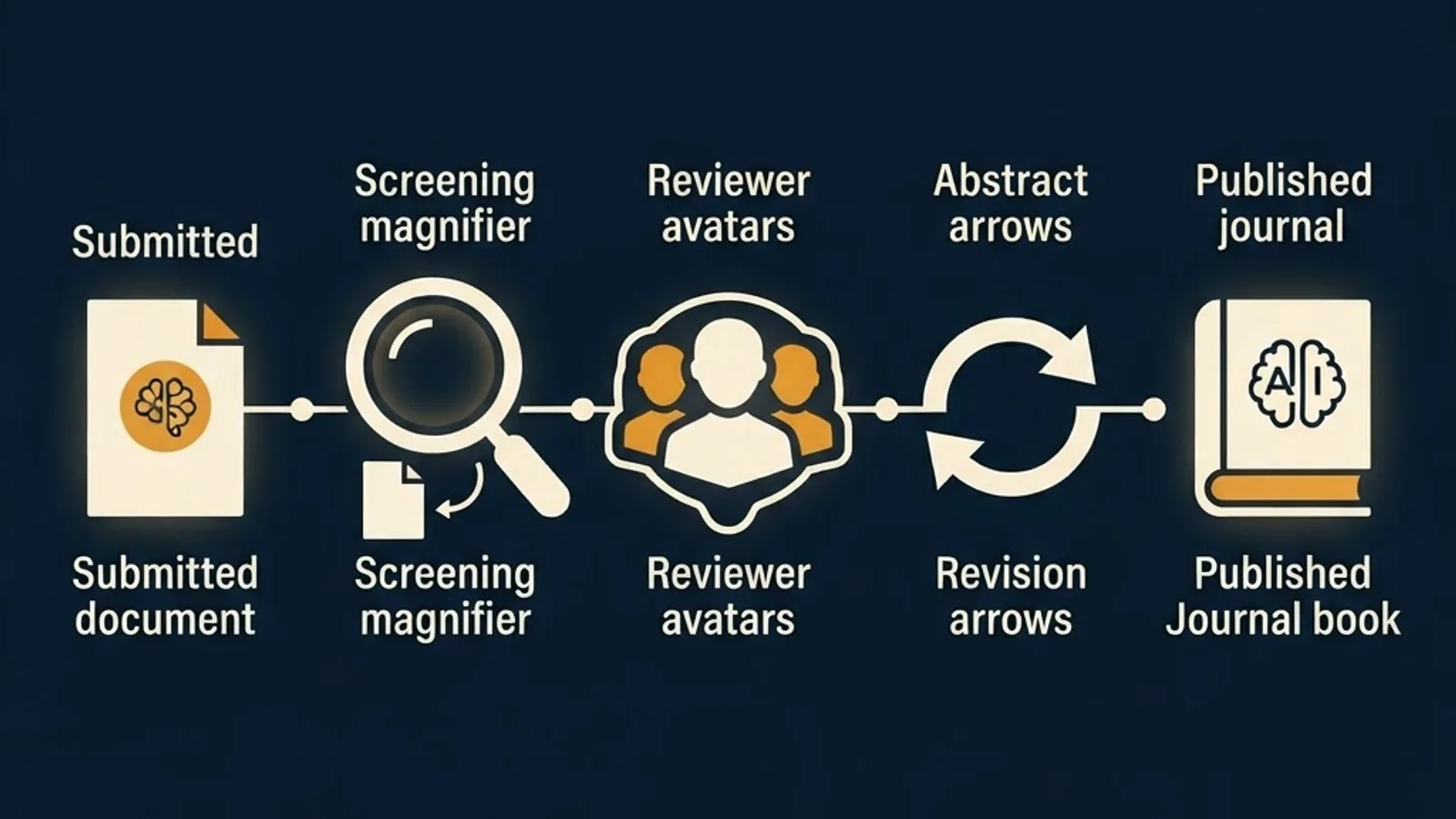
What Does a Typical Manuscript Cycle Look Like?
- Assignment from the editor in chief, usually by keyword match
- Desk screening within a few days, with rejection if the paper is out of scope
- Reviewer invitations, often five to eight invitations to secure two or three reports
- Review period of two to six weeks depending on journal policy
- Decision recommendation: accept, minor revision, major revision or reject
- Verification that revisions genuinely address each substantive point
Who Is Eligible to Apply?
Most calls list similar baseline requirements, and journals rarely make exceptions for the first two:
- A PhD in computer science, statistics, engineering, applied mathematics or a closely related field, or equivalent industry research standing
- A peer-reviewed publication record in the journal's subject area, commonly described as several first-author or corresponding-author papers
- Prior reviewing experience for journals or major conferences such as NeurIPS, ICML, ICLR, AAAI or ACL
- A public academic identity, typically an ORCID record plus a Google Scholar or institutional profile
- Availability to handle a stated number of manuscripts per year
Industry researchers are increasingly welcome, particularly for applied areas such as deployment, safety evaluation and MLOps, where practitioners often see failure modes that academic reviewers do not encounter. Teams that build production systems, including specialists at ZoneTechify, work with constraints such as latency budgets and data drift that rarely appear in benchmark papers.

How Do Editorial Board Roles Compare?
Applicants often misjudge which role they are being offered. The comparison below reflects common practice at established publishers, although exact terms vary by journal.
| Role | Main Responsibility | Typical Term | Decision Power |
|---|---|---|---|
| Reviewer | Assess one manuscript and write a report | Per paper | Recommends only |
| Associate Editor | Manage assigned papers end to end | 2 to 3 years, renewable | Recommends or decides |
| Editor in Chief | Set scope, resolve appeals, final calls | Multi-year | Final authority |
| Guest Editor | Run a single special issue | Length of the issue | Decides within that issue |
| Editorial Advisory Board | Advise on strategy and scope | 1 to 3 years | None over papers |

How Do You Apply for an Associate Editor Position?
- Verify the journal first. Check indexing in Scopus, Web of Science or DOAJ, confirm the publisher is a member of COPE, and read two or three recent papers to judge quality yourself.
- Match your profile to a stated area. Applications that name a specific section, such as reinforcement learning or clinical AI, are easier to accept than generic offers to help anywhere.
- Prepare a two-page academic CV. Highlight recent publications, review history and any programme committee service.
- Write a short cover letter of 200 to 300 words stating your area, your reviewing volume last year and how many manuscripts you can handle per month.
- Include verifiable links: ORCID, Scholar profile, institutional page and DOIs for representative papers.
- Name two references if requested, ideally people with editorial experience.
- Follow up once after four to six weeks. Silence beyond that usually means the board is full.

Why Are AI Manuscripts Harder to Handle Than Average?
Evaluation in machine learning is unusually noisy, and an associate editor is the person who absorbs that noise. The NeurIPS 2021 consistency experiment, which routed a subset of submissions through two independent review committees, found that roughly half of the papers accepted by one committee were rejected by the other. That result does not prove peer review is broken, but it does show that reviewer disagreement is normal rather than exceptional, so editors cannot simply average scores.
Three recurring problems require editorial judgement:
- Reproducibility gaps, where code, seeds, hyperparameters or compute details are missing
- Unfair baselines, where a new method is compared against undertuned prior work
- Benchmark contamination, where evaluation data may overlap with pretraining corpora

What Ethics Rules Apply to Associate Editors?
Editorial ethics are governed by published standards, not personal preference. The Committee on Publication Ethics maintains Core Practices covering conflicts of interest, allegations of misconduct and post-publication corrections, and ICMJE authorship criteria are widely adopted beyond medicine. Two rules matter most in daily work.
First, recuse yourself when a conflict exists: recent co-authorship, shared institution, funding overlap or a supervisory relationship. Second, treat every manuscript as confidential. Pasting an unpublished submission into a public generative AI tool is a confidentiality breach, and several major publishers now prohibit it outright while requiring authors to disclose any AI assistance in writing.

What Is the Real Time Commitment and Career Value?
Expect two to six hours per manuscript across the full cycle, concentrated in reviewer recruitment and the final decision letter. A load of two papers a month is therefore a realistic part-time commitment of roughly one working day monthly. Associate editor positions are almost always unpaid, which is worth knowing before you accept.
The return is practical rather than financial. You read work months before publication, you learn what separates an accepted paper from a rejected one, and board service is documented evidence of standing for promotion, grant panels and tenure files. It also builds a reviewer network you can draw on later.
How Do You Spot a Predatory Call?
Treat these as warning signs and verify before replying:
- Unsolicited email praising a paper you did not write, or naming the wrong field
- Promises of an editorial title in exchange for submitting or paying for articles
- Review turnaround guarantees of a few days, which no genuine process can meet
- No named editor in chief, no ISSN, or an unverifiable indexing claim
- Pressure to recruit submissions from your own network as a condition of appointment
Key Takeaways
- An associate editor manages peer review for assigned manuscripts and recommends or makes decisions, unlike a reviewer who assesses a single paper.
- Standard requirements are a doctorate or equivalent expertise, a publication record in the area and prior reviewing experience.
- Typical terms run two to three years and are renewable; the position is normally unpaid.
- Budget two to six hours per manuscript, so two papers monthly is about one working day.
- The NeurIPS 2021 consistency experiment showed that independent committees disagreed on roughly half of accepted papers, so editorial judgement matters more than score averaging.
- Verify indexing, COPE membership and a named editor in chief before accepting any invitation.
Frequently Asked Questions (FAQ)
Do I need a PhD to become an associate editor in artificial intelligence?
Almost always yes, or equivalent research standing such as a strong industry publication record. The requirement exists because the role involves judging methodology and defending decisions to authors. Some journals accept advanced doctoral candidates as reviewers first, then promote them to editorial roles after consistent review quality.
Are associate editor positions in AI journals paid?
Usually not. Associate editor service is normally voluntary at both commercial and society publishers, with occasional small honoraria or fee waivers. Editor in chief roles are more often compensated. Treat any call that offers substantial payment for editorial titles with caution, since it can indicate a low-quality or predatory operation.
How many manuscripts will I have to handle each year?
Most AI journals assign between ten and thirty manuscripts per associate editor annually, though high-volume titles assign more. Many calls state the expected load explicitly. Ask before accepting, and negotiate a lower number for your first term so you can learn the workflow without missing deadlines.
Can I use ChatGPT or similar tools to help write review decisions?
No, not with unpublished manuscript content. Uploading a submission to a public generative AI tool breaches author confidentiality, and several major publishers explicitly prohibit it. You may use such tools for general language polishing of your own text, provided no confidential manuscript material is entered.
How long does the application process usually take?
Expect four to twelve weeks from application to decision. Editorial boards typically review candidates in batches when vacancies open, and an interview or short call with the editor in chief is common. If you hear nothing after six weeks and one polite follow-up, assume the positions have been filled.