Discover the best web development framework for 2026: compare Next.js, React, Vue, Svelte, Laravel, and Django by speed, SEO, hiring, and project fit.
Best Web Development Framework
There is no single best web development framework — there is only the best framework for a specific project, team, and timeline. After shipping dozens of production applications across React, Next.js, Vue, Laravel, and Django, the pattern is always the same: teams that pick a framework based on hype rewrite their codebase within eighteen months, while teams that pick based on constraints ship faster and maintain cheaper. This guide gives you the decision framework professionals actually use.
Quick Answer: The best web development framework depends on your project type. Next.js is the strongest all-round choice for SEO-driven, full-stack web apps in 2026. Choose React for complex dashboards, Vue or Svelte for lightweight interfaces, Laravel or Django for data-heavy backends, and Node.js with Express for APIs.
What a Web Development Framework Actually Is
A web development framework is a pre-built collection of code libraries, conventions, and tooling that handles repetitive tasks — routing, rendering, data fetching, form handling, security, and build optimization — so developers write feature code instead of infrastructure code.
The distinction that matters in practice: a library (like React) gives you tools and lets you assemble the architecture yourself. A framework (like Next.js, Laravel, or Django) makes architectural decisions for you. Libraries offer freedom and cost you time. Frameworks offer speed and cost you flexibility. Which trade-off is correct depends entirely on how well-understood your problem is.
The Data Behind Framework Choice
Two statistics should shape every framework decision.
First, according to Google, 53% of mobile users abandon a site that takes longer than three seconds to load. That single figure eliminates any framework configuration that ships a large client-side JavaScript bundle before showing content — which is why server-side rendering moved from optional to default.
Second, the Stack Overflow Developer Survey has consistently shown React used by roughly 40% of professional developers, with Node.js leading the broader web technology category. This matters less as a popularity contest and more as a hiring signal: framework popularity directly determines how quickly you can replace a developer who leaves.
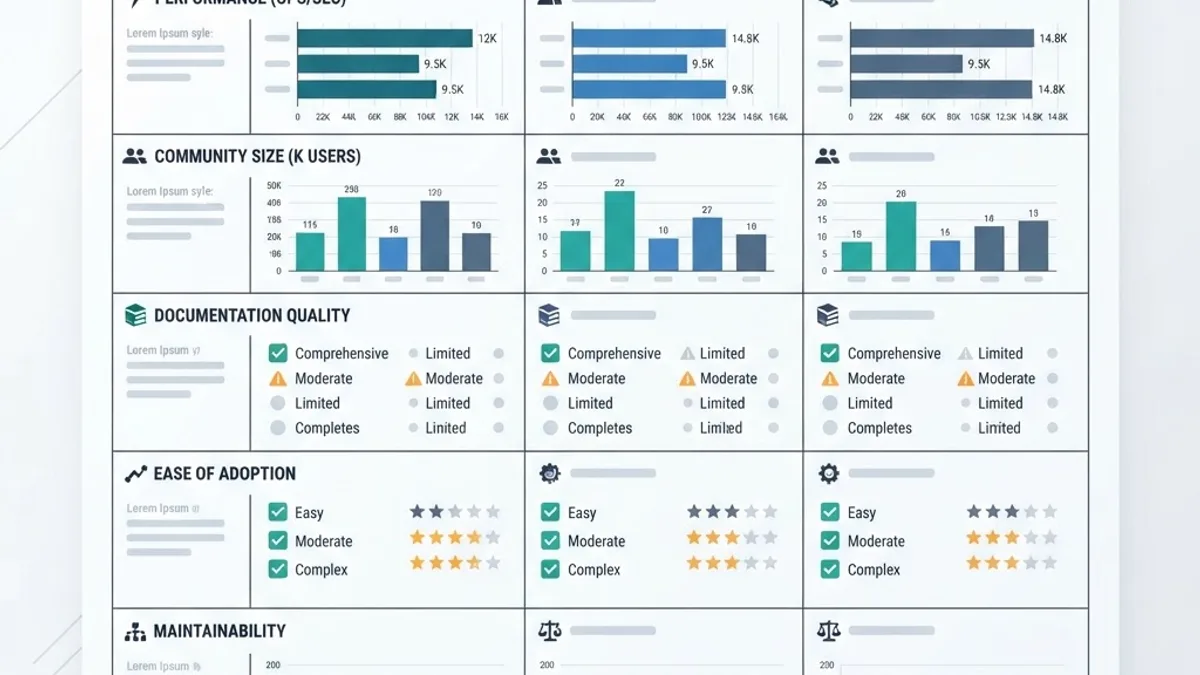
Framework Comparison Table
| Framework | Best For | Learning Curve | SEO Out of the Box | Hiring Pool |
|---|---|---|---|---|
| Next.js | SEO sites, full-stack apps, ecommerce | Moderate | Yes | Large |
| React | Complex dashboards, SPAs | Moderate | No | Very large |
| Vue / Nuxt | Mid-size apps, fast onboarding | Low | Yes (Nuxt) | Medium |
| Svelte / SvelteKit | Performance-critical, small bundles | Low | Yes (SvelteKit) | Small |
| Angular | Large enterprise systems | High | Partial | Medium |
| Laravel | Content platforms, admin-heavy apps | Low | Yes | Medium |
| Django | Data science, analytics, complex models | Moderate | Yes | Medium |
| Node.js + Express | APIs, microservices, realtime | Low | No | Very large |
The Best Frontend Frameworks in 2026
Frontend framework choice determines how your interface behaves, how fast it loads, and how maintainable your component code stays after year two.
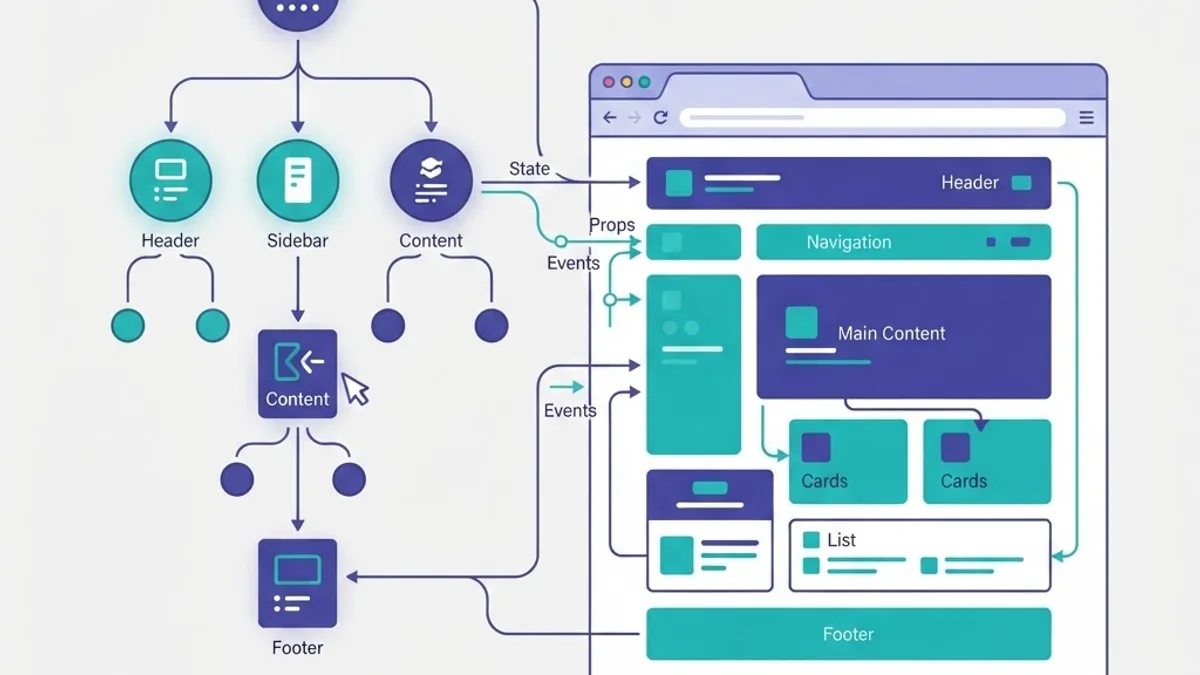
Next.js — the Strongest Default
Next.js is the best choice for most commercial web projects because it solves the two problems that break React projects: rendering strategy and routing. It gives you server components, static generation, incremental revalidation, and API routes in one codebase.
Pick Next.js when your site needs to rank in search, load fast on mobile, and also contain authenticated app functionality. A marketing site with a customer portal is the exact shape Next.js was built for. Our engineering teams default to it for web development projects where organic traffic drives revenue.
Avoid it when your product is a purely internal tool behind a login with zero SEO requirement — you are paying complexity tax for benefits you never use.
React — for Interface Complexity
Choose plain React with Vite when the application is a dense, stateful interface: trading dashboards, design tools, data grids with thousands of rows, collaborative editors. In these cases server rendering adds no value and the freedom to control your own state architecture is worth more than convention.
Vue and Nuxt — the Fastest to Onboard
Vue's single-file components are the easiest structure for a mixed-skill team to read. In practice, developers coming from HTML, PHP, or WordPress become productive in Vue noticeably faster than in React. Nuxt adds the same server rendering benefits Next.js provides. Choose this stack when your team is small and turnover is a real risk.
Svelte and SvelteKit — for Raw Performance
Svelte compiles components to plain JavaScript at build time, so it ships less runtime code than any mainstream alternative. That makes SvelteKit excellent for landing pages, embedded widgets, and markets where users are on slow 3G connections. The trade-off is a smaller ecosystem and a smaller hiring pool — quantify that risk before committing a multi-year product to it.
Angular — for Enterprise Scale
Angular's opinionated structure, dependency injection, and built-in TypeScript become advantages once you have thirty developers in one repository. Below roughly ten developers, the same structure feels like overhead.
The Best Backend Frameworks in 2026
Backend framework choice determines your data modeling speed, your security defaults, and your operational cost.

Node.js with Express or Fastify
One language across frontend and backend genuinely reduces context switching and lets a single developer own a feature end to end. Node.js is the correct choice for realtime features, chat, notifications, and API gateways because of its non-blocking I/O model. Fastify is worth choosing over Express for new projects — it ships schema-based validation and better performance.
Laravel
Laravel remains the most productive framework for content-driven and admin-heavy applications. Eloquent ORM, queues, scheduled jobs, and authentication scaffolding are built in, which means a two-person team can deliver a functional CRM in weeks instead of months.
Django
Choose Django when the application involves analytics, reporting, machine learning, or complex relational models. Its admin interface alone saves weeks of internal tooling work, and Python's data ecosystem means your API and your data pipeline share one language.
Choosing Between Them
- Realtime and streaming features dominate → Node.js
- Content, billing, and admin dominate → Laravel
- Data models and analytics dominate → Django
- You need one deployment for frontend and backend → Next.js server actions and route handlers
How Framework Choice Affects Performance
Framework choice sets your performance ceiling, not your performance floor. A poorly built Next.js site will lose to a well-built Svelte site — but a well-built version of either will pass Core Web Vitals.

The measurable factors that actually decide performance:
- Initial JavaScript payload. Every kilobyte delays interactivity. Svelte and Astro ship least; unoptimized React and Angular ship most.
- Rendering strategy. Static generation beats server rendering, which beats client rendering, for first contentful paint.
- Hydration cost. Partial hydration and server components dramatically reduce main-thread blocking versus full-page hydration.
- Image and font handling. Frameworks with built-in optimization pipelines, such as Next.js, remove the most common cause of poor Largest Contentful Paint scores.
Audit these four items before blaming your framework. In our experience, roughly eight out of ten slow sites are slow because of unoptimized media and third-party scripts, not the framework underneath.
SEO and Rendering: the Decision Most Teams Get Wrong
If organic search matters to your business, rendering strategy is not a technical detail — it is a revenue decision.

Google can render JavaScript, but rendering is queued and delayed, and other answer engines and AI crawlers are far less capable. Content that only exists after client-side JavaScript executes is content that may never be cited by ChatGPT, Perplexity, or Gemini. That is why server-rendered HTML has become essential for both SEO and AEO.
Practical rules we apply on every project:
- Render all primary content server-side or statically.
- Give every page a unique server-generated title, meta description, and canonical URL.
- Output structured data as JSON-LD from the server, not injected by client scripts.
- Keep client-side JavaScript for interaction only — never for delivering text.
- Generate sitemaps programmatically so new pages are discoverable within hours.
Teams that combine a server-rendered framework with a deliberate content strategy consistently outperform teams that treat SEO as a post-launch task. That combined engineering and marketing approach is exactly what our team at ZoneTechify and our partners at WebPeak build into projects from day one.
How Your Team Shapes the Right Answer
The framework that fits your codebase is inseparable from the people maintaining it. A technically superior choice your team cannot staff is a liability, not an advantage.

Before committing, answer three questions honestly. How many developers will touch this repository in the next two years? Can you hire a replacement for your lead developer within thirty days in your market? Does your team have the discipline to enforce one state management pattern in code review? Teams that answer these three questions accurately almost never need a rewrite.
A Practical Framework Selection Checklist
Use this sequence instead of comparing GitHub stars.

- Define the primary job. Is it a content site, an application, an API, or a hybrid? Hybrid points to Next.js or Nuxt.
- Check your SEO dependency. If organic traffic drives revenue, eliminate client-only rendering immediately.
- Audit existing team skill. A framework your team already knows will beat a theoretically better one for the first year.
- Estimate the maintenance horizon. Projects living five or more years should favor large ecosystems and long-term support.
- Confirm hiring availability. Search your local job market for the framework name and count real candidates.
- Prototype the hardest feature. Build the single most complex screen or endpoint in two candidate frameworks before committing.
Step six is the one most teams skip and the one that prevents the most expensive mistakes. Two days of prototyping regularly saves two months of migration.
Common Framework Mistakes We See in Audits
- Choosing for the resume, not the roadmap. Selecting an unfamiliar framework to learn it, then discovering the deadline does not allow a learning curve.
- Adding a heavy frontend framework to a brochure site. A five-page site needs Astro or static HTML, not a single-page application.
- Ignoring the build and deploy story. A framework that is pleasant to develop in but painful to deploy costs more over time.
- Mixing three state management libraries. Pick one pattern and enforce it in code review.
- Treating accessibility as optional. Frameworks give you semantic tools; skipping them creates legal and usability risk.
Key Takeaways
- There is no universally best web development framework — the best choice is determined by project type, SEO dependency, team skill, and maintenance horizon.
- Next.js is the strongest general-purpose choice in 2026 for projects needing both search visibility and application functionality.
- Google reports 53% of mobile users abandon pages taking over three seconds, making server rendering and small JavaScript payloads business-critical.
- React remains the most widely used frontend technology among professional developers, which makes hiring and support easier than with newer alternatives.
- Svelte ships the smallest bundles; Angular scales best for large enterprise teams; Vue onboards new developers fastest.
- Laravel wins for admin and content-heavy backends, Django for analytics and data modeling, Node.js for realtime and APIs.
- Prototype your hardest feature in two frameworks before committing — it is the cheapest insurance against a future rewrite.
Frequently Asked Questions (FAQ)
What is the best web development framework for beginners?
Vue is the best starting point for beginners because its single-file components closely resemble standard HTML, CSS, and JavaScript. Next.js is the best second step, since it teaches routing, rendering, and data fetching using conventions that transfer directly to professional commercial projects.
Is Next.js better than React?
Next.js is built on React, so it is not a competitor but an extension. Next.js adds routing, server rendering, image optimization, and API handling that plain React lacks. Choose plain React only for complex internal applications where SEO and initial load speed are irrelevant.
Which framework is best for SEO?
Next.js, Nuxt, SvelteKit, and Astro are the best frameworks for SEO because they deliver fully rendered HTML from the server. Search crawlers and AI answer engines index that content immediately, without waiting for JavaScript execution, which improves both rankings and citation likelihood.
Should I use one framework for both frontend and backend?
Yes, for most small and mid-size projects. Full-stack frameworks like Next.js, Nuxt, or Laravel reduce deployment complexity and duplicated logic. Split frontend and backend only when you need independent scaling, multiple client applications, or a specialized backend language such as Python for data work.
How often should I change my web development framework?
Rarely. Migrate only when your framework blocks a required capability, loses official security support, or makes hiring genuinely difficult. Framework migrations typically consume months of engineering time with no visible feature output, so upgrade versions continuously and replace frameworks reluctantly.
Which framework is fastest in 2026?
Svelte and Astro produce the fastest initial loads because they ship minimal or zero client-side JavaScript. However, real-world speed depends far more on image optimization, caching, and third-party scripts than on framework choice, so measure your own Core Web Vitals before switching.
Final Recommendation
If you want a single answer: choose Next.js for public-facing commercial projects, React with Vite for complex internal applications, and Laravel or Django when your product is fundamentally about data and administration. Then spend your remaining effort on performance budgets, accessibility, and content quality — because those decide outcomes long after the framework debate is settled.