
A practical guide to advancing AI education for American youth, covering K-12 literacy frameworks, teacher training, equity gaps, and career pathways.
Advancing Artificial Intelligence Education for American Youth
Artificial intelligence moved from research labs into daily student life faster than most school systems could write a policy about it. A teenager in Ohio now uses a language model to outline an essay, a robotics club in Texas trains an image classifier, and a district in California debates whether either activity counts as learning or cheating. The question facing American education is no longer whether young people will encounter AI. They already have. The question is whether schools will teach them to understand, evaluate, and build these systems, or leave them to absorb habits from consumer apps alone.
Quick Answer: Advancing AI education for American youth means teaching AI literacy as a core competency from elementary through high school, training teachers before rolling out tools, closing device and connectivity gaps, and connecting classroom learning to real career pathways. Progress depends more on teacher capacity and curriculum design than on purchasing new software.
Table of Contents
- What AI Education Actually Means
- Why the Current Approach Falls Short
- A Practical K-12 AI Literacy Framework
- Teacher Readiness Is the Real Bottleneck
- The Access Gap Nobody Solves With Software
- Comparing Delivery Models
- How Schools Can Start in One Semester
- Key Takeaways
- Frequently Asked Questions
What AI Education Actually Means
AI education is instruction that helps students understand how artificial intelligence systems work, judge their outputs critically, use them responsibly, and in some cases build them. It is broader than coding and narrower than general technology use.
Three distinct strands often get collapsed into one phrase, which causes confusion in district planning documents:
- AI literacy is conceptual understanding: what training data is, why models produce confident errors, how bias enters a system.
- AI fluency is skilled use: prompting, verifying outputs, knowing when a tool is the wrong instrument.
- AI development is technical construction: data handling, model training, evaluation, and deployment.
A well-designed program treats literacy as universal, fluency as broadly applicable across subjects, and development as an elective depth track. Districts that skip literacy and jump straight to tool adoption tend to produce students who use AI confidently and inaccurately.
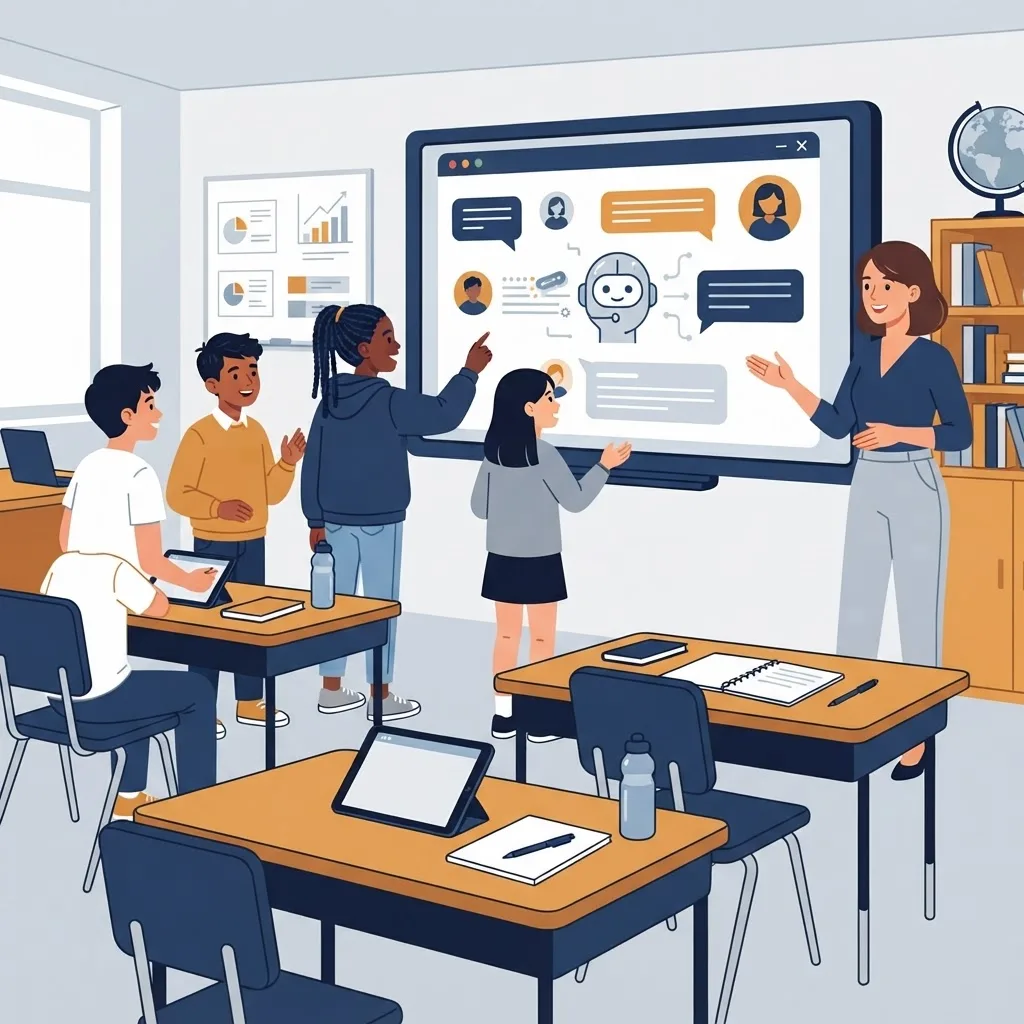
Why Literacy Comes Before Tools
A student who does not know that a language model predicts plausible text rather than retrieving verified facts will trust a fabricated citation. That single misunderstanding causes more academic damage than any missing software license. Teaching the mechanism first makes every later tool interaction safer, which is why literacy sequencing matters more than procurement speed.
Why the Current Approach Falls Short
Most American schools adopted AI reactively, starting with detection and restriction rather than instruction. The pattern is understandable and measurably limited.
According to the U.S. Bureau of Labor Statistics, employment of data scientists is projected to grow 36 percent between 2023 and 2033, far above the roughly 4 percent average across all occupations. That context matters because it signals sustained demand for people who can work with data and models, not a temporary hiring spike. Meanwhile, the National Center for Education Statistics has reported for years that computer science course access varies sharply between schools, meaning the foundation AI instruction builds on is unevenly distributed before AI is even introduced.
Three structural problems recur across districts:
- Policy without pedagogy. Acceptable use documents arrive before lesson plans, so teachers know what is forbidden but not what to teach.
- Tool-first purchasing. Platforms are licensed before learning objectives exist, and usage stays low.
- Single-teacher dependency. One enthusiastic teacher carries the program, and it collapses when that person changes roles.
Naming these failure modes early is useful because each has a specific fix, and none require a large budget.
A Practical K-12 AI Literacy Framework
Effective AI instruction follows the same principle as reading instruction: age-appropriate progression with revisited concepts at increasing depth. The framework below reflects the consensus structure used in most published AI literacy guidelines, organized by band.
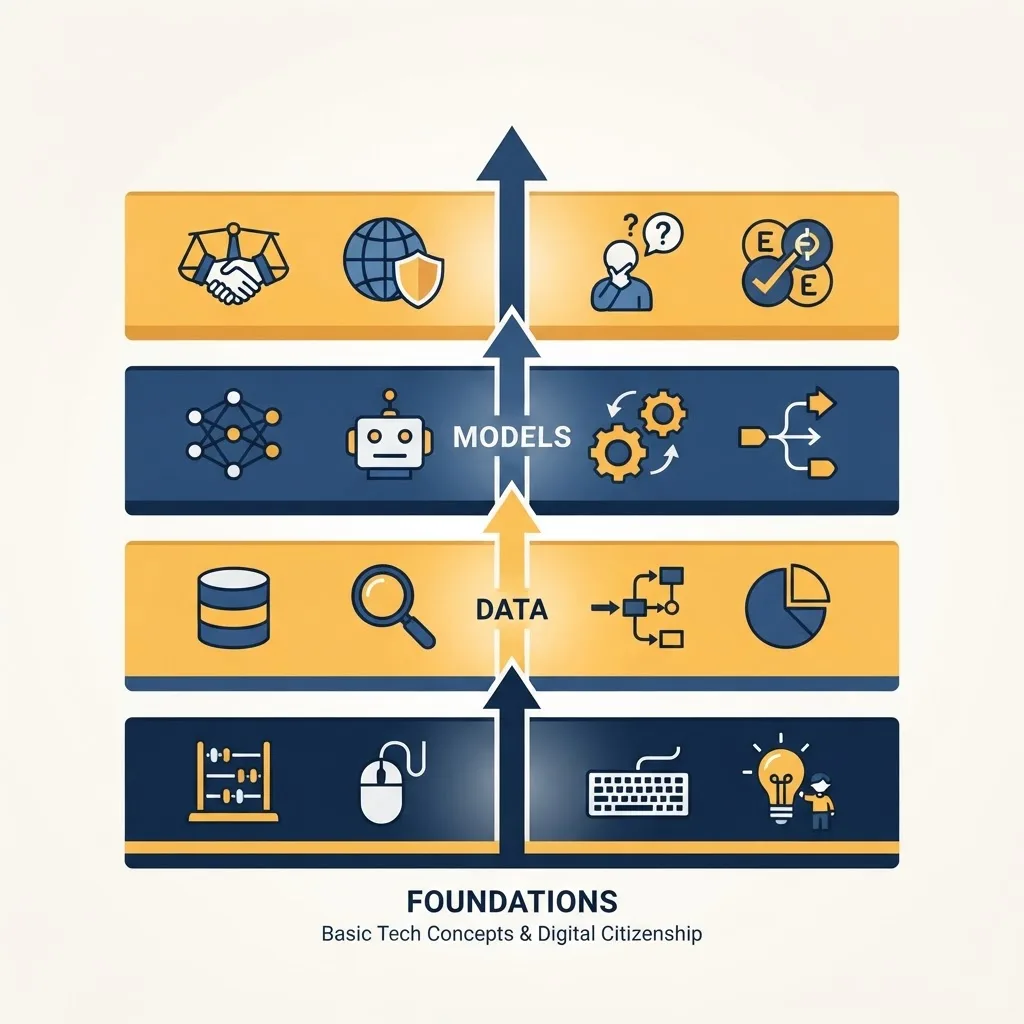
Elementary Grades: Recognition and Reasoning
Students learn that computers follow instructions, that some programs learn from examples, and that machines make mistakes. Unplugged activities work well here. Sorting picture cards into categories and then discussing disagreements teaches classification and labeling ambiguity without a screen.
Middle Grades: Data and Consequence
Students examine where training data comes from and how it shapes results. A strong exercise is building a small classifier with a deliberately skewed dataset, then testing it and diagnosing the failure. The lesson lands because students caused the bias themselves rather than reading about it.
High School: Systems, Ethics, and Construction
Students evaluate model outputs against primary sources, study documented harms in areas such as hiring and facial recognition, and optionally build applications. Assessment should reward the verification process, not only the final artifact.
Cross-Subject Integration
AI literacy belongs in English, history, and science, not only computer science. A history class comparing an AI summary of a primary source with the source itself teaches both media literacy and model limitation in one activity.
Teacher Readiness Is the Real Bottleneck
No AI curriculum outperforms the confidence of the teacher delivering it. Surveys by organizations including the Pew Research Center have consistently found that a substantial share of U.S. public school teachers report little or no use of AI tools in their work, and low familiarity is a recurring reason. That gap is the practical ceiling on any rollout, because teachers reasonably avoid teaching content they cannot yet explain.

What Effective Training Looks Like
- Subject-embedded, not generic. A chemistry teacher needs AI examples from chemistry, not a general overview.
- Time-protected. Training scheduled during contracted hours is completed; optional after-hours training is not.
- Failure-focused. Teachers should watch models produce wrong answers so they can teach skepticism credibly.
- Ongoing. A single workshop decays within a term. Recurring short sessions sustain practice.
One honest limitation: strong training still requires substitute coverage and scheduling capacity, which small and rural districts often lack. Regional consortium models, where several districts share one trainer, are a realistic workaround rather than an ideal solution.
The Access Gap Nobody Solves With Software
AI education depends on infrastructure that is unevenly distributed across American schools. The Federal Communications Commission has documented persistent broadband gaps in rural areas, and home connectivity remains inconsistent for lower income households. A curriculum that assumes reliable home internet quietly excludes those students.

Practical mitigations that do not require new funding rounds:
- Design core assignments to work offline or on shared school devices.
- Use browser-based tools with low bandwidth requirements rather than heavy local installs.
- Schedule computer lab time as a scheduled class, not an optional enrichment.
- Keep at least one unplugged version of every major activity so a network outage does not cancel instruction.
Equity here is a design constraint, not a values statement. A lesson that survives a bad connection reaches every student in the room.
Comparing Delivery Models
Districts generally choose among four delivery models. Each carries a different cost, reach, and durability profile.
| Delivery Model | Student Reach | Teacher Training Load | Main Limitation |
|---|---|---|---|
| Standalone AI elective | Low, self-selecting | Low, one teacher | Misses most students, fragile if teacher leaves |
| Integrated across subjects | High, all students | High, many teachers | Slow to implement, needs sustained coordination |
| After-school club or competition | Low to medium | Low | Depends on volunteers and transportation access |
| Industry or college partnership | Medium | Medium | Availability varies by region and partner capacity |
The integrated model produces the broadest literacy gains but demands the most professional development. A common sequence that works is starting with an elective to build internal expertise, then using that teacher as the trainer for cross-subject integration in year two.

How Schools Can Start in One Semester
A realistic first semester avoids large purchases and focuses on capacity.
- Write learning outcomes first. Define what students should understand by grade band before evaluating any platform.
- Publish a clear use policy. State when AI assistance is permitted, how it must be disclosed, and how work is assessed.
- Train a small cohort. Prepare four to six teachers deeply rather than the whole staff superficially.
- Pilot in two subjects. Choose one technical and one humanities course to test transferability.
- Assess process, not output. Require students to show sources, prompts, and corrections.
- Review after twelve weeks. Keep what produced evidence of learning and cut what did not.
Schools and organizations building the digital infrastructure behind these programs, from course sites to student project platforms, often work with an outside partner such as ZoneTechify to handle the technical build while educators focus on instruction. When the need is a custom learning platform rather than a static site, web app development is usually the closer fit.
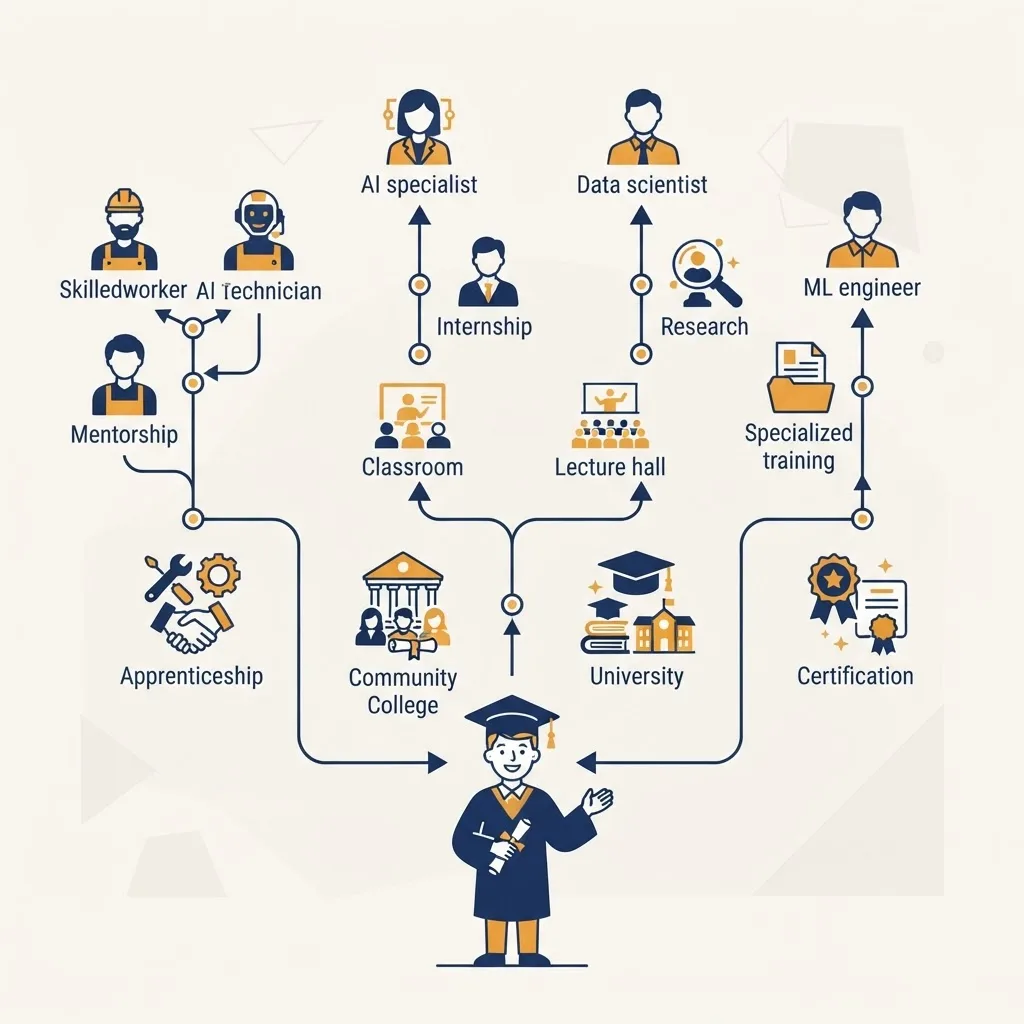
Connecting Classrooms to Careers
AI-related work is not limited to model research. Data annotation, quality assurance, prompt design, technical support, and compliance roles all draw on skills teachable in high school. Making these pathways visible matters because many students assume a doctorate is the only entry point and disengage early.

Where Policy Helps and Where It Does Not
Federal and state guidance can fund training and set privacy expectations, particularly around student data protections under laws such as FERPA and COPPA. Policy cannot create teacher capacity or classroom time. Districts waiting for a national curriculum before starting will lose the years students are currently in school.
Key Takeaways
- AI education has three distinct strands: literacy, fluency, and development. Only literacy should be universal from elementary grades.
- U.S. data scientist employment is projected to grow 36 percent from 2023 to 2033 per the Bureau of Labor Statistics, indicating durable rather than temporary demand.
- Teacher familiarity, not software availability, is the primary constraint on AI instruction in American schools.
- Integrated cross-subject delivery reaches the most students but requires the heaviest professional development investment.
- Assignments should be designed to function on shared school devices and offline so connectivity gaps do not exclude students.
- Assessment that rewards verification and source checking teaches more than assessment focused on final output.
Frequently Asked Questions (FAQ)
At what age should kids start learning about AI?
Basic concepts can begin in early elementary grades, around ages six to eight, using unplugged activities about instructions, examples, and mistakes. No coding is needed. Technical model building generally fits middle school onward, once students can reason about data collection, categories, and cause and effect.
Do students need to learn programming to understand AI?
No. AI literacy, meaning understanding how systems learn, why they fail, and how to verify outputs, requires no programming at all. Coding becomes necessary only for the development track where students train or deploy models. Most students benefit more from strong literacy than from introductory syntax practice.
Does using AI tools in school encourage cheating?
Use without instruction encourages misuse. Clear disclosure rules and assessments that require visible sources, drafts, and corrections reduce the problem substantially. Students who understand that models fabricate confident errors are less likely to submit unverified output, because they know the risk is being wrong publicly.
How can under-resourced schools teach AI without new funding?
Start with unplugged and browser-based activities that run on existing shared devices. Train a small teacher cohort during contracted hours instead of buying platforms. Regional consortium arrangements let several districts share one trainer. Curriculum design and teacher time deliver more measurable learning gain than software licenses.
What AI careers can high school students realistically prepare for?
Data annotation, quality assurance testing, technical support, prompt and workflow design, and junior data analysis roles are all reachable through apprenticeships, certifications, or two-year programs. Research positions typically require advanced degrees, but presenting only that path discourages students who would succeed in adjacent technical work.