
A practical breakdown of SEO specialists versus web developers, covering skills, salaries, overlap, and which role your website actually needs first.
SEO vs Web Developer
Most business owners discover the difference between an SEO specialist and a web developer the hard way: they pay for a beautiful website, launch it, and then wait months for traffic that never arrives. The site works. It just is not findable. That gap is exactly where these two roles separate, and understanding it saves budget, months of delay, and a painful rebuild.

Quick Answer: A web developer builds and maintains the website itself, writing code for structure, features, and performance. An SEO specialist makes that website rank in search engines through keyword strategy, content optimization, technical fixes, and link acquisition. Developers create the asset; SEO specialists make sure people find it.
What a Web Developer Actually Does
A web developer turns designs and requirements into working software. The job is production of a functioning product, not visibility for it.
Day to day, that means writing HTML, CSS, and JavaScript, wiring up a backend or CMS, connecting databases and APIs, handling authentication, fixing bugs, and deploying safely. A frontend developer focuses on the interface users touch. A backend developer handles data, logic, and servers. A full stack developer covers both, which is why full stack roles dominate job listings for small teams.

The defining trait of a developer is that their work is verifiable in binary terms. A checkout flow either processes payments or it does not. A page either loads in 900 milliseconds or it takes four seconds. This clarity is why development work is easier to scope and quote than SEO work.
Key Term: Web Development
Web development is the practice of building and maintaining the code, architecture, and infrastructure that make a website or web application function. It covers everything from markup and styling to server logic, deployment, and ongoing maintenance.
What an SEO Specialist Actually Does
An SEO specialist increases the amount of qualified organic traffic a website earns from search engines. Their raw material is demand that already exists in search queries.
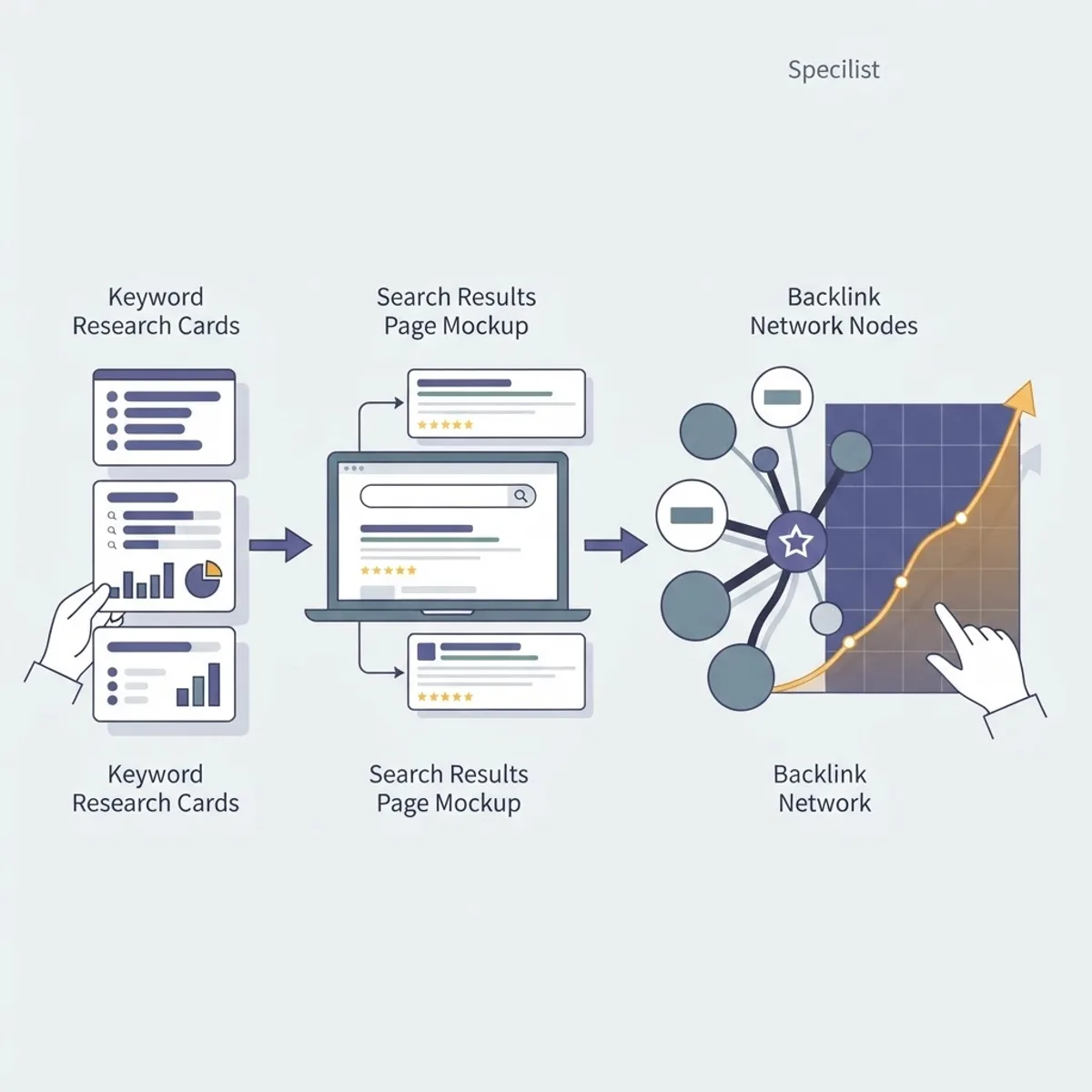
The work splits into four practical areas:
- Keyword and intent research. Identifying what buyers type, how competitive each query is, and which pages should target which terms.
- On-page optimization. Titles, headings, internal links, content depth, and matching page content to search intent.
- Technical SEO. Crawlability, indexation, sitemaps, canonical tags, structured data, Core Web Vitals, and site architecture.
- Off-page authority. Earning links and brand mentions from credible external sites.
Two data points frame why this matters. First, Google's own Search Central documentation confirms that Core Web Vitals are part of its page experience signals, meaning measurable load performance influences rankings directly. Second, industry click-through studies consistently show the first organic result capturing roughly a quarter to a third of all clicks for a query, with steep drop-off after position three. Rank five instead of one and you are trading away most of the available traffic for that term.
Key Term: Search Engine Optimization
SEO is the process of improving a website's technical foundation, content relevance, and external authority so search engines rank its pages higher for queries that matter to the business.
SEO vs Web Developer: Side by Side Comparison
| Factor | Web Developer | SEO Specialist |
|---|---|---|
| Primary goal | A functional, fast, maintainable site | Qualified organic traffic and rankings |
| Core skills | HTML, CSS, JavaScript, backend, databases, Git | Keyword research, content strategy, technical audits, link building |
| Main tools | VS Code, Git, Next.js or WordPress, browser devtools | Google Search Console, GA4, Screaming Frog, Ahrefs or Semrush |
| Success metric | Uptime, load time, shipped features, bug rate | Impressions, rankings, organic sessions, conversions |
| Time to visible result | Days to weeks | Three to nine months typically |
| Output type | Code and infrastructure | Strategy, content, and technical recommendations |
| Dependency | Needs design and requirements | Needs a site that can be changed |
The last row is the one people underestimate. SEO recommendations are worthless if nobody can implement them. That is why SEO retainers on rigid, poorly built sites tend to underperform.
Where the Two Roles Overlap
Technical SEO is the shared territory, and it is larger than most job descriptions admit.

These tasks require both mindsets:
- Rendering strategy decisions, since client-side-only rendering can delay or prevent proper indexing of content
- Page speed and Core Web Vitals work, which lives in image handling, bundle size, and caching
- URL structure, redirects, and canonical logic during migrations
- Structured data implementation for rich results
- Pagination, faceted navigation, and crawl budget control on large ecommerce catalogs
- Server response codes, robots directives, and log file behavior
In practice, an SEO specialist diagnoses and a developer implements. A specialist who can read a rendered DOM and open a pull request is dramatically more effective than one who can only export a spreadsheet of issues. Teams that build this overlap deliberately, like the senior engineers and strategists at ZoneTechify, tend to ship optimization work in days rather than quarters.
Original Analysis: Why the Handoff Fails More Often Than the Skills
After auditing sites that had both a competent developer and a competent SEO specialist, one pattern repeats: the failure is almost never a knowledge gap. It is a sequencing and ownership gap.
Three recurring causes:
- SEO enters after launch. Information architecture, URL structure, and rendering approach are already locked. Fixing them post-launch costs several times more than deciding them correctly during planning.
- Recommendations have no engineering ticket. An audit lands as a PDF. It never enters the sprint backlog, so nothing changes and the retainer looks ineffective.
- Success metrics conflict. The developer is measured on shipping features. The SEO specialist is measured on rankings. Nobody owns the outcome that connects them, which is revenue from organic search.

The fix is structural, not personal. Bring SEO into the wireframe stage, convert every audit finding into a ticket with a named owner and a priority score, and report organic revenue as a shared number. Agencies that keep strategy and engineering under one roof, such as WEBPEAK Agency, avoid the handoff problem entirely because the same team owns both sides of the ticket.
Salaries and Career Paths Compared
Developer compensation generally runs higher at equivalent experience levels, largely because engineering skills are transferable across every industry and are easier to benchmark objectively.

Typical progression differs in shape:
- Developer path: junior developer, mid-level developer, senior developer, then either tech lead and engineering manager or staff and principal engineer.
- SEO path: SEO executive, SEO specialist, SEO manager, then head of organic growth, or a pivot into broader growth and product marketing leadership.
SEO offers a faster route into revenue conversations because the work maps directly to pipeline and sales. Development offers stronger salary floors and clearer credential portability. Freelancers see the inverse of the salary picture: experienced SEO consultants often earn more per hour than mid-level developers because they can attribute their work to measurable revenue rather than delivered features.
Which One Should You Hire First?
Diagnose before you hire. The correct first hire depends entirely on which constraint is actually limiting growth.

Hire a web developer first when:
- You have no website, or the current one cannot be edited without breaking
- Load times exceed three seconds or mobile usability is failing
- You need ecommerce, booking, gated accounts, or custom application features
- Search Console reports crawling or indexing errors you cannot resolve in the CMS
Hire an SEO specialist first when:
- The site is technically sound but ranks for nothing commercially valuable
- You have impressions in Search Console but low click-through and no conversions
- Competitors outrank you with objectively weaker products
- You publish content regularly with no organic growth to show for it
If your site is a modern, well-built stack that simply lacks visibility, SEO is the higher-leverage spend. Reliable technical SEO services work best on a codebase that can absorb changes quickly, which is why platform quality and search performance are budget decisions, not separate ones.
Can One Person Do Both?
Yes, and the hybrid profile is increasingly valuable, but only above a certain competence threshold in each discipline.

A realistic hybrid skill set includes semantic HTML, rendering trade-offs between server-side and client-side approaches, Core Web Vitals optimization, structured data, log file and crawl analysis, plus genuine keyword and intent research. Notice what is missing: link acquisition and editorial content production remain specialist work that rarely fits inside an engineering role.
The honest constraint is depth. A hybrid practitioner is excellent for a startup with one site and limited budget. Once organic search becomes a primary revenue channel, separate specialists outperform one generalist because content velocity and authority building demand dedicated time that engineering deadlines will always consume.
Key Takeaways
- Web developers build and maintain the site; SEO specialists make it discoverable and profitable in search.
- Technical SEO is the genuine overlap: rendering, speed, crawlability, structured data, and redirects.
- Google confirms Core Web Vitals are part of page experience signals, making performance a shared responsibility.
- The top organic result captures roughly a quarter to a third of clicks, with sharp decline after position three.
- SEO typically needs three to nine months to show compounding results; development changes are visible within days.
- Most failures stem from broken handoffs and conflicting metrics, not from insufficient skill on either side.
- Bring SEO into the wireframe stage, not after launch, to avoid expensive architectural rework.
Frequently Asked Questions (FAQ)
Is SEO or web development harder to learn?
Web development has a steeper technical entry curve because you must learn programming syntax, tooling, and debugging before producing anything useful. SEO is easier to start but harder to master, since search algorithms change constantly and results depend on competitive context you cannot fully control.
Do web developers need to know SEO?
Yes, at least the technical fundamentals. Developers should understand semantic HTML, indexable rendering, redirect handling, and Core Web Vitals. These decisions get locked into the codebase during the build, and correcting them later costs far more than implementing them properly from the start.
Which pays more, SEO or web development?
Salaried web development roles generally pay more at equivalent experience levels because engineering skills benchmark easily across industries. However, senior freelance SEO consultants often bill higher hourly rates, since their work ties directly to measurable revenue and pipeline rather than to delivered features.
Can I rank a website without hiring an SEO specialist?
You can for low-competition local or niche queries by writing genuinely useful content, fixing technical basics, and earning natural mentions. Competitive commercial keywords are different: they require sustained strategy, content production, and authority building that generally outpace what one non-specialist can maintain.
Should SEO come before or after building a website?
Before, ideally during planning. Keyword research shapes your page structure, URL hierarchy, and navigation. Retrofitting SEO onto a finished site usually means rewriting URLs, adding redirects, and restructuring content, which costs several times more than deciding correctly upfront.
What tools do SEO specialists use that developers do not?
SEO specialists rely on Google Search Console, GA4, crawlers like Screaming Frog, and backlink platforms such as Ahrefs or Semrush. Developers use code editors, version control, browser devtools, and deployment pipelines. The two toolsets meet at Lighthouse, PageSpeed Insights, and server log analysis.