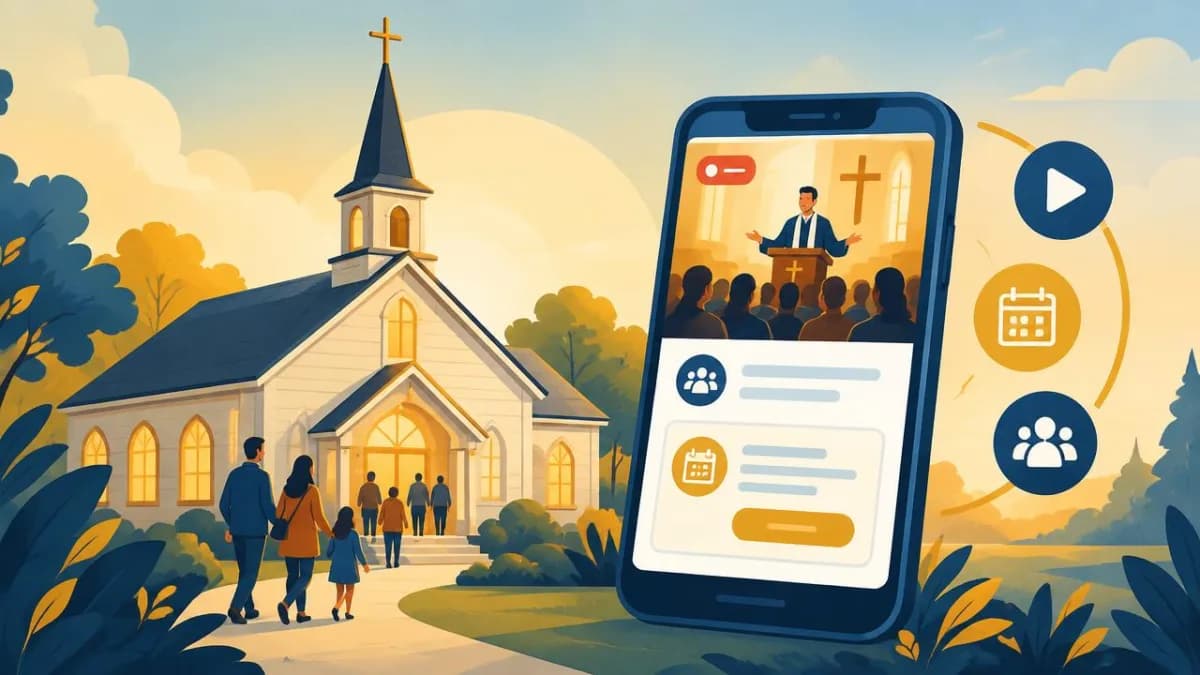
Church digital marketing is hospitality online. Learn the website, local search, content, and follow-up steps that turn first visits into lasting community.
Digital Marketing for Churches
Churches are not selling a product, but they are competing for attention in the same feeds and search results as everyone else. A family relocating to a new town types a simple query, scans three websites in under two minutes, and decides which service to visit on Sunday. Digital marketing for churches is mostly about making that two-minute evaluation easy, honest, and welcoming.
Quick Answer: Digital marketing for churches means helping people find, understand, and feel comfortable visiting your congregation online. The essentials are an accurate Google Business Profile, a clear website with service times and location, consistent social presence, sermon content that answers real questions, and simple follow-up for first-time visitors.
Start With the Visitor's Actual Questions
Most church websites lead with a mission statement. Most visitors are looking for six practical answers: when do services start, where exactly do I park, what should I wear, what happens to my kids, how long does it last, and will anyone single me out. A homepage that answers those in the first screen converts far better than one leading with a doctrinal summary.
This is not a compromise of the message. It is basic hospitality translated to a screen. The doctrinal content still belongs on the site, one click deeper, where someone genuinely researching your beliefs will look for it.
The First-Screen Checklist
- Service times and full address with a map link
- A one-line description of who you are in plain language
- A photograph of actual people at your actual building, not stock imagery
- A visible Plan Your Visit or What to Expect link
- Livestream access if you offer one
Local Search Is the Front Door
A church's Google Business Profile is often visited more than its website. Claim it, set the correct category, add service times using the hours feature, upload recent photos quarterly, and answer questions in the Q&A section proactively by posting the questions visitors ask most.
Two grounded facts shape effort here. First, Google has stated that a substantial share of searches carry local intent, and church-seeking queries are almost entirely local. Second, Pew Research Center's long-running studies of American religious life document steady growth in online engagement with religious services, a shift that accelerated after 2020 and did not fully reverse. Practically, your online presence now serves both prospective in-person attenders and a genuinely remote audience.
From practitioner observation, the single most common technical failure on church sites is outdated information: a holiday schedule from two years ago, a staff page listing someone who left, or a livestream link that 404s. Accuracy costs nothing and protects trust more than any campaign.
Channel Priorities for Congregations
| Channel | Primary Purpose | Effort Level | Realistic Timeline |
|---|---|---|---|
| Google Business Profile | Being found by newcomers nearby | Low | 2 to 6 weeks |
| Website clarity and speed | Converting interest into a visit | Medium once, low upkeep | Immediate after launch |
| Sermon and video content | Depth, discipleship, and search reach | High ongoing | 3 to 9 months |
| Email and text follow-up | Retaining first-time visitors | Low | Immediate |
| Paid social for events | Filling specific events and seasons | Medium seasonal | Days |
Volunteer capacity, not ambition, should decide how many channels you run. A church doing two channels consistently outperforms one attempting five sporadically.
Content That Serves Rather Than Promotes
Sermon recordings alone rarely attract new people, because nobody searches for a sermon title. What they search for is the question underneath it: grief after losing a parent, marriage conflict, anxiety, forgiveness, questions about faith and doubt. Publish written companions to sermons using those plain-language questions as headings, and the same message becomes discoverable.
Other formats that reliably serve congregations:
- Practical local guides such as a list of community resources, food assistance, or recovery meetings in your area
- Short staff introductions on video so visitors recognize faces before they arrive
- Event recaps with photos that show what participation actually looks like
- Plain-language belief explainers that answer what you teach without insider vocabulary
- Accessibility and family information covering nursery procedures, special needs support, and transportation
For congregations building or rebuilding their site, a team offering ROI marketing agency discipline can help prioritize the handful of pages that actually influence attendance instead of a sprawling build nobody maintains.
Following Up With First-Time Visitors
Most churches lose new attenders in the gap between the first visit and the second. Close it with a simple, respectful sequence.
- Collect contact details with a short digital connect card linked by QR code in the bulletin and on screens
- Send one personal message within twenty-four hours from a real person, not a mailing list
- Send a second message within a week offering one specific next step, such as a newcomer coffee or a small group
- Stop after three messages unless they respond, because persistence past that point reads as pressure
Measure the second-visit rate. It is the single most useful number a church can track digitally, and it is almost always improvable by follow-up speed alone.
Social Media Without Burning Out Volunteers
Choose one platform where your community actually is, usually Facebook for older congregations and Instagram for younger ones, and post consistently rather than everywhere occasionally. A workable weekly rhythm is one service announcement, one photo from real church life, one short quote or encouragement, and one community or service opportunity.
Avoid the two frequent mistakes: posting only announcements, which trains people to ignore you, and posting only inspirational graphics, which tells a newcomer nothing about your actual community. Faces, places, and specifics outperform typography every time.
Budget and Stewardship
Many churches operate this with zero paid media. A realistic annual digital budget for a congregation of 150 to 400 people is 1,500 to 6,000 USD, covering hosting, a church management or giving platform, email tools, and occasional event advertising. Spend first on accuracy and speed, second on follow-up systems, and only third on advertising.
Be transparent with your congregation about digital spending. Framing it as hospitality infrastructure, the digital equivalent of clear signage and a staffed welcome desk, tends to earn more support than framing it as marketing. Partners such as ZoneTechify Team often structure church projects around that stewardship framing, keeping recurring costs predictable.
Online Giving and Practical Trust
If you accept online giving, make the process short, mobile-first, and clearly explained, including any processing fees. Publish a brief page on how funds are used and how financial oversight works. Financial clarity reduces hesitation for newcomers who have read stories about churches that lacked it.
Accessibility and Inclusion Are Marketing Too
A church website that is hard to read on a phone, lacks captions on video, or hides accessibility details excludes the very people most likely to feel hesitant about visiting. Add captions to every posted sermon video, use high contrast text, describe images with alt text, and publish a short page covering wheelchair access, hearing assistance, parking for those with mobility needs, and support available for children with additional needs.
These details also help search engines understand your content, but the real reason to do them is simpler: someone deciding whether they belong in your building is reading for signals, and specificity is the strongest signal you can give.
A Simple Annual Rhythm
Plan digital effort around the church calendar instead of inventing campaigns monthly. Four seasonal pushes usually cover the year: a back-to-school or fall launch, a Christmas services promotion, a new-year or spring series, and a summer community or service event. For each, prepare the same short set of assets: an event page with time and location, a social announcement series, an email to the congregation asking them to invite someone, and a follow-up plan for anyone new who attends.
Between those pushes, maintain the baseline: accurate information, weekly posting, prompt review replies, and fast follow-up for first-time visitors. This rhythm is sustainable for a volunteer team and produces more results than sporadic bursts of activity.
Assign ownership before launching anything. The most common cause of a neglected church website is shared responsibility with no named owner. One staff member or committed volunteer should hold a short weekly checklist: verify service times, confirm the livestream link works, post once, reply to reviews and messages, and follow up with any new connect cards. Fifteen minutes a week of that discipline outperforms an expensive redesign that nobody maintains afterwards.
Review your analytics once a quarter rather than weekly. Look at which pages newcomers visit before submitting a connect card, and strengthen those pages first. Everything else can wait until the basics are consistently accurate and genuinely useful.
Key Takeaways
- Visitors need service times, location, parking, dress, children's arrangements, and duration answered on the first screen.
- Google Business Profile accuracy is the highest-return single task for church visibility.
- Pew Research documents durable growth in online religious engagement, so plan for remote attenders as a real audience.
- Publishing plain-language answers to the questions behind sermons makes messages discoverable in search.
- Second-visit rate is the most actionable metric for church digital efforts.
Frequently Asked Questions (FAQ)
What should a church website include first?
Include service times, full address with a map link, parking details, what to expect for children, and a photo of real people at your building. Add a clear Plan Your Visit page. Doctrinal statements and staff pages belong one level deeper, not on the homepage.
How can a small church market itself with no budget?
Focus on free, high-impact work: claim and optimize your Google Business Profile, keep service times accurate everywhere, collect and respond to reviews, post weekly on one social platform, and send a personal follow-up message to every first-time visitor within a day.
Is social media advertising appropriate for churches?
It can be, particularly for seasonal services, community events, and outreach programs where reaching nearby families matters. Keep spending modest and targeted geographically. Use photos of real people and specific invitations rather than generic inspirational content, which rarely drives attendance.
Should we keep livestreaming services?
Yes, if you can maintain quality consistently. Livestreams serve homebound members, travelers, and people cautiously exploring before visiting. Treat the stream as an on-ramp rather than a replacement by clearly inviting online viewers to specific in-person next steps.
How do we measure whether church digital marketing is working?
Track first-time visitor counts, second-visit rate, Google Business Profile calls and direction requests, connect card submissions, and event registrations. Second-visit rate matters most because it shows whether your follow-up is turning discovery into genuine community participation.